Protean finds funding in China for electric vehicle system; U.S. may benefit eventually
I’ve written about U.S. alternative fuel tech companies that turned to China for funding after being shunned by the U.S. Department of Energy. Well, some U.S. companies that looked to China for funding even didn’t even bother to apply with the DOE. https://lpo.energy.gov/?page_id=43
“We did not apply for a DOE loan,” Protean Electric Inc. CEO Bob Purcell told me. “We thought our technology had enough promise to attract private investors. “ Those investors turned out to be in China, and not all are private.
Protean , of Troy, MI, produces in-wheel motors for electric drive systems. On July 9 it announced it had landed an investment of $84 million from a group of Chinese investors: GSR Ventures; a Liyang, China – based company called New Times Group; and the government of Liyang. www.proteanelectric.com

Protean CEO says his company didn’t even apply for a DOE loan. It hopes to find a market for its in-wheel systems in China initially then other areas.
Chinese investors seek proven technology and Protean’s in-wheel system is proven—sort of. Not proven for high-volume production, but at least proven in a car that one can drive around. Protean’s system was installed on the Trumpchi EV that the Guangzhou Automobile Corp (GAC, which I hate to say because it sounds like the noise my cat makes when he is about to cough up a hairball. GAC, GAC….) www.gaic.com.cn showed at the 2011 Guangzhou Auto Show, http://chinaautoweb.com/2012/03/gac-to-release-hybrid-4wd-trumpchi-sedan-this-year/ as well as three Mercedes E –Class sedans at the 2011 Frankfurt Motor Show.
China offered Protean more than just money; it also offered a potentially huge market, said Purcell. “The general frame on all of this is you want to launch the technology in the market that has the most real demand potential,” he said. “The Chinese government for some years now has expressed a very strong industry in moving to electric based technologies. I give the policy makers a lot of credit for passing policies to promote the major components inside of China.”
Indeed, the Chinese government has stuck to its guns regarding growing the new energy vehicle segment in China (which includes electrified vehicles). And it has issued policies that offer preferential treatment to companies producing the major components of an EV system. The problem: Chinese companies couldn’t produce many of the most important components, such as battery management systems. So the recently-issued Fuel Efficient and New Energy Vehicle Policy encourage cooperation with foreign firms. All the better for companies such as Protean.
I get comments on my blog fairly often about how Chinese companies just want to steal the technology. Fair enough and intellectual property protection should be a major concern of any U.S. company working with Chinese partners. But as Dan Squilller, CEO of PowerGenix www.powergenix.com told me (more on what PowerGenix is up to soon): “When you get married to somebody you don’t go into it expecting the person to cheat.” Of course, cheating does occur nonetheless.
I asked Purcell about intellectual property concerns. Purcell, who has a long history in Asia including working closely with GM’s powertrain joint ventures in China, told me the best protection is being partnered with the right people because they want to protect the IP, too. I know nothing about Liyang or Jiangsu New Times Group. I guess we will see. Purcell said Protean would also soon be partnered with some automakers.
The city of Liyang has provided space for Protean to begin prototype production of its in-wheel drive systems. That should start in early 2013, said Purcell. Liyang is also “supporting our ability to build a factory,” he said. I assume that means free land and low taxes. The factory should be finished by early 2014, said Purcell. Protean is aiming to produce 100,000 motors annually – each vehicle uses 2-4 motors. You do the math. That’s not too many vehicles. But Protean’s main goal is licensing, so selling motors it has produced won’t be its primary income stream, it seems. Purcell said he is already talking with potential customers in China, the U.S., and Europe. “We will help our customers early on with motors produced in our plant,” he said. The first customers are likely to be Chinese, said Purcell.
Protean’s current in-wheel electric drive system fits an 18-inch road wheel, which is the type on larger passenger vehicles and light commercial vehicles. Protean expects early customers to be light vehicle manufacturers, said Purcell. “It is ideal for minivans,” he said. Also the smaller delivery vans (I guess he means mianbao che) and executive sedans. The cost of the in-wheel motors and electronics is $1,500. A battery pack and system control (I guess he means BMS) is extra. “The advantage we have is our regenerative capability is very high,” said Purcell, “so the battery can be downsized.” So less expensive, I guess.
Purcell claims the strength of Protean’s in-wheel system is that it can be used on existing vehicles, so “we are the fastest path to high volume application of hybrid systems in the world.” I do not claim to be a technical expert so readers can weigh in on this assertion. In any case, it can be used on pure EVs or PHEVs, Purcell said. He figures, however that converting existing vehicles to PHEVs will be the first use of Protean’s system in China. Purcell says the best application is for light city delivery vehicles. What advice would he have for U.S. companies with alt fuel tech eyeing China as a source of investors, I asked Purcell? “Go for it,” he said. But there was a caveat. “You have to create a world presence for your technology,” he added.
I heard that same advice, phrased slightly differently, from a handful of companies I recently talked to for an upcoming story in Automotive News, that is, make sure you have technology that is already tested and has commercial applications. China isn’t looking to nurture new tech firms, at least not non-Chinese firms. It wants technology it can put to use immediately.
Of course, none of the companies I talked to had technology that has been tested in high-volume production. So China is actually doing the U.S. a favor by investing in these companies. If the technology is as good as the companies always claim it is the U.S. can also use it after it has been tested in China. For a price….
Fleets are where it’s at: China utilities should study PGE’s electric vehicle purchase program
China’s recently-released plan to promote fuel efficient and (mainly) battery electric and plug-in hybrid electric vehicles touches on fleets, but sadly doesn’t do much to address this most important segment for widespread electrification. http://www.gov.cn/zwgk/2012-07/09/content_2179032.htm Perhaps some of the two dozen cities Beijing designated as experimental sites for public fleet electrification are making huge efforts in that direction, but I doubt it. They certainly weren’t not long ago. http://www.chinadaily.com.cn/business/2012autoshow/2012-04/23/content_15114562.htm
Beijing (by this I mean China’s central government) would do well to pay more attention to fleets, and to promote more cross-industry cooperation of the kind I found here in the U.S. when I talked to Dave Meisel, director of transportation for Pacific Gas & Electric www.pge.com, or PG&E. As one of the largest public utilities in the U.S., PG&E has a huge fleet—some 14,000 vehicles. That’s a pretty big Petri dish for testing out alternative fuel technologies, and PG&E has been doing that for years, says Meisel, who says he has been in the business for 35 years. The utility has gotten much more active in testing alternative fuel technology vehicles in the last four or five years, he says, which makes sense because finding replacements for gasoline as a vehicle fuel has become a much hotter topic in the last four or five years.
PG&E isn’t doing this out of the goodness of its heart. Partly, it is compelled by California law to have a certain percentage of low-emission vehicles in its fleet. www.arb.ca.gov But PG&E is also looking to save money. Isn’t PG&E a bit special because it has a huge fleet so small savings can equal a large amount? I asked Meisel. (Sort of like a small percentage of the Chinese population can still equal a big market.) He said: “(Alt-fuel vehicles) makes sense everywhere but the dollars are much bigger for PG&E because of our fleet size. We actually do (the alt-fuel vehicles) because they make business sense. Sometimes they make sense because you are improving your carbon footprint, sometimes they save money.” Some examples of money-saving later in this blog.
As you might expect, PG&E is trying out various kinds of electrified vehicles. It has a varying numbers of vehicles in its fleet from a wide range of companies including VIA Motors (extended range electric vehicles) www.viamotors.com, Efficient Drivetrains Inc. (PHEVs) www.efficientdrivetrains.com , and Quantum Technologies (multiple kinds of electric drivetrains and fuels) www.qtww.com . PG&E also works with battery makers such as A123 www.a123systems.com and Dow Kokam http://dowkokam.com/technology.htm and with OEs such as General Motors www.gm.com on development. What I found unique and useful for not just PG&E and the companies it works with, but also eventually for consumers of alt fuel vehicles, is that PG&E influences the design of the vehicles so that they better meet its needs. That is why VIA Motors extended-range Chevy Silverado pickups come with an optional on-board inverter that can be used in place of an external generator. PG&E suggested VIA add that feature, says Meisel. At around $79,000 per truck (“Anticipated selling price is $79,000 at volume” says the VIA website), the EREVs are pricey. But the ability to one day use a fleet of them to light up a neighborhood that has lost power makes that price acceptable, says Meisel. Utilities are judged by their ability to provide continuous service, he says, and this could contribute to that that ability. Having input from a potential future customer helps both parties out, adds Meisel. “Sometimes when you are a pickup truck manufacturer you look at it purely from your perspective. I have a different perspective,” he says. “I ask them if it can do things that would help us out, have conversations about how to make it a good deal for everybody.” Since other utilities have the same needs as PG&E, this also helps create a market for the vehicles, says Meisel.
The money for these projects comes from different sources. Sometimes the technology company pays for the modification, says Meisel. Sometimes PG&E chips in. Sometimes there is government money involved. For example, PG&E is working with Peterbilt Motors Co. www.peterbiltmotors.com (think really really big trucks) on a Class 7 extended range electric truck. PG&E contributed grant money from the California Energy Commission www.energy.ca.gov to the project.
When I spoke with him Meisel has just returned from Toronto, where he met with General Motors (Meisel is on an advisory board) about GM’s b-fuel compressed natural gas Chevy Silverado and GMC extended cab pickups. http://www.worktruckonline.com/News/Story/2012/03/Video-GM-s-Ed-Peper-Discusses-New-Bi-Fuel-CNG-Pickup-Trucks.aspx Meisel is excited about this technology. Though CNG is cheaper to use than gasoline, the re-fueling infrastructure is not as extensive. “Straight CNG is pretty hard for us,” he says. But the 17 gallons of CNG is enough for PG&E’s trucks to get pretty much anywhere they need to, he says. After that, they can run on widely-available gasoline. The bi-fuel option adds $11,000 to the price, says Meisel, but he figures the payback period won’t be that long with the cost of gas these days. GM is taking orders now for 2014 delivery.
PG&E is electrifying its entire fleet of bucket trucks (as the name suggests, those are the trucks with those bucket-like lifts that a person stands in to repair electric lines and the like), says Meisel. He didn’t go into detail about what kind of electrification (or rather I didn’t ask) though he did say PG&E is working with several companies. The payback period for the $24,000 conversion cost is only 3.5 years, says Meisel. “In the old version we would idle a vehicle 7-8 hours a day. In the new version it is zero,” he says. There’s also a substantial environmental benefit, I couldn’t help thinking….
How big is his budget for alt-fuel vehicles? I asked Meisel. PG&E doesn’t have a budget just for alt-fuel vehicles, he says. “What we do is we have a vehicle acquisition budget,” he says. “We know we are going to add, delete, buy sell vehicles.” Right now, he seems pretty high on VIA, or companies with similar technology. “We really like the idea of an extended range electric a lot, we like the idea of exportable power, we are spending a lot of time on that,” says Meisel.
If you don’t have a bi-fuel pickup or an extended –range EV with exportable power, however, don’t despair. Just keep track of where Meisel is spending his time. He speaks at about 100 events a year, says Meisel. People approach him about new technologies at these events all the time, or the technology is on display and PG&E likes it.
Now, I must return to China’s situation. Are China Southern Grid http://eng.csg.cn/ and State Grid www.sgcc.com.cn guys hanging out at various alt-fuel vehicle events to find promising new technologies for their fleets? I can only hope so.
China official EV plan short on details, long on optimism. Good news is that China has a plan.
China’s State Council finally released the official “Plan for the Development of the Energy Efficient and New Energy Automotive Industry (2012-2020)” last week. http://www.gov.cn/zwgk/2012-07/09/content_2179032.htm The plan is dated June 28, 2012 but the complete document wasn’t posted immediately. That delay means little since the plan mainly reiterates what Wen Jiabao said in April. http://news.xinhuanet.com/english/china/2012-04/18/c_131536124.htm
And like that April announcement, this Plan is a bit disappointing. By focusing on the production side of the equation rather than the market side, the Plan shows that China’s government still hasn’t figured out how to actually get Chinese to buy the vehicles after they are produced, or they don’t think that is important. The emphasis on using foreign technology whenever necessary shows that on the production side the government has recognized there are serious shortcomings in China’s domestic industry. At least, however, the Plan shows that the government is still set on growing China’s EV sector—even if it doesn’t quite have a good way to do that.
There are already plenty of stories out there about the Plan. http://www.greencarcongress.com/2012/07/china-20120709.html Just in case you haven’t read any of them, a few details. Cumulative production and sales of battery electric and plug-in hybrid electric vehicles will reach 500,000 units by 2015 and 2 million by 2020. That’s a pretty big leap given that only around 5,500 were sold in 2011 despite government subsidies of up to 120,000 RMB in some cities. The latest Plan talks about building out infrastructure and admits that China is woefully behind in that area, as well. (This might be an eye-opener for those silly people who write about how China has a huge EV industry and infrastructure, for some reason believing it does just because the government said a few years ago it was going to….).
To be sure, the Plan does give lip service to all the right areas needed to build out an EV industry and market, and the Plan may seem detailed after a cursory reading. It stresses the need to build an aftersales service network and a charging network. It says China needs to explore both battery swapping and charging stations as network models, as well as fast and slow public charging stations. It mentions the load on the electrical network as a concern. The Plan mentions the need to deal with recycling of batteries. It says standards will be out by 2013. It mentions the need for financial policy support for electrification of public fleet.
On the consumer side, there will be experiments in consumer subsidies to boost demand, it says. The plan even mentions trying out battery rental. China needs to build out financing, insurance, logistics, and a second hand market for new energy vehicle, it says. The report goes into technical details such as: By 2015 BEVs and PHEVs should have a maximum speed of at least 100 km/h (62 mph). Battery power should be 150W/kg at 2 RMB/Wh $0.31/Wh) with a cycle life of 2,000 or more than 10 years. The electric drive system power density should be 2.5 Kw/kg at a cost of 200 yuan/kW. By 2020, the battery module should have a specific energy of 300 Wh/kg or more. (Thanks to Green Car Congress for these technical details; it would have taken me forever to translate them.) Okay, my eyes are glazing over. I read the original Chinese version of this report, straight from the State Council website. Anyone who has read these Chinese plans knows there is A LOT of repetition.
Sounds great, right? The Chinese government is finally getting down to business with the EV sector. But wait a minute. Weren’t a lot of these goals announced a few years ago? How much progress has been made? (Answer: Very little) The lack of details on how to boost the market is telling. Purchase subsidies have done little to attract buyers. (Though giving the money straight to the consumer rather than to the OE might help…) And how is it going to get cities to build out infrastructure? The Plan also ignores regular hybrids though at one point not too long ago the government seemed to be warming to them as an interim step. And though fleets are where China should be concentrating its electrification, efforts there is little about fleet electrification in the report aside from a few throw away lines about subsidizing public vehicle electrification.
Nonetheless, I am encouraged by this plan. What is does show is that the Chinese government continues to be serious about supporting the EV sector. And rather than simply dictate how charging networks, financing, etc. should develop, the Plan says that China will try different models to see what works best. That is a great approach if politics don’t get in the way. That is a big if, naturally. Competing interests in China have very different ideas about how vital elements such as charging standards should develop. If China shares the data from its experiments, the entire global industry will benefit. Again, kind of a big if given China’s reluctance to share that kind of information.
Foreign suppliers with EV technology should be encouraged by the Plan. China has finally admitted (well, Wen Jiabao actually said this months ago) that China’s domestic companies don’t have the all technology needed to grow the sector. So the Plan is full of references to foreign cooperation and using foreign technology. Now, if China can just resist mandating that foreign companies provide technology as a price of entry. I talk to a lot of smaller EV drivetrain companies here in the U.S. and they are all signing deals with Chinese companies. A good example of such an agreement—one that I’m pretty certain will bear fruit—is Wanxiang EV’s agreement with Smith Electric to produce electric buses in China. I talked with Bryan Hansel, CEO of Smith Electric (a full blog on that soon) a few days ago and he said that Wanxiang approached Smith about using Smith’s pure electric drivetrain technology about a year and a half ago. Initially sides were just talking, but when Smith came out with an electric school bus Wanxiang was suddenly interested in full JV, said Hansel. (There is big push to make school buses safer in China. Smith had that technology as well as an electric drive train, so working with Smith was killing the proverbial two birds with one stone.)
There are many other examples out there. Will some of those deals fall through? Definitely. But the fact that the Chinese parties are looking for technology in the U.S. means they see the government’s policy as lasting. Can China get it right with the EV sector? Well, it sure ain’t gonna hit the numbers this plan lays out. And there are so many vested interests in China trying to get their way with how the system is built out that it could yet flounder. But as I’ve written before, China makes policy by using the “crossing the river by feeling for the stones” method. This Plan is one more stone to feel for as it crosses the EV river.
BYD e6 taxi fire still not fully explained; China EV market and BYD would benefit from more disclosure
It has been a bit over a month since a BYD e6 electric taxi caught fire in the south China city of Shenzhen and burned to a crisp, killing the three people inside. http://www.nytimes.com/2012/05/30/business/global/byd-releases-details-about-electric-taxi-fire.html?_r=1 The taxi was struck by a Nissan GT-R being driven by a drunk driver at 112 mph. Naturally, the initial reaction was to blame the EVs lithium-iron phosphate battery, which BYD www.byd.com claims is one of the safest batteries around.
The Shenzhen police snatched the fried taxi to investigate the cause of the fire. The most recent report on the investigation, according to BYD, was released on June 11. The report that BYD provided to me concluded that the fire was caused by either a short in electrical wires igniting the car interior and/or high-friction heat and fire from the skidding tires. The battery did not explode during the crash, the report concluded. Pretty inconclusive conclusion, actually. http://www.businessweek.com/news/2012-06-07/byd-executive-says-electric-car-battery-didn-t-cause-crash-fire
Investors in Hong Kong-listed BYD seem to have gotten over that incident. To be sure, the share price of BYD Co. (HK 1211) dropped on the news of the accident. http://www.marketwatch.com/story/car-maker-byd-shares-fall-after-fatal-taxi-crash-2012-05-28 But it recovered in a few days. Of course, recovery is relative—the stock continued its gradual downward trend, really what one would expect from a company that is seeing sales fall in its major product areas. On the Hong Kong stock exchange website, BYD’s principal activities are listed as research, development and sale of rechargeable batteries, handset components, and assembley (sic) service as well as automobiles and related products.
But have potential buyers of a BYD electric vehicle gotten over the taxi fire issue? It seems to have vanished from the news cycle. ( I can’t search Chinese-language websites very well on my laptop so maybe the story is all over those sites. I doubt it, though. I do read some Chinese-language auto sites regularly.) Yet there still hasn’t been a thorough analysis of what actually happened, or at least we don’t know about it. Has BYD gotten its hands on the car and has it done an analysis? Or is it satisfied with the official report that absolves the battery of blame?
Studys show Chinese consumers are leery of the new technology in electric vehicles especially as it comes at a premium. And safety ranks first or second in many polls ranking what Chinese consumers look for in a car. It seems BYD could have reaped some good publicity by doing its own tests on the cause of the crash and being very transparent about the results, which would hopefully prove BYD’s assertion that the battery is very safe.
Okay, now I’m going to re-purpose content from a column I wrote for auto163.com, a Chinese automotive website. http://alyshawebb.blog.163.com/
The Chinese government—and BYD—should study the way the U.S. government and General Motors handled the case of a battery fire in a Chevrolet Volt Extended Range Electric Vehicle after a crash test. The transparency with which that problem was dealt with—including the full explanation of the tests performed –helped maintain consumer confidence in the Volt’s safety. http://www.nhtsa.gov/PR/Volt
A bit of background on the Volt issue (in case you don’t already know): On November 25, 2011, the National Highway Traffic Safety Administration (NHTSA) announced it would open an investigation regarding the safety of the battery in the Chevrolet Volt. Among its many responsibilities, the NHTSA sets vehicle safety standards, investigates possible safety defects, and tracks safety recalls. The NHTSA had conducted a crash test on the Volt; three weeks later the car’s battery caught fire because of a ruptured coolant line and a damaged battery casing. No one was injured in the fire; it apparently occurred when the car was sitting in a NHTSA garage. The NHTSA said it would be working with the Department of Energy, Department of Defense, and General Motors to “complete rigorous tests of the Volt’s lithium-ion battery.
The NHTSA described in detail the tests it conducted after the fire, and all the information is available online. It conducted three tests that intentionally damaged the battery pack. “In each of the battery tests conducted in the past two weeks, the Volt’s battery was impacted and rotated to simulate a real-world, side-impact collision into a narrow object such as a tree or a pole followed by a rollover,” said the NHTSA
No fire resulted from the first two tests though a rise in temperature was detected after the second test. In the third test, however, “the battery pack was rotated within hours after it was impacted and began to smoke and emit sparks shortly after rotation to 180 degrees,” said the NHTSA. It continues to monitor the battery from the second test, said the NHTSA. The NHTSA also issued recommendations to consumers and emergency responders in case of a crash involving an electric vehicle.
GM offered to loan Volt owners a car or to buy back the Volt. No Volt owners wanted to sell their car back to GM. Meanwhile, GM quickly crafted a fix for the problem—it installed more shielding to protect the battery. The NHTSA tested Volts with the fix; no fires resulted. http://blogs.automotive.com/gm-to-strengthen-chevy-volt-battery-pack-in-response-to-nhtsa-investigation-72663.html
Sorry to bore you with all these details, but I wanted to show you how much information the U.S. government released regarding the Volt fire, and the way GM responded to the incident. To be sure, there are inconclusive EV fires here in the U.S. We still don’t know exactly what happened with that Fisker Karma that burned up in a garage in Texas. At least no one died there.
The BYD case is a bit different from the Volt case—the fire was caused after the e6 was pushed into a tree after being struck by a car going 180 km/hour. Any car, electric or not, would likely burst into flame after such an impact. However, the Chinese authorities—and BYD—should be no less diligent in investigating the problem. BYD’s response that the e6 had passed all the relevant tests is not sufficient. The Volt has also passed all the relevant tests. But EV technology is so new that it is difficult to know what the relevant tests—or potential problems—are. China’s government has just announced policies to expand the use of electric vehicles in its municipal bus fleets, and to encourage more consumer purchases of electric vehicles. Riders in those buses, and buyers of those EVs, deserve to know how safe the vehicles they are riding in are.
Would release of the full test results from the e6 accident boost sales of the e6? Maybe not since I don’t even think the e6 is available for consumers to purchase in China yet. But it couldn’t hurt, and might show BYD in a positive light. Of course, BYD may not want to spend the money right now on more extensive testing. In late June, the Chinese press reported that BYD was cutting pay by 14% to save money.
China aim to lead in EV standards tough; ANSI aims to have a say in China standards nonetheless
This May, China approached the American National Standards Institute (ANSI) www.ansi.org with a request to hold a workshop on electric vehicle standards in Beijing. The workshop will be held July 23rd and is a stepping stone in China’s plan to be a leader in electric vehicle standards. Success on that front will be tough, not least because it will require more openness from China than it is used to or comfortable with. But the meeting also serves an important purpose for ANSI.
Just a few years ago, China aimed to be the pure electric vehicle production and sales leader. It figured that its dominance in the consumer good lithium-ion battery industry would give it an insurmountable lead in the pure EV industry. http://www.greencarcongress.com/2010/10/12th-five-year-plan-for-chinas-auto-industry-to-make-new-energy-vehicles-priority.html But producing a li-ion battery for an electric car (and all the systems that make the car actually run) turned out to be a lot tougher than making one for a mobile phone. So that plan stalled. Not one to give up on a goal which after all was immortalized in the 12th Five Year Plan (2010-2015) Beijing adjusted. Now it is focusing on plug-in hybrid electric vehicles in the near term and leaving pure electric vehicle domination as a future goal.
Beijing would still like to be a leader in the EV industry, however, and it sees standards as another possible candidate. To accomplish that, it is wholeheartedly engaging in, and planning, lots of international events related to EV standards, from workshops to conferences. They are useful to learn and, probably as a future goal, lobby participants to support Chinese standards. “Being part active in the international standardization is a big part of the strategy,” Elise Owen, ANSI’s director of international development told me. “But China will be pushing for Chinese technologies and solutions, too.” The meetings are also strategic for ANSI, however.
Chinese participation in the International Organization for Standardization ( ISO) www.iso.org and International Electrotechnical Commission (IEC), www.iec.ch two international standards bodies, has “catapulted” in the last few years, says Owen. “I have never seen a country get involved so quickly.” And the involvement isn’t low-level technical apparatchiks, it is top-level government official, she says. “Everything starts with high-level blessing and is implemented from there,” says Owen.
That is one thing that makes ANSI’s work in China different from the U.S., says Owen. In the U.S., the top officials get involved after technical experts have fleshed out a policy. In China, because it is official government policy for China to dominate the EV sector, “high level officials are expected to show what they are doing to advance these things. They are involved to a much greater degree than in other countries.”
I call that meddling, but of course Owen didn’t use that word. ANSI does not take a stand on China’s approach, she says. It just accepts the reality and figures out a way to make it work for ANSI members. In the case of China, that means ANSI gets involved in the policy-making process very early-on. It hopes to influence not just those who formulate the policies but the officials who will ultimately okay it. “By the time things hit the international stage, you might have people at very high levels that have decided on a position,” says Owen.
ANSI wants to ensure that its members’ voices are heard as that position is decided upon. So ANSI President and CEO Joe Bhatia makes the rounds of the related agencies and ministries in China at least once a year. He will also address the workshop in Beijing in July. ANSI is asking China to send equally high-level participants. Workshops are one of the most “strongest tools we have in our arsenal” to influence China’s standard-making, says Owen.
Hoping China uses a U.S. map
In April, ANSI released its Standardization Roadmap for Electric Vehicles. http://www.ansi.org/standards_activities/standards_boards_panels/evsp/overview.aspx?menuid=3 Just to give you an idea of how complicated this standards thing is, ANSI has 365 EV standards from 34 different organizations, Jim McCabe, senior director of standards facilitation told me. (That does include some regulations, he added.) To come up with the Roadmap ANSI considered 22 near-term priorities that it wants to address in the next two years. They fall into three main areas: Vehicles, charging infrastructure, and support services.
In Beijing in July, ANSI will give a fairly in-depth overview of the Roadmap and how it was arrived at. ANSI will ask China to do the same, says Owen. (Good luck with that. China hasn’t announced any detailed standardization plans yet and probably won’t get around to it. More wiggle room that way. But I’m just being cynical….)
China should overcome its inherent secrecy and share how it goes about formulating its standards if it aims to be a leader in standard development. Because international standards call for openness and cooperation. And becoming a leader is is the goal. Zhou Rong of the Automotive Standardization Research Institute at the China Automotive Technology and Research Center (CATARC) www.catarc.ac.cn last year in a presentation to a workshop at Argonne National Lab www.anl.gov summarized China’s strategy as: “The strategy of standards development will be transformed from a follower to a leader.” (Okay, that was a first bullet point. But it set the tone.)
China likely won’t be able to be a leader in all standards. For example, leading in plug standards might be a stretch. China already has a Level 1 and Level 2 plug standard. The Chinese standard resembles the German standard, Ted Bohn, a power electronics engineer at the Advanced Powertrain Research Facility in the Argonne National Laboratory told me last year. But the Chinese standard cuts out an interlocking circuit, he said. The circuit is an extra safety measure; without it, the car could not be sold in the United States, said Bohn.
One area where China may be able to lead in standard development is battery swapping, says ANSI’s McCabe. Last summer, China drafted several standards related to battery swapping, he says, and China is forming a work program within the IEC to take up battery swapping standards at an international level. “This seems to be one area where the Chinese seem to have a lead in the market,” says McCabe.
To be sure, both of China’s state-owned utilities are experimenting with battery swapping. Southern Grid www.eng.csg.cn has a project with Better Place www.betterplace.com in Guangzhou, and State Grid www.sgcc.com.cn has said it will also build some swap stations. But automakers aren’t too keen on the idea, and they have to build EVs that are set up for battery swapping. If the central government thinks China can set an international standard for battery swapping, however, I expect some of the larger state-owned automakers to manufacture some enthusiasm for the idea, and maybe even a few EVs with swappable batteries. Oh, wait a minute, Beijing Auto showed an EV with a swappable battery at EVS25 in Shenzhen in November of 2011. http://www.autoblog.com/2010/04/23/beijing-2010-baic-saab-c60-and-c71-and-swappable-batteries/ Wadda ya know.
Intertek EV battery testing grows in China–its customers trust government support will continue
If you have a really big battery that you want to shake up in China, visit Intertek Group plc.’s www.intertek.com Shanghai lab. It has a custom-made shaker that measures 2.6 meters X 2.6 meters and can shake a 500kg battery, Jonny Dong, manager of Intertek’s reliability and material testing department in Shanghai, told me proudly. I visited Intertek in Shanghai in April at the invitation of Eric Reyes, regional director of strategic development.
I am not normally that in to testing equipment. But hey, he invited me. And it was interesting, full of complex machines to shake, bake, and otherwise torment batteries. It also gave me some insight into why Chinese automakers are having trouble producing their own battery management systems. And confirmed that despite a slow start, companies in China—be they automakers or suppliers—are convinced the government’s push to develop the EV sector is for real despite a slowish start. Unlike here in the U.S., where government support hinges on the results of the next presidential election.
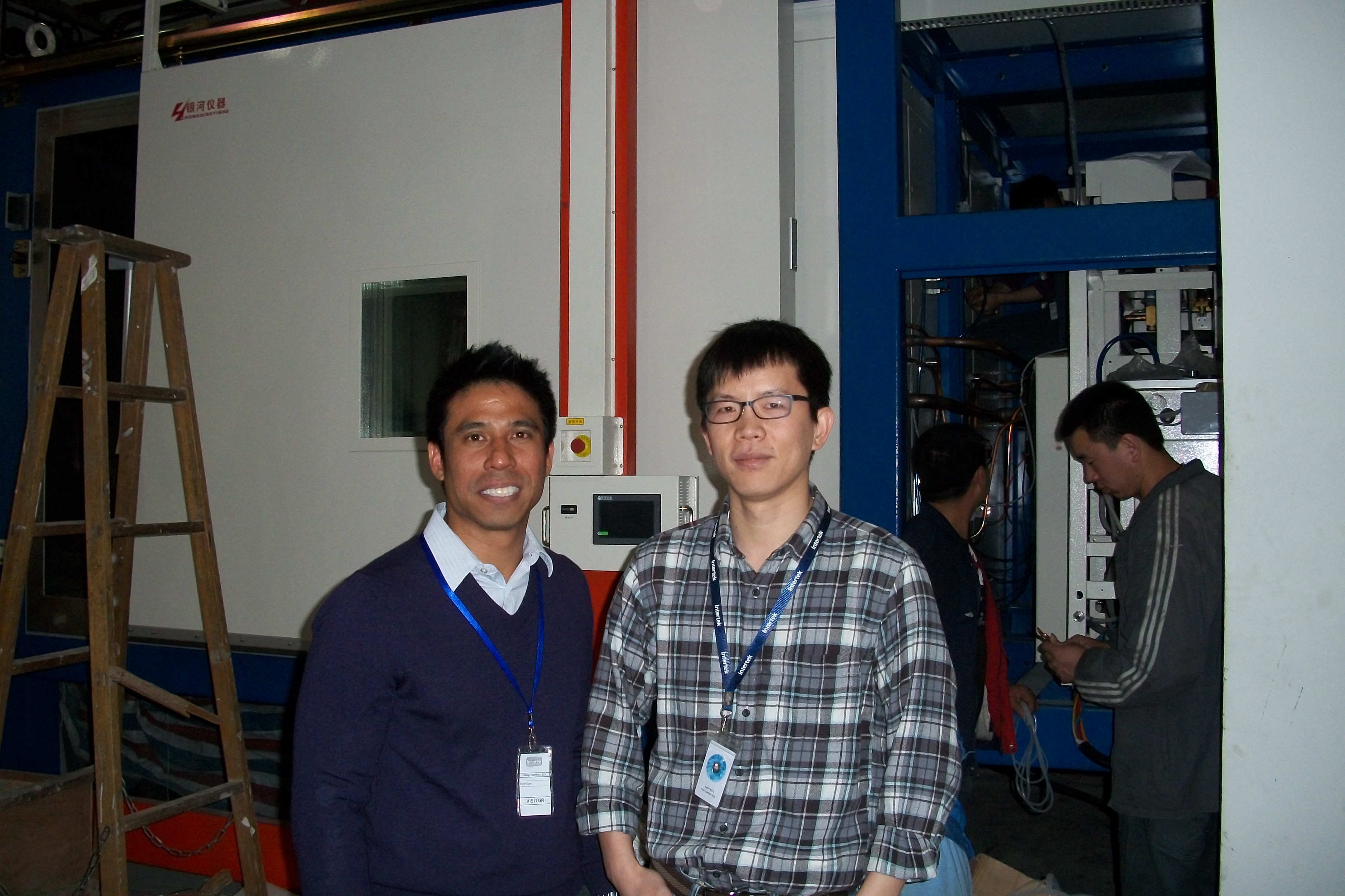
Eric Reyes and Jonny Dong show off their huge battery shaker.
A warning: This blog may read a bit like an endorsement. I have no skin in this game. But I wanted to post a blog and Intertek did invite me to visit. I’m so easy.
Intertek, based in the U.K., certifies product safety and quality. It can also help firms gain efficiencies and fix problems with products. In the EV sector, its customers include all the major battery makers as well as some automobile manufacturers. Intertek opened its China facility in 2007 to do reliability testing for automotive suppliers in vibrations, temperature, humidity and other adverse conditions.
It is in the midst of a multi-million dollar expansion in Shanghai. Intertek has invested around $2.5 million to double its battery module testing capacity in China by the end of 2012. It will boost that amount in 2013 if the market warrants it. “We see a majority of the key manufacturers — our customers– investing a great deal of resources in developing suppliers, R&D, and market awareness for EVs,” said Reyes. “This tells us that it’s not only us that are investing in this.”
For now, government policy is the driving force behind its customers’ expansion in China, said Reyes. The most recent target, announced by the central government in April, is for China to be producing and selling 500,000 battery electric and plug-in hybrid electric vehicles by 2015, and 5 million by 2020. “Everyone is in a big rush because of the 2015 deadline,” said Reyes.
Intertek has battery testing capability in the U.S. Indeed, it is adding capacity there as well. But the China market has enough potential that Intertek figures it needs to have testing and certification capability there. Anyway, said Dong, batteries are too heavy to ship to the U.S. for testing. “Plus customers want to see the tests,” he added.
That big shaker may get some use soon because the government is focusing on bus fleets as a way to expand China’s number of electrified vehicles quickly. In a recent policy announcement, the government emphasized expanding the number of hybrid buses and also speeding up the use of new energy fleet vehicles (which according the the Chinese government’s definition includes only BEVs, PHEVS, and FCVs) in the 25 pilot cities program. China has identified 25 cities that will serve as tests for rapid expansion of NEV fleets. That goes beyond buses and includes taxis and other fleet vehicles. http://www.mof.gov.cn/zhengwuxinxi/caizhengxinwen/201205/t20120529_654869.html
Things haven’t expanded so rapidly, however. Beijing appears to be trying to give them a bit of a push. But I don’t think things will speed up all that much.
Intertek also tests battery management systems, and three local manufacturers were having their battery management systems tested when I was there. But China’s relative lack of experience in the automotive sector, plus the newness of the electric vehicle technology, makes it difficult for Chinese BMS companies to pass the tests, said Dong. “The requirements are different from a cell phone or home appliance,” he said. As Chinese’s erstwhile EV producers are discovering….
Seems China is becoming the Yellow Brick Road for U.S. companies with plug-in hybrid electric drivetrain technology. Or rather, it is becoming the hoped-for Yellow Brick Road. Will be interesting to see how many of the companies shopping their technology there actually make it to the Wizard’s castle. (Wizard of Oz reference. Those of us of a certain age watched that about a dozen times growing up. )
I recently visited with yet another U.S. company that couldn’t get U.S. Department of Energy funding and is shopping its technology in China. To be sure, ALTe LLC, www.altellc.com based in Auburn Hills, MI, also has funding from other investors here in the U.S., and is seeking customers here. But when I asked chief technology officer Jeff DeFrank which market would be bigger for ALTe he said: “We will launch in both more or less at the same time, but probably China will be bigger.”
That might be because of steadier government support for the EV sector in China versus the U.S. Like so many other companies with alternative powertrain technology, the DOE http://www.lgprogram.energy.gov/ kept ALTe dangling for two years regarding its request for funding. “We made the decision we weren’t going to put all our eggs into the DOE loan basket,” said DeFrank. ALTe has been able to find private funding—some angel investors plus investments from its founders, DeFrank, CEO John Thomas, and VP of Programs Nam Thai-Tang. The amount “wasn’t seven figures,” said DeFrank. But it has been enough to build some prototypes that give ALTe something to show potential customers.
The Ford F150 pickup and Ford Econoline F350 van with ALTe powertrains that were at an the Enterprise www.enterpriseholdings.com rental car office in an business park in the LA suburbs (Enterprise is on ALTe advisory board and likes to keep an eye out for new technologies it might want to include in its rental fleets, said Greg Tabak, director of EV Programs at Enterprise Holdings.) are a far cry from the previous electric vehicle that the three founders worked on, which was the Tesla Roadster. www.teslamotors.com DeFrank, Thomas, and Thai-Tang are all Tesla alum, but they had a different vision from Tesla founder Elon Musk, said DeFrank. The trio figured there was a bigger market for electric vehicles in the commercial fleet world than the luxury world. Fleets are concerned with total cost of ownership, they calculated, so the additional cost of an electric vehicle would be justified over the longer term. With that in mind, in mid-December, 2008 (December 19 to be exact; they remembered the date), the three quit their jobs at Tesla. Two days later they founded ALTe. Seven days later they put in the application for the ill-fated DOE loan.
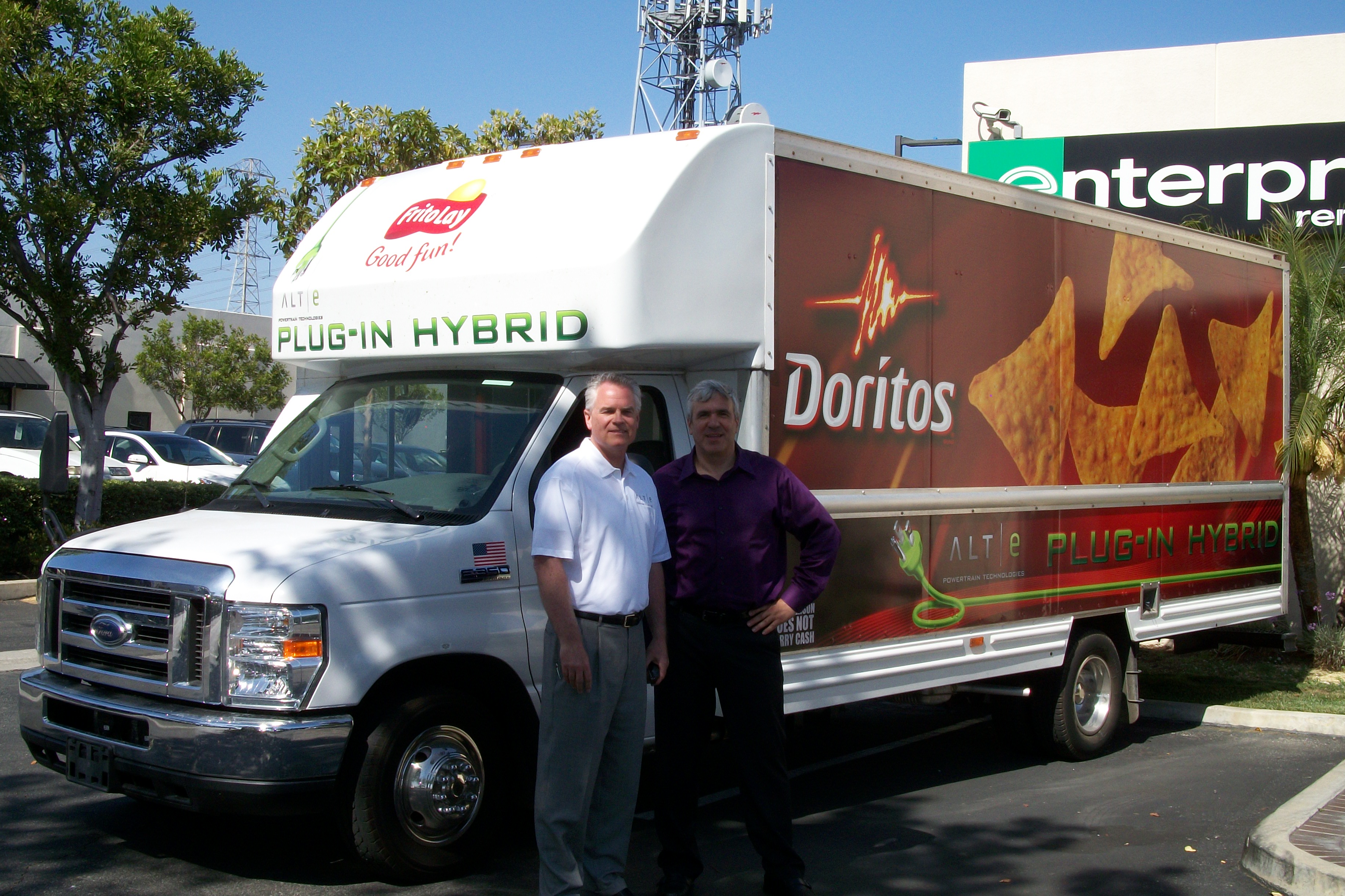
Dennis Baranik and Jeff DeFrank, two of the co-founders of ALTe, with a Ford Econoline F350 with an ALTe powertrain. The Tesla alum saw more opportunity in fleets.
ALTe likes to call its vehicles Range Extended EVs. Their powertrain is a series hybrid that runs on the battery for a certain distance, then switches to a gas engine which simultaneously recharges the battery and propels the vehicle. It must be plugged in to fully recharge the battery, however. “We recognized right away that with a series hybrid we would keep the cost down and maximize the effectiveness on routes,” said DeFrank.
The first prototype they built was a taxi. They completed it in March, 2009, and used it to attract more investors. But the trio soon realized the taxi market was not where the big bucks lay and switched to a pickup. Ford www.ford.com was a natural choice—all three co-founders had worked at Ford (as well as Tesla). The model—the F150—is the best selling pickup in the world. Besides, DOE guidelines mandated that the EV had to be a certain size, said DeFrank.
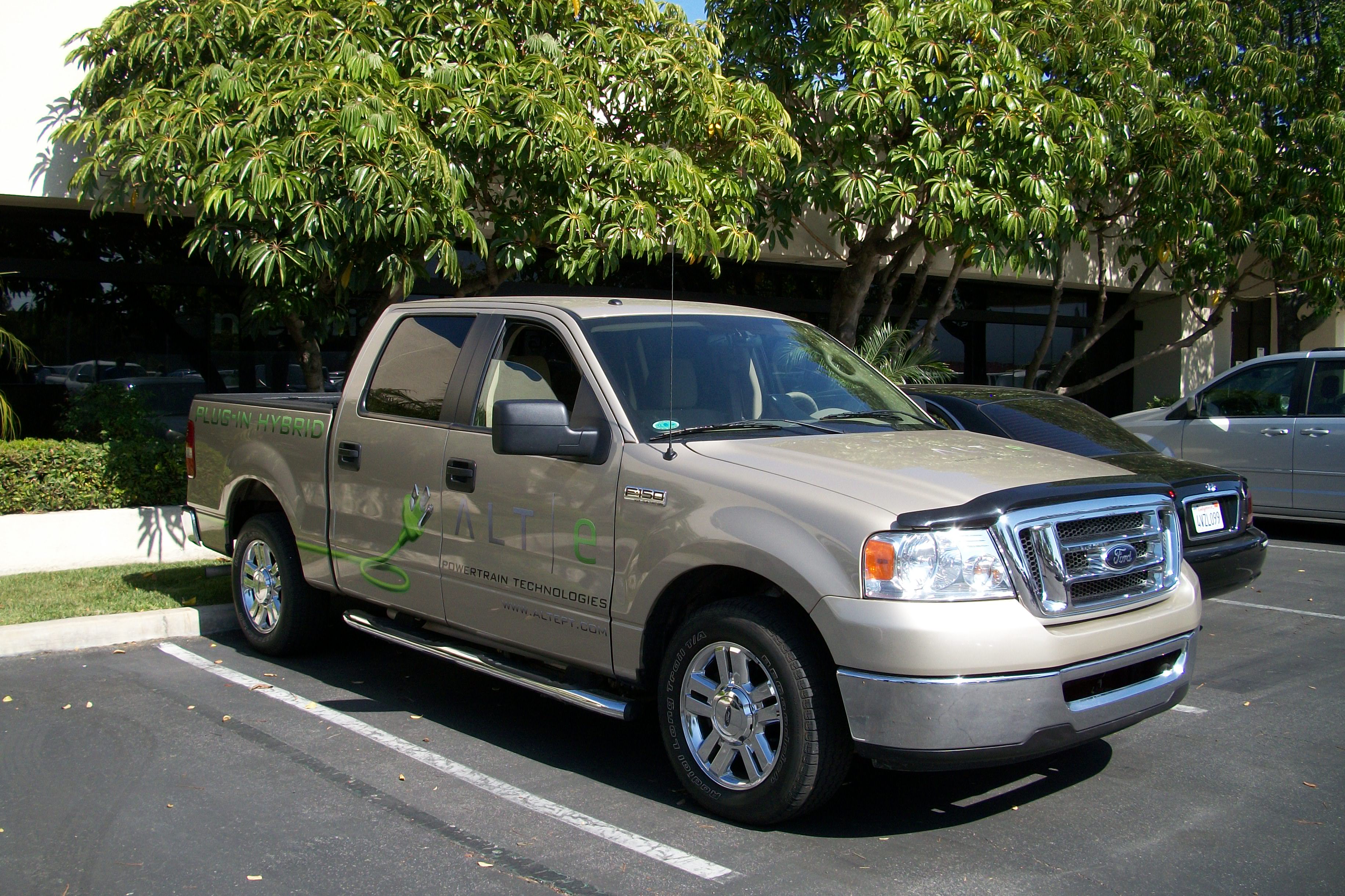
The Ford F150 was a obvious choice to modify–it is the best-selling pickup in the world and the ALTe co-founders were all Ford alum.
The pickup helped attract more investors, including former Chrysler CEO Tom LaSorda (an ALTe board member until February 2012 when he became CEO of PHEV-maker Fisker http://www.autonews.com/article/20120409/OEM06/304099984), and current board member attorney Simon Ahn, www.ahnlawfirm.com ALTe’s largest investor. To date, ALTe has raised more than $20 million, said Baranik in a follow-up email exchange.
ALTe’s demo fleet isn’t large—it has four F150’s and one Ford Econoline F350. But it does have a big Fleet Advisory Board, as ALTe calls it, composed of dozens of companies such as Frito-Lay that operate big fleets. ALTe claims nearly 100 major fleets have driven an ALTe prototype vehicle. Ten are ready to do pilot programs of up to two dozen vehicles, said Baranik. Be that as it may, the survival record isn’t so good for companies looking to make it in the electric fleet and/or commercial vehicle world. Bright Automotive aimed to sell delivery van PHEVs; it folded in February of 2012. http://nlpc.org/stories/2012/03/05/gm-funded-ev-company-gives-doe-loan-ends-operations Azure Dynamics, a producer of electric powertrains for delivery vehicles, filed for bankruptcy in March or 2012. http://online.wsj.com/article/SB10001424052702303816504577307672196301122.html Enova Systems, a producer of electric drivetrains for heavy-duty vehicles, reportedly has struggled to find funding. http://www.reuters.com/finance/stocks/companyProfile?rpc=66&symbol=ENA
ALTe is currently looking for more investors. But in this kind of environment, where many have failed, what makes ALTe think it will survive, I asked? “We have a different business proposition,” said DeFrank. Well, not totally different, but somewhat different. ALTe will modify used vehicles, unlike competitor VIA Motors, www.viamotors.com the Bob Lutz-backed startup that is converting new Chevy Silverado pickups at $79,000 a pop into Extended Range EVs (EREV as opposed to REEV….), An ALTe conversion costs $30,000. That will come down into the mid-$20,000’s within two years as battery prices come down, said Baranik. Yeah right. Still, it never hurts to dream.
The ALTe guys also see their decades of combined auto industry experience as a big plus. Sure, lots of people can produce a few dozen, or a few hundred PHEVs, said DeFrank. But, “I can’t emphasize enough you have to understand how to make that work in thousands of units a year,” he said. That experience may give ALTe an advantage in China. Chinese automakers are often relatively new to the car making business, and always new to the alt powertrain business.
DeFrank said ALTe has signed Memorandums of Understanding with two Chinese companies—he wouldn’t name them, but did say one is a bus company. Perhaps ALTe pitched the principles’ backgrounds with Ford and Tesla as selling points. There are a lot of U.S. companies with PHEV and battery electric vehicle powertrains shopping their technology around in China these days, so having that on a resume couldn’t hurt as a way to stand out.
Chinese government policy is also on ALTe’s side, In April, the Chinese government issued new targets for the electric vehicle sector. The aim is for 500,000 battery electric and plug in hybrid electric vehicles to be on the road by 2015, rising to more than 5 million by 2020. That will be tough to achieve without relying heavily on fleet electrification. The government has recognized that BEVs are much more difficult to produce then it first envisioned, and the emphasis is now on PHEVs and regular hybrids in the near term. So ALTe is in a bit of a technology sweet spot as far as the China market is concerned. A caveat: ALTe company admits that vehicles using its powertrain lack acceleration and speed. But in China, where traffic jams are the norm, that won’t matter as much, asserted the co-founders. I’m not so sure that is true. Chinese consumers — even fleets — want it all, just like consumers anywhere. And there is a lot of competition, including from other U.S. companies that missed out on DOE loans!
Already planning expansion in U.S.
Back here in the U.S., ALTe has applied with Ford to become a qualified vehicle modifier. If accepted (the process takes 18 months), the modified pickups and Econoliners would be covered by the Ford warranty, if the vehicle was still within the warranty period. Since it is modifying three to six-year old vehicles, many may already be outside of the warranty period, said DeFrank. ALTe offers a five-year, 75,000 mile warranty for now.
It has not yet completed California Air Resources Board www.arb.ca.gov and U.S. Environmental Protection Agency www.epa.gov certification; ALTe is “in the midst of a major funding event” to help fund that as well as expand its current 185,000 sq ft building in Michigan and hire additional engineers (it may have to fight Coda for them; Coda is also hiring www.codaelectric.com .), said Baranik in his email. “We anticipate full execution of this funding this summer,” he said. “In the meantime, we are negotiating a bridge element with an investor that we expect to close very soon.” Seems there is quite a bit of uncertainty there, but like all of these start-up EV companies ALTe has big plans. If it completes the expansion, ALTe will have a 90,000 unit annual capacity (working two shifts). But ALTe can break even at only several thousand units annually, it says.
If ALTe’s technology is as good as it claims, the lower cost may make its product appealing. But what about the latest challenger to fleet electrification, natural gas-fueled fleets, http://online.wsj.com/article/SB10001424052702304707604577422192910235090.html I asked Baranik? “It is not all or nothing,” he said. “There are going to be some fleets where (natural gas) is an answer.” Now he just has to hope ALTe’s powertrain looks like the best answer for some companies.
Okay, this is a bit late but here are my impressions of the press days (April 23-24) at Auto China 2012, which this year was held in Beijing. First thought—I’m really glad Beijing built a subway line out to the new venue in Shunyi. Second thought—I really hate that venue. It is confusingly laid out and I always get lost. The bathrooms are dirty and lack toilet paper. The press room was hard to find, too small, and didn’t have any good food. The new venue in Shunyi is too small so the suppliers and commercial vehicle companies had to be placed in the old venue. I did not have time to go there and so missed out seeing them. I’m sorry to be such a complainer. But Beijing should do a better job.
I had much more positive impressions about the show itself, however. It demonstrated that Chinese automakers have come a long way in terms of styling and technology, and in how they present themselves at the show. China’s domestic OEs have grasped that the automotive industry is international and now avail themselves of global design firms and suppliers. The cars still have a ways to go before they will be taking on the global brands around the world. But they have made a lot of progress.
For those of you who miss scantily-dressed women at the Detroit show (I don’t count myself among that group), there are still plenty of those at Auto China. Alas, there was no good food, neither at the stands nor in the expo center itself. (Okay, I ate some decent food upstairs at the Fiat stand thanks to my good friend Jack Cheng. But few had access to that.)
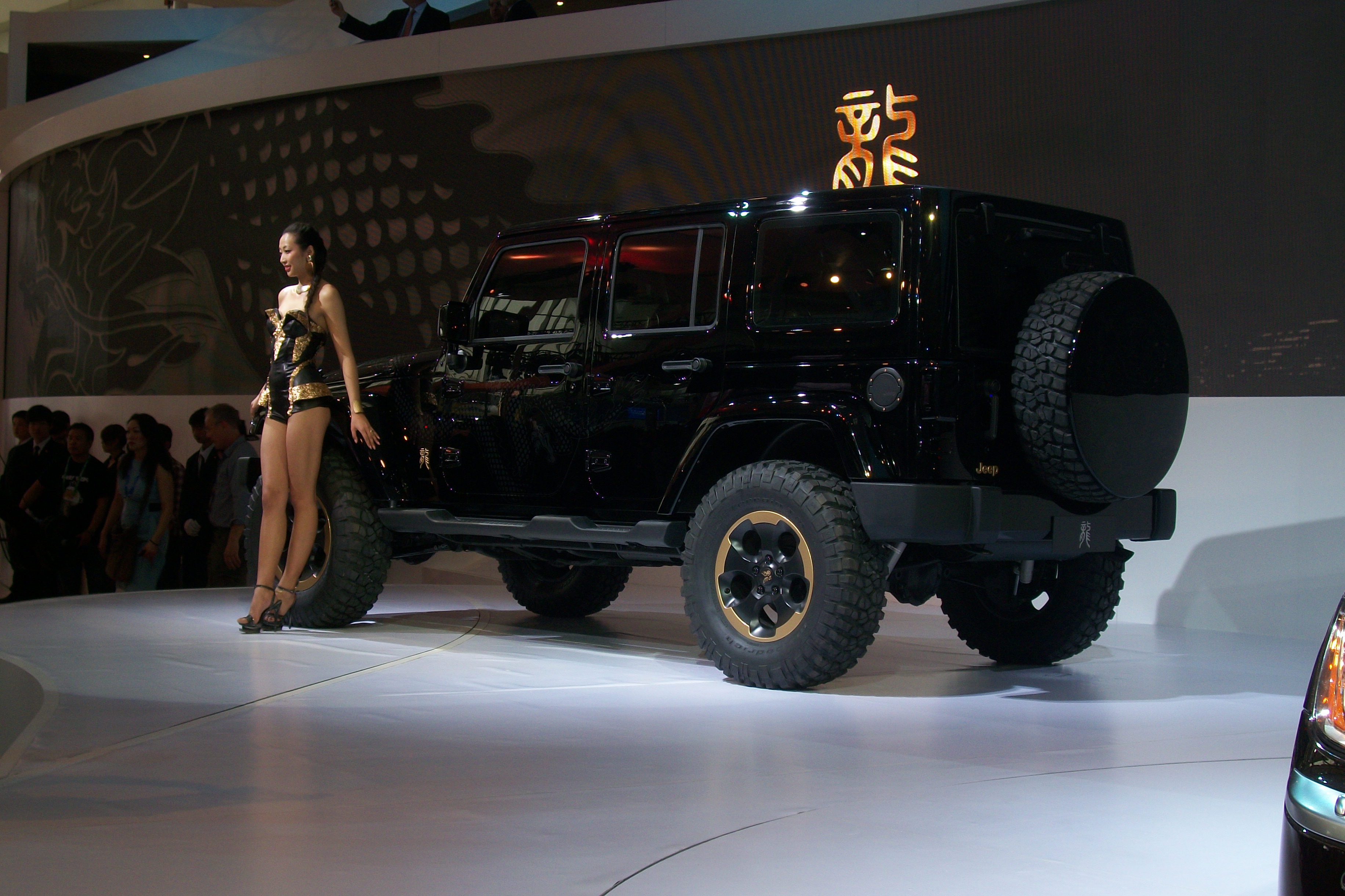
If you are a guy, are you looking at the Jeep?

The rear view. Of the model, not the Jeep.
But I digress. First, styling. Okay, there are plenty of questionable-looking Chinese models. But the same can be said of foreign brands. It is clear that Chinese automakers have availed themselves of international design firms such as Bertone www.bertone.it and Pininfarina www.pininfarina.it , however.
Chinese automakers have also enthusiastically embraced foreign technology to improve a vehicle’s engine and transmission. Great Wall Motors Co, www.gwm.com.cn for example, China’s largest SUV maker and one of my favorite local OEs (hey, it has a woman president), now boasts turbo-charged, gasoline direct injection, and common rail engines. It works with many international suppliers such as Bosch www.bosch.com and Borg Warner www.borgwarner.com. Chinese automakers have long had trouble doing automatic transmissions themselves. Now they turn to overseas suppliers. Chery Automobile Co. www.chery.com.cn showed a model with continuously variable transmission developed with Ricardo Plc, www.ricardo.com for example.
The Beijing show also demonstrated how important catering to local tastes has become for foreign automakers, many of whom showed models styled exclusively for the China market. Chrysler, for example, is just entering the China market and showed the Chrysler 300 Ruyi, a concept version of its 300 sedan styled by Chinese designer (albeit in Michigan) especially for Chinese consumers. http://media.chrysler.com/newsrelease.do?id=12279&mid=&searchresult
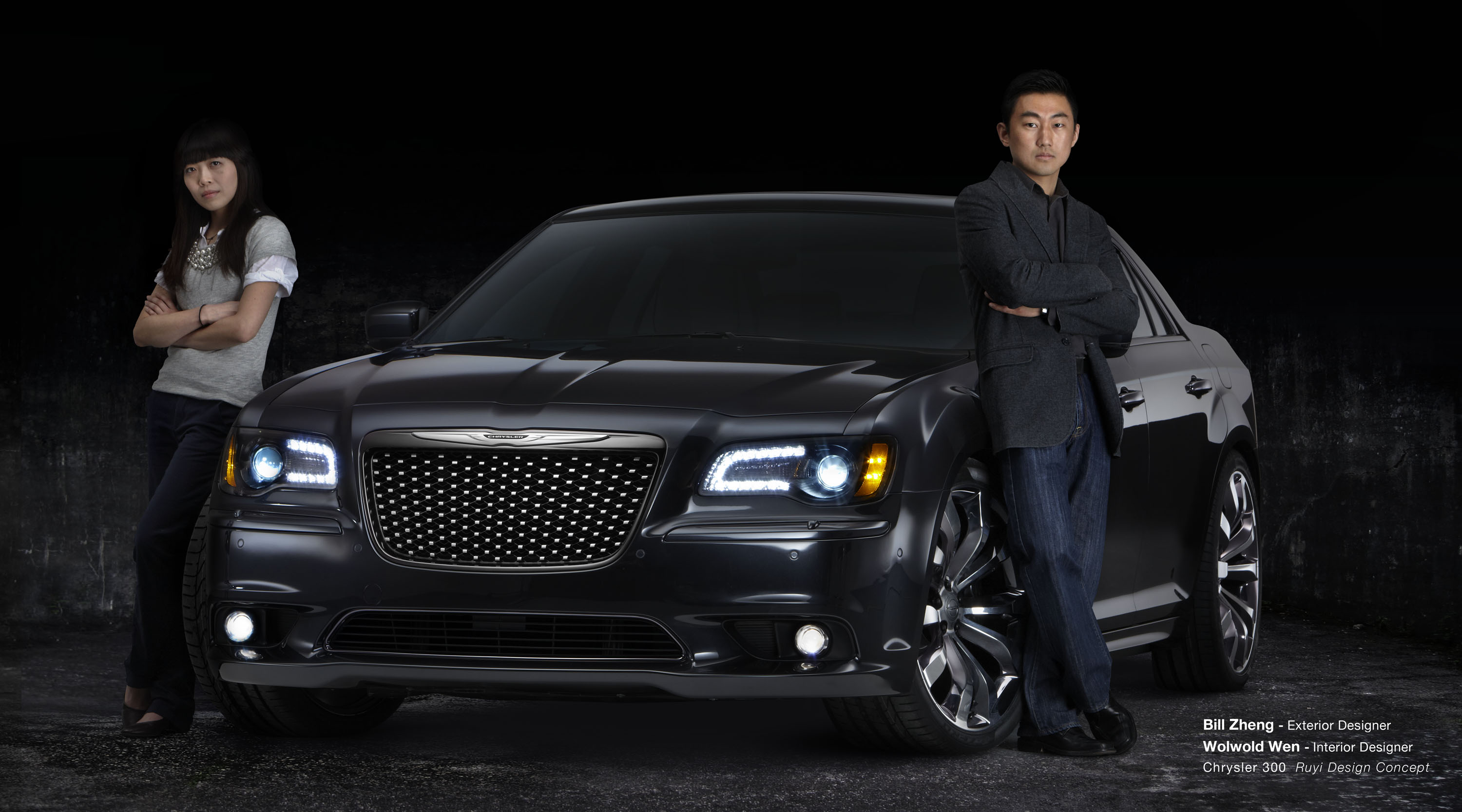
Chysler showed the Ruyi concept car, a version of the 300 designed by Chinese for Chinese.
Meanwhile, despite the government’s periodic calls for consolidation in China’s domestic auto industry, the number of brands is growing due to a mandate that China’s automotive joint ventures produce China-only brands. So, I checked out the Venucia brand, launched by Nissan and Dongfeng, as well as Guangzhou Honda’s Everus brand. Then there was the Denza brand concept car—the first electric vehicle out of the joint venture between Daimler and BYD. http://www.denza.com/index.php?a=show&m=Article&id=45&l=en
Which brings me to one of my favorite topics, electric vehicles. As we all know, the Chinese government has slowed its push to develop electric vehicles a bit. As I’ve told many people, China is clearly using its “crossing the river by feeling for the stones” policy-making approach in its EV plans. The most recent goal, announced in April, is for 500,000 battery electric and plug in hybrid electric vehicles to be on the road by 2015, rising to more than 5 million by 2020.
I would hate to be an automaker or supplier trying to figure out how to get ready for China’s EV growth. But, several that I talked to seemed resigned to the situation, and what choice do they have? I ran into a Ford Asia-Pacific www.ford.com executive on the show floor and asked him what Ford’s EV plans for China were. “We need to wait and see how the (government’s) plan evolves,” he said. “We are trying to time our entry right. Our deliberate strategy of electrifying the cars we have is the right one for China.”
I interviewed Luigi Lubrano, vice president of research and development at Magneti Marelli S.p.A. www.magnetimarelli.com and asked him about Magneti Marelli’s work in the EV sector in China. “We are working with a couple of OEs, but they are only making demos,” he said. The battery cost is too high, he said. “Right now, the China market is more targeted to downsizing—smaller engines, GDI, turbocharging,” said Lubrano. Magneti Marelli is ready if electrification takes off in China. “We have in our portfolio a standard solution” for electrification, said Lubrano.
It will be very interesting to see what the government says about electric vehicle purchase incentives between now and next year’s show in Shanghai and how that impacts what automakers are showing there. I look forward to attending the show in Shanghai. Not just because I want to see what technologies dominate, but because I cannot tell a lie, I like the Shanghai venue much more. The bathrooms are really clean.
Okay, I wasn’t completely correct about the implications of the Coda/Great Wall announcement back in August of 2011. http://www.greencarcongress.com/2011/08/coda-20110816.html At that time, Coda www.codaelectric.com said it had signed a letter of intent with Great Wall www.gwm.com.cn to develop electric vehicles. I predicted that the Coda/Great Wall partnership heralded the end to the Coda/Hafei relationship. Not so, at least not in the near term. Nonetheless, I am sticking to my prediction that the Great Wall relationship will be the dominant one with Coda, and that the Hafei connection will eventually die a natural death.
And I’m keeping a close eye on Coda. It seems Coda is taking a Tesla approach to the EV segment. That is, Coda is not just selling cars. It is selling its EV propulsion technology to other automakers. And it is selling its battery as a storage device. Of course, Tesla doesn’t have an energy storage business. But it has a damned good-looking car (and another on the way http://www.teslamotors.com/modelx) and its technology is going into a Toyota model (RAV-4) http://green.autoblog.com/2011/07/20/tesla-scores-100-million-toyota-rav4-ev-related-contract/ that will probably sell many units. Meanwhile, Coda has (so far) an ugly car with few units sold and its technology is going into a Chinese automaker’s cars. So Coda is lucky to have an energy storage business, too, just in case.
Another interesting aspect of this saga, at least for me right now, is what the new partnership means for Coda and Great Wall suppliers. Great Wall showed an electric vehicle at Auto China; it must have its own network of suppliers. Coda has its own. Who gets to supply the vehicles made through the new partnership? More on that later.
First, what prompts this discussion? On April 25 Coda announced that it had formed a strategic partnership with Great Wall to develop electric vehicles for the China, U.S., and European markets. http://www.insideline.com/car-news/coda-cements-global-ev-deal-with-great-wall.html I happened to be in Beijing at the time to attend Auto China and the Automotive News China Conference. Even though Phil Murtaugh was in town, too, we didn’t get to meet up. But I did get an exclusive phone interview with Phil the next morning. Of course, I had already listened in on the group phone interview the night before (for U.S. journos). But it was nice to get to ask my own questions.

Phil Murtaugh, CEO of Coda Holdings, says he has been talking with Great Wall since 2002. Finally, a good chance to work together has come along with the EV deal.
Under the agreement, Coda will provide the electric propulsion system; Great Wall will provide the chassis. The first model will be launched in the second quarter of 2014 and will be based on an existing Great Wall model (Didn’t I write about that a few months ago? My arm hurts from patting myself on the back. Or maybe it is just that old cycling injury….) The vehicle will be marketed in the U.S. as Coda, in China as Great Wall. “For Europe, it will be badged Coda, Great Wall, or some other brand we decide is even better,” Phil told me.
Coda’s propulsion systems can be used for BEVs, PHEVs, and HEVs. So what kind of vehicles will be produced in cooperation with Great Wall, I asked. For Coda, it will always be battery electric vehicles, said Phil. I asked Roger Gao, a spokesman for Great Wall, the same question at the AN China Conference. He said Great Wall would likely produce battery electric and hybrid electric vehicles using Coda’s technology. We didn’t discuss which would come first.
What does this mean for Great Wall’s partnership with Hafei http://www.facebook.com/pages/Hafei-Motor/110863255603984 , I asked Phil? He said: “That is an important partnership for us. It will remain extremely important to us. It gives us a customer for our batteries.” Now Phil is pretty crafty when it comes to answering reporter’s questions. But I checked with some suppliers to Coda at the Automotive News China conference. They confirmed that at least for now Coda still plans to produce pure EVs with Hafei. It would be politically too tricky to end that partnership, said one supplier, and besides, as Phil said, it gives Coda a customer for the batteries produced at the Coda/Tianjin Lishen battery joint venture in China. http://en.lishen.com.cn
As for volumes for Coda’s existing electric sedan, the supplier who confirmed the Hafei partnership said Coda has produced a few hundred of the sedans so far and planned to produce around 5,000 this year. That jives with Coda’s remarks. Another supplier at the conference said that Coda is sticking to its original future estimates of 10,000 annually for the time being.
Great Wall has already produced a battery electric vehicle—the electric small SUV was in the Great Wall stand at Auto China in Beijing. At the show, I asked someone in the Great Wall stand how many other EVs Great Wall planned. He said Great Wall was waiting to see what kind of support the government offered for EV purchases. According to Great Wall’s website, the automaker will focus on developing pure electric and hybrid electric models and over the next five years will invest 5 billion RMB (US $795 million at current exchange rates) in r&d and launch of new energy vehicles. By 2013, it will be capable of producing up to 150,000 new energy vehicles. http://www.gwm.com.cn/en/about.html If Great Wall achieves that target this could be a good deal for Coda. Fortunately, it seems Great Wall’s future EV sales won’t be held hostage to the Chinese government’s support or lack thereof for EV purchases since the partnership is producing vehicles for the global market.
Great Wall already has electric drive train technology.
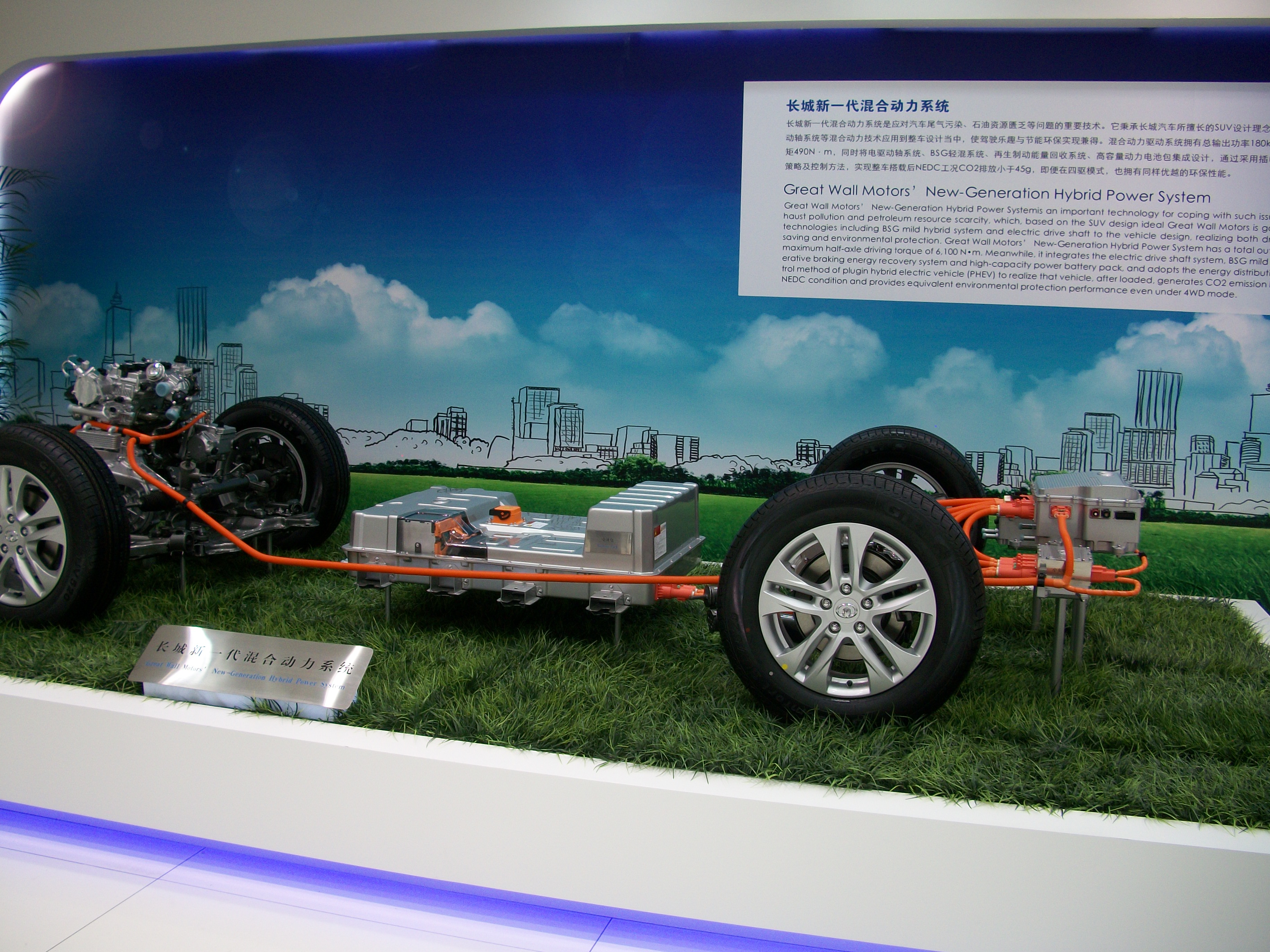
Great Wall touted its own EV powertrain at Auto China in Beijing in 2012.
It touts a hybrid power system in its literature from the Beijing show, for example. Why did it form this partnership with Coda, I asked Dr. Liu Zhen, special assistant to the president at Great Wall Motor Co. He was a speaker at the AN China Conference. Great Wall is always looking for the best technology, he said. Phil gave about the same answer. He said: “Coda has a really good EV propulsion system. Great Wall decided they could achieve their goals faster by teaming up with us.” (First he said, “Ask Great Wall.” See Phil, I did ask Great Wall.) I wondered what that means for suppliers to either the current Great Wall EVs or the Coda EV sedan. For UQM Technologies, at least, it means trying to get the additional Great Wall/Coda business, a UQM exec told me. UQM www.uqm.com supplies the electric propulsion system to Coda. No guarantees the original suppliers will get the new contract, though with UQM I’d say it is a good bet it will. A supplier to Great Wall told me the same thing, that it was trying to get the new business. One existing supplier is sure to get the new business. Tianjin Lishen will definitely supply the batteries to the jointly-developed vehicles, Phil told the journos on the group phone call. “We have a great JV with Lishen,” he said. “We will utilize that JV.”
I visited the Shanghai campus of General Motors www.gmchina.com a few weeks ago and got a personal tour from Ray Bierzynski, GM China’s executive director of electrification strategy and his colleague David Reeck, electrification strategy manager. (Those titles make it sound like Ray comes up with the ideas and David has to come up with a way to make them reality. If so, I predict David will get a lot more gray hairs a lot faster than Ray. ;-0 )
I came away understanding that GM’s electrification strategy in China involves more than just producing cars. It is taking an holistic approach to electrification in China, looking at all the elements needed to make EVs a success. While I won’t predict GM will be successful in the foreseeable future – it will take a lot of factors coming together for EV use to become widespread in China – I think GM’s endeavor will benefit everyone involved in the EV sector in China, from utilities to automakers.
Bierzysnki listed three (or four?) areas they were concentrating on: Infrastructure, supplier development and capability, and public policy. “Cost and infrastructure are where it is at,” he said. “They are the two key elements to the development of the EV sector.”
That doesn’t mean GM is ignoring the car part of the equation, of course. The first thing you see when you enter the GM campus on Jinwan Lu in Pudong in Shanghai is a row of Volt hybrid—oh, I mean extended range — electric vehicles recharging using solar energy.
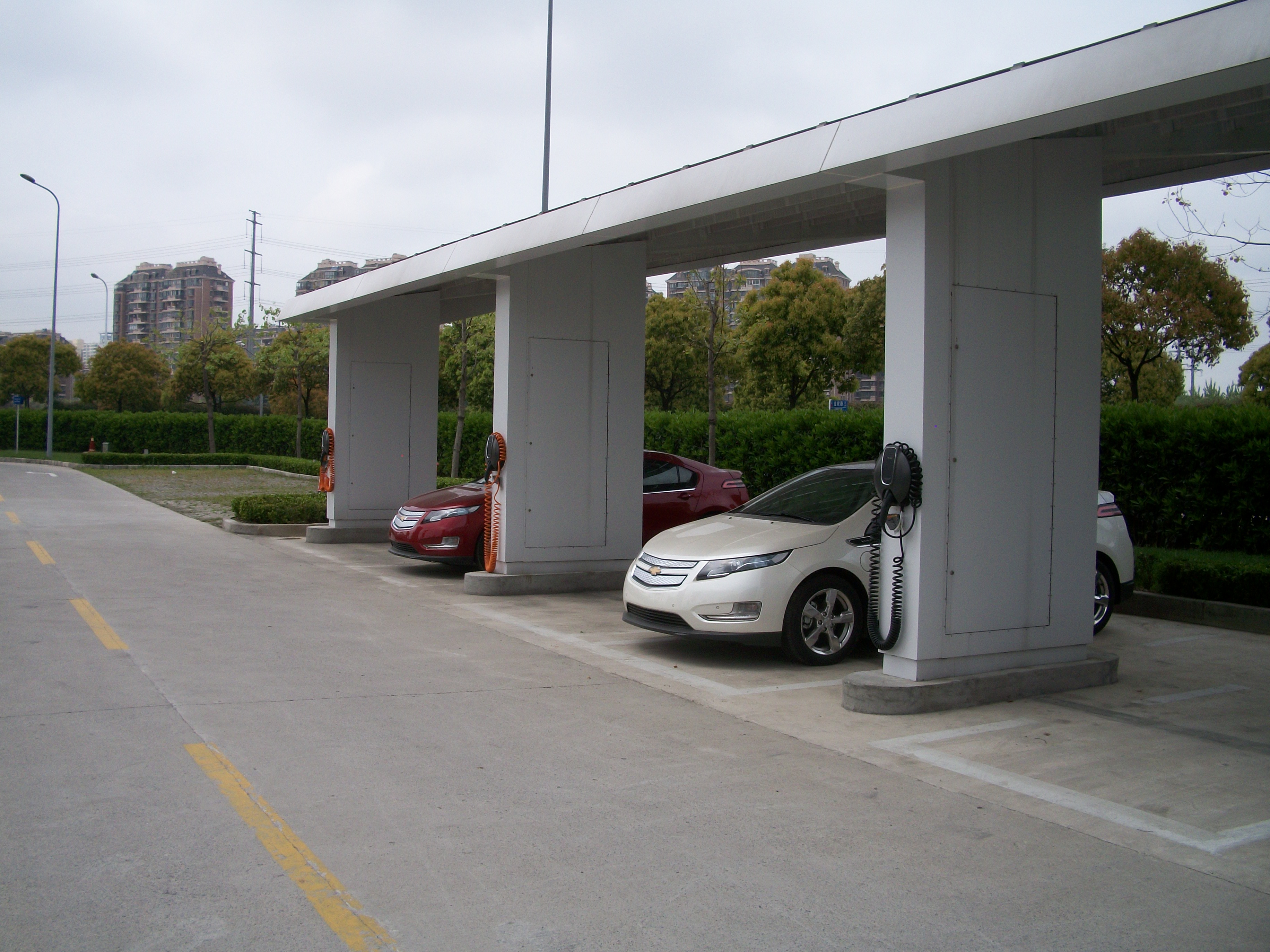
Volts charging at a solar station in GM's Shanghai headquarters. The Volt is on sale in China but GM's real goal is to expose officials to the technology, it seems.
The Volt is already on sale to consumers through GM’s dealership network in China for a hefty 498,000 RMB (US $79,250 at current exchange rates). But, says Bierzynski, “The Volt is not about sales volume. It is about testing the market place, seeing how people use the car, where they recharge,” and stuff like that.
In that same spirit is GM’s March 2012 agreement with CATARC, China’s national vehicle testing standards lab, to manage a test fleet of Volts for a year in Beijing. http://tinyurl.com/d3pzco7 The press release doesn’t say who will be driving the Volts, but you can bet it will be some high-ranking decision makers. In the press release Bierzynski is quoted as saying: “It is important for us to offer those in key positions to affect policy an opportunity to experience firsthand our variety of electrification solutions for reducing the automotive industry’s dependence on petroleum.”
He put it much more simply to me during my tour: “We want (the various stakeholders) to experience that the Volt is a hell of a lot of fun to drive.” GM has 10 Volts deployed nationwide, between Beijing, Tianjin, and Shanghai. (For the record, Bierzynski again told me that GM has never been asked to transfer EV technology to China….) GM has regular meetings with MIIT www.miit.gov.cn , MOST www.most.gov.cn , CATARC www.catarc.org.cn , and other government agencies to share its thoughts on energy policy, said Bierzynski. I’d love to be a fly on any of those walls.
Walk a little past the recharging Volts, and you come to a row of charging units from domestic and foreign suppliers. Nothing from BYD www.byd.com.cn . Why not, I asked? They haven’t sent us one, said Reeck. One issue that has dragged on in China is the setting of national standards, be they plug, battery or whatnot. GM is involved in the whole standards discussion, said Reeck. China has finally settled on an AC plug standard of its own, which is close to the European standard, which is close to J1772, the SAE standard. But the Chinese standard is still “fuzzy and undefined,” said Reeck.
Just beyond is a collection of electric vehicles from domestic brands.
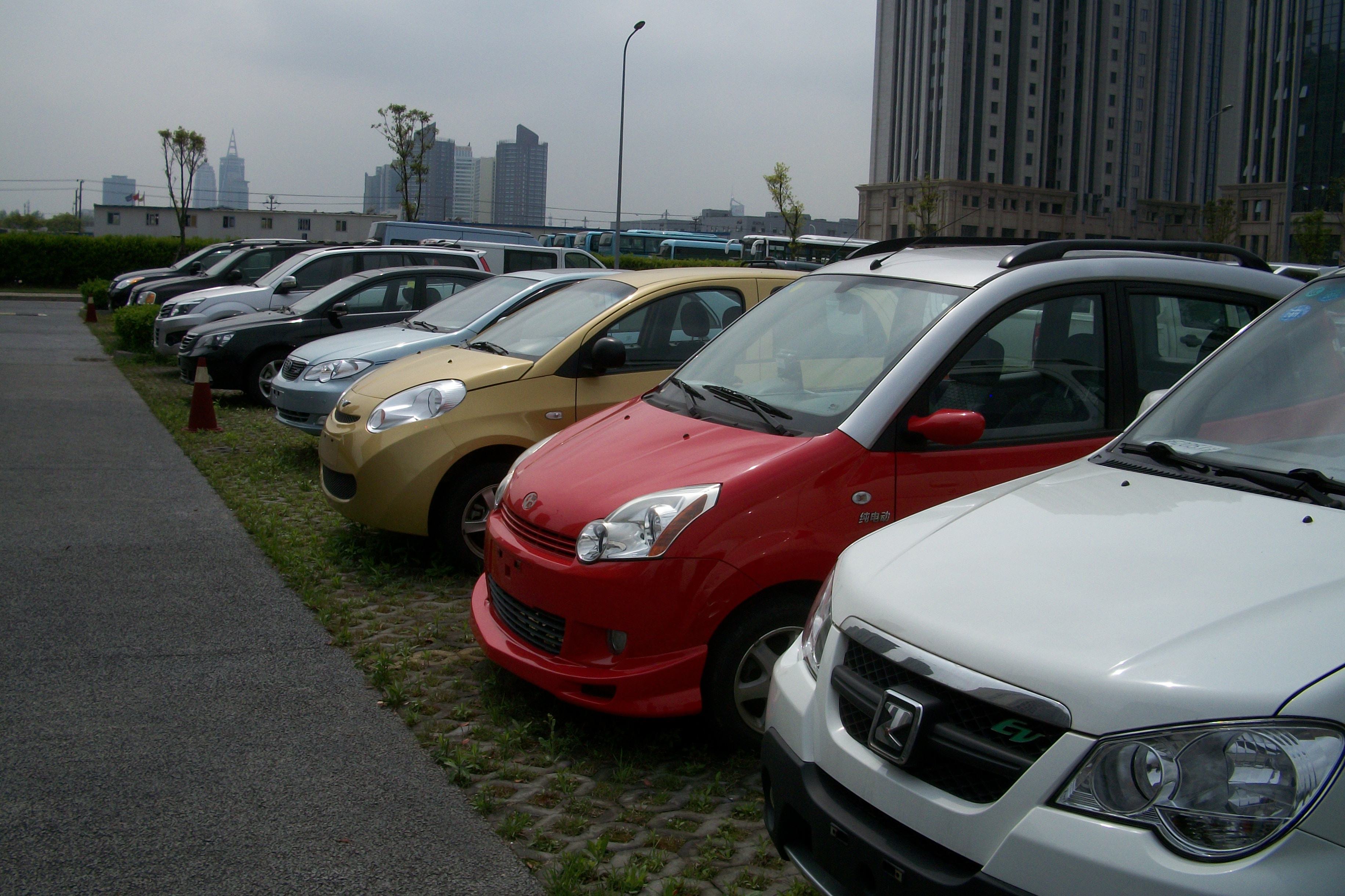
GM has a bunch of domestic EVs at its Shanghai headquarters. Helps GM check out the local supplier base, says Ray Bierzynski, executive director of electrification strategy.
Ahh, checking out the competition, I asked? Actually, it is part of GM’s efforts to develop a local supplier base, said Bierzynski. “One of the aspects of local engineering is you want to understand where the local market is,” he says. There are four main supplier areas in an electric vehicle, he said, the propulsion system, the heating and cooling systems, and the steering.
GM is evaluating local suppliers in all those areas, as well as testing locally-produced batteries. That occurs in GM’s new Advanced Technical Center, in a new building next to the main office building. The Lab is only partly finished, but is doing r&d into battery composition as well as testing batteries. (See my October 19, 2010 interview with John Du, director of GM’s China Science Lab, for more on the battery r&d). It has 96 test channels, Thomas Zhu, manager of battery systems and test lab at GM China, told me. Which sounds like a lot until you hear that some tests take a long as 900 days.
Besides the Volt, GM is also introducing its eAssist mild hybrid technology to China in the Buick LaCrosse www.buick.com/eAssist and developing the Sail battery electric vehicle which it showed as a concept at the Guangzhou Auto Show in 2010. http://www.autoblog.com/2010/12/26/gm-unveils-sail-ev-concept-in-china/ It has also just launched the second generation EN-V, a pod-like personal electric vehicle which GM first showed at the Shanghai Expo in 2010. http://tinyurl.com/7os5nno
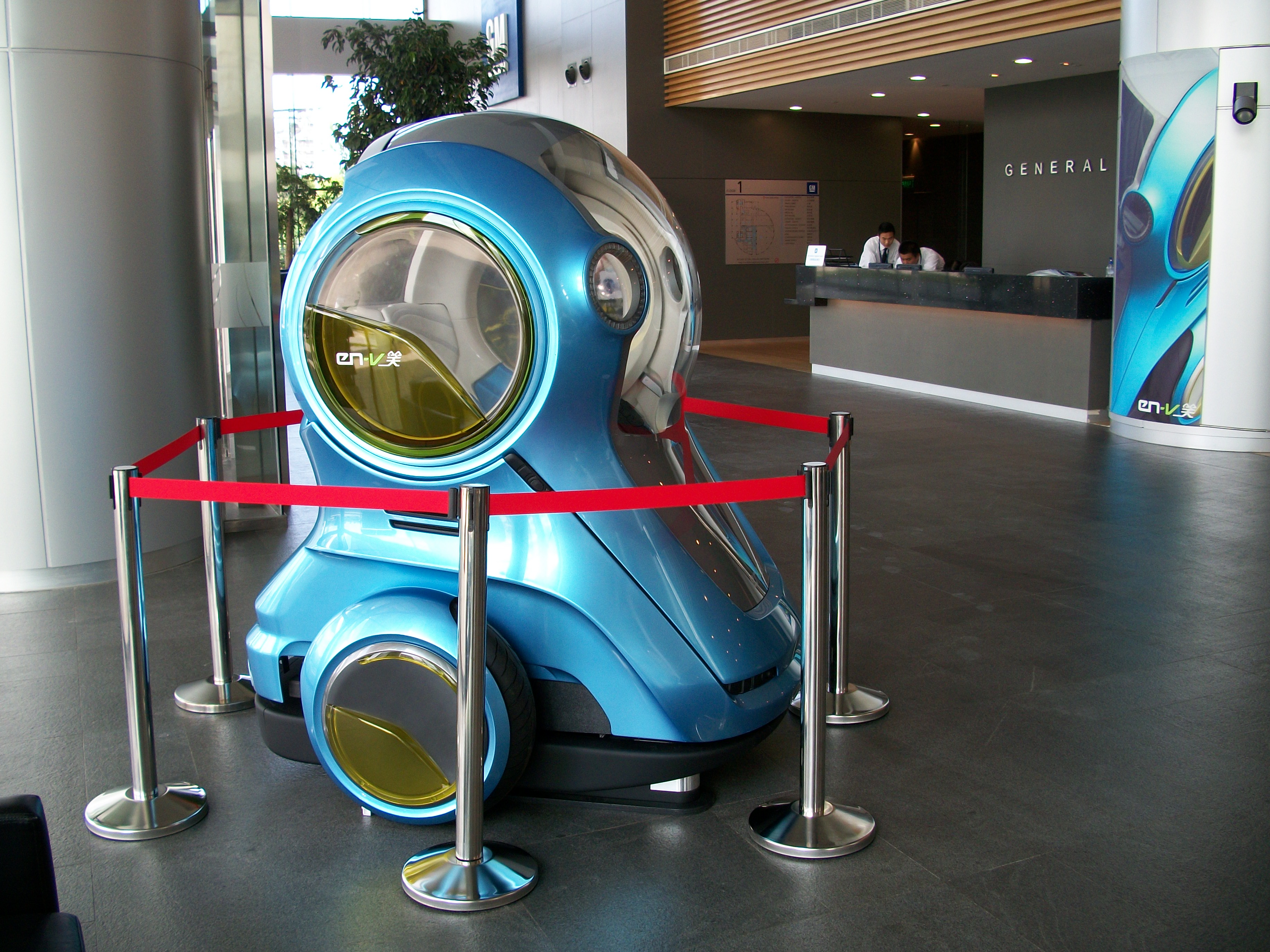
The EN-V 1.0 lacked climate control and personal storage space, both of which the EN-V 2.0 has. Both versions are networked to the max, though.
At a press event in Beijing a few days after I toured the Shanghai campus, I asked GM China Group president Kevin Wale if GM thought there was an actual consumer market in China for a vehicle like the EN-V. He said: “We do think there is a market for it in the longer term. As we redesign urban living, different types of solutions designed to (adapt to) dense city environments (will arise). We want to be part of that solution.” (GM is not the only one. Other automakers—such as Chery Automobile Co. – showed similar tiny EVs at the Beijing show.)
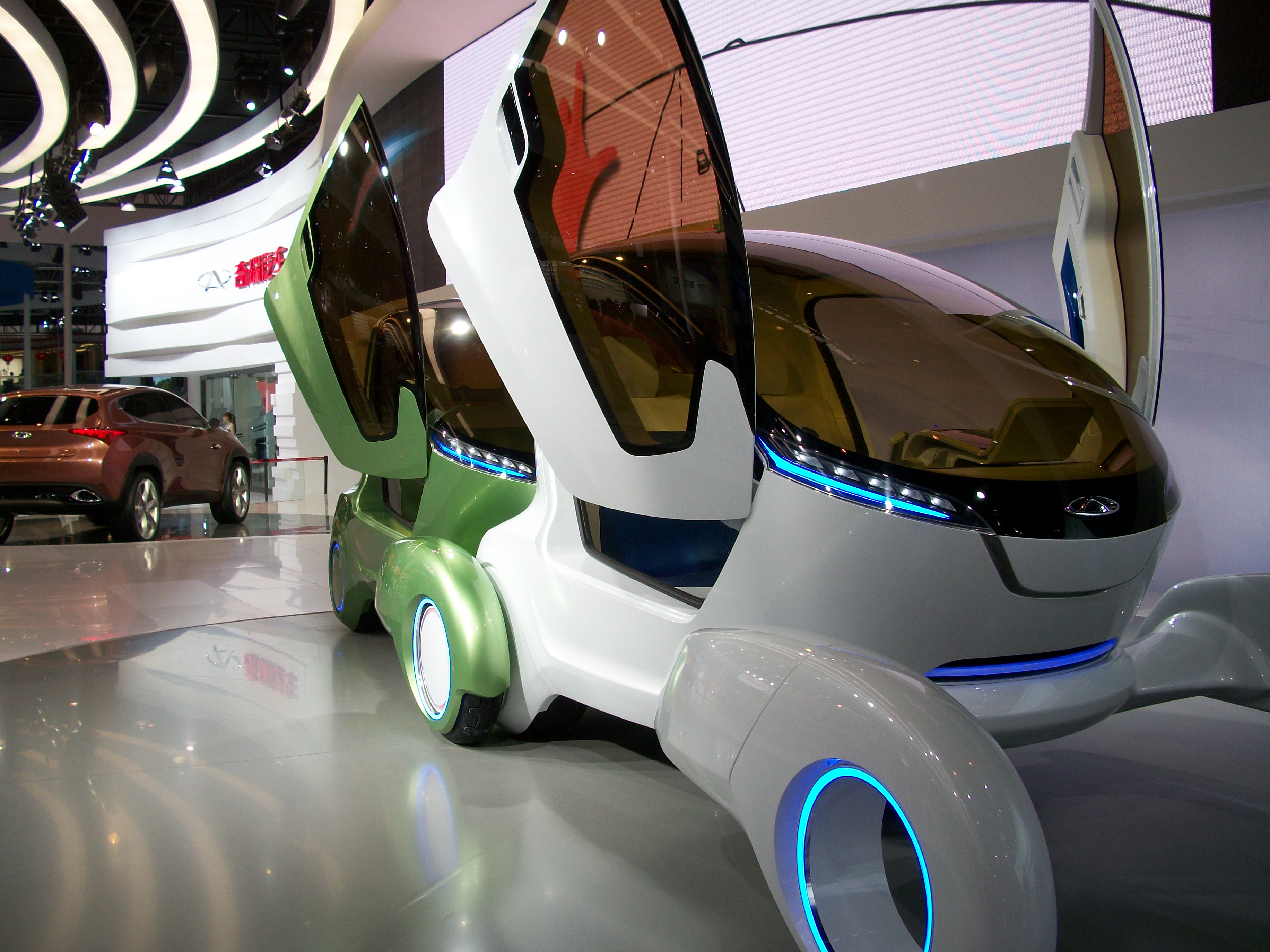
Chery's pod-like EV that it showed at the Beijing auto show in 2012 is a stretch version of the EN-V. Not sure if the Chery EV is as technically advanced as GM's, though.
While at GM in Shanghai, I asked Bierzynski if he thought there would ever be a real consumer market for EVs in China. The Chinese government has mandated that fuel economy reach 5.0 liters/100K by 2020 http://tinyurl.com/7m923xr , he said, so the automakers are going to have to include EVs in their product mix to meet that standard. Just as in the U.S., however, EVs wouldn’t be the only answer in China, Bierzynski added. It would be a continuum of technologies, including fuel efficient vehicles and EVs.
In the near term, however, the majority of EVs in China would likely be commercial vehicles, said Bierzynski. That is easy to figure out from looking at the list of type approvals (government permission to produce a specific model in China), he said. Of the EV approvals, 80% are commercial vehicles, including buses.
.
 Alysha Webb's ChinaEV Blog