Murtaugh will have a tough job at Coda even if mission is selling electric vehicles in China
Coda Automotive announced last week that it had hired Phil Murtaugh to be the company’s permanent CEO. In the sense that he is replacing temporary CEO Mac Heller, that is. Heller was filling in for former CEO Kevin Czinger, who resigned in November because, Czinger told me at the LA Auto Show, he felt “there are different roles at different times in a movement.” (Coda sees itself as the initial vanguard of a movement away from dependence on oil and into a new reality, Czinger told an audience at the show.)
Is Phil the right man to lead Coda’s movement? Depends on what that movement really is.
To be sure, Murtaugh has more experience in China’s automotive industry than just about any other foreigner. In 1996 he negotiated the original agreement that paired SAIC www.saicmotor.com with General Motors www.gm.com , forming Shanghai GM www.shanghaigm.com . The partnership now encompasses multiple companies, and is arguably the most successful Sino-foreign partnership in the world.
Murtaugh said his job at Coda was to launch a new car into the market, the same situation he faced in China in 1996. “But I don’t have to negotiate the joint venture,” he said. He also said something I hadn’t previously heard from anyone at Coda–that Coda would sell its vehicles in China as well as the U.S.
Coda Automotive www.codaautomotive.com , based in Santa Monica, CA, is a manufacturer of electric vehicles. The chassis and body of the electric car it will launch is produced in China at Hafei Automobile Group www.hafeiauto.com.cn . The car is based on the same aged Mitsubishi model as Hafei’s Saibao, though Coda says the design has been substantially modified.
The battery is also produced in China, at Lio Energy Systems, a joint venture in the north China city of Tianjin between Coda and Tianjin Lishen Battery Joint-Stock Co. http://en.lishen.com.cn The remaining components are from multinational suppliers such as Delphi, Borg Warner, and Lear. Final assembly will take place in the U.S.
I like and respect Murtaugh, whom I have known for a decade. But I think he faces a much different task at Coda than he did at GM. He is not backed by General Motors, one of the world’s largest and, at the time, most successful, automakers. GM had a stable of proven, popular products it could bring to the joint venture.
China was, to be sure, a difficult market for a foreign company to do business in at that time. But GM had the help of SAIC, a well-connected state-owned company. And the competition was limited. Volkswagen was the only foreign automaker with successful joint ventures at the time—it had two, with First Auto Works www.faw.com and SAIC. (My friend/translator/editor Kevin Huang pointed out that the Guangzhou Auto and Peugeot joint venture was still limping along at that time, as well. It closed in 1997 because of poor sales.)
With Coda, Murtaugh has a relatively expensive, unproven vehicle. In the U.S., Coda is selling its electric car for $37,400 after a federal tax break. It will be fighting for share in a small market with many established brands.
Coda originally planned to deliver 14,000 units of its electric car in 2011. Now, the start of production has been delayed until the second half of 2011. It will deliver more than 10,000 units within a year of starting production, said Forrest Beanum, Coda’s vice president of public affairs and communications.
However, Coda has not yet finalized the location of its assembly plant in the United States.
As for the China market, Coda hasn’t given me any more details about the China electric vehicle launch plan–yet. I’ve submitted questions and have been nagging Beanum. But, the China market for electric vehicles will be at least as competitive as the U.S. market. And, the Saibao, the car on which the Coda is based, doesn’t have an especially good track record in China. Hafei sold fewer than 1,200 in 2010, according to J.D. Power and Associates www.jdpa.com . Of course, Coda did upgrade the small sedan’s looks. But it will also be trying to sell an electric vehicle, a segment for which there is essentially no market in China right now.
As I wrote last year, I think Coda is really just using the car as a marketing tool for the battery. Coda denies this publically, though people it has approached about investing have told me the company is upfront about the strategy. Coda does say it also aims to market the battery for electric utility grid storage.
Murtaugh said Coda’s product “is truly going to be a very, very competitive.” He also said Coda’s business model of marketing the battery as an electricity grid storage device had as much potential as the automotive applications. Well, if Phil is aiming to sell batteries as storage devices, there isn’t really a market for that yet, either. But it will probably develop.
If his aim is volume sales in China of Coda’s electric vehicle, the size of China’s electric vehicle market remains to be seen (as does the size of the U.S. market). But I think he faces an even tougher challenge than he did when he was at General Motors. Still, Coda couldn’t have found a better man to lead that movement.
Will plug standards be China’s perestroika?
A favorite phrase among China’s leadership these days is building a harmonious society. http://english.peopledaily.com.cn/200506/27/eng20050627_192495.html
If China hopes to supply electric vehicles to the world, the leadership needs to also promote a harmonious electric vehicle plug standard.
Recharging is a major concern for potential electric vehicle consumers, in China just as in the U.S. http://www.zpryme.com/
Without a widespread universal plug standard, a consumer could end up having to carry lots of plug convertors around, just as I already do when I go to China. (An aside: Hong Kong has four different kinds of plugs. I am not making that up.)
Just kidding. It’s unlikely that a convertor would be robust enough for an EV plug. So, if no standard is implemented, a driver could have the ability to recharge in, say the southeast China city of Shenzhen, http://www.shenzhen-standard.com/2010/11/08/electric-charging-stands-to-be-installed-thoughout-shenzhen/ which is already building out a recharge network using its own standard. But if the EV owner decides to drive to Fujian, a city in a neighboring province, he wouldn’t be able to “refill.”
Making a plug that is internationally compatible is an even bigger issue, if China’s EV makers want to one day export their vehicles. The cost of producing a compatible car for each country would be huge. Utilities and charge station producers have a stake in the game, too.
“To the extent that we can harmonize anywhere in the world, it is cheaper for the automaker,” says Kristen Helsel, vice president of EV solutions for AeroVironment Inc. of Monrovia, CA. http://www.avinc.com/ Also, “the infrastructure providers can build business models based on higher volumes.”
AeroVironment produces charging stations as well as systems to test EV batteries. It is supplying home recharging stations for the Nissan Leaf electric car, and eyeing China for future business. “We’re spending a lot of time there,” says Helsel.
The J1772 standard for Level 1 (120V) and Level 2 (240V) charging was developed in the U.S. and is accepted by many in Japan and Europe. J1772 was issued in by the Society of Automotive Engineers (SAE) in 2010. http://standards.sae.org/j1772_201001
As for Level 3, or DC fast charging, there is currently no standard though a Japanese standard known as CHAdeMO has achieved some acceptance (and is used in the Nissan Leaf electric car). http://www.chademo.com/
Given that there are very few electric cars on the market, and very few Level 3 charging stations yet being built, that hasn’t been a problem.
To get ahead of the issue, the Society of Automotive Engineers (SAE) is spearheading an industry group attempting to come up with a next generation J1772 standard that combines Level 2 and Level 3 plugs, says Jack Pokyzrwa, SAE’s director of ground vehicle standards.
China wants to be part of the group and has met with SAE several times, he says. Frequent communication is tricky given the language and time differences, says Pokyzrwa. But it is important that China be included. So SAE is going to create an official liaison position with the China Automotive Technical and Research Center, he says. CATARC sets automotive standards in China. http://www.catarc.org.cn/
“We see a trend of (China) trying to adopt a more Western-type process,” Pokyzrwa told me. “They are much more involved with us.”
That is not as “well duh” as it might sound. China is famously secretive about its decision-making process, and that extends to plug standards. Generally, there is a lot of consultation (such as the industry group meeting now on the next-gen J1772); a proposed standard is released; then a government can chose to adopt the standard in part of full, says Pokyzrwa.
In China, he says, it seems a standard is developed and adopted, then announced. “Our process is more transparent,” he says.
China released a Level 1 and 2 standard last year, but the standard does not seem to be widely used in the country. At the EVS25 forum and conference in Shenzhen last November, a dozen or more Chinese companies displayed recharging stations with unique plug standards.
The Chinese standard resembles the German standard, says Ted Bohn, a power electronics engineer, at the Advanced Powertrain Research Facility in the Argonne National Laboratory. www.anl.gov But the Chinese standard cuts out an interlocking circuit, he says. The circuit is an extra safety measure; without it, the car could not be sold in the United States, says Bohn.
The committee working on the next gen J1772 plug standard has some 130 international members. Within that, a task force of 20 or 30 meets twice a month. Pokyzrwa says his best projection (or perhaps his hope) is that a year from now there will be a new standard that combines AC and DC charging capabilities. Implementation wouldn’t start until as late as 2020, Pokyzrwa figures. China may be on board.
“China is coming to the table,” says Pokyzrwa. “They do have a different standard, but the next release can be harmonized.”
Back in the old days, 2006 that is, Chinese automakers thought getting their cars ready for the U.S. market would be easy. Do you remember the Geely car in the lobby of Cobo Hall at the North American International Auto Show? At that time, Geely was talking about starting exports to the U.S. in 2008. http://www.autonews.com/article/20060116/SUB/60113044 Chery has similar grand, or rather grandiose, plans.
They soon backed off those optimistic predictions. Sure, meeting stiff U.S. emissions and safety standards was tough. But even tougher, engineers in China admitted to me, was getting the fit and finish right. U.S. consumers wouldn’t put up with the imperfections that Chinese consumers were willing to overlook.
Five years have passed. Cars in China look a lot more polished than they did back then. Now that a lot of companies are talking about selling China-made electric vehicles in China, the fit and finish shouldn’t be a problem, right? Wrong. Even if they have the technology, Chinese automakers still have trouble parsing U.S. consumer demands.
So BYD Auto Co. www.byd.com has delayed launching its cars here in the U.S. partly so it can make them more suitable for the U.S. market, Michael Austin, VP of BYD America told me. BYD plans to hire industrial engineers here in the U.S. to tweak its design for the U.S. market. Already, it has repositioned the integrated chassis and battery unit on the model of the e6 electric car destined for the U.S. to add leg room in the rear seat, said Austin.
More changes are doubtless on the way. As part of a broader agreement signed in mid-2010, the City of Los Angeles Housing Authority http://www.hacla.org recently leased ten of BYD’s F3DM hybrid cars. That fleet will test both the technology and the design. Fit and finish suggestions will be incorporated into the e6, as well.
BYD will show a version of the e6 at the Detroit auto show next week. www.naias.com But, “we won’t launch if there are concerns that are not addressed,” said Austin.
Zotye Holding Group www.zotye.com is another Chinese automaker that is grappling with the fit and finish issue. Zotye is a small SUV maker located in east China. It recently signed a 10-year extension of an agreement with Green Automotive Co. Inc, http://www.usaelectricauto.com a Dallas, TX-based company, to distribute its small electric SUV in the U.S. No Zotye vehicles are here yet. Well, maybe one or two that Green Auto execs can drive around and show off.
Last July I wrote a not-too-skeptical blog about Green Auto’s plans to import Zotye’s electric SUVs. As it turns out, my usual degree of skepticism was called for. Steven Fly, who was CEO at the time, is gone. Who knows how long the new management team will last. At the time, Fly admitted that the Zotye SUV’s fit and finish needed work. It still does.
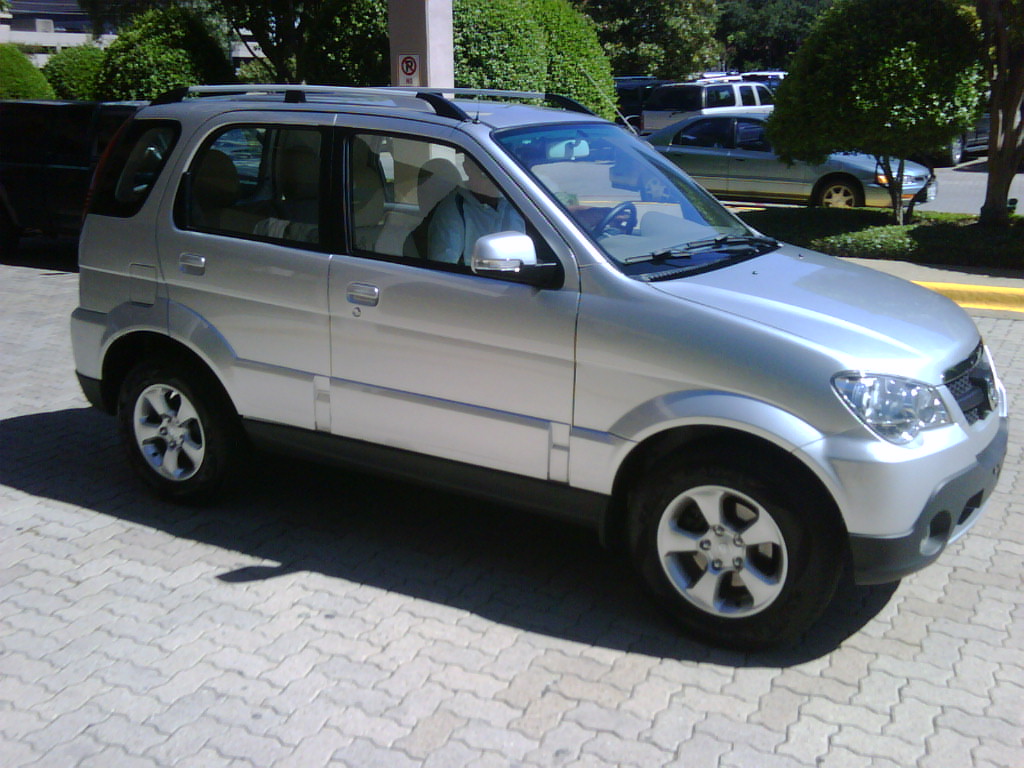
Don't expect to see more of the Zotye EV in the U.S. any time soon
A few days ago, I talked with Zotye’s Wu Aibing, special assistant to the general manager of overseas projects. He said Zotye was working very hard to get the cars ready for the U.S. market. But he wouldn’t predict when the cars would be ready. “We have a lot of things to do,” said Wu.
Why do Chinese automakers have such a hard time getting the finer details of a car’s fit and finish right? I guess it is still the prevalence of a “cha bu duo” mentality. The phrase translates as “more or less,” and it implies that something is good enough. But good enough isn’t enough for the U.S. market. It should be the highest quality. That’s not just a process technology issue; it’s a mindset issue, as well. Changing a cultural mindset is hard. Five years wasn’t enough. Maybe ten?
If you are an engineer with some EV experience, China needs you!
I’ve written about potential potholes in China’s road to world domination of the electric vehicle segment. They range from lack of domestic battery management system technology for large battery packs and short battery life to process technology issues. http://www.autonews.com/article/20101213/OEM06/312139964/1429
Even if China can avoid these potholes—it can simply buy some of the technologies, for example—it faces another potentially serious problem. There aren’t enough engineers in China with expertise in electric drivetrains.
There is a lot of controversy in China about the availability of engineers in China, says Majdi Abulaban, managing director, Asia Pacific for Delphi Automotive LLP. www.delphi.com Delphi has a large technical center in Shanghai that employs 700 engineers. For all of China, http://delphi.com/careers/international/china/ Delphi employs about 1,500 engineers. Not all work on electrification, however. Delphi has about 150 (please note this is a correction. Delphi sent me an incorrect figure initially.) engineers in the Asia Pacific region working on China-related hybrid and EV projects, says Abulaban.

Majdi Abulaban, managing director Asia Pacific for Delphi Automotive, says there is a shortage of engineers with electrification experience in China. Not too surprising since the technology is so new.
Sure, Chinese universities graduate a lot of engineers each year, he says. But trained engineers, with five to 10 years experience, are hard to find. “There is an ample supply of college graduates,” he says. “The issue for us is, do we have time to train them?”
This problem isn’t unique to China. In the December 13 issue of Automotive News, Dave Guilford writes that automakers and suppliers in the U.S. are having a hard time finding enough engineers to work on electric-drive powertrains. http://www.autonews.com/article/20101213/OEM06/312139964/1429
The scale of the problem in China is worse, however. For one, rather than a handful automakers (and, granted, quite a few suppliers) trying to find engineers to work on electrification, China has dozens of automakers being “urged” (and that was toned down, at C.C.’s request) by the government to produce electric vehicles, says C.C. Chan, president of the World Electric Vehicle Association. www.electricdrive.org Chan, who is based in Hong Kong and Shanghai, advises the Chinese government on its electrification strategy.

C.C. Chan says the government is pressuring all of China's domestic automakers to develop electric vehicles.
To refresh your memory, or create one: By 2020, the government’s plan calls for China to produce and sell one million battery-electric and plug in hybrid electric cars annually. Some 5 million such vehicles will be plying China’s roads by then, if all goes according to plan.
This mandate is likely giving the top guys at China’s domestic automakers gray hairs, though they will use black dye to hide them. Indeed, Abulaban, says they are all trying to figure out how to comply.
“How do you map this out when you haven’t figured out how to compete in the traditional (automotive) technology?” he asks rhetorically. “If you can’t develop and design a traditional combustion vehicle, how can you leapfrog into the electric vehicle segment?”
For Delphi, the mandate to create a huge EV industry in China is very good news, however. Delphi has long been a leader in two areas crucial to electrification—green technology and vehicle connectivity, says Abulaban. From battery cell monitors to DC/AC inverters, Delphi produces everything in an electric drivetrain except the battery cell itself, and the motor.
So while Abulaban doesn’t think the number of EVs in China will reach the “ambitious” levels the government is calling for, electrification will be an important part of Delphi’s future business in China, he says.
Already, the China market is growing so fast (for traditional technology as well as EV technology), that Delphi is considering adding another technical center, most likely in one of China’s inland cities, says Abulaban. Cities that are already have a large automotive base such as Chongqing, Chengdu, or Wuhan are top candidates, he says.
“The manufacturing base in the west is well-established,” says Abulaban. “The question is: How fast can you develop the technical facilities?” That is, can you hire enough engineers?
Tom Gage, CEO of AC Propulsion, www.acpropulsion.com made a telling statement to me today. He told me that I might see a China-made vehicle powered by an AC Propulsion electric drive train on the road in the U.S. within five years.
“We are talking to many automakers in China, and I think they all have plans to export,” he said.
I’ve scoffed at the chances for Chinese automaker BYD’s e6 www.byd.com/showroom.php?car=f6 electric sedan to succeed in the U.S. market. Ditto for Coda Automotive’s plain jane electric sedan http://www.codaautomotive.com/all-electric-car/with a Chinese body. Of course, the Coda is pretty pricey at $37,400 after a federal tax rebate. Even with a lower priced car, however, I still think U.S. consumers will demand a similar level of refinement in their electric vehicles as they do in their current cars.
Gage argues that ain’t so. He believes that there is a market in the U.S. for China-made electric vehicles with less content than competitors, at a lower-price. If he is right, the China competition could benefit U.S. consumers by forcing other automakers to innovate at the low-end in the electric vehicle segment. That’s what happened in China with regular cars.
Now, because this is my blog, I am allowed to digress without a subhead and give you some background on AC Propulsion’s recent activities in China.
AC Propulsion just announced it is building a new electric drivetrain plant in Beijing. The plant is due to start production in late 2012. The capacity will be more than double that of AC Propulsion’s current plant in Shanghai, says Gage. That plant produces between 1,000 and 2,000 units annually, he says. Most of the output of the new plant is destined for the greater China market, though a few hundred units will be exported, says Gage.
“We are planning for the era (in China) five years and beyond when people are saying there will be one to five million EVs on the road,” says Gage. He doesn’t necessarily believe those numbers, he says, but does believe the market will be substantial.
AC Propulsion, which is based in the Los Angeles suburb of San Dimas, provided the drive train for BMW’s Mini E. In China, it has signed preliminary agreements with some Chinese automakers, says Gage. He wouldn’t reveal any names.
If some of those EVs eventually end up in the U.S., it will create an interesting market dynamic. Will that create a low-end EV segment? Will Chinese EVs dominate the low-end EV segment in the U.S., the way they initially did in China?
We all know what happened when the low-end segment for traditional cars in China took off. Okay, we don’t all know. What happened was that foreign automakers found ways to make cars for less, so they could compete in that segment too. For example, Shanghai General Motors launched the New Sail, http://media.gm.com/media/cn/en/vehicles/chevrolet/NewSail/2010.brand_gm.html a domestically-developed small car that costs only 56,800 RMB, or US $8,530 at current exchange rates. J.D. Power and Associates http://businesscenter.jdpower.com/ says the SGM New Sail “not only grabs market share from its peers in (the sub-compact) segment, but also from high-end mini cars.”
General Motors just announced it is hiring 1,000 engineers and researchers http://www.bloomberg.com/news/2010-11-30/general-motors-said-to-hire-1-000-electric-vehicle-engineers-in-michigan.htmlto work on electrification. They better start honing their low-cost production skills. If Gage is right, the Chinese are coming.
Swimming, and drowning, in the electric vehicle sea
When I lived in China in the early 90’s, going into business for ones’ self was known as “xia hai,” or jumping in to the sea. These days, many Chinese companies are jumping into the sea of electric vehicle manufacturing, and some of them are going to drown. That’s the way the market works.
I saw a lot of these companies in Shenzhen a few weeks ago at the 25th World Battery, Hybrid, and Fuel Cell Electric Vehicle Symposium and Exhibition, an international conference and electric vehicle show.
There were several dozen companies showing mini EVs. Some were already manufacturing the tiny cars, some were hunting for partners. All saw the sector as a good business opportunity.
Why? The government. As I learned from several presentations by government officials at the Symposium, mini EVs and buses are important stepping stones in the evolution of China’s electric vehicle segment. So, the government is encouraging their production.
That, in turn, has encouraged companies that had no previous experience in manufacturing cars to jump into the electric mini vehicle sea.
At EVS25 I met people such as 24-year old Zhang Biao, assistant general manager of the Dongyuan Three New Electric Vehicle Technology Co. Ltd. www.dg.sysu.com The company is attached to the Sun Yatsen University Research Institute in south China’s Guangdong province.
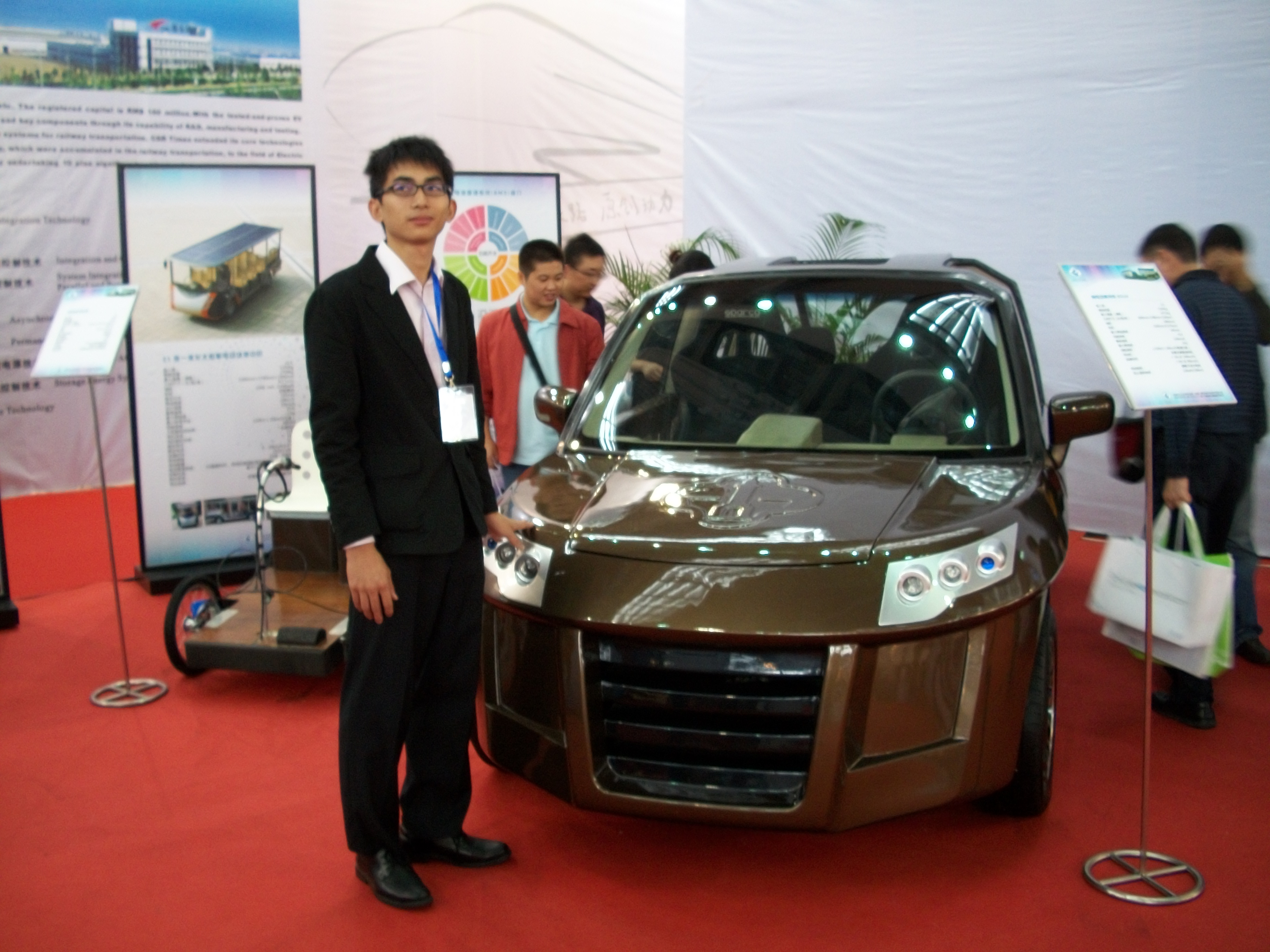
We have the technology and we see a good business opportunity, says Zhang of the EV sector.
The university has developed its own electric drive train and battery management system, he says. Now, it’s looking for someone to produce an EV using that technology.
“We think there are many opportunities in the EV sector now,” says Zhang.
Then there was the Shandong Bidewan Power Technology Co. Ltd., www.byvin.cn which gets my vote for the cutest mini EV, mostly because it was pink and had a stuffed bear hanging on the side mirror. Byvin, as it goes by, started selling its low-speed EVs mini EVs last year for 29,800 RMB or US $4,487 at current exchange rates. More than an electric bike, but cheaper than a Chery QQ, which starts around 31,000 RMB.
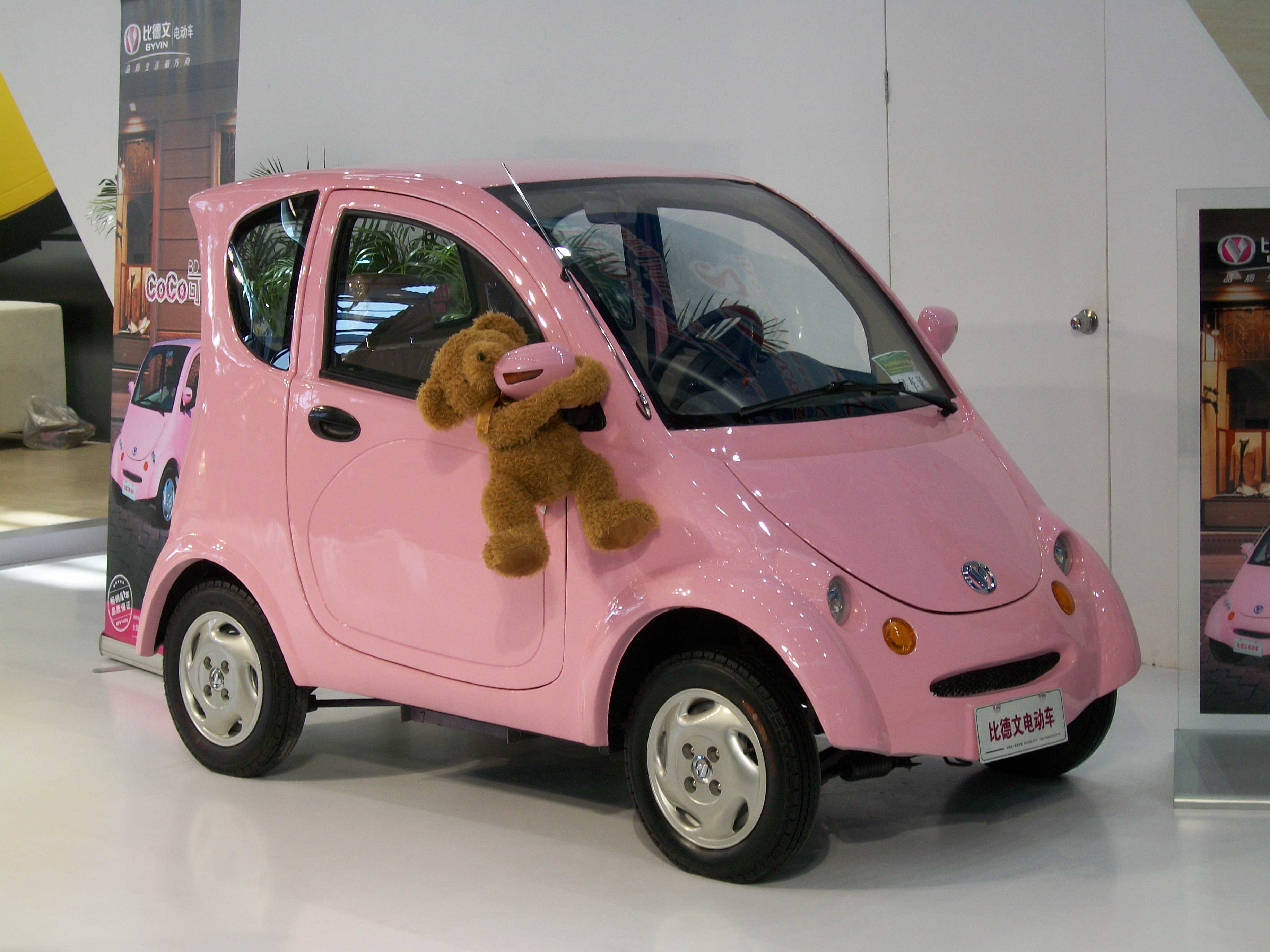
Does the bear come with the car?
Privately-owned Shandong Baoya New Energy Vehicle Co. Ltd. www.baoya-ev.com started making mini EVs three years ago, piggy backing on its electric bike technology.
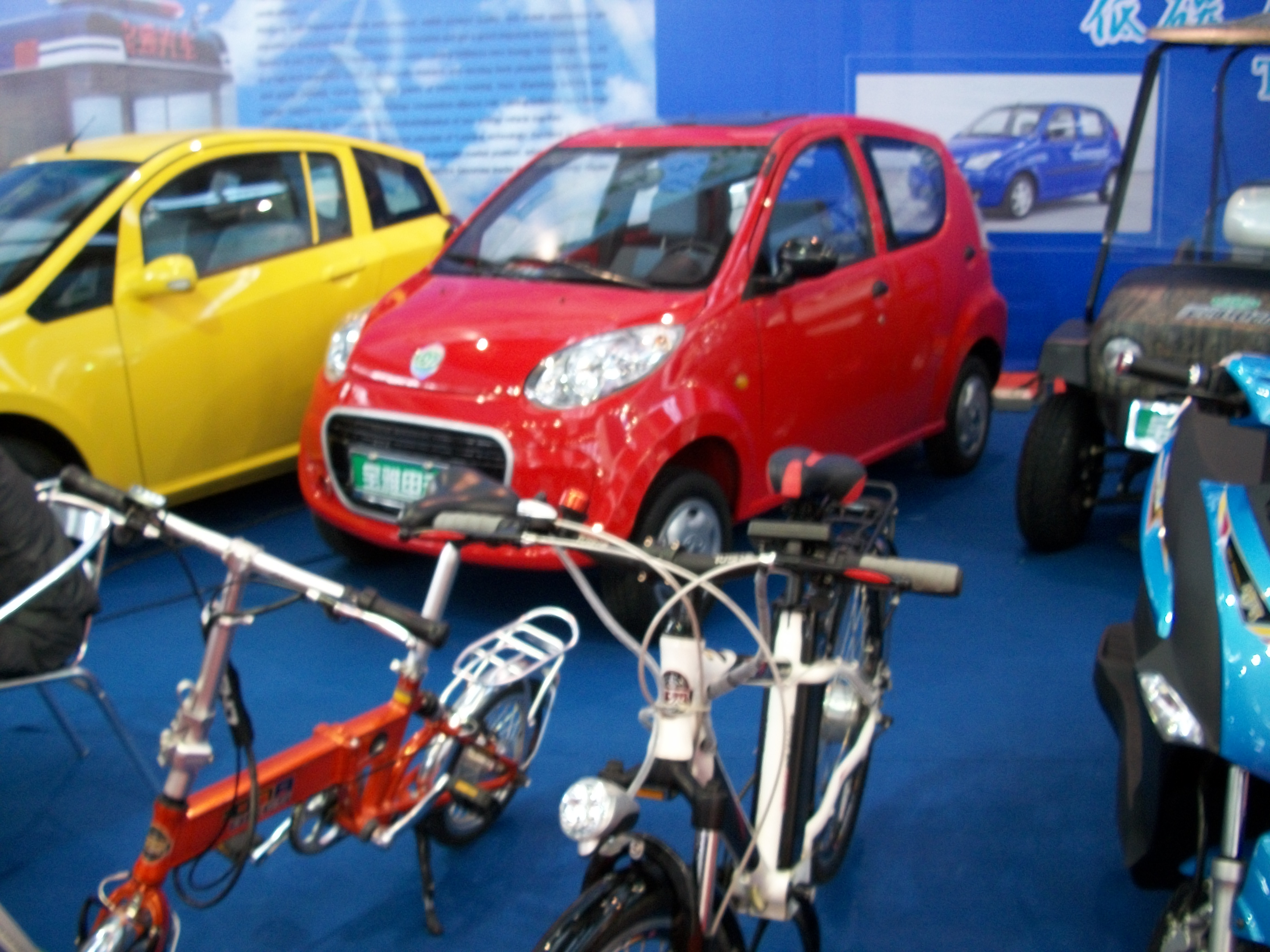
Luojo (Weihai) EV R&D Co. Ltd. produced an electric vehicle that meets Euro 4 emissions standards a year ago, claimed sales manager Andy Yang. Now the company is looking for a partner to mass produce its mini EV.
Clearly not all of these companies are going to make it. For one, the government may not license their vehicles for sale. And there is a debate going on right now about allowing such low-speed vehicles on China’s roads. But, it seems that will be decided in the affirmative as the government is promoting the sector.
The privately-owned companies face the biggest hurdle because funding will be hard to come by and they won’t have a local government propping them up for job creation. So, is Beijing wrong to encourage investment in the sector?
No, I don’t think so. While this may not produce breakthroughs in EV technology, it already has produced a flurry of research and development. What the government should do is set high technical standards for these mini cars, to push companies to innovate.
Will some of the companies fail? Yes. China may end up with a bunch of tiny EV makers on the local governments’ payrolls. That’s what has happened in the regular automotive sector. That would be bad.
And, the roads could be clogged with slow-moving mini EVs. That’s the biggest harzard.
China makes a Great Leap Forward into electric vehicles; will corporate starvation result?
I was in Shenzhen last week at the 25th World Battery, Hybrid, and Fuel Cell Electric Vehicle Symposium and Exhibition (That’s a mouthful. Hereafter EVS25), an international conference and electric vehicle show. www.evs25.org
There were some glitches—like the tiny room allocated the hugely-popular workshop on plug-in hybrid electric vehicles, and the non-functioning equipment at the same workshop. But the event was a packed with government and industry folks, all talking about electric vehicles and batteries. There were lots of people from the U.S. Department of Energy, www.doe.gov one indication of how important the whole EV sector is becoming.
There were also plenty of Chinese government officials. The details of their message were confusing, at least to me. But the message was clear: China aims make its auto industry the world leader in electrification technology and standards.
What I’m wondering is if this is another Great Leap Forward.
Both Ouyang Minggao, a Tsinghua University professor deeply involved in forming the government’s new energy vehicle strategy, and Xiao Chengwei, a battery expert at the Ministry of Science and Technology’s Key Lab for Power Sources, presented an overview of the government’s electrification strategy. It emphasizes developing electric vehicles first in two areas: fleet vehicles, especially buses, and mini-vehicles.
That will lead to the second generation of EVs, which will be passenger cars, they said. What?!? Why are all the automotive manufacturers in China launching all manner of electric passenger vehicles, then?
It seems that hybrid passenger cars are to be developed concurrently with full electric buses and mini vehicles, leading to a second generation full electric passenger car. And because China loves numerical shorthand names, (You are permitted to roll your eyes now, as I am doing.) the strategy is called the “three verticals” and the three horizontals.” The three verticals are battery electric vehicles, fuel cell vehicles, and hybrids. The three horizontals are battery technology, electric motors, and controls. At least that’s what Ouyang said at EVS25. The interpretation was slightly different in a speech he gave in October of this year at a forum in Shanghai sponsored by General Motors. Same basic idea, though. http://www.gmexpo2010.com/forum/en/node/405
China figures such an important task is waaay too important to be left up to market forces (especially considering there isn’t a market for these cars yet), or to be left in private hands. Ouyang said in the October speech:
“In order to elevate the strategy of developing electric cars from a corporate or industry strategy to the height of national strategy, ‘vehicle electrification’ strategy must fall under the general guidance of collective development, and keep pace with the transition and transfiguration of fuel-efficiency and new-energy cars. Governments will directly intervene to breed new industries, striving to keep pace with international goals that, by 2015, see China with some 1 million electric cars in use.”
That includes up to 300 million light electric cars, according to his presentation. Okay, I’m not sure what exactly a “light electric car” is. But, the rest are likely buses and/or mini EVs.
Actually, my head spins a bit trying to sort out China’s very ambitious plans for new energy vehicles. The exhibition was full of mini electric vehicles produced by companies who previously had no experience making vehicles. But, the government is encouraging minis, so companies jumped right in. “We see a good business opportunity,” several of the companies told me.

Shandong Bidewen Power Technology Co. Ltd. makes electric bikes and motorcycles. Now it makes mini cars too!
There were also plenty of hybrids and pure electric vehicles from the major automakers. Some of them, such as BYD, were also showing electric buses since the government is promoting electrification in the public transport sector. 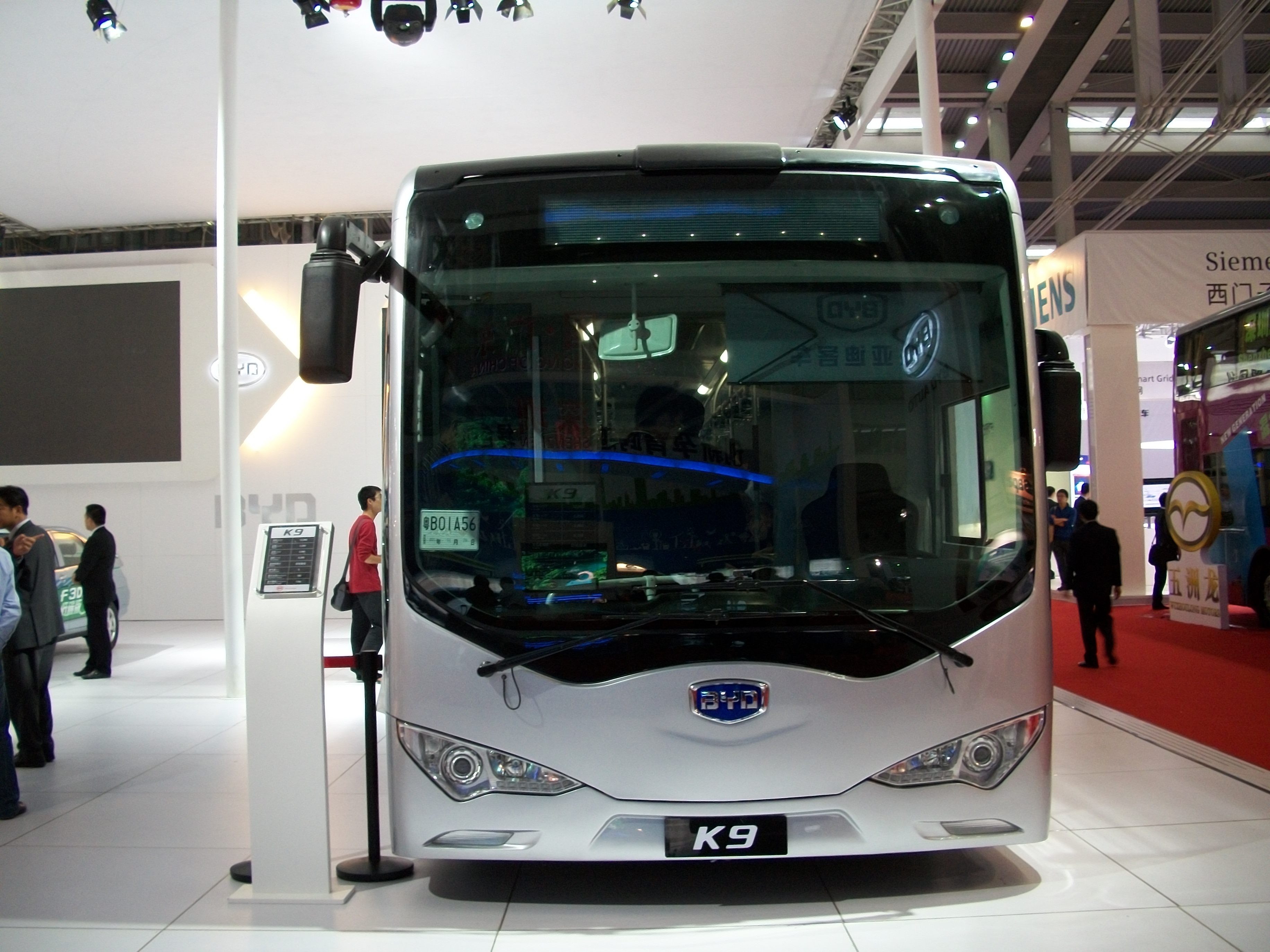
Is this another Great Leap Forward, as Mao’s attempt to push China’s modernization by promoting back yard steel mills and collectivizing agriculture, among other measures, was known? His reasoning was that China had lots of people, so people power should be the modernization force. Widespread starvation resulted from attempts to organize agricultural into communes during the GLF.
Some companies may starve to death as a result of this NEV Great Leap Forward. Too many are rushing into the EV segment (too many battery manufacturers, as well), in a market that can’t support them all. Does this mean the strategy will fail?
Although I am as always skeptical, I am also influenced by a conversation I had with my friend Mark Clifford, the executive director of the Asia Business Council in Hong Kong. www.asiabusinesscouncil.org So what if some businesses fail, he said. That’s how it works. And China always rushes into things this way, Mark pointed out. (Like a “swarm of bees” as a friend of mine in Kunming said back in 1992 when everyone was going into small scale private business.)
Okay, some of these companies will survive, and maybe even thrive. I am, however, skeptical that China will achieve the technological breakthroughs it desires on the tight time frame it has set. Of course, as I pointed out in earlier blogs, Chinese companies will get some help from foreign companies with good technology. Indeed, “cooperation” was a buzzword at the symposium.
Some will also fail, if the government lets them. It is having trouble rationalizing the regular auto sector; how will it fare with the EV sector?
The next few years will be a roller coaster ride that I’ll be on voyeuristically, at least.
GM aims for China e-bike riders with a cheap electric car, but will it be cheap enough?
I just returned from two and an half weeks in China. I found that, despite a government target of producing one million new energy vehicles by 2020 http://af.reuters.com/article/energyOilNews/idAFTOE69F00L20101016, companies who will be major players in China’s new energy vehicle sector are uncertain about how big the sector will actually be. Nonetheless, they are ramping up to supply EVs to China’s masses.
And I learned something! Well, quite a few things. One of the most interesting is that GM wants to produce a low-cost, basic transportation electric vehicle for China. GM’s thinking is this: China has hundreds of millions of electric bicycle riders, especially in smaller cities. Those people would love to have an electric car, which might cost a bit more but offer protection from the rain, and be safer than, an electric bike.
As an example, GM offers its EN-V, a two-wheeled Jetsons-like vehicle it is showing at the Shanghai Expo (and in the lobby of its office building in Pudong). http://media.gm.com/content/media/us/en/news/news_detail.globalnews.html/content/Pages/news/global/en/2010/0817_env_capabilities
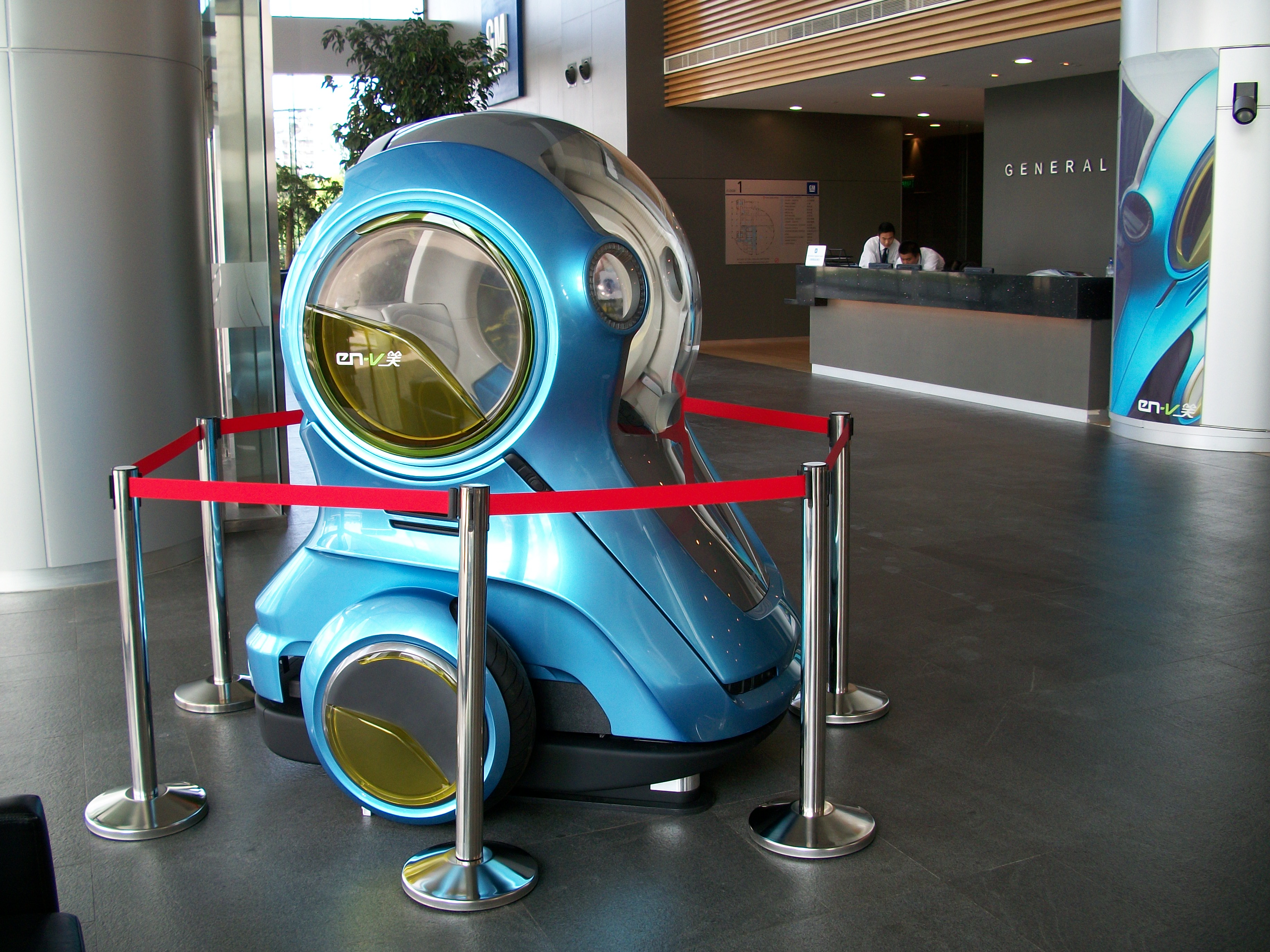
GM showed its vision of the cheap EV future at the Shanghai Expo. The little pod includes software that keeps it from crashing into other little pods.
“This is like upgrading from a black and white TV to a color TV ,” says John Du, director of GM’s Science Lab.

I disagree with Du’s assessment. Deceptively simple-looking, the EN-V includes technology that talks to other vehicles to avoid collisions. A television upgrade might involve a 100 RMB additional investment. Upgrading from an electric bike to an electric car, no matter how basic, would involve considerably more. Especially if it was as technologically-rich as the EN-V.
“There is a definite movement in China to create a segment of low-end electric vehicles to replace the low-end auto segment,” says former GM China executive Frank Chou, now with consultancy PAC Group in Shanghai. http://www.pacgroup.com/
But price will be a major factor. A e-bike costs as little as 2,000 RMB. An entry level mini car such as Chery’s QQ or BYD’s F0 costs a bit more than 30,000 RMB.
To hit the sweet spot between those two choices, GM needs to price its electric vehicle at no more than 25,000 RMB, figures Chou. If it can’t get the price that low, “GM is just dreaming,” he says.
Du admits GM doesn’t yet know what the acceptable price range would be for an entry-level electric vehicle, or even who the target consumer is.
Says Du: “We are going to do research on this. But we are pretty sure the 200 million e-bike riders will view this as like a TV upgrade.”
There may also be competition in that segment. In May, Chinese automaker BYD Co. http://www.bydauto.com/ and German automaker Daimler AG formed a joint venture. http://www.daimler.com/dccom/0-5-7153-1-1298502-1-0-0-0-0-0-8-7145-0-0-0-0-0-0-0.html
A BYD executive says the venture aims to produce a low-cost electric vehicle. He questions if GM can get its battery price down enough to be competitive.
That’s what John Du hopes to find out. The China Science Lab, which Du calls “my baby,” is so far just a dirt field in the Shanghai district of Pudong. But it will do research in half a dozen areas, including person- vehicle interaction, battery materials basic research, and alternative powertrains. http://www.theautochannel.com/news/2009/09/25/478974.html
One project his China Science Lab will work on is lithium-ion battery composition. “We are hoping to make a better lithium-ion battery,” Chou says. Better, okay. But it will also need to be pretty darn cheap.
Nissan faces dilemma in bringing the Leaf electric vehicle to China
I’m in China on a consulting gig for the Specialty Equipment Market Association (monster trucks!) www.sema.org. But of course I’m also cramming in as much electric vehicle nosing around as I can. In that spirit, I attended the kickoff of Nissan’s Safety and Environmental Technology Tour in Beijing.
The tour’s intent (in my estimation) to allow Nissan to 1. Brag a bit and 2. Tout its dedication to reducing road deaths in China and improving the environment, two causes both commercially and politically correct. I was mainly interested in number two, because it includes the launch of Nissan’s Leaf electric vehicle in China.
I also wanted to find out more about a project between Nissan and the government of the central China city of Wuhan. Oh, and I wanted to drive the Leaf, which Nissan plans to launch here in 2011.
Despite all the Chinese government’s talk about how big the new energy vehicle sector will be in China, it seems Nissan is taking a bit of a plunge introducing the Leaf here because the actual demand for such cars is far from certain. That makes the chance that Nissan will produce the Leaf in China uncertain, as well.
I met with Tsunehiko Nakagawa, vice president of Nissan (China) Investment Co. Ltd.
We discussed some of the hurdles to growing the electric vehicle sector in China. And a reported plan that seems to require foreign automakers of electric vehicles to hand over their technology if they want to sell electric vehicles in the China market. (He was suprisingly sanguine about the plan, though it may have been a front.)
Nakagawa san said the biggest hurdle is (not unlike the U.S.) the lack of a recharging infrastructure. Committing to a nationwide build out aside, China needs to decide on a plug standard for recharge stations. And any decision on that is at least a year off, figures Nakagawa san.
“The concerned party is going to make a standard, but maybe it will take a year. The decision process is quite complex,” he told me with an emphasis on complex.
One issue is the number of “concerned parties.” Industry sources say Miao Wei, vice minister of China’s Ministry of Industry and Information Technology, favors local standards, no surprise as he was previously the chairman of Dongfeng Motor Corp. ( the former Third Auto Works). It is owned by the Wuhan government, though a subsidiary, Dongfeng Motor Co, is 50 percent owned by Nissan.
Another concerned party: Wan Gang, head of the Ministry of Science and Technology. Wan Gang, who has a PhD from a German university, previously worked at Audi in China, then was dean of the New Energy Automobile Engineering Center at Beijing’s Tongji University. http://www.most.gov.cn/eng/organization/leadership/
Wan favors a national standard, sources say. (Wan Gang has reportedly been grilling the scientists at Argonne National Lab in the U.S. about the standards there.)
But, said Nakagawa san, “Finally, the State Grid will decide.” The State Grid builds and operates China’s power distribution system.
China is leaning toward a standard that more closely resembles the European standard, he said, with elements of the U.S. standard, which was created by the Society of Automotive Engineers. But, Nakagawa added, China wants the standard to have Chinese characteristics, as well. So, a “complex” decision process indeed.
Promoting the Leaf was also part of the event. I drove one. Nice car. Much better acceleration than BYD’s e6 electric vehicle. A nice interior, too. And roomy. http://www.nissanusa.com/leaf-electric-car/
For the Leaf to succeed beyond the test city of Wuhan, however, the government will have to decide on a charging standard. That’s one necessary condition, in any case. Meanwhile, Nissan is moving ahead with a joint program with the Wuhan city government to make Wuhan an electric vehicle hub.
http://www.nissan-global.com/EN/NEWS/2010/_STORY/100325-01-e.html
The program will start in 2011 with 25 Nissan electric vehicles. Wuhan will build 250 slow EV chargers. Nissan will also provide two (imported) quick-charging stations. They will collaborate on an educational program.
Nakagawa san said the program aims to resolve two issues. The first, how many recharge stations are needed in one square kilometer so people can use an electric vehicle “without resistance?”
The other is more fundamental—education. “People have to know what is an electric vehicle,” said Nakagawa. Because BYD is the poster child for electric vehicles in China, and BYD is known for producing small, cheap cars, Chinese consumers think all electric vehicles are small and cheap, he said.
We also discussed a rumored Chinese government plan may require foreign automakers to turn over their electric vehicle technology to a Chinese partner if they want to sell in the domestic market. There’s a lot of uncertainty around the law.
Said Nakagawa: “We don’t know what the law means. We can’t collect the information about the actual process, or the approval criteria for what and how much we have to disclose.”
So, I asked him, does that influence when, or if, Nissan will produce the Leaf in China? Not really, said Nakagawa. Since Nissan has a 50/50 joint venture with Dongfeng Motor Co, technology transfer would occur if the Leaf was produced locally, he said.
The real deciding factor for local production of the Leaf is the size of the market in China for electric vehicles, said Nakagawa. And that is unknown.
“Especially with the battery plant, it is necessary to make a huge investment,” he said. “Therefore the decision (to produce the Leaf locally) is quite difficult.”
Nissan is in a bit of a Catch 22. It wants to know what the demand for the Leaf will be before it decides whether or not to produce the car in China. But, if the Leaf is not produced locally it won’t qualify for a the government’s new energy vehicle purchase subsidy, so the price will be high, suppressing demand. http://www.chinadaily.com.cn/bizchina/2010-03/09/content_9560631.htm
In any case, Nissan Motor Co. is expanding its production capacity in China. In September, CEO Carlos Ghosn said Nissan aims to nearly double its capacity in China by 2012 to 1.2 million units. http://www.cnbc.com/id/39264109/Nissan_to_Double_China_Capacity_to_Tap_Hot_Market
At the time, Ghosn said that the future of electric vehicles in China was “very bright.” Whether it is bright enough for Nissan to produce the Leaf locally remains to be seen, however.
BYD aims to be a green giant. But it needs to sell lot’s of cars to fund that dream.
BYD Co. Ltd’s car sales in China took a hit in August, falling19% compared to the same month in 2009, according yto J.D. Power and Associates.
A BYD spokesman made light of the matter, naturally, saying the entire market was weak in August (thoughpassenger vehicle sales rose 25% in August according to J.D. Power). http://www.reuters.com/article/idUSTOE68603T20100907
In any case, BYD chairman Wang Chuanfu has another trick up his sleeve besides auto sales–becoming a holistic green company. Can a company that started out making batteries become a green giant? Not without selling a lot of cars to fund the expansion. Here in Los Angeles, I have a front seat to see what happens.
On September 16, BYD and the Los Angeles Department of Water and Power signed an agreement to develop an energy storage unit for the city’s wind power farm. http://mayor.lacity.org/PressRoom/PressReleases/LACITYP_011469
It is the second non-automotive green tech event BYD has held here in recent months. A few weeks ago, I went to an event in Lancaster, CA hosted by BYD, among others. (see July 14 blog) http://www.kbhome.com/pdf/press/2589/KB-BYD_Green_Home_%20Final_100713.pdf
That event involved a house built by KB Home that included BYD’s solar panels, and other green tech. In Lancaster, I asked BYD senior vice president Stella Li if BYD is an auto maker that dabbles solar tech, a battery maker that also makes cars and solar panels, or what? She replied that BYD is “a unique automaker.” But I think Wang Chuanfu dreams of being much more.
I haven’t seen it reported on anywhere else, but Wang’s speech at the Sept 16 LADWP event was very strategic, and telling. He said:
“BYD’s dream is to help the West solve their pollution problems and achieve the goal of reduced oil dependence.
However, solar and wind power plants in themselves cannot help us replace fossil-fuel electric generation, it requires renewable-power with “firm capacity” — Firm Capacity and Energy that we can rely upon at peak demand. Energy Storage (our second focus) makes renewable energy generation relevant to the grid. Only with renewable-energy generation and energy storage in place will electric vehicles truly be ZERO-emissions. That is my true goal. A zero-carbon, zero-emissions eco-system “template” that we can create and run our homes and our vehicles, our businesses and our public transportation.”
Wait a minute, the U.S. needs a Chinese company to wean itself from foreign oil dependence? Wang makes a good point, though. Electric vehicles charged with electricity generated from fossil fuels ain’t that green. And I have to hand it to Wang—he’s creating, or at least pointing out, synergies between BYD’s different business lines.
Buildings play an important role in driving (get it?) Wang’s point home, as it turns out. BYD plans to build “green theme” dealerships in the U.S., says Michael Austin, vice president at BYD America (which will be headquartered right here in Los Angeles).
“Our delivery may be different,” says Austin. “It’s not a car dealership, it’s a green dealership.”
A green dealership would educate customers on how to reduce their electricity costs, etc., he says. Then it would sell them an electric car. And a home charger. And maybe a solar panel. As Austin says, “Real solutions that you can buy.”
There won’t be any BYD green dealerships in the U.S. until at least 2011, however. BYD is sticking to its plan of first using its hybrid and pure electric cars in municipal fleets here in Los Angeles, beginning later this year. Those fleets will be Petri dishes of a sort, helping BYD to pinpoint what changes need to be made to make its cars palatable to American drivers.
One move I recommend: Allowing the e6 electric vehicle battery to be tested here in the U.S.—perhaps at the Argonne National Lab– so American consumers can see independent test results of the technology.
Then, of course, BYD will need to make the car’s driving experience match U.S. consumers’ expectations. BYD is thinking of that, apparently. It will hire U.S. industrial design engineers with experience working on cars for the U.S. market to create U.S. versions of the Chinese models, says Austin. That won’t begin until the first quarter of 2011, he adds.
For all cars, whether electric or internal combustion, the car’s interior ranks first in importance in J.D. Power studies as far as satisfaction is concerned, says Tim Dunne, director of global automotive operations at J.D. Power and Associates.
“I can’t think it can ever be a bad move to try to tailor your product to the market,” Dunne says. “For all buyers, whether of alternative powertrain or internal combustion cars, interior designs are important. That’s where they spend all their time.”
Especially if you’re a commuter in Southern California.
It all sounds good. But Wang’s grand vision is a long way from being realized. He has already scaled back his grandiose sales targets for autos in the face of the August sales numbers. That may allow BYD to focus some of its energy on its other businesses. But car sales are the company’s cash cow. It will be tough for BYD to do it all.
 Alysha Webb's ChinaEV Blog