The U.S. and China are cooperating on EV development. Can both sides come out winners?
An American friend of mine in China was always very frustrated when he entered into negotiations with a Chinese company. “They always have to come out on top,” he would complain. “There is no concept of win-win in China.”
Win-win—the Chinese word for it is “shuang1 ying2”, literally a pair of wins. For China, that usually implies that China comes out on top, however. Nonetheless, the U.S. government is committed to working with China on electric vehicle development. Indeed, several cooperative research relationships were formed in the past few weeks. The key will be to ensure that we get as much out of the arrangement as China does.
At the end of August, the U.S. China Electric Vehicle and Battery Technology Workshop meeting took place at Argonne National Laboratory in Chicago, IL. http://www.anl.gov/
The meeting, between scientists from Argonne, the U.S. Department of Energy, and China’s Ministry of Science and Technology, had three aims, said Jeff Chamberlain, leader of the energy storage initiative at Argonne National Laboratory. https://blogs.anl.gov/expertsguide/jeff-chamberlain/
They were:
- To compare notes and see if the U.S. and China are working on the same problems.
- To do the direct comparison of who is working on what, the results, and what the next step is.
- Map out where we might work together to help each other.
“The objective is to move the technology forward in a way that is better for humanity and the planet,” said Chamberlain.
That’s very noble. But this is the real world. So Chamberlain added: “The complicated aspect is to find a way in which we can collaborate in the science while recognizing that ultimately we will be competing.” In other words, make it a shuang ying arrangement—to a point. I don’t know if that’s possible.
I was feeling kind of optimistic. My friends in business in China tell me the younger generation of Chinese is more attuned to international business norms. But then I read a story in the New York Times by Keith Bradsher about how China is heavily subsidizing the clean energy industry. http://www.nytimes.com/2010/09/09/business/global/09trade.html
That violates its WTO agreement, and effectively shuts foreign companies out of the market. I realized that, at least in the government’s mind, shuang ying situations are not desirable.
But hey, let’s look for a bright side. Those subsidies may allow Chinese battery makers and others to advance technology in new ways. And hopefully the U.S. will have access to that through these cooperation agreements. But I’m not holding my breath.
A lot hangs, it seems to me, on how advanced China’s battery technology really is. And that is not known because China’s lithium ion batteries haven’t been made available to researchers in the U.S., who would run same kinds of tests on them that batteries in the U.S. are subjected to so we can really know what Chinese batteries can do.
Until that happens, we won’t know how to interpret the Chinese test results. So one big benefit of the Argonne/China cooperation could be finding a way to understand what battery performance test results from China actually mean.
“If we can work together in a way that helps us show the consumer that (electric) vehicles are safe, that advances the market,” said Chamberlain.
But that could take a while. The American and Chinese scientists and engineers will need to find a way to “collaborate at a higher mission to change the world while protecting the tax payers’ interests,” said Chamberlain.
The taxpayers he is referring to are you and me. Our interests lie in not having our intellectual property stolen. So, the two sides will have to develop trust, and that will require time and effort.
Some details about the Argonne meeting: It lasted three days. The three roundtables on day two accounted for the most of the meat (or the tofu in my case). The topics covered were technology; testing and performance evaluation; and vehicle performance. Chamberlain led the testing and performance evaluation session.
As it turns out—no big surprise here—China and the U.S. apply different standards when they test battery systems. One substantive result of the meeting was this agreement: Each side will test the same battery system according to its own procedures. Each will provide the other side with the full test results.
The Chinese were “a little frustrated” by the suggestion, says Chamberlain. But, “we agreed to start with this experiment and publish together.”
This approach will be very useful when Chinese EVs start being sold in the U.S. Which could happen by early next year, but I’m skeptical. (Surprise!) In any case, we should at least see some BYD pure EVs here in Los Angeles by early 2011 in municipal fleets.
So long as a team in the U.S. tested a similar system, the performance information can be fairly evaluated and compared to other vehicles, hopefully before the BYD e6 even arrives.
U.S.-China collaboration on clean vehicle develop is already official U.S. policy. During President Obama’s late November visit to China, the U.S. and China agreed to form the China-U.S. Clean Energy Research Center. http://www.energy.gov/news2009/8090.htm
Saving the planet is one goal of the Center. But cold hard cash – hopefully in the pockets of U.S. companies – is also a goal.
Said Steven Chu, U.S. energy secretary: “The U.S.-China Clean Energy Research Center will help accelerate the development and deployment of clean vehicle and clean coal technologies here at home. This new partnership will also create new export opportunities for American companies (emphasis added), ensure the United States remains at the forefront of technology innovation, and help to reduce global carbon pollution.”
The first CERC research grant for clean vehicle development has already been awarded. The University of Michigan will lead a consortium of universities that will receive $25 million in federal funding to develop clean vehicle technologies. China will match that funding, and Chinese universities will be in the consortium. The U.S. funding will only be used by the U.S. companies, said Katinka Podmaniczky in the DOE’s office of public affairs.
Chamberlain said China is “dead serious” about investing in clean vehicle technology. Hopefully, that will help make the U.S. China collaboration a shuang ying one. He also said he suspects the Chinese scientists are “just as paranoid as we are about sharing our secrets.” Wish I could be a fly on the wall in that lab.
I got the latest Sales Satisfaction Index study for China from J.D. Power and Associates a few days ago. It measures how happy a car buyer was with the purchase process. http://businesscenter.jdpower.com/news/pressrelease.aspx?ID=2010172
“For automakers and dealerships, it is of the utmost importance to design and implement effective (sales) processes, as well as to have properly trained sales staff to perform them, says the press release.
That got me thinking about the Chinese government’s plan for new energy vehicle production to reach 500,000 units annually within three years, and for NEV sales to be 5% of the total market. (NEVs include plug-in electric, electric, and hydrogen fuel cell vehicles. Hybrids are considered “energy conservation” vehicles.) http://www.sasac.gov.cn/n1180/n1566/n258237/n258854/7500833.html
Selling these cars is going to test dealerships–and auto manufacturers themselves–not just in China, but around the world. Car salesmen will need to develop a new skill not generally associated with their job—restraint. If NEVs are foisted on the wrong owners, it could create a big pothole on China’s road to world dominance in the NEV sector.
Toyota started educating its dealers about selling hybrids more than a year before the launch of the Prius, says Greg Marchand, president of Automotive Aftermarket Training. http://www.intelligentmechanic.com/
Marchand worked as a field technical specialist at Toyota when the Prius was launched. Now, he has a company that trains independent mechanic shops how to service electric vehicles.
The Toyota salespeople had to fully understand the technology so they could clearly explain it to customers because “if you get somebody to purchase that technology and they don’t understand it, they won’t like it,” says Marchand.
Now this was for hybrids, mind you. They work more or less like a traditional car, except they are a lot quieter at stop lights and get better mileage. Not so electric vehicles. The current technology has limited range capabilities, recharging takes hours, and the recharging infrastructure is nascent in China and the U.S.
Bottom line—a pure electric vehicle is not for everyone, at least not right now.
Bill Jones is general manager at Tonkin Wilsonville Nissan http://www.tonkinwilsonvillenissan.com/ in Oregon, where, as at all Nissan dealerships, his staff is preparing to sell the Nissan Leaf pure electric car. http://nissan-leaf.net/
Managers and sales people are getting on-site training and online certification, says Jones. But selling the Leaf will also require some judgment on the part of the sales staff, he points out.
Says Jones: “We need to be cognizant of the fact that the EV is not going to be for everyone. It may not be the right car if someone has to drive long distances. We have to be responsible enough to know by interviewing the client if the Leaf is the right car for them.”
Let’s face it, a pure electric car is not currently suitable to be the only car most people own. And in China, 70 percent of car purchases are by first time buyers. That won’t change much for a long time, though second-car purchases in China’s wealthier cities are on the rise.
Which brings me to the task of selling all those NEVs in China. I haven’t read anything that indicates much thought is being put into the salesperson education issue among the automakers in China.
Anecdotally, however, the issue seems to be at least on the foreign automakers’ minds. Sewells Group of Australia http://www.sewellsgroup.com/ offers dealer management and skills training. In China, Sewells counts most of the foreign automakers among its clients, says Kyle Dickie, managing partner in China. Sewells is not currently working with any local auto makers, he adds.

Kyle Dickie, managing director, China, Sewells Group points out that a dissatisfied customer doesn't just get mad at the dealership where the car was purchased, he or she gets made at the brand itself.
Dickie says conversations with the foreign automakers regarding training on how to sell NEVs are “ramping up exponentially.” However, dealerships in China are no closer to being prepared than those in any other country, he says.
It is not that a new sales process needs to be learned, says Dickie. The basic steps are the same, be it a car with a traditional drivetrain or an alternative fuel drivetrain.
“The biggest issue is how an electric vehicle fits into your lifestyle,” he says. Which is the same issue that Nissan dealer Jones talked about.
Because of the need to recharge, and the paucity of recharge stations, a pure electric vehicle “doesn’t augment your lifestyle, you have to adapt to it,” says Dickie. (Can you say “range anxiety”? Well, maybe not without paying GM a fee, if GM has its way… http://wheels.blogs.nytimes.com/2010/09/02/g-m-is-trying-to-corner-the-market-on-range-anxiety/?src=mv )
The first buyers will likely be early adopters who understand the recharging issues, says Dickie. But when the average Zhou (he said Joe, but I’ve sinocized it) comes into the dealership, the salesperson will need to make that judgment call.
That presents what Dickie calls the “ethical conundrum.” Do you sell an electric vehicle to someone you know it is not suitable for, or advise against the purchase?
Alas, I don’t have a lot of faith in the ethics of car salespeople in China or anywhere else. As Dickie points out, sales people will take the shortest path to success.
But if you think this is the just the dealer’s problem, think again. It’s the automaker’s problem, too.
If a customer is dissatisfied with the car, he or she likely won’t return to that dealership to buy another car. But they aren’t just mad at the dealership for selling them an unsuitable car. They are mad at the brand.
“The impact of the first purchase experience reflects on how the brand is viewed,” says Dickie. “The customer isn’t going to blame the dealer, they are going to blame the OE.”
Damned straight, J.D. Power would say. Okay, Dave Power probably wouldn’t say that, and McGraw Hill owns the company now anyway. But J.D. Power studies do show that dealerships with good SSI scores will have more repeat purchase customers. And customers will be more likely to return to that dealership to have their car serviced. And to recommend the brand to a friend.
So how do automakers ensure their dealers don’t sell electric vehicles to customers for whom the car is simply not suitable? (That’s a rhetorical question, though the answer might be education/training plus a different pay structure….)
There are additional potholes in that NEV domination road.
For example, the nature of dealership footprints in China. In Texas, where I grew up, car dealership lots were the size of football fields, with hundreds of cars in stock. In China, in contrast, even the dealerships in the suburbs have small lots. Dealerships in the center of major metropolitan areas such as Beijing and Shanghai often have no lot at all. Instead, they have multiple floors. So on-site inventory is very limited. And that inventory will include traditional and NEV models.
With only a handful of electric demo models, how can a dealership make sure all the vehicles are fully charged all the time for test drives, points out Dickie? Getting to test drive a car greatly boosts satisfaction with the sales process, according to J.D. Power, but running out of “fuel” while taking an EV on a test drive isn’t likely to add much in the satisfaction column.
Even with a larger inventory, China has a lot of walk-in customers, he says. “How do you manage the stock behind the store to make sure the models are always charged?”
Okay, I’ve just about whipped the NEV sales horse to death, so let’s start hitting the service pony. Where will China get all the service technicians to maintain and repair those NEVs?
Audi won’t launch its electric sports car until 2012, and the German car maker is already planning a technician training program. “Electric cars bring with them new service and maintenance requirements, so we have already started preparing our dealer and service networks,” Bernd Hoffman, head of sales for aftermarket and genuine parts for Audi told Automotive News Europe.
http://www.autonews.com/apps/pbcs.dll/article?AID=/20100901/ANE/309019998
Nissan in June opened a 23,000 square feet center in Livermore, CA to train EV technicians.
http://nissan-leaf.net/2010/06/23/leaf-training-center-for-technicians-opens/
Those are just a few examples of the lengths automakers are going to so their models can be serviced appropriately.
To be sure, there could be a lot of training activity going on in China, but somehow I doubt it. The State Council should perhaps mandate the establishment of some training centers. China will need them if it plans to become the global number one in NEVs.
On August 18, Li Rongrong, director of the State Council’s State Assets Supervision and Administration Commission, announced the establishment of an alliance of state-owned companies to promote the electric vehicle sector. http://www.sasac.gov.cn/n1180/n1566/n258237/n258854/7500833.html
The speech confirmed for me something Tom Gage, president of AC Propulsion Advanced Vehicle Technologies, www.acpropulsion.com said when I visited him in the company’s San Dimas office last week regarding China and new energy vehicles.
“My impression is that the government doesn’t understand the industry,” said Gage.
He points to China’s announcement a few years back of a timeline for meeting stricter emissions requirements. Vehicles in most of China’s large cities should be required to meet Euro IV standards by now. Few do. The government’s plan “wasn’t consistent with the development cycle,” says Gage.
It’s a reminder that China is, after all, still a planned economy. Though some of the economy is now more or less market-based, the government still likes to do things via mandate. And it is hard to mandate innovation. But, Beijing considers the automotive industry too important not to meddle in. And it sees NEVs as a way for China’s auto industry to leapfrog all those western countries stuck in old technology i.e. internal combustion engines.
But establishing a commission of state-owned companies to promote the sector will not produce the leapfrog effect that China seeks. China needs to encourage firms that have the best technology, regardless of ownership. And stop setting targets that firms will feel obligated to achieve, or at least seem to be achieving, regardless of true market conditions.
We’ll come back to Gage, and AC Propulsion’s experiences in China. First, a bit more about Li’s speech. China’s State Council is sort of like the U.S. Congress and executive branch rolled into one. Not much gets done in China without the State Council’s seal of approval. Does the State Council’s seal of approval mean something gets done, however? Not necessarily. But it is a great place for big plans.
So, I kind of laughed as I read the text of Li’s speech because it was full of the kind of big plans, and contradictions, one expects where the Chinese government is concerned.
The new commission is to be composed of 16 state-owned companies. They range from large automakers such as FAW Group Corp and Dongfeng Motor Corp (SAIC was strangely absent, but it could fall under the “deng,” or etc. at the end of the sentence.) to state-owned battery makers such as China Aerospace Science and Industry Corp, to major electric utilities such as the State Grid Corp. of China.
Those state-owned companies, joined in the new commission, are directed to make China’s electric vehicle industry globally competitive according to market principles, and solidify China’s dominant position in the industry, “under the leadership of the SASAC” (the leadership of the central government, that is).
China has “already mastered the key technologies of electric vehicle development,” said Li, and “begun the development of all kinds of electric vehicles,” and “realized the self-development and commercialization of key electric vehicle components.” Well, that’s a bit in question. But I digress.
Over the next three years, said Li, China would achieve an NEV production capacity of 500,000 units, and NEVs would account for 5% of total vehicle sales in three years. (China produced 8.4 million light vehicles in 2009, according to J.D. Power and Associates. Production was up 49% on-year in the first seven months of 2010.)
Hmmm. Sounds a bit like a central government pep talk, because Chinese companies—state owned or otherwise—aren’t there yet as far as technology is concerned. Let’s not even get into who is going to buy those 500,000 NEVs.
I’m less optimistic than my friend Tim Dunne at J.D. Power and Associates about China’s chances of achieving this milestone. In the August 2010 “China Automotive Monthly: Market Trends,” Dunne expresses some skepticism. He cites JD Power studies showing hurdles to NEV sales in China are pretty much the same as those in the U.S.: range anxiety, concern that the technology is not mature, and the price.
But Dunne concludes by saying, “based on China’s past performance in overcoming obstacles, we should not be surprised if China is able to pull off its ambitious plan to create its own NEV future.”
Dunne is smart. He has spent a lot of time in China. But I can’t agree with him. Besides the fact that it is just my nature to be skeptical where China is concerned, I’m influenced by my talks with people who have experience with China’s NEV industry. Such as AC Propulsion’s Gage.
AC Propulsion designs and produces electric vehicle drive trains, including the battery management system and the battery its self. It has been doing this for a while—its first electric drive train was unveiled in 1994.
It has achieved some success. Among its customers: BMW Group built 500 Mini E electric vehicles using AC Propulsion technology.
http://www.acpropulsion.com/pressreleases/11.20.2008%20BMW%20Press%20Release.pdf
Yulon Group in Taiwan is also building electric vehicles using AC Propulsion technology. http://www.acpropulsion.com/pressreleases/10.10.2008%20ACP%20Yulon%20press%20release.pdf
AC Propulsion manufactures its drive trains at a plant in Shanghai. They are then shipped to the U.S. for final assembly. But the company would like to be doing much more than just manufacturing in China.
“We want to sell our technology into China,” says Gage. “The homegrown technology is lacking. We want to promote the adoption of our own technology.”
(A bit of a common theme among independent U.S. alt-fuel powertrain companies. See my July 20, 2010 blog about EDI.)
AC Propulsion has developed prototype electric vehicles for several Chinese automakers, but none have gone past the prototype stage. In 2007, it built an EV for Chery Automobile Co. Chery is a state-owned automaker in the central China province of Anhui, in the growing city of Wuhu.
(I have been to Wuhu several times, most recently December, 2009. The hotel selection is improving…sort of. The breakfast buffet at the Crowne Plaza had skim milk, a real sign of progress. Little things can mean a lot in China.)
Says Gage: “Chery asked us to give (the prototype) to them for three months to evaluate.”

Chery asked AC Propulsion to leave the EV so it could "study" the vehicle. AC Propulsion declined.
AC Propulsion took the vehicle home. I drove it to lunch (At an Italian restaurant in downtown San Dimas, which is a pretty small town.).
AC Propulsion also built a prototype electric vehicle for Beijing Automobile Industry Corp. (BAIC), a state-owned company that partners with Hyundai and Daimler in China. BAIC didn’t originally produce passenger cars itself, but the central government pretty much told the local partners of foreign automakers that they should have their own brands, or else.
As with all of China’s domestic automakers, BAIC also wants its own new energy vehicle now (also strongly encouraged by the central government). Alas, once BAIC had the prototype, it didn’t have the money to go to production, says Gage.
“We converted their model into an electric vehicle,” he says. “But the changes need to be validated. They didn’t have the budget.”
Validation would include testing safety and crash worthiness, durability, manufacturability, and cost optimization, says Gage, as well as building several more prototypes.
One could suspect Gage of exaggeration regarding the state of China’s domestic EV technology. After all, he admittedly wants to sell his company’s technology to China. But others corroborate.
Duan Chengwu, Greater China lead analyst with IHS Automotive http://ihs.com/automotive/index.htm in Shanghai agrees with Gage that China’s domestic technology is lacking. “Lot’s of Chinese companies can develop prototypes,” says Duan. But “given the short history of the Chinese auto industry, Chinese companies are still learning to make product at a consistent level of high quality.”
And as I mentioned in an earlier blog, InterChina Consulting http://www.interchinaconsulting.com/en/aboutus/companyprofile/index.php
in its “Electric Car Sector in China” report lists battery management systems and battery film as among weaknesses in China’s domestic NEV supplier industry.
(Chery just announced it will manufacture battery film. http://www.autonewschina.com/en/article.asp?id=5702 The quality remains to be seen.)
AC Propulsion’s experience with BAIC highlights another problem Chinese automakers face in achieving the government’s lofty NEV production and sales goals—money. Okay, the government is going to pour billions of RMB into the industry. But that will be spread among at least a handful of companies. And as Gage points out, BMW spent millions to build just 500 electric Minis.
As well, the sales slowdown in China’s auto industry will give both state-owned automakers and private companies such as BYD less money to invest in developing new technology. http://online.wsj.com/article/SB10001424052748704504204575445263274052370.html?mod=WSJ_auto_IndustryCollection
And it is unclear if private companies will get any government money under the new plan anyway.
To be sure, something good might come out of the government-mandated alliance. Duan, of IHS Automotive, says it is a good collaborative model because it includes multiple industries that are important to the success of NEVs. “This is definitely towards the right direction,” he says.
Which brings me back to Li’s speech. Is it a step in the right direction? Hard to tell. It may indicate that the recipients of central government largesse will be state-owned companies. And they are not known for being nimble.
But, Li also said that the NEV sector may face “temporary” difficulties and problems. In that case, he said, the newly-established commission should “positively study and benefit from the successful market expansion experiences of other foreign and domestic commissions.” (Learn from Li Feng! Inside joke.)
The benefit will be, as it has been in the auto industry as a whole, the acquisition of foreign technology. That may be through joint ventures with foreign firms. And if Chinese companies can afford it, outright purchase from companies such as AC Propulsion.
But the most vibrant companies in China’s auto industry haven’t been the large state-owned companies. They have been the Sino-foreign joint ventures and the privately-owned companies. One of those privately-owned companies, BYD, is leading China’s BEV charge.
Here’s Gage’s evaluation of the new commission: “It can make sense in the near term, but at some point they have to step back and let market forces into the game.”
Let’s look at the auto industry as a whole to evaluate that statement. China mandated that foreign automakers could only produce cars for sale in the domestic market by entering into 50/50 joint ventures with domestic automakers. Decades later, that requirement remains in place. When will the government step back from that requirement?
Seems there is more fuel cell vehicle action among automakers than I realized, in the U.S. and even in China (I sort of bashed China for dropping fuel cell research like a hot potato in favor of BEVs in my July 20 blog).
According to Michael Wang, manager of the systems assessment section of the Center for Transportation Research at the Argonne National Laboratory in Chicago, China is still putting money into fuel cell research. Among the research activities, Tongji University, in Shanghai, is even holding an international fuel cell forum this year.
There is a lot of activity in fuel cell research in the United States too, which I didn’t know about. Okay, the info is out there. But it’s generally only talked about in circles where people understand all of California’s zero emission vehicle program (which I may have also been a bit hasty to commit to the dustbin of history), or super-geek alternative fuel vehicle circles (I may catch hell for that. But hey, it’s my blog.).
Indeed, the California Fuel Cell Partnership estimates there will be 54,300 fuel cell passenger vehicles (including public transport) on the road by 2018. Huh?
To understand why that might be true, I spent part of last Thursday at the University of Irvine with Tim Brown, technology manager in the sustainable transportation department in the Uni’s advance power and energy program. www.apep.uci.edu The National Fuel Cell Research Center www.nfcrc.uci.edu operates under the APEP’s umbrella.
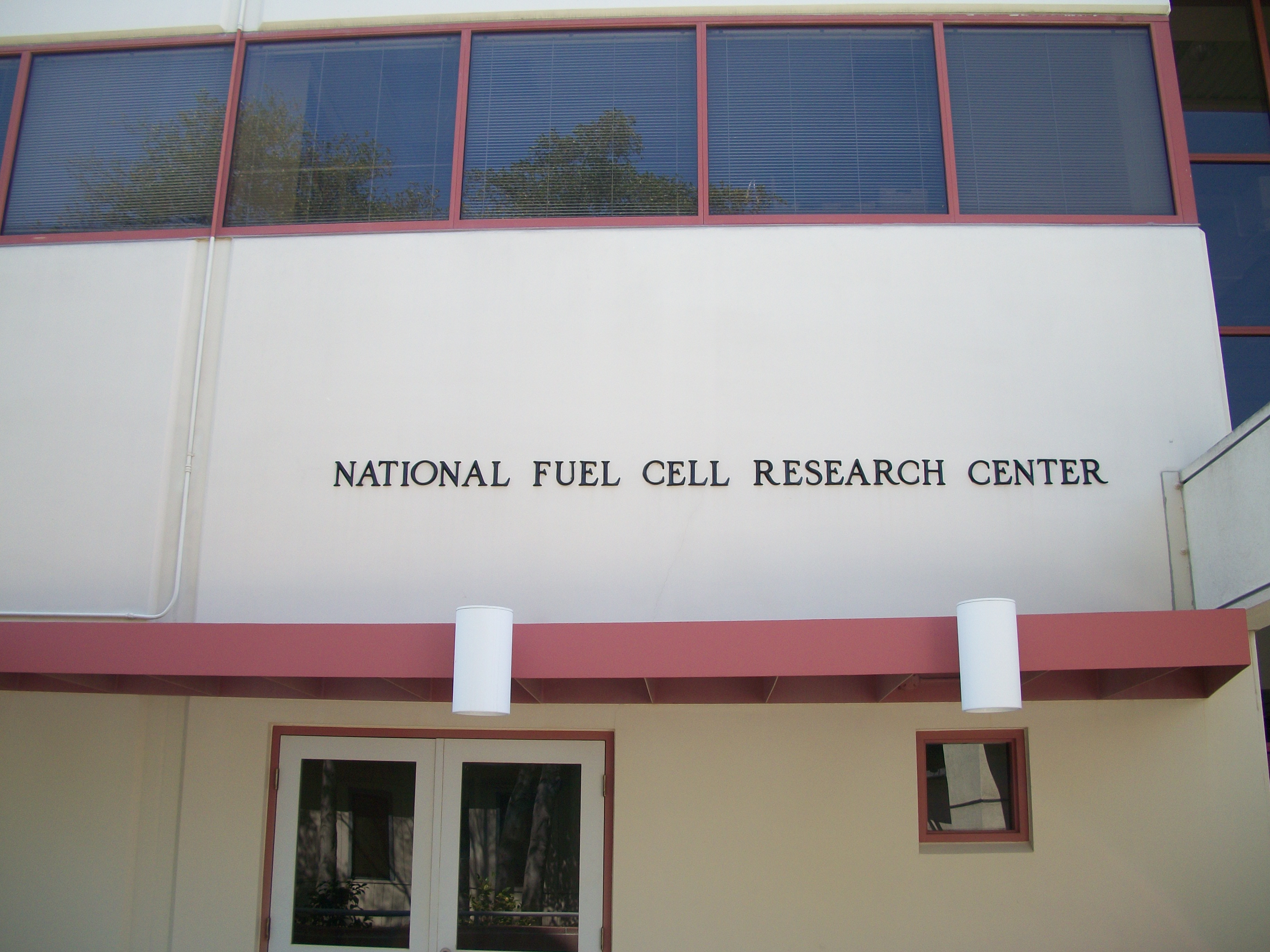
The National Fuel Cell Research Center at UC Irvine is home to a fleet of fuel cell vehicles. The University has its own refueling station.
Brown, who is one of the chief super-geeks, sees consumers driving fuel cell vehicles in the U.S. the near future.
“In 2015 you should be able to walk into a dealership and buy a fuel cell vehicle,” says Brown
.
Mercedes, General Motors, Honda, and Toyota have the most serious fuel-cell development programs, he says. According to Brown, in California, Mercedes has 100 vehicles on the road, GM has 119, Honda says it will have 200 eventually, and Toyota currently has more than 100. All are members of the California Fuel Cell Partnership. www.cafcp.org
“They see this as a marketable car, and acceptable to consumers,” he says.
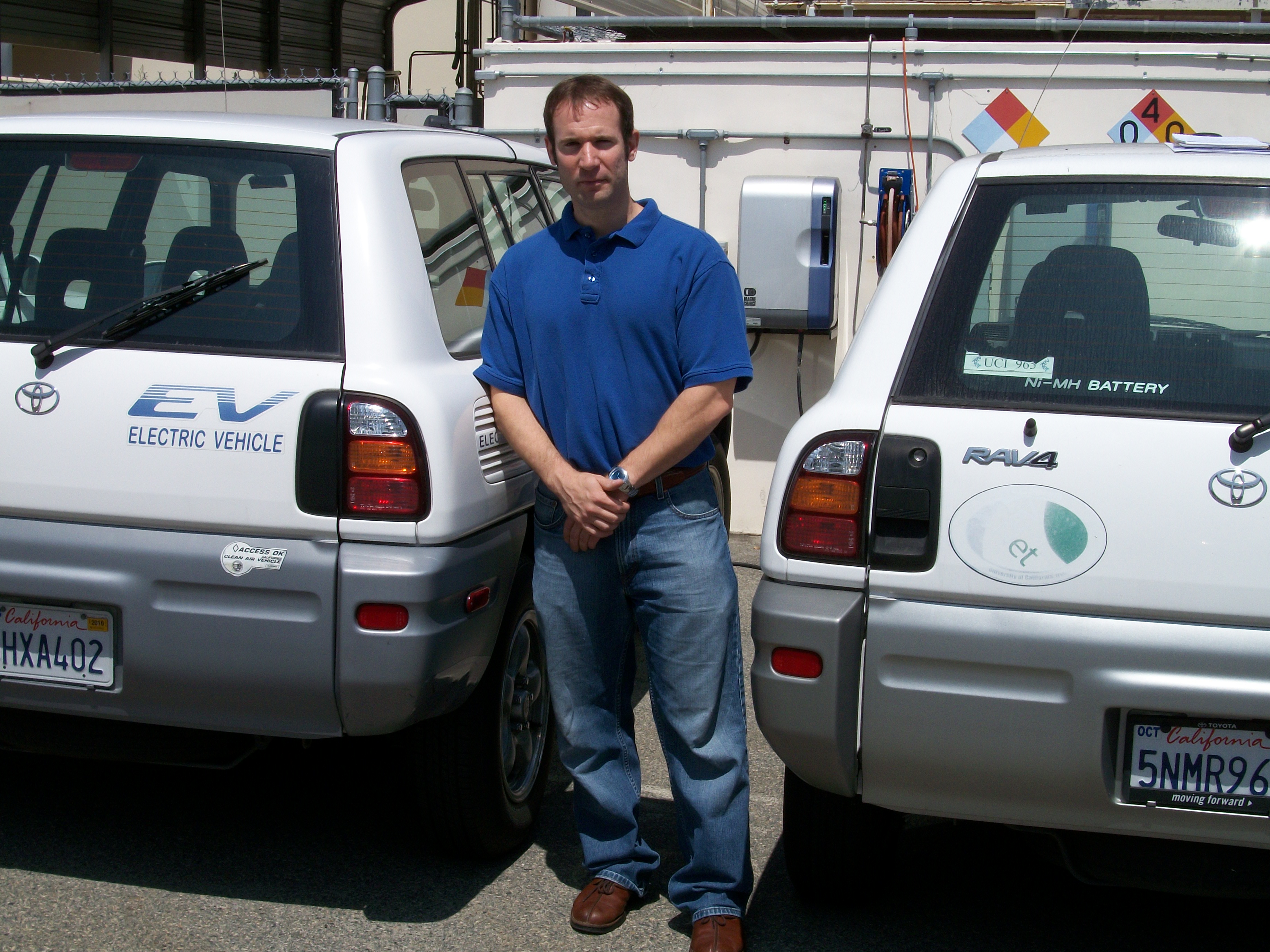
Brown is like a proud parent with his fleet of aging Toyota RAV4 FCVs.
Toyota has pledged to bring the cost of a fuel cell vehicle below $50,000 by 2015, plus make the segment profitable, says Brown. Other automakers also have produced at least one fuel cell vehicle. http://www.cafcp.org/progress/vehicles
(okay, this is overkill, but here’s even more info on automakers’ fuel cell plans. P 4 http://www.cafcp.org/sites/files/FINALProgressReport.pdf )
Brown, who has a PhD in Mech E from UCIrvine, is a gearhead, albeit a brainy one. He has an M.A. in automotive engineering from the University of Michigan at Dearborn, and worked at General Motors in the structural test lab in Warren, MI and the GM proving grounds in Milford, MI.
Now, managing a filling station is one of his jobs. Okay, it’s not exactly a filling station. Brown manages UCI’s hydrogen refueling station, “arguably the most heavily used public hydrogen station in the world” according to Brown’s CV. (Could be a little CV padding, though. By Brown’s admission, Germany and Japan have much larger hydrogen fleets, though also more refueling stations…).
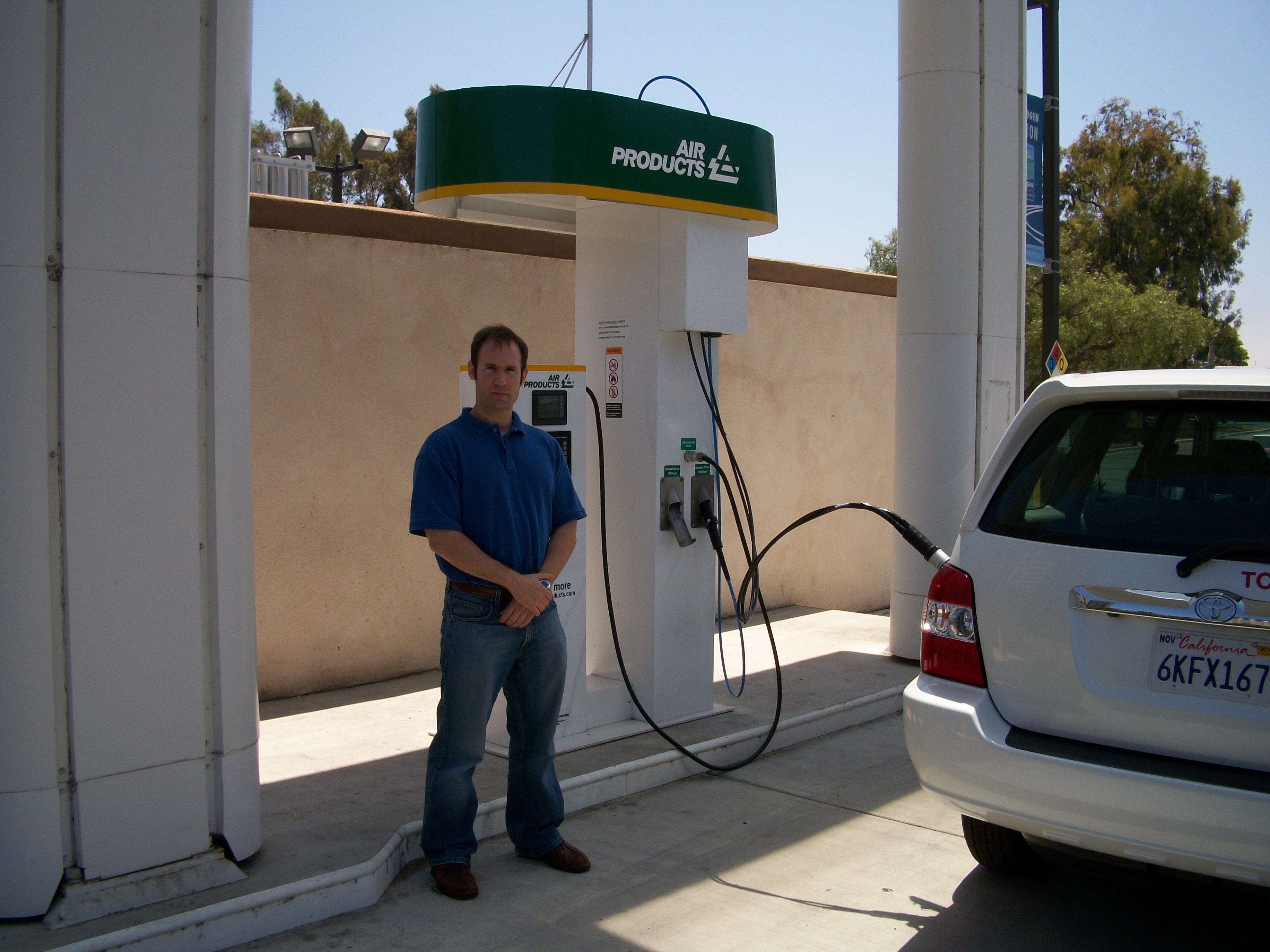
Brown manages UC Irvine's hydrogen refueling station, which his CV calls “arguably the most heavily used public hydrogen station in the world.”
He also manages a fleet of 17 Toyota RAV-4 fuel cell vehicles. I drove one to lunch at Wahoo Fish Taco (not relevant to this blog). I didn’t check out its zero-to-sixty abilities (which wouldn’t have meant much to me anyway as I’m not really a gearhead). But to me the FCV drove just like any other car, except for the eerie lack of engine noise.
The problem with commercialization of fuel cell vehicles, says Brown, is not technology. The technology is mature, he says. The main problem is the cost of a fuel cell vehicle, which runs in the hundreds of thousands. All the automakers agree it can be reduced by 10 times by ramping up the scale of production, he says.
So why aren’t GM, Honda, Toyota, and Mercedes turning out growing numbers of FCVs? There aren’t enough refueling stations, among other hurdles. Why aren’t there enough refueling stations? There aren’t enough fuel cell vehicles on the road to warrant the investment. Sound like a Catch 22?
To be sure, not all agree that cost is the main reason there aren’t lots of fuel cell vehicles on the road today. Tom Gage, president of AC Propulsion Advanced Vehicle Technologies in San Dimas, CA, http://www.acpropulsion.com/ is one critic. He argues that the reason hydrogen fuel cell vehicle development hasn’t been more vigorously pursued is that hydrogen can only be produced by separating it from natural gas or water. That process is so energy-intensive it mitigates any potential benefits, he says. “They can’t solve the thermodynamic problem,” says Gage, also a mechanical engineer. Of course, AC Propulsion makes electric vehicle drive trains, so he is invested in a competing alt fuel technology.
I’ll let those two Mech E’s duke that one out.
Which brings me to my re-consideration of California’s zero emission vehicle program. I wrote about it for Automotive News, looking at how it has created a market for the credits among automakers. http://www.autonews.com/apps/pbcs.dll/article?AID=/20100802/OEM01/308029992
While reporting that story, I became convinced that the ZEV program–though driven by a noble idea, reducing green house gas emissions (that is the rationale now, at inception it was to clean up the air)–was a failure. It is mind-numbingly complex. Even the tutorial http://www.arb.ca.gov/msprog/zevprog/factsheets/zev_tutorial.pdf is nigh impossible to follow. The program is thus very difficult to implement.
However, the ZEV program may have achieved one of its goals. Brown credits the program with jump-starting fuel cell vehicle development in California. (Gage credits it with killing GM’s electric vehicle program, however. When GM no longer had a corner on the market, it wasn’t worth producing, he said.)
The California Air Resources Board’s Elise Keddie says: “The program was initially seen as a technology driving force.”
Keddie, who is manager of the Zero Emission Vehicle Implementation Section at CARB, told me, “We wanted the automakers to take longer strides, to look over the horizon.”
But without a good refueling structure, that horizon still seems a bit distant. Let’s look at Honda’s fuel cell program as an example. Ed Kjaer at SoCal Edison called Honda’s FCX Clarity “the best fuel cell packaging technology on the planet.” But only about 20 of the vehicles are on the road. “We are actively looking for more leases,” says Jessica Fini, the environment and safety specialist flack at American Honda Motor Co. But, only people who live close to a refueling station are even considered for the program, says Jon Spallino, who just received his FCX Clarity.
This is Spallino’s second go-around. He leased the original FCX, introduced in 2002, as well. (I live close to both the Santa Monica and the Torrance stations, and so will get a FCX Clarity to try out for a few days in October!)
Says Spallino: “If you get a Clarity. You have to think about where you get fuel. As someone who drove one for three years, I had to sometimes plan appointments around getting fuel.”
Driving a hydrogen fuel cell vehicle has gotten easier for Spallino because the new Clarity has a greater range, and a refueling station is being built in Torrance, CA, close to his home. But there are still only a handful of public refueling stations in California, even fewer in other states.
http://www.cafcp.org/sites/files/FINALProgressReport.pdf
For fuel cell fans, the good news is that we should be getting a few more hydrogen refueling stations in the next year or so. Eight new public stations, funded mostly through California’s Hydrogen Highway program, should be up and running by 2011.
California just allocated an additional $22 million to build refueling stations. The political wrangling over location has now begun, with different automakers making pitches.
The California Fuel Cell Partnership has its recommendation. UCIrvine is doing its own study, as well, of the best locations for the stations, says Brown. Now there is “renewed interest” from the California Fuel Cell Partnership in working with UCIrvine on determining locations, he says.
Says Brown: “The only way we can reach our environmental and security goals without the consumer paying a price in range anxiety and charging time is with fuel cell technology.”
Well, Tom Gage wouldn’t agree. I love a good scrum, even one over technology. Have at it!
A few weeks ago, an automotive executive asked me if I had heard that the Chinese government was pressuring foreign automakers to bring their alternative fuel vehicle—or new energy vehicle, as they are known in Chinese–technology to China or face unspecified consequences. New energy vehicles include electric drive train technologies only, so plug-in hybrid electric, battery-electric, and hydrogen fuel cell.
Turns out it is not that the government told foreign companies to bring NEV technology to China. Not exactly, anyway. Rather, a combination of government support for the sector and the eagerness of the automakers to be part of a potentially very large market has produced pretty much the same result as a government mandate would have.
In any case, China will need all the outside technology it can get if it hopes to even come close to achieving its ambitious new energy vehicle sector development goals.
Details of the plan recently appeared in the local press. Briefly, as reported by the Shanghai Securities News on August 4, China aims to be number one in the world in new energy vehicle production and sales by 2020. To achieve that, the government will invest more than 100 billion RMB, (that’s US $14.8 at current exchange rates) in the NEV sector over the next ten years. Half will go to companies producing NEVs. Purchases of NEVs will be subsidized, and the government will give companies in the sector tax breaks.
The policy calls for China to have three to five “key” NEV manufacturing companies as well as two to three “internationally competitive” supplier companies in the area of batteries, motors, or other key components. They should own the intellectual property rights to that technology i.e. they won’t be manufacturing another company’s products.
The policy as reported doesn’t specify if the companies must be fully domestic, or if joint ventures (companies partly owned by a foreign entity) or wholly-owned foreign suppliers qualify. (In China, foreign automakers can own no more than 50% of a company manufacturing vehicles for the domestic market. Suppliers can be 100% foreign-owned.)
But hey, the point of the new energy vehicle policy is to promote the domestic industry. My guess? No way will foreign-invested companies qualify.
In any case, many foreign companies already have plans to bring, or have already brought, their NEV technology to China. Those plans probably won’t change regardless of the policy. Why? Firstly, no one knew, and it is still not clear, who will qualify for the subsidies. Second, even if foreign companies can’t climb on the Chinese government’s gravy train, they hope to benefit from overall growth in the sector.
Some examples: Renault-Nissan in April 2009 signed an agreement with the Ministry of Information Industry Technology (MIIT) to set up a partnership to promote pure electric car development, according to a report by InterChina Consulting of Beijing. Nissan Motor Co. plans to begin selling its Leaf Electric vehicle in China in 201, albeit initially as an import.
Last year, I interviewed Tsunehiko Nakagawa, vice president of research and development for Nissan (China) Investment Co. Ltd. (One of a number of interviews I did for the J.D. Power and Associates report “China Automotive 1015: The Cost of Opportunity,” which I co-authored). Nakagawa said EVs could account for 5% of the China market by 2015—if the government subsidized development and purchase. Which we now know will occur.
“Electric vehicles will become very important to business in China,” he said. “Even if only 5% buy one, it will still be a huge market.”
Well, let’s do the numbers. J.D. Power forecasts that China’s light vehicle market, including light commercial vehicles such as minibuses and mini trucks, will grow to 19.1 million units by 2015. So 5% of that would equal nearly one million units annually.
General Motors is developing a prototype Chevy New Sail electric vehicle for China, and in 2011 will introduce the Chevy Volt and a hybrid Buick LaCrosse and to the market. GM built the GM China Advanced Technical Center in Shanghai to “accelerate the realization of GM’s electrification strategy,” GM China Group President Kevin Wale told the “Electrification—Plugging into the Future” forum in Shanghai in June. GM hosted the forum. “We will intensify the research and testing in China of advanced propulsion systems, which include electrification technologies such as batteries, electric motors and power controls,” Wale said.
So, are these moves the result of pressure from the Chinese government? Not exactly, says Michael Wang, manager of the systems assessment section of the Center for Transportation Research at the Argonne National Lab http://www.anl.gov/ in Chicago, IL. Wang advises the China on alternative vehicle technology. http://www.flickr.com/photos/argonne/4207282994/
Rather, he says, foreign automakers were told in order to participate in any government subsidies for the industry, they would need to bring their new vehicle technology to China, and to produce locally.
Says Wang: “For internal combustion engine technology, China is behind the U.S. and Europe. For electric vehicle technology, the government thinks China has a good chance to get on the same level or even ahead of some other countries. This is a strategic decision to get the Chinese auto industry on the global level.”
To be sure, foreign technology is needed to fill some gaps in domestic companies’ EV production capabilities. InterChina Consulting, in its April 30, 2010 “Electric Car Sector in China” report, notes that Chinese companies lacks crucial EV technologies such as a mature battery management system and powertrain control systems.
Other foreign companies are also coming to the rescue. For example, in May, Daimler AG announced it would form a 600 million RMB (US $85.6 million at current exchange rates) 50/50 joint venture with China’s BYD to develop an electric car for the China market. http://www.daimler.com/dccom/0-5-7153-1-1298502-1-0-0-0-0-0-12080-0-0-0-0-0-0-0-0.html
Reading over my notes, I noted another intriguing comment from Nakagawa. “In the near future, there might be some restriction on foreign ownership of battery manufacturers in China,” he said.
China’s battery manufacturers could use some help with their electric vehicle battery technology, and a policy restricting foreign ownership in the auto manufacturing sector helped China’s domestic automakers (such as SAIC) gain global technology.
(“China faces difficulties in reducing battery charging time, increasing battery driving distances and lifespans, and maintaining consistent product quality in high-volume production,” says the InterChina report. China’s battery manufacturers also much import most of their battery film, it says.)
Battery producer A123 Systems of Massachusetts to the rescue! (Among others. Don’t want to seem like I’m picking on A123) In December of 2009, A123 formed a joint venture with SAIC Motor Co. Ltd. (whose parent company, Shanghai Automotive Industry Corp, partners with GM in China and India) to develop, manufacture, and sell vehicle traction battery systems for use in pure electric and hybrid vehicles. SAIC owns 51% of the joint venture. http://ir.a123systems.com/releasedetail.cfm?ReleaseID=430981
And while Chinese companies such as BYD Co. and Tianjin Lishen Battery Joint Stock Co. are global behemoths in terms of manufacturing lithium-ion batteries for consumer electronics, the margins in the consumer electronic battery business are very thin, and the market has approached saturation, says Wang. Meanwhile, “automotive is a huge opportunity,” he says.
Now, I’m going to sit back and watch how this new NEV policy plays out. As a reference point, I look back about six years ago, when as part of a new auto industry policy Beijing required that automotive manufacturers in China develop their own brands, with their own their intellectual property.
The result was a frenzy of own-brand development by domestic automakers. And that policy didn’t even come loaded with cash. Of course, Chinese automakers are already in a frenzy of talking about NEV development. Maybe now that the government has shown them the money, some real development will begin.
I’m impressed by the enthusiasm and sincerity of the people I talk to that are diving into the brave new world of electric vehicles. It sometimes nearly thaws my cold, skeptical heart where China-related things are concerned.
Steven Fly, chairman and CEO of Green Automotive Co. Inc. www.usaelectricauto.com in the Dallas suburb Addison, TX is such a person. His company aims to begin importing by the end of this year pure electric SUVs produced by Zotye Holding Group, www.zotye.com a small Chinese automaker.

I figured my talk with him would be like most of the conversations I had when I was the China bureau chief for Automotive News regarding this or that Chinese automaker and the prospects for selling its cars in the U.S. My advice then was always “be extremely cautious and do thorough due diligence.” I would hang up and think “sucker.”
Perhaps it is that Fly is a fellow Texan. Perhaps it was just late in the day. But after our phone conversation I thought, hmm, maybe. Just maybe, though. We’ll get to that later.
Fly calls himself as a “car guy.” He started working in dealerships right out of college, and worked in just about every position except service manager, he says. About two years ago he got interested in importing cars from China. Electric vehicles seemed the way to go, to avoid having to pass the EPA emissions tests, says Fly. He got burned by his first attempt. But, he was sold on the concept. And, “when somebody tells me it won’t work, that just fuels me,” says the tall Texan.
Green Automotive has already signed up some dealers, including Bob Rohrman Auto Group of Lafayette, IN. Fly says he has about 30 points so far, though not all are firm commitments. “If we opened up tomorrow, we would have a firm 10 dealerships,” he says. Some of the dealers have put down a deposit, from $25,000 to $50,000. Others are waiting for the cars to arrive.
Initially, Fly figures sales may only total 1,000 EVs a month for all the dealers. It’s a cautious figure, but “we’re taking baby steps ‘cause we don’t want to be like Mahindra and have a bunch of pissed off dealers,” says Fly. Passing U.S.- mandated safety and emissions tests is taking longer than Mahindra & Mahindra Ltd anticipated, and the Indian automaker is being sued by its U.S. distributor because of delays in bringing its diesel pickups to the U.S.
Since the Zotye SUV is fully electric—and thus emission-free—the vehicle won’t have a problem with emissions testing. It still has to pass crash tests, however. Ten of the small SUVs will arrive in the U.S. in late August for crash testing, says Fly. “The biggest thing is to make sure we’re Federal Motor Vehicle Safety Standard compliant,” he says.

It looks good from the outside.
The electric SUVs will sell for around $35,000 before tax incentives, says Fly. To lower the cost, Green Automotive will later seek government funding. The first buyers will likely be people who “really want to go green, not just the pretenders,” he says.
The SUV’s range is advertised as up to 250 miles, but “that’s doing like 28 miles an hour,” says Fly. Fly says he has driven his Zotye electric SUV 150 miles doing 60 miles per hour, in the Texas heat. The airco runs off a separate 12-volt battery, he says.
Fly has visited Zotye in China, and one of Green Automotive’s eight employees is in China now working with the Chinese automaker to make sure the vehicle’s fit and finish meet U.S. consumer standards.
And this is where the skeptical section begins. Privately-owned Zotye, in the east China province of Zhejiang (which is famous for its private businessmen, by the way), has only been producing vehicles since 2003, according to its website. The SUV, which comes in both electric and gasoline-powered versions, is based on the Daihatsu Terios platform. Zotye also produces a very small car based on a Fiat platform. It also produces engines and components. The Chinese automakers sold around 45,000 units in 2009.
This isn’t the first time news of a Zotye SUV coming to the U.S. has appeared. In 2008, stories circulated that the Zotye electric SUV would be arriving. Nothing happened, possibly because Zotye didn’t have an electric SUV yet.
In 2009, Zotye raised 720 million RMB (US $105 million at the exchange rate then) through a share sale to private investors. The money was to go to developing an electric vehicle. Zotye’s president said the automaker planned mass production of electric vehicles by the end of 2009.
In 2010, Zotye is finally producing an electric SUV—known as the 2008EV. The numbers seem very limited. About 30 of the EVs are now on offer as rental cars in the lovely city of Hangzhou.
A Green Automotive exec got to drive one around what appears to be West Lake, in the center of Hangzhou. Here’s a rather disjointed video of that drive: http://www.youtube.com/watch?v=yC7yVKB6J2Y
And a wander about of the vehicle (if you watch it you will see why I do not call it a walk about):
http://www.youtube.com/watch?v=1_NYtHhpglQ&feature=related
At least one electric SUV has been sold to an actual consumer in China, says Fly (and he is driving one in Dallas). But, Zotye has said that selling the electric vehicle in China is not realistic because of the high price of the electric vehicle, double that of the gas-powered SUV, says Kevin Huang, an automotive analyst based in Guangzhou.
Huang sees a motive behind Zotye’s push to sell electric vehicles in the U.S., even though it isn’t selling them in China. The automaker is preparing for an initial public offering in Hong Kong. Launching a vehicle in the U.S. may help Zotye attract overseas investors, says Huang. That would give the company money to develop new models, whether electric or conventional, he says.
For now, Zotye should concentrate on improving the electric SUV’s fit and finish.
The gasoline-powered SUVs are not high-quality, says Bill Fisher, COO of AmAsia International www.amasia.biz. AmAsia is a consultancy in Florida that aims to help Chinese and U.S. companies understand markets. Its ultimate goal is to import Chinese vehicles.
Fisher has visited many Chinese auto manufacturers, though not Zotye. He checked out Zotye’s vehicles at out at this year’s Auto China in Beijing, however. “Their fit and finish is not up to U.S. standards, says Fisher.
Fly admits the early versions of the electric vehicle were not impressive. But Zotye has made a lot of improvements, he says. “I had my doubts,” says Fly. “But the (new and improved) fit and finish is extraordinary.
“The product is much better than we thought it would be, but it is going to be even better,” he adds.
The Zotye project is probably giving Fly gray hairs (China gave me gray hairs, or at least that’s how I claim they got there). “I haven’t slept at night for the last year and a half,” he says.
He probably won’t get any sleep for some time to come.
But I look forward to following Green Automotive’s progress. I don’t think we’ll see Zotye electric SUVs in the U.S. by the end of this year. But maybe in 2011. I don’t want to have to assign my fellow Texan to the “sucker” category.
I’ve been reading a lot of comments lately about how the market in China for electric vehicles is going to be the world’s largest in somewhat short order. I suppose people come to that conclusion because of the fast growth of China’s automotive market and the government’s wholehearted support—for now—for electric vehicles.
My friend and former colleague Yang Jian, managing editor of Automotive News China (Which I’m fond of since I launched it. Everyone subscribe! It’s free!) wrote a nice column about the government’s EV fixation. http://www.autonewschina.com/en/article.asp?id=5397
I’m my usual skeptical self about this latest government crusade. But, it seems to have given one U.S. company, Efficient Drivetrains Inc., an opportunity to finally see its technology commercialized. And maybe even get paid for it.
First, my skepticism. At one time, China was going to be a first mover in fuel cell technology. Fuel cell technology was targeted for special funding under the National Hi-Tech R&D Program, which goes by the (very Chinese) nickname of 863 because it was initiated in March, 1986.
I think back to 2004, when I was working for Automotive News in China. General Motors and Shanghai Automotive Industry Corp. announced they would jointly develop a fuel cell vehicle. The vehicle “will serve as an important point of reference for government decision makers in the creation of regulations and standards,” I quoted GM’s then-CEO Rick Wagoner as saying.
In 2005, General Motors unveiled its Sequel fuel cell vehicle (the one that sort of looked like a fish) at the Shanghai auto show. In an interview at that show, a GM executive told me China might be the first place GM built a large number of fuel cell vehicles.
That plan, like Rick Wagoner, is gone. That’s no surprise, because China’s government isn’t talking much about fuel cell vehicles now, though some local automakers such as Chery and SAIC have demo models. Nope, now electric vehicles are the thing.
That’s just fine with Andy Frank. Frank is a professor at the University of California at Davis and the founder of Efficient Drivetrains, Inc. www.efficientdrivetrains.com

Frank is the “father” of the modern plug-in hybrid electric vehicle. Among other accomplishments, Frank worked on General Motor’s EV1 project, building a plug-in version of its pioneering electric car. The car “went like a rocket,” said Frank. It was crushed along with all the other EV1s.
Frank founded Efficient Drivetrains Inc. (hereafter EDI) four years ago to commercialize the technologies he had developed. But he is the chief technology officer at EDI rather than the CEO. “I would rather be the technology guy,” said Frank. “I’ve never really run a business. I would be sort of a duck out of water.”
Frank has met with U.S. automakers about his technology, with little result. “They have their own technologies,” he said. “I’ve visited all the companies, they want to do it themselves. They don’t want to pay you a nickel for it.”
Chinese companies are interested, however, especially now that the government is pushing (and funding) electric vehicle development.
EDI is closing in on some deals with Chinese companies to commercialize EDI’s plug-in hybrid technology, said Frank and EDI president Joerg Ferchau. They wouldn’t name names. But the first uses in China would be in commercial fleets, they said.
Frank relentlessly promotes the suitability of plug-in hybrid electric vehicles for China. The infrastructure already exists, he insists. As proof, Frank offers up that there are already thousands (more probably) of electric scooters in China.
PHEVs don’t require the high-power infrastructure that battery-operated EVs do, he said. “If the cities really want to get the movement going, all they need to do is install the three point plugs. That is doable and possible.”
That’s a bit too optimistic. Most urban Chinese live in high-rises, or at least multi-floor apartment buildings. A scooter can be pushed into an elevator and taken up to be recharged inside a home. Not so a PHEV. So, infrastructure would still be a problem for consumer use. For commercial use, however, it is more plausible.
EDI is working with several Chinese bus companies, said Ferchau. It also has a proposal for a taxi fleet of plug-in electric hybrid electric vehicles. The taxi fleet owner is just interested in the possible cost savings, said Frank. For China’s central government, the objective is to displace the use of oil. “There is an intersection of those two objectives, and that is where we are trying to fit,” said Frank.
Working with Chinese companies requires a lot more handholding than in the U.S., said Ferchau. “Virtually 100% of the projects want us to build the first PHEV,” he said. “So we are not only providing tech, we are also building vehicle. They could build the vehicle, but it is new technology. People in these companies are fairly conservative. They don’t want to take the internal political risk of starting a project that won’t be finished.”
EDI is working with Chinese companies on building a limited number of demo vehicles, and the beginning of commercialization would be in 2011, said Ferchau. Initially only two to three companies would be involved, with fleets of a dozen vehicles each, he said. “All will lead to mass production,” said Ferchau.
Well, maybe. Words don’t always lead to actions. At least EDI has actually started getting paid–a bit– for some of its work in China.
Said Ferchau: “We got our first project deposit.”
That didn’t happen overnight, however. Frank has been talking to China for nearly 8 years about EDI technology. That should be a warning for foreign companies with EV technology looking to cooperate with Chinese companies.
“It takes an awful lot of talk with a lot of people,” said Frank. “The point is you really don’t have a project until money crosses the ocean.”
I’ll watch hopefully for EDI technology to appear in vehicles in China. And hopefully, the Chinese government’s attention span has gotten longer. It probably has. Reducing dependence on foreign oil is a national security issue to Beijing, and China would love to be a leader in electric vehicle development (just as it once wanted to be a leader in fuel cell vehicle development).
Who knows, maybe it hasn’t flaked out on fuel cells, either. Secret fuel cell vehicle research may be going on. A friend of mine heard (from an admittedly not entirely reliable source) that SAIC has a huge fleet of fuel cell vehicles.
For now, however, I’m waiting to see how Beijing’s electric vehicle fixation plays out.
BYD hopes the sun will shine on its new line of business
I’m still skeptical about the chance of success for Chinese automaker BYD’s pure electric and dual mode vehicles, both here and in China. BYD wasn’t especially happy with the tone of this story I wrote for Automotive News.
http://www.autonews.com/article/20100524/OEM05/305249999
But it may have hit on something with its latest line of business, solar energy.
In China, people joke that BYD makes everything that goes into a car except glass and tires. It is taking the same vertically-integrated approach to the solar business. BYD mines the silica that is used in its own solar cells, and it sells silica to other solar cell makers. It manufactures solar cells that are sold under its own brand and other brand names.
In January, BYD announced it would invest 22.5 billion RMB (US $3.32 billion at current exchange rates) to build a solar power battery plant in China. It also manufacturers solar panels and LED lighting, and makes home chargers ranging from 110 to 480 volts for electric vehicles.
Most of those products were on display on July 13 in Lancaster, CA, an exurb of Los Angeles. Lancaster is out in the desert, so lot’s of sunshine. Ideal for showcasing solar technologies, and BYD and KB Homes built a home in Lancaster they claim creates more energy than it uses.
BYD is known in China as a manufacturer of affordable (i.e. economy, okay, cheap) cars. Its F3 compact sedan (powered by a traditional internal combustion engine) was the best-selling light vehicle in China in 2009. The F3 starts at around 56,000 RMB, or US $8,270 at current exchange rates.
But BYD began life as a supplier of batteries for consumer goods such as mobile phones, and is still one of the world’s largest manufacturer of mobile phone batteries. BYD founder and chairman Wang Chuanfu is widely revered (in some circles) as a business genius. I reserve judgment. But, he is certainly ambitious.
BYD supplied solar panels, energy storage batteries, and LED energy-saving light bulbs to the Lancaster home. BYD also supplied a recharger for an electric vehicle in the home’s garage. A BYD e6 battery electric vehicle and an F3DM hybrid were also out front. But KB wouldn’t go along with providing a BYD electric car with each home sold, joked Micheal Austin, vice president of the North American business region for BYD America.
It’s considerably easier to make a solar panel than an electric car. And the batteries that store the energy in the home use the same lithium iron phosphate technology as BYD’s car batteries. But the energy discharge rate of the home solar energy storage battery is slower, so the demands on the battery considerably lower. The batteries that store energy gathered from the solar panels for the home have a 25-year life span, compared to a 10 year warranty for a car battery, said BYD senior vice president Stella Li, who was also in Lancaster.
The drawing on the front of the BYD Solar Energy booklet I received at the event is of a solar panel farm, but the photo on the second page is of Wang Chuanfu and BYD investor Warren Buffett. Wang is handing Buffet a toy car in exchange for Buffet’s wallet. (A joke photo, says Austin. Sort of.)
So, is BYD an automaker that dabbles in solar tech, a battery maker that also makes cars and solar panels, or what, I asked Li?
“We will be an automaker, but a unique automaker,” said Li.
Good answer! Clearly, BYD is learning the U.S. PR game. Another indication the Chinese are learning what U.S. politicians want to hear: In her speech to the gathering of Lancaster, CA city officials, BYD people, KB Homes execs, reporters, and a bunch of LA County Sheriffs (inexplicable to me as this didn’t appear to be a high-crime area), Li stressed how BYD’s “cost-efficient” technology could create more green tech jobs in the United States.
(She also somewhat jokingly pitched the idea of selling the excess electricity the home generated.)
Though I will remain skeptical about BYD’s pure electric and hybrid cars until proven wrong, I think the company could be on to something with the solar business. The technology involved is a less complex than a vehicle. And as Duan Chengwu, a Shanghai-based analyst with IHS Global Insight points out, “The rhythm of BYD’s massive renewable energy program is very harmonious with the Chinese governments’ initiatives.” So, federal and local government support is pretty much guaranteed.
Indeed, Andrew Pan, the North American rep for the south China city of Shenzhen that is home to BYD, was at the Lancaster event (which was really hot, I guess because it is the desert…). Shenzhen’s local government is the first customer in China for BYD’s e-6 all electric cars. Already, 50 have been delivered. Another 200 are on order for a taxi fleet, says Austin.
Few of BYD’s new energy vehicles (to use the Chinese term) have yet been sold to ordinary consumers. No e6 EVs are in consumer’s hands. And BYD’s F3DM hybrid vehicle has just gone on sale to consumers in China. BYD figures early adopters will be the first buyers. Which will be more like trying to sell hybrid vehicles in Detroit than in California.
BYD isn’t going to bring its internal combustion engine cars to the U.S., says Austin. “We will only ship all electric or dual-mode vehicles to the U.S.,” he says.
Austin told me that the F3DM and the e6 will be sold to fleets in the U.S. starting this year, and that the F3DM hybrid would likely arrive here first.
I think BYD will need to upgrade the fit and finish on its cars for the U.S. market. I drove an e6 around the block in Lancaster. The exterior is boring, the interior pretty cheesy. Reminded me of the Coda EV I saw a few months ago. Both were so non-descript my only memory is of the colors blue for the exterior and tan for the interior.
But, BYD has time to make improvements. The fleet sales here in the U.S. are information-gathering excursions. Li said BYD is aiming for sales to consumers in the U.S. to begin in the next two years. Plenty of wiggle room.
It will be interesting to see if, and when, BYD’s electric cars enter the consumer market here. I’m waiting for that to happen in China, too. I’m not sure how long the wait will be. But, I admit to being a little impressed with BYD’s excursion into the solar side of things.
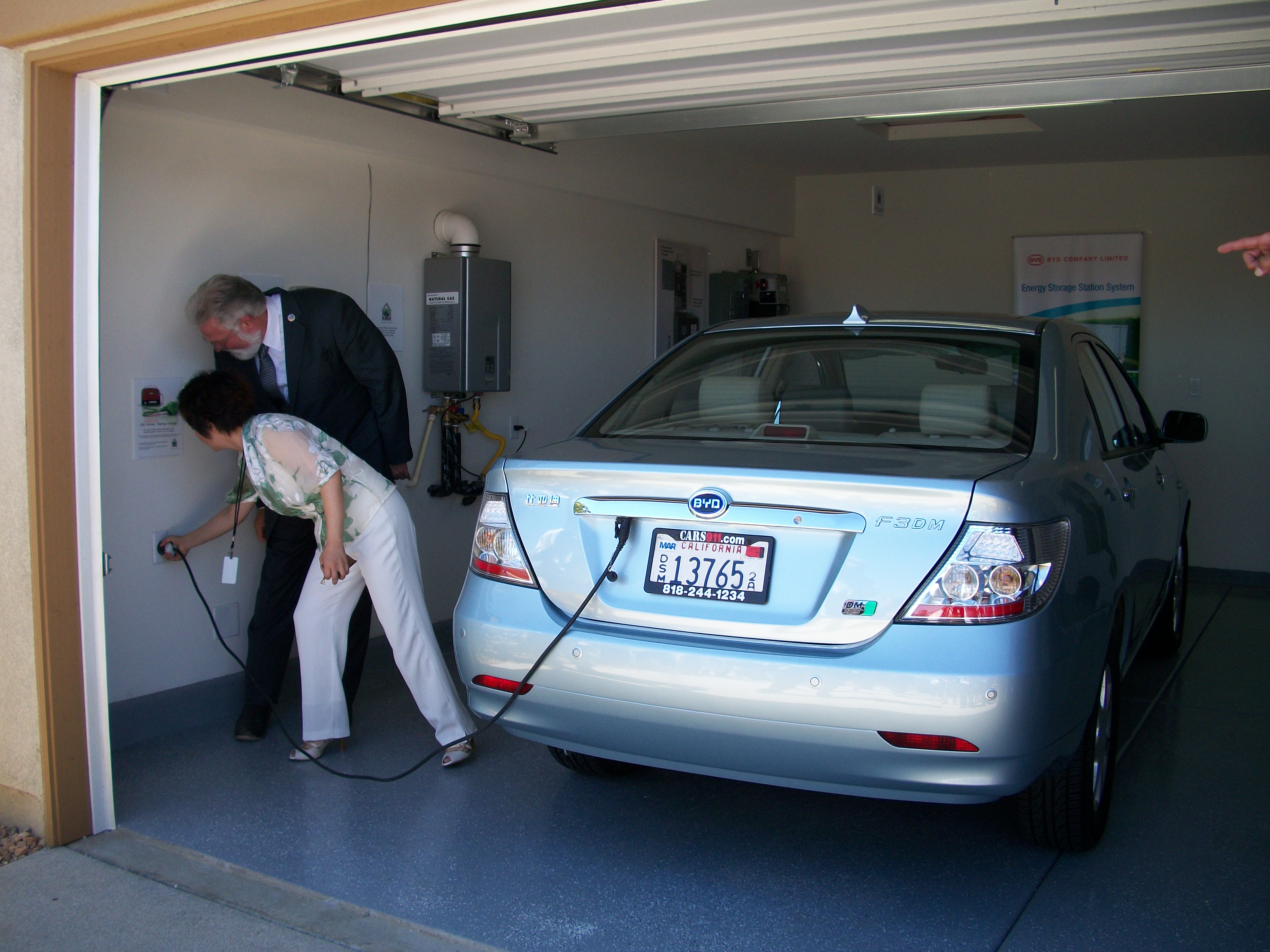
Plugged in in Lancaster
Check this out…
General Motors Europe president Nick Reilly recently fretted that Asian suppliers would dominate the market when it comes to supplying electric vehicles. Perhaps, but it won’t happen without help from foreign technology.
A few weeks ago I met Andy Burke, a professor at the University of California Davis, at the Electric Vehicle Consumer Adoption Summit in San Francisco. Burke is connected to the UC Davis Institute of Transportation Studies, and specializes in hybrid vehicle technology.
He visits China often, and the Institute of Transportation collaborates with Chinese universities. http://chinacenter.its.ucdavis.edu/activity.html
Burke says he is amazed at the poor quality of some Chinese EV batteries. “They’re useless for hybrid electric vehicles,” says Burke. Chinese batteries tend to be high resistance batteries with relatively low power, he says. They are designed for the kind of electric vehicles China has a lot of—low performance, neighborhood EV types.
Well, despite all the talk about pure electric vehicles, just about everyone thinks that hybrid vehicles will account for the bulk of electric vehicle sales, at least in the medium term.
So, Chinese suppliers will miss the boat, right?
No. Because they are acquiring the technology to build better batteries for all types of electric vehicles, hybrid and otherwise, Foreign companies are giving it to China through their collaboration with Chinese companies.
Take Maxwell Technologies Inc. of San Diego. Maxwell makes ultra-capacitors, which allow a battery to charge and recharge very quickly without wearing out. In 2007, it began cooperating with Tianjin Lishen Battery Joint Stock Co. Ltd. to develop applications combining Maxwell’s ultra-capacitors and Lishen’s lithium ion batteries for hybrid vehicles. (This is the same Tianjin Lishen that recently formed a joint venture with Coda Automotive to manufacture lithium-ion batteries). Lishen also assembles ultra-capacitor products for Maxwell.
Lishen produces lithium ion batteries for consumer electronics for Apple and Motorola. But the state-owned company is “very focused on automotive now,” says Mike Sund, vice president of investor relations and communications at Maxwell.
Maxwell has proprietary electrode technology. Maxwell president David Schramm assured investors in an earnings call in February of 2010 that fabrication of Maxwell’s proprietary electrode material “remains under lock-and-key inside Maxwell and won’t be going offshore.” Precautions aside, however, as Maxwell deepens its cooperation with Lishen some tech transfer is bound to occur, admits Maxwell.
Producing in China does save money, and the supply chain in China for batteries of all kinds is very well developed. But it also comes with the hidden cost of creating your future competitors.
So Nick Reilly’s fears aren’t unfounded. Asian suppliers may dominate some sectors of the EV supply chain. But foreign firms will be complicit in that process.
 Alysha Webb's ChinaEV Blog
