GM sees car sharing in China as way to intro EVs but there are potholes in the road
Car sharing seems to work in the U.S. and Europe, and a growing number of consumers want to give it a try. Why else would global car-rental giant Avis Budget Group Inc. have recently paid $500 million to acquired Zipcar Inc., a Cambridge, Mass.-based car sharing company that has trouble making a profit? http://online.wsj.com/article/SB10001424127887324374004578217121433322386.html
But will the model work in China? There are many barriers, both structural and, in my mind, cultural.
The business, whereby a consumer becomes a member of a company and then can use one of that company’s vehicles short-term in any city where it has a presence, is growing. Zipcar www.zipcar.com says the car-sharing market could reach US $10 billion North America, Europe, and Asia. For automakers, it is also a good way to introduce consumers –and many of the users of Zipcar’s services are a targeted young demographic – to new technologies such as pure electric vehicles. American Honda has Fit EVs (a pure EV) as well as the Insight hybrid in the Zipcar fleet. http://ir.zipcar.com/releasedetail.cfm?ReleaseID=663235 General Motors has Volt extended range electric vehicles in the Zipcar stable. http://chicago.cbslocal.com/2012/03/22/zipcar-to-add-5-chevy-volts-to-its-fleet-3-electric-cars-for-i-go/
Now, General Motors is hoping car-sharing can turn Chinese consumers on to electric vehicles. But its approach in China is a bit more circuitous since there is not a Chinese version of Zipcar. In China, however, GM is battling not just consumer reluctance to use an EVs but also bureaucratic infighting that is preventing the build out of a charging infrastructure. How much to charge for the electricity is also an issue. If the car-sharing program gets off the ground, I would add to that list a Chinese consumer indifference to taking good care of something that is only borrowed, not owned.
In October of 2011, General Motors announced it had signed a Memorandum of Understanding with the Sino-Singapore Tianjin Eco-City Investment and Development Co. to integrate its EN-V personal mobility pure electric vehicles into the Eco-City. http://media.gm.com/media/cn/en/gm/news.detail.html/content/Pages/news/cn/en/2012/Jun/0627_Signs_MOU.html The Tianjin Eco-City, located 40 kilometers from the center of the northeast China city of Tianjin, aims to build a sustainable community of 350,000 residents in a 30-square-kilometer area.
Though it has not been widely discussed, a car sharing program is part of GM’s plan to introduce pure EVs to the inhabitants of the Eco-City. It’s part of a wider scheme to convince Chinese to buy GM’s just-launched Sail SPRINGO EV, http://media.gm.com/media/cn/en/gm/news.detail.html/content/Pages/news/cn/en/2012/Jun/0627_Signs_MOU.html but the SPRINGO (GM always caps that in its press releases so I am doing the same. Perhaps it wants us to shout the name when we read it….) isn’t the car GM is using in the Eco-City experiment. Rather, it will use a fleet of EN-Vs, the pod-like pure electric vehicle first introduced at the Shanghai World Expo in 2011. GM showed an artist’s rendition of the EN-V 2.0, a more advanced version, at the Beijing auto show in 2012.

The automaker aims to have a small demo fleet of EN-Vs in operation in the Eco-City within a few years, according to people familiar with the project. If it can overcome some bureaucratic barriers, that is. GM envisions charging station installation in apartment parking areas and commercial buildings for workplace charging. But currently there is no method to get permission to install charging stations. That might sound like a small thing. But it isn’t in China.
China’s various government ministries have also not agreed on what charging plug standard to use, though China has announced its own China GB standard. The China GB standard is similar to the European IEC standard with some important differences that make it less safe. The State Grid, www.sgcc.com.cn one of China’s two state-owned electric utilities, and SinoPec, http://english.sinopec.com/ a state-owned oil company that also owns gas stations, are arguing over how to resolve that issue.
Another unresolved issue is who will be allowed to sell the electricity used for charging, and at what price. The electricity price to residential customers is much cheaper than to industrial customers, but the State Grid wants to charge more than the industrial price to its customer for EV charging.
There are already nascent car-sharing programs in China using electric vehicles. The government of the east China city of Hangzhou offers car sharing through its EVnet company. Car leasing company Shanghai Dazhong has said it will offer car sharing, though it hasn’t said it will include electric vehicles. And Shanghai’s Jiading District, home to Shanghai International Auto City, is also putting together a car-sharing program using local automaker SAIC’s pure electric Roewe E50 , sources tell me. A source at an international car rental company says his company is also talking to Tianjin and Jiading about car-sharing.
What I wonder is how Chinese consumers will treat these borrowed cars. Okay, I don’t wonder. I fear. Perhaps the assumedly younger consumers who will want to become members in an electric car-sharing program will return the cars in pristine shape, both inside and out. But I doubt it. I envision smoke-filled vehicles with much trash in them and cigarette ash strewn throughout. I hope I’m wrong.
GM preps Wuling to be China’s cheap exec van production base; export also part of plan
I was in Shanghai Dec 6-17 and as usual met with many friends and gossiped a lot. One topic of discussion was GM’s plans for SGMW, its joint venture with SAIC and Wuling Auto. www.sgmw.com.cn The JV produces minivans under the Wuling badge and passenger cars under the Baojun badge. It exports to more than 40 countries, and many of the exports are badged Chevrolet.
I have always been interested in Wuling, but my interest increased a few months ago when Ray Bierzynski, GM China’s executive director of electrification strategy, was transferred to Liuzhou to become an EVP at SGMW. http://media.gm.com/media/us/en/gm/news.detail.html/content/Pages/news/cn/en/2012/Oct/1012_Bierzynski.html What was GM up to? At the time I speculated that GM wanted to boost SGMW’s importance as an export base. I still believe that. I think GM sees SGMW as its growth engine going forward in China, as well. China’s inland cities are where the growth opportunities are now for automakers. SGMW produces a model that is perfect for aspiring middle-class families in China’s interior – the Hong Guang minivan. Nah, say not that it is a minivan. When SGMW launched it in September of 2010, it was labeled “China’s first compact business vehicle.” Said Kevin Wale, then president of GM China Group (since retired): “The Hong Guang addresses the growing need for a small, economical vehicle for business use and family travel.” https://media.gm.com/media/us/en/gm/news.detail.html/content/Pages/news/us/en/2010/Sept/0914_wuling.html Translation: It is the poor man’s GL8! Okay, not poor man’s. The less wealthy man’s GL8. The GL8 is GM’s wildly successful MPV. The GL8 First Land model – the lower end – starts at 228,000 RMB (US $36,580). GM China sold 58,566 GL8s in China in Jan-Oct according to LMC Automotive.
The Hong Guang has seven models priced between 44,800 RMB and 60,800 RMB. Quite a price difference from the GL8, but income levels are lower in China’s inland areas. And not bad for a rear-wheel drive seven-seater with power windows and locks, airco, radio with an MP3 port, and a CD player, among other amenities. And here’s a news flash–remember you read it here first. SGMW will produce a front-wheel drive version of the Hong Guang. Currently it is only offered in RWD. And, they may start badging it Baojun rather than Wuling. Makes sense. The Wuling name stands for workhorse small commercial vans. SGMW is marketing the Hong Guang as a sophisticated business car that can double as a family van on weekends.
SGMW sold 258,678 Hong Guangs in January through October of 2012, according to LMC Automotive. No comparison figure was available. Wuling’s aging Sunshine minivan is still SGMW’s best-selling model at 442,593 units sold in January through October of 2012. But that was down 27% on-year. The king is dead, long live the new king!
SGMW isn’t giving up on the Sunshine. It will continue to sell well — albeit at a declining rate — for many years. So SGMW is building a new plant in the inland China city of Chongqing. Sources tell me Sunshine production will be transferred there. http://www.reuters.com/article/2012/11/28/us-gm-china-idUSBRE8AR0LV20121128 The plant, which will begin producing minivans in 2015, will have a 400,000 unit capacity and also produce 400,000 engines annually. A side note: Chongqing is home to Changan, another large minivan producer. A source tells me that the Chongqing government asked SGMW, “Why are you doing this?” when the new plant was announced. SGMW said it considered Chongqing and Chengdu as locations, but decided Chongqing was superior. I’ll bet it is. It has a ready supplier base, courtesy of Changan and joint venture partner Ford as well as good logistics, courtesy of Ford and Changan. Hey, nobody said business was friendly.
Meanwhile, back in Liuzhou, where SGMW is located, capacity has been cleared to produce lots of Hong Guang compact business vehicles. Indeed, space being used to produce the Baojun passenger cars is available now, Also in November, SGMW opened a new 400,000-unit plant in Liuzhou to produce passenger cars. http://media.gm.com/content/media/cn/en/gm/news.detail.html/content/Pages/news/cn/en/2012/Nov/1118_Wuling.html
As for the Hong Guang, SGMW is already exporting the vehicle to multiple countries, including India, where it is assembled from a kit and badged a Chevrolet. . But trouble is brewing in India between GM and SAIC. In October SAIC divested itself of shares in the GM-SAIC joint venture in India, reducing its stake to 7% from 50%. The China Daily said SAIC did so after the JV failed to make a profit but sources tell me SAIC wants to market its own brand cars in India. http://www.chinadaily.com.cn/cndy/2012-10/29/content_15852533.htm

Ray Bierzynski left his position as executive director of electrification strategy at GM China to become EVP of its joint venture with SAIC and Wuling. Will part of his new job be chief diplomat?
Which brings me back to speculation about why Bierzynski was moved to SGMW. He has years of experience working with SAIC – he was head of PATAC, GM and SAIC’s 50-50 research and engineering venture, after all. Seems his diplomatic skills may be needed to preserve the partnership as SGMW boosts it exports. He may need a strong liver, though. Those talks may involve some long nights over bai jiu.
General Motors www.gm.com plans to export lots of vehicles from China, and some of them will be badged Chevrolet. But the joint venture that produces those vehicles won’t be Shanghai GM, GM’s flagship venture in Shanghai with SAIC. The vehicles will be produced by SAIC-GM-Wuling Automobile Co, GM’s venture with Wuling Motors and SAIC www.saicgroup.com . A lot of exciting stuff is happening at SGMW these days, and the JV is worth keeping a close eye on.
Few casual observers of the Chinese auto market realize how crucial SGMW www.wulingmotors.com has been to GM’s sales growth in China. Of the 2.33 million vehicles GM sold in China in the first ten months of this year, 51% were produced at SGMW. http://media.gm.com/media/cn/en/gm/news.detail.html/content/Pages/news/cn/en/2012/Nov/1105_Oct_Sales.html A lot of those vehicles didn’t have a GM-brand badge on them, though the venture is producing Chevrolet models. They were badged Wuling and Baojun.
I have long kept my eye on SGMW. But I realized just how much importance GM was placing on this venture in October when GM announced that Ray Bierzynski, one of its most able and China-savvy executives, had been appointed executive vice president of the venture. http://media.gm.com/media/cn/en/gm/news.detail.html/content/Pages/news/cn/en/2012/Oct/1012_Bierzynski.html I’ve known Ray since the mid-2000’s when he assumed the leading role at PATAC, www.patac.com.cn the GM-SAIC design and engineering joint venture in Shanghai. More recently he served as executive director of electrification strategy for GM China. Why would a man with Ray’s background be sent to Wuling, I mulled? Now I think it is because SGMW is set to become a big export base for GM in China and GM wanted to send a very capable guy to oversee that expansion.
Among other recent SGMW news: In August, GM announced the Lechi mini car built on the Daewoo Matiz platform (can you say Chevrolet Spark?) was being rebadged Baojun. http://media.gm.com/media/cn/en/gm/news.detail.html/content/Pages/news/cn/en/2012/Aug/0815_Lechi.html Baojun is SGMW’s own brand; it targets buyers in China’s second- and third-tier cities. The Lechi minicar is also “GM’s new global strategic product,” according to SGMW website. (It was previously being produced at SGMW but badged a Chevy).

The Chevy Spark became an SGMW model, re-badged Baojun and re-named the Lechi. It is a global model for GM, but initially aimed at China’s smaller cities.
In mid-November, SGMW opened a new 400,000 unit passenger car production base “initially” producing Baojun brand cars. http://media.gm.com/media/cn/en/gm/news.detail.html/content/Pages/news/cn/en/2012/Nov/1118_Wuling.html It is also building an engine plant with annual capacity of 400,000 due to begin operating in September 2013. Adds the press release announcing the new plant: “SGMW also plans to enhance its R&D capability …. Integrating engineering design and testing resources, and establishing a systematic capability for product development and technical research. The aim is to fully support the overall development strategy of SGMW by helping it achieve 2 million annual vehicle sales goal (and) grow its export business.”
SGMW is counting on exports – badged Wuling and Chevy and Baojun — to help reach that 2 million unit sales goal. GM China spokesperson Dayna Hart wrote in a November 20 email to me that in 2012 SGMW has exported 12,773 units year-to-date. The list of countries SGMW exports to – and its exports in general– is growing. SGMW models badged Chevrolet are exported to 15 markets through GM’s Chevrolet distribution channels. “Our export models fill a gap in the existing Chevrolet portfolio in other market,” she wrote in the email. Yeah, a gap for inexpensive minivans and trucks! Those Chevy-badged exports are Wuling products.
As for Wuling-badged models, they are exported to some 40 countries overall, says the SGMW website.
The exported models are segment leaders in Chile, Ecuador, and Colombia, said Hart, and are in the top six in their segment in other markets such as Egypt. As you may have figured out, the SGMW-produced cars are mainly exported to developing countries. But the U.S., Japan, Germany, and the U.K. are also among the 19 country sites on the SGMW site. So at least a few of the exports are also going to developed countries, it seems. SGMW has even exported at least several hundred minitrucks or vans to the U.S.
Most of those exports were minivans and minitrucks. But you can bet GM aims to export growing numbers of mini cars and even compact sedans such as the Baojun 630, a model based on the same platform as the Buick Excelle platform. I mean exports to all destinations, not just the U.S…..
A bit about Liuzhou Wuling and the SGMW joint venture. Launched in November of 2002, SGMW was formed with investment from GM, SAIC, and Liuzhou Wuling Motors Co. Ltd. Wuling was as China’s largest maker (and seller) of minivans – known in China as mianbao che, or “bread box cars.” At the time it was formed GM had only a 34% stake in the joint venture. SAIC had 50.1% and Wuling 15.9%. In late 2010, however, GM boosted its share to 44%, leaving Wuling with 5.9%. SGMW produces China’s best-selling minivan, the Wuling Sunshine. In 2011, it sold 731,749 Sunshine minivans down3%. In the first ten months of 2012, SGMW sold 442,593 Sunshine units, down 27%. Minivan sales were boosted artificially in 2011 by a government rebate program.
Liuzhou Wuling was China’s largest minivan manufacturer before the joint venture formation, but it transferred most of that business to the joint venture. The state-owned Chinese company seems to have merged in 2007 with Dragon Hill Holdings Ltd. and transformed into Liuzhou Wuling Automobile Industry Co. Ltd. www.wulingauto.com.cn The new entity produces electric vans, trucks, and pickups (some of which are exported to the U.S. and sold through EcoCentre dealerships. www.ecocentre.us See my earlier blog on that topic). It also produces components including brakes, axles, pressing and jointing parts, instrument panels, seats, and door winder assemblies. SGMW is among its customers. And, it produces gasoline engines.
Given that Ray Bierzynski just came off an assignment as director of electrification strategy for GM China, I’ll be interested to see if SGMW now starts producing electric vehicles, too. But I’ll be more interested to keep following SGMW’s development overall. I predict big things for the venture in the not-too-distant future.

Ray Bierzynski left his position as executive director of electrification strategy at GM China to become EVP of its joint venture with SAIC and Wuling.
I visited Liuzhou Wuling in the south China province of Guangxi in 2001 before it had officially become GM’s partner. At the time I interviewed Wuling president Shen Yang and toured the Wuling production line. Shen at that time wore fairly tacky Chinese suits, had bad teeth, and wore transparent Chinese socks. The plant was already transforming. Though the building exterior was old and the machinery inside somewhat out-of-date, the manufacturing process was already changing over to GM’s system. Red lines delineated where visitors could walk, signs noted how many injury-free days the plant had recorded. I’m sure there were many other changes I couldn’t see.
I ran into Shen Yang, who is now president of the JV, at the Shanghai Auto Show five or six years ago. He was wearing a very nice suit; I’m guessing his socks weren’t see-through and his teeth were perfect. In Liuzhou, Wuling has built a new plant and is adding another. I’ll have to visit again to see the changes for myself.
EDI looks to China for buyers for its PHEV tech. Now China needs to push its EV policy.
Efficient Drivetrains Inc. www.efficientdrivetrains.com is charging ahead in China. Now if China’s central government can only make those pesky local governments start ordering electric vehicles, things will really look good for the alternative fuel vehicle company.
EDI, as the company is usually known, is based in the northern California town of Dixon, near the university town of Davis. Though it has been around for a while – it was founded in 2006 – EDI is still small and hungry just like a start-up. Only recently, in the wake of finishing development of a new PHEV parallel/series drivetrain for delivery trucks, EDI has begun to grow. Now, it is also about to seek more funding. I spoke with CEO Joerg Ferchau to learn what’s new at EDI. (Full disclosure: I do some business development work for EDI and also write a short story each month for its company newsletter. The newsletter is free – subscribe! http://www.efficientdrivetrains.com/newsletter.html And not just to read my stories. It also has company updates and insights from Ferchau and EDI founder Andy Frank, considered the father of the PHEV.)
But I digress. As I mentioned, EDI just finished work on a new PHEV drivetrain. Usually, EV drivetrains are either parallel – switching back and forth between electric and gas propulsion—or series, using the electric drivetrain then switching to the gasoline drivetrain, but not back to the electric again. (I hope I got that right. I am not an engineer….)
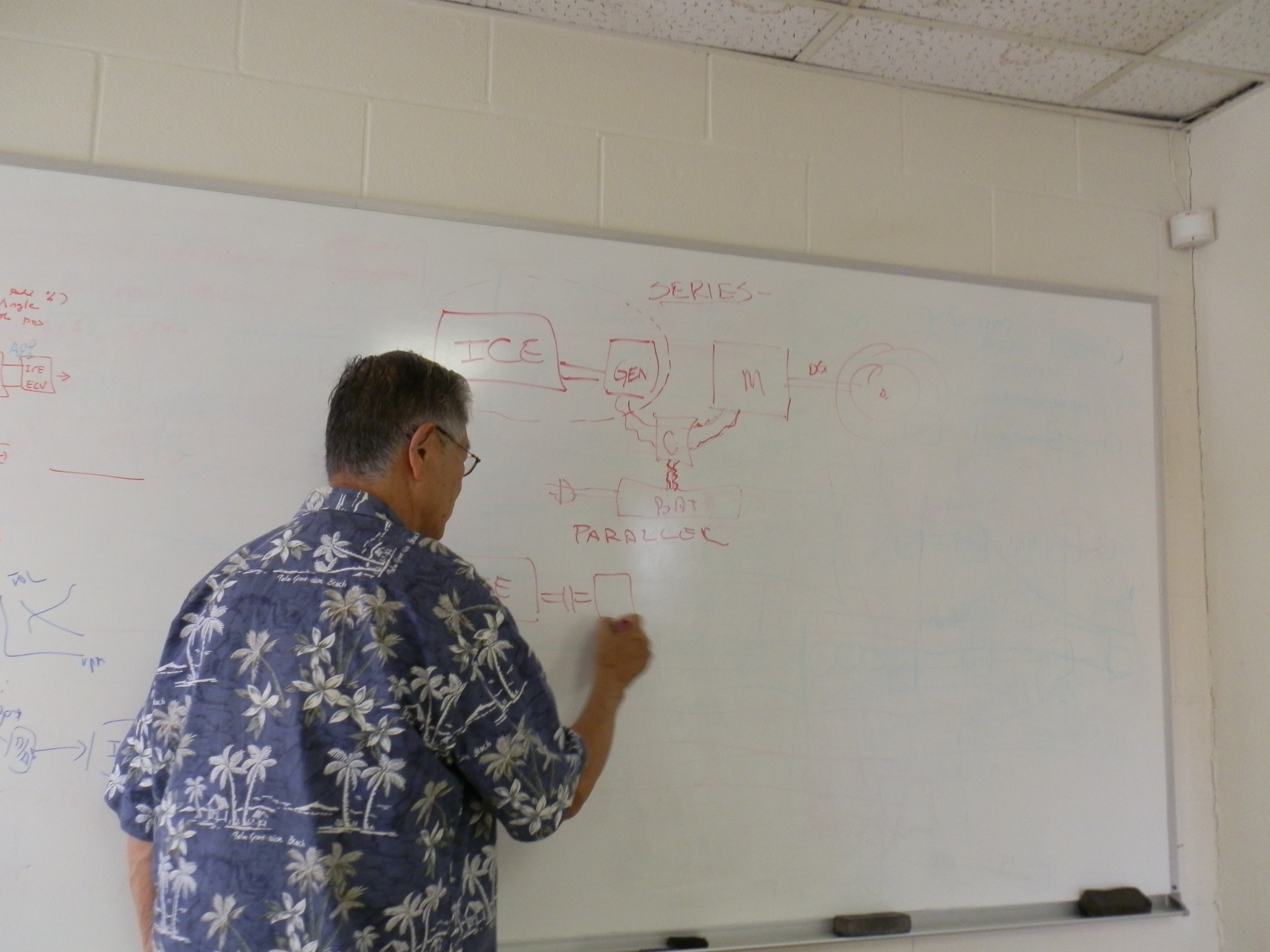
Prof. Andy Frank, co-founder of EDI, attempts to explain the difference between series and parallel hybrid drivetrains to me at EDI world headquarters in Dixon, CA.
It usually costs less to develop a series hybrid than a parallel hybrid, said Ferchau, because the parallel control system is more complex. But, a parallel system costs less to build. Ferchau claims EDI’s new drivetrain is less expensive than many series hybrids because EDI already had a number of patented designs that it could leverage in this new design. It has fewer components and smaller motors than a pure series, he said. “Also we are willing to go minimum on engineering costs because product sales are what we are after,” said Ferchau.
EDI just finished a demo truck built on a GM platform using the new PHEV system. That truck is going to China. While EDI has a handful of customers here in the U.S., including Siemens, China is where it sees real growth potential. Now, China has been talking about becoming a big market for electric vehicles since 2009 and not much has happened. But even less has happened here in the U.S., points out Ferchau. “For EDI, China is high priority,” he says.
To be sure, China’s central government hasn’t given up on the technology. In July, it issued the latest new energy vehicle policy. http://www.gov.cn/zwgk/2012-07/09/content_2179032.htm http://www.greencarcongress.com/2012/07/china-20120709.html It placed more emphasis on PHEVs than in the past, and stated fairly strongly that China’s municipal governments should get started on electrifying their fleets. That is good news for EDI. It is focusing on fleet vehicles – especially light and medium-duty trucks such as the small delivery vans that zip through urban alleys. Besides trucks, EDI can design or work with partners to design drivetrains for SUVs, sedans, and even busses, says Ferchau. “We can do PHEV, HEV, or EV but are most interested in PHEV opportunities,” he says.
EDI already has a Chinese customer, Ankai Bus www.ankai.com , a manufacturer in central China’s Anhui province. The two have been working together since around 2008, says Ferchau. They will launch a PHEV bus in the first quarter of next year, he says. http://english.ankai.com/news/company-news/2012110601.html Ankai is already promoting the PHEV bus with EDI technology inside on its website. And it seems the central government has already started more aggressively pushing for municipal fleet electrification. Ankai reports on its website: “In September 2012, the Ministry of Finance … issued a notice on promoting the hybrid bus demonstration cities to change from 25 cities to all over China. And the promotion goal amount of the buses are (sic) 3,000 – 5,000 units. The highest subsidy of a single bus can reach RMB 420,000 (US $67,300).”
Ferchau says EDI should be announcing several other projects in China in the next few months.
That’s one reason it is seeking new funding. Up until now, EDI has gotten funding from a handful of sources: Seed investors; a small low-interest loan from the city of Dixon; a venture capital group partly supported by the government of Wuxi, China; and revenue from customers. But to meet its anticipated growth needs in the U.S. and China over the next year, EDI will open up in the first quarter of 2013 for US $2-3 million in investment, providing Preferred Series A shares in exchange, said Ferchau.
EDI is already ramping up its China presence. In June, it registered a wholly-owned company in Wuxi, a small city east of Shanghai. http://www.efficientdrivetrains.com/news.html#global The company, New Energy Automotive Technology, or NEAT, is recruiting engineers now. It is talking to two or three groups in China about forming joint ventures, says Ferchau. “That is a big part of our strategies, forming JVs,” he said.
What about your intellectual property? I asked Ferchau. How will you protect it? Much of EDI’s intellectual property is contained in the software and controllers it provides, he said. That kind of IP can be hard to copy. Still, “you always have to be worried about intellectual property,” said Ferchau. “I have lost three other products with other companies.” But IP protection is an issue anywhere one does business, he says philosophically. EDI hopes its joint venture partners and investors will show a vested interest in protecting the ventures intellectual property.
In any case, Ferchau is (not unexpectedly) optimistic about the future for companies such as EDI. There are fewer companies competing for what he figures will be a surge in orders from companies and from the U.S. and Chinese governments and militaries, all of whom are committed to greater electrification of their fleets. He predicts the market will really start heating up in 2015.
EDI has not grown too quickly, as did many companies that went under, says Ferchau. It still only has several dozen engineers. “The last year and a half we have had our heads down to get the vehicle and drivetrain down,” says Ferchau. But EDI has a demo vehicle now so it can more aggressively court new customers. The new funding – or deals it now has in the pipeline – will allow EDI to scale up quickly if it needs to, he says. I guess we will know if Ferchau is right in a year or so ….
U.S. dealers to sell low speed EVs made at China’s Liuzhou Wuling. Biz model may work.
Liuzhou Wuling Motors Co. http://www.wulingauto.com.cn/en/index.aspx is breaking into the U.S. market with low-speed electric vehicles! And they are being sold through regular car dealerships, by established car dealers. I visited the first EcoCentre dealership, located in Irvine, CA, in October. I came away thinking it is a formula that might succeed. But it will still be a tough slog to make it work.
The Wuling name is familiar to many of you because of the SAIC-General Motors-Wuling joint venture www.sgmw.com.cn that produces minivans and a mini car under the SGMW badge and now cars under the Baojun name. Liuzhou Wuling also exists as a separate company; that is who Bill Fisher, the man who is spearheading the Wuling EV venture, deals with.
A bit of background on both Wuling and Fisher. I was the first foreign journalist to visit Wuling in 2001, when the SAIC/GM/Wuling venture was just being formed. I interviewed Shen Yang, then president of Liuzhou Wuling. I believe he is head of the group now. Even then, the GM influence was apparent on the plant floor. The production line was in an old building with a railway track outside so rail cars full of coal could bring power to the plant. But inside the plant was clean and organized, with red lines showing where non-production personnel and visitors should walk and a sign keeping track of days without a worker injury. Those old buildings and production lines have been replaced by new, fully modernized buildings and equipment now, says Fisher.
As for Bill Fisher, I met him in Shanghai about eight years ago. Fisher is CEO of AmAsia International, the Florida-based importer of the electric vehicles. I admit to some skepticism when I first met him about Fisher’s dream of importing Chinese vehicles. And he has had some dead-end ventures. But Bill stuck with it, which makes me respect him. In China, he works with Frank Chou, a retired GM executive and generally great guy.
Fisher’s idea this time is to import low-speed electric fleet vehicles produced at Wuling and sell those vehicles badged as the “Eco” brand through a chain of EcoCentre dealerships. The Eco brand products currently are the EcoVan, the EcoTruck, and the EcoE mini-car, three pure electric vehicles produced in China by Liuzhou Wuling. They range in price from $9,995 for the EcoE to $17,995 for the EcoVan. Target customers are municipalities, universities, medical schools and the like, all of which have large fleets of low-speed vehicles.

A line of Wuling-produced EcoTrucks awaits buyers at the Irvine EcoCentre.
If you are from China or have spent time there, the EcoVan and the EcoTruck would look familiar. The EcoVan is based on the Wuling Sunshine van, only it has a 96-Volt battery instead of a gasoline-fueled drivetrain. The EcoTruck is based on Wuling’s D150 truck, says Fisher. The EcoE is a mini car that Fisher says he worked with Wuling to develop. Fisher says he has the western hemisphere distribution rights for these Wuling vehicles.
In turn, Fisher has appointed Ramon Alvarez as his representative in the U.S. Alvarez has trademarked the Eco brand name and is finding dealers to open EcoCentre dealerships http://www.ecocentre.us/EcoCentre/index.php to sell the Eco brand. Alvarez has been in the car business in California for 30 years. He owns Lincoln http://www.alvarezlm.com/ and Jaguar dealerships in Riverside, he is president of the state’s New Motor Vehicle Board, and he helped found an alliance of minority dealers. So he had some cred in the dealership world.
The vehicles I saw in Irvine, California were not the first Wuling vehicles Fisher has brought to the U.S. He started importing the vehicles some five years ago, and worked with several other distributors before starting the EcoCentre concept. Why didn’t he start out selling Wuling vehicles through established dealerships, I asked Fisher? “At the beginning, I don’t think our vehicles were prepared,” he said. “The drivetrains weren’t sophisticated enough to merit being sold in a dealership.” But Fisher worked with Wuling to make improvements such as replacing the 72 volt battery with a 96 volt battery, he says. Then he started lining up auto dealers here in the U.S. to open EcoCentres.
Alvarez sees gold in the inexpensive Wuling vehicles. “If you sell 30 of my cars a month you are going to make $100,000” a year, he said. That optimistic estimate relies on dealers tapping into their local communities, finding universities, municipalities, and others to buy the inexpensive EVs. “Not everybody can buy a Volt but a lot of people can buy a $9,995 car,” said Alvarez.
Denice Fladeboe Mock, president of the Fladeboe Automotive Group in Irvine, Calif., is the dealer principle at the first EcoCentre store, in Irvine. “I have always been involved in green things,” said Mock. “Ramon approached me and I liked his concept.” Mock is also selling another China-made product in her store –she is also a Coda www.codaautomotive.com dealer and the body of the Coda sedan is produced at Hafei Motors in China.

Ramon Alvarez and Denise Fladeboe Mock with an EcoE.
Mock has no worries about selling the Wuling electric vehicles. “Ramon has really done his research,” said Mock. She figures her location is a “perfect storm” for reaching fleet customers. The University of California Irvine is nearby, as are a medical center and numerous corporate campuses. But Mock doesn’t see sales immediately skyrocketing. She will do a lot of grassroots marketing, said Mock. “I don’t think the EV market will grow really fast. My job is to educate the public.”
Alvarez will open EcoCentre dealerships in some half dozen Southern California cities in the next year. A Glendale dealer just finished his training and will open in early December, says Alvarez. A Riverside dealer just signed on, and Alvarez says he is in discussion with dealers in several other cities. This is just the beginning of his master plan. “We plan to have conservatively 175 to 200 (dealerships) in a five year plan,” said Alvarez. And he isn’t stopping with small low-speed vehicles. Alvarez asked me if I knew of any Chinese companies making good quality medium-speed electric vehicles that he could sell in his stores.
I have some faith in Wuling’s quality. It has worked with GM for years, after alll. But I think Alvarez will have a harder time finding a high-quality medium-speed product in China. In any case, first he needs to concentrate finding dealers to sell the three models he has. I’ll check back with him — and the dealers — in a few months and report on the progress!
ALTe China EV deal shows the risk of working with Chinese investors; reward is uncertain
The Chinese government’s recently-announced plan to promote the growth of the EV sector http://www.greencarcongress.com/2012/07/china-20120709.html in China has created a risky environment for foreign companies with EV technology. It has also created a lot of opportunity for such companies. The saga of U.S. PHEV-drivetrain manufacturer ALTe www.altellc.com illustrates both the risk and the opportunity. It should be a cautionary tale for foreign companies that are looking to China to sell or license their technology.
A few days ago I talked with John Thomas, ALTe co-founder, president, and CEO about its recently announced agreement to form a $200 million joint venture in China. http://www.altellc.com/?p=1054 Turns out ALTe had already been stiffed by several Chinese investors by the time it signed the announced agreement. Thomas is hoping the third time will be the charm for his company. He related the fascinating saga of how ALTe ended up partnering with a Dubai investor and unnamed Chinese investors to convert medium-duty buses and trucks in PHEVs and hybrids.
On February 13, ALTe signed a letter of intent with a Chinese billionaire it met during Chinese vice president Xi Jinping’s February visit to the U.S., Thomas told me. http://www.reuters.com/article/2012/02/17/us-china-xi-economy-idUSTRE81G1JY20120217 But those funds failed to materialize by April 13, the agreed-to date, despite a trip to China to confront the investor. Another Chinese billionaire on Xi’s trip had also expressed an interest in working with ALTe, but he also failed to come through, said Thomas.
Fortunately, ALTe had already been approached by another investor, S. Moody Alavi, managing director of MESA Century New Energy Technology Inc. Alavi, who has bases in Dubai and Atlanta, was shifting his investment strategy from mostly commodities such as copper to include companies such as ALTe, said Thomas. So Alavi had a track record and he frequently worked with one of ALTe’s main investor, Simon Ahn of Atlanta, GA. When the second Chinese investment deal fell through, ALTe jumped on the Alavi offer. The parties didn’t bother with a letter of intent and the deal was sealed quickly, said Thomas.
The parties in the $200 million joint venture are ALTe, Alavi, and unnamed “private” Chinese investors. I put private in quotation marks because I’m pretty sure those Chinese investors are actually investment vehicles for the municipal or provincial government where each of the joint venture’s four plants will be built. One site has been announced, Shunyi, a Beijing suburb which also houses the Daimler-BAIC joint venture, among other companies. That site will be greenfield, said Thomas. Two other sites will use existing plants, he said. The fourth site has not been finalized.
A big part of ALTe’s contribution to the JV is engineering, “essentially a technology license,” said Thomas. Of the $200 million, $70 million will go to the U.S. to finish the production engineering. ALTe, based in Auburn Hills, Michigan, will nearly triple its staff to around 150 people, Thomas said. The JV will do some R&D in China, as well, he said. The aim is to make a powertrain that can pass U.S. certification so vehicles using it can be exported if and when the JV wants to do that, he said.
A bit of background on ALTe: ALTe retrofits vehicles that run on gas or diesel with plug-in electric drivetrains. I attended an ALTe press event in the Los Angeles suburbs in May 2012. See earlier ChinaEV blog on that event. (Thomas was not at that event and several of the executives who were there have since left ALTe.) Around the same time, I talked with Simon Ahn, http://www.ahnlawfirm.com/ the attorney in the Atlanta area who had invested nearly $20 million into ALTe. He said was impressed with the experienced management, and the “seven million lines of code” that make ALTe’s drivetrain work. “I saw ALTe technology as something really valuable,” Ahn told me. ALTe needed more funding, and Thomas told me ALTe was talking to Chinese investors. Meanwhile, it was getting funding from Chinese and Korean businessmen looking to obtain a U.S. visa, said Thomas. That requires an investment of at least $500,000 in a U.S. company, and job creation.
At that time (i.e. late May), ALTe’s target customers were fleet vehicles at U.S. companies such as PG&E http://www.pge.com/myhome/environment/pge/fleets/ and FritoLay. http://www.fritolay.com/about-us/press-release-20120810.html A Ford Econoline Doritos delivery van with an ALTe drivetrain was at the event, as was a retrofitted Ford F150 pickup. ALTe execs said the company was in discussions with Ford Motor Co. about becoming a Qualified Vehicle Modifer. But that process wasn’t very far along at all, I learned by asking around. Pacific Gas &Electric was (and is) testing some vehicles with an ALTe drivetrain in its fleet. In any case, the U.S. projects are on hold now, Thomas told me. “We are shifting our U.S. plans for range-extended PHEV here back one year to emphasize the China orders first,” he said. “The entity with funding gets priority.”
Well, I’d say the Alavi group is a pretty good bet but it remains to be seen if the Chinese investors will come through with funding. It also remains to be seen if China’s central government will wholeheartedly implement the EV sector plan. ALTe better hope it does – the U.S. company is betting its future on the belief that China’s government will make good on its plan to produce 500,000 BEVs and PHEVs by 2015. Thomas said he has met with some high-ranking Chinese officials and others and they are through with throwing money at poorly-executed plans. They are determined to get it right this time, he said. “They have given hundreds of millions of dollars to (state-owned enterprises) and they have failed,” said Thomas. “The powerbrokers and money providers have said we are done, we are going with outside stuff.” But will they actually start producing EVs in volume?
As for how ALTe will compete against the many other foreign companies vying for business in China, Thomas said ALTe is the only one making a complete powertrain system. Other foreign companies that have Chinese investors, such as Boston Power www.boston-power.com and Protean Electric www.proteanelectric.com , could potentially be ALTe suppliers. “We are passing an awful lot of our revenue to component suppliers,” he said.
The agreement says production must begin no later than 12 months from funding. The Chinese investors are pressuring ALTe to start as soon as possible, said Thomas. He is trying to explain to them why it takes time to get it right. “We are trying to balance speed with risk,” he said. Hope the Chinese funding sticks around long enough for the JV to turn out a world-class vehicle. I’m not sure it will.
China’s Wanxiang is helping U.S. by buying A123; U.S. needs more nuanced take on China investment
As expected, some U.S. congressmen have been raising a ruckus regarding Wanxiang’s proposed purchase of U.S. electric vehicle battery maker A123. http://articles.chicagotribune.com/2012-08-19/business/ct-biz-0819-a123-chinese–20120819_1_a123-million-investment-wanxiang The sale would risk giving China cutting-edge technology that would endanger America’s security, several congressmen have claimed. That is to be expected, especially in an election year. But it would be nice if many in the U.S. took a more nuanced look at China investment in U.S. companies and consider what we stand to gain.
I think the congressmen are more upset that a Chinese company will be taking over a company that has so far survived with an infusion of cash from the U.S. Department of Energy than with losing technology vital to U.S. security. A battery isn’t that vital. But it rubs those congressmen the wrong way that the U.S. is paying for China to have access to technology.
Well, it is sort of true that the DOE paid for China to have access to the technology, because A123 www.a123systems.com has received $175 million from the Department of Energy, with another $120 million yet to be drawn down. The company would have gone under months ago without the funding. But another way to look at it is that Wanxiang is saving A123’s ass, and the DOE investment. http://www.a123systems.com/12824480-de55-4032-9351-6f7955a5a36e/media-room-2012-press-releases-detail.htmhttp://www.doe.gov/articles/energy-secretary-steven-chu-attend-grand-opening-recovery-act-funded-a123-systems-battery And that the U.S. will now have access to technology that might have been otherwise lost if A123 went out of business. So maybe those congressmen be thanking Wanxiang instead of bashing it.
Consider the facts: In late August A123 received notice from the Nasdaq stock exchange that its stock would be de-listed because its price had gotten too low. The erstwhile battery maker has only a few months operating cash left, according to its executives. While A123 still has $120 million it has yet to draw down from the DOE loan that likely wouldn’t be enough to save the company. And if A123 is held up to the same standards as other companies that have been denied portions of their DOE loan, it won’t have access to that money anyway. If it goes under, A123’s 1,200 employees will lose their jobs.
And, Wanxiang www.wanxiang.com has already gained access to battery technology at another U.S. company that received a DOE loan, and likely helped save that company, too. EnerDel (the former Ener1) received US $118.5 million from the DOE in 2009. It and Wanxiang formed a joint venture in early 2011 that will be based at Wanxiang’s Hangzhou manufacturing site. http://www.prnewswire.com/news-releases/ener1-agrees-to-joint-venture-with-wanxiang-largest-auto-parts-supplier-to-the-chinese-car-industry-95048544.html An executive at Ener1 at the time told me that Ener1 was putting its “entire intellectual property portfolio” into the JV. Where were the upset congressmen then?
Ener1 filed for bankruptcy in late January of this year. It emerged from bankruptcy in late March as a privately-held company. EnerDel, as it is now known, says its joint venture with Wanxiang is going forward. Frankly, I’m not sure what Wanxiang will get out of the EnerDel JV that it won’t get from A123. But I’m sure that Wanxiang played a role in EnerDel’s survival. And in keeping that DOE investment from being a total bust.
I think that the A123 Wanxiang deal will go through, eventually. If Wanxiang were a European company, would congressmen be making all this noise, I doubt it. It is time for a more nuanced understanding of Chinese investment by our politicians. But I don’t expect that to happen any time soon.
China’s central government finally seems to be getting serious about its plans to grow China’s new energy vehicle segment – and by serious I mean putting immense amounts of pressure on Chinese automakers to get moving with EV production. And in line with the government’s push for using foreign technology where necessary, Beijing Automotive Industry Holding Co., or BAIC, http://investing.businessweek.com/research/stocks/private/snapshot.asp?privcapId=9284293 is trying out different battery manufacturers to see whose system works best.
I learned that BAIC is testing various systems in a recent conversation with Christina Lampe-Onnerud, founder and international chairman of Boston-Power Inc., www.boston-power.com a battery maker that moved its operations from Massachusetts to China after a $125 million investment from mainly Chinese entities.

Boston-Power produces lithium-ion battery cells, modules, and systems. In early August it announced that Beijing Electric Vehicle Co. (BEVC), the EV division of BAIC, would use Boston-Power batteries in an electric sedan. Turns out that Boston-Power is only one of the companies whose battery system BEVC is trying out. But apparently Boston-Power has fared well, so far. “I think they want to go as quickly as possible,” Lampe-Onnerud said of BEVC. “They have tried a few battery companies. We had the best performance. They have multiple sources. It is a scale up game.”
Rather than building EVs and seeing if there is market, BEVC is taking a pre-order approach, said Lampe-Onnerud. The Beijing Municipal government, which owns BAIC, orders electric vehicles and BEVC, produces. The first EV will be apparently be based on the C70, a sedan based on the Saab 9-5 chassis BAIC bought from Saab in 2009. Pre-ordered EVs will be available in the fourth quarter of this year, according to the press release. BAIC is using these government orders to try out the technology, and “performance is critical,” said Lampe-Onnerud. “We are fairly hopeful this market will develop into a real market. We are not the only supplier that needs to perform.”
In late 2011, BAIC also signed a letter of intent with Daimler to produce electric cars. http://europe.autonews.com/apps/pbcs.dll/article?AID=/20111108/ANE/111109880/1131 But now it seems BAIC is producing electric cars on its own through its EV subsidiary. And Daimler is designing EVs with BYD in the Denza brand joint venture. http://www.insideline.com/byd/daimler-and-byd-launch-denza-ev-brand-in-china.html I’m not sure how the Daimler deal fits into what BEVC is doing with Boston-Power. Perhaps it is moving forward on a number of fronts…. That wouldn’t be surprising, actually. Lampe-Onnerud says the pressure from the central government for local automakers to produce EVs is “absolutely on.” Boston-Power has had a hard time getting BEVC engineers to the U.S. for consultation because they are under such pressure to produce EVs, she said.
Lampe-Onnerud seems confident that Boston-Power’s technology will win over the government entities that drive cars using it. It doesn’t hurt that she has spent a lot of time in China getting to know the right people. Those kinds of relationships can make technology look better.
And she sounded really happy to see her years of efforts finally having results—or at least hopefully having results. “There is not one solution,” said Lampe-Onnerud. “There are quite a few that will work. We are trying hard to be a good supplier.” What is really comes down to is validation for all her hard work. “Seven years ago I had a really big idea,” she said. “Now we have multiple automotive customers as well as storage customers. It is a lot of work to grow something from nothing.”
I like Lampe-Onnerud and wish her luck. But it is too early to predict success if that is defined as volume production. The government has to stick to its resolve. And Boston-Power’s battery has to beat out competitors, some of whom may have better connections than Boston-Power. And it may help that Boston-Power chairman Sonny Wu, chairman of Boston-Power and managing director of Beijing- and Silicon Valley-based venture capital firm GSR Ventures, www.gsrventures.com seems to have good connections in China. At least he sure does in the east China city of Liyang, where Boston-Power is building a plant. Another GSR-invested company, Protean Electric, www.proteanelectric.com is also putting up a plant in Liyang.
Andy Frank talks China EV policy with me. I see wasted resources but a nice way to test new technologies.
I visited Efficient Drivetrains Inc. www.efficientdrivetrains.com last week for the first time. EDI, as it is usually known, produces a plug-in hybrid electric drivetrain and a continuously variable transmission. I met EDI founder Andy Frank, the father of the plug-in hybrid electric vehicle, a few years ago at a conference in San Francisco. I now know EDI CEO Joerg Ferchau and others at the small company, as well, and do some work for EDI. But this was my first time to visit. EDI is located in an office park in Dixon, CA, which is between Davis and San Francisco. Its current space is small—just a few offices and a larger garage-like area. But it recently rented more space in the business park, tripling its footprint there. The growth is business-driven, fortunately, and some of the business is in China. EDI opened an office in Wuxi, east of Shanghai, a few months ago. The China deal that is the farthest along is an agreement to produce a PHEV bus optimized for both city and high-speed highway travel. The Chinese company is bus producer Anhui Ankai Automobile Co. http://www.chinabuses.com/english/manufacturer/ankai.htm based in central China’s Anhui province. China is the initial target, but export is also possible Joerg told me. Ankai has already exported buses to the U.K. and the U.S.
Andy and Joerg visit China frequently. Both meet with a variety of company and government sorts and have great insights into the direction China’s EV policy is taking. Joerg was out of the office, but I had a great talk with Andy about the China market.

- Andy Frank, the father of the PHEV, loves his Volt. He has driven 21,000 miles and used 162 gallons of gas.

It seems to me that some resources are going to be wasted by the rather scattered approach China is taking to EV development. On the other hand, some good technologies may emerge as well. And Beijing is determined to develop China’s EV industry, it is clear.
Beijing i.e. China’s central government, recently released its new energy and fuel efficient vehicle development plan. http://www.greencarcongress.com/2012/07/china-20120709.html The plan calls for China to have 500,000 PHEVs and/or BEVs on the road by 2015. Since Chinese consumers aren’t going to be buying EVs in anything close to those numbers in the next few years, the government is brainstorming for ways that goal can be reached. One idea it is considering, said Frank, is short distance (duan tu) vehicles. I immediately said: “Oh, Shandong province will like that because it has so many low-speed EV producers.” No, said Andy, these are not low-speed EVs. They are short distance EVs. Of course the details of this potential strategy aren’t worked out. But as Andy explained it, these would meet regular vehicle standards but their batteries would not have much range. I guess they would be city vehicles. Range is the biggest issue with the current crop of batteries. Sure, one can find batteries that can go hundreds of kilometers on one charge. But those batteries cost a lot. Producing a BEV with a limited range would lower the cost and potentially make it more commercially viable.
I have said a number of times that municipal fleets are the way Beijing will meet its EV goals. http://www.chinadaily.com.cn/cndy/2012-07/30/content_15628934.htm That, in my estimation, is why so many municipal governments are now investing in companies with electric drivetrain and battery technology. An executive at a foreign automaker in China that works with the Chinese government on electrification concurred that fleets are the likely solution. He listed garbage trucks, street sweeping, postal and package delivery, and taxi and bus fleets as good candidates for electrification. Some of those types vehicles – postal and package delivery and street sweeping for example – are also good candidates for the short-distance EV strategy.
Once upon a time, like 2009, Beijing thought China could become the BEV capital of the world quickly. Now it is more interested in PHEVs in the near term. Beijing thinks BEV is the ultimate, “but the technology is not here,” Frank told me. “They feel the problem now, and the problem is to displace gas.” That’s for sure. A recent report by consultancy McKinsey says oil imports in China are likely to double by 2020, when it could amount to 16% of total world oil demand. Andy is a true-believer in PHEVs, so he naturally thinks that the PHEV is better than a pure electric vehicle in any case. As fpr the short-distance EVs, I’m not sure how the mix between BEVs and PHEVs might play out. After all, if range isn’t a big issue then BEVs might be more appealing. I’m sure Beijing doesn’t currently know what the mix will be either. It will make up that part of the policy up as it goes. Are short-distance EVs the way to go? I think it would be an enormous waste of resources. The minute the government hints that it is interested in a short-distance EV tons of companies will jump into that sea. I can imagine many, many of the low-speed vehicle makers in Shandong going down that road. Many already are, judging from what I saw at EVS25 in Shenzhen in 2010. The majority would make a product that would be poor quality and find little market. But some good technology might emerge. I guess that is a chance the central government wants to take.

- Professor Andy emerges as he tries to explain to me the difference between serial and parallel hybrid technology. EDI’s drivetrains have both.

Andy also helped me see that the pressure on local governments to electrify their fleets, while on the one hand a big waste of resources since economies of scale aren’t possible, is also a great way to test different technologies. Think about it. For a recent story for Automotive News, companies I talked to included PowerGenix www.powergenix.com , which has its own Nickel-Zinc battery chemistry and is working in part with a local government in central China’s Anhui province; Protean Electric www.proteanelectric.com , which has in-wheel electrification and is working with the local government in the east China city of Liyang; and battery maker Boston-Power www.boston-power.com , which has Chinese investment and is also building a plant in Liyang. (Both B-P and Protean work with venture capitalist Sonny Wu, managing director of GSR Ventures. www.gsrventures.com Clearly Sonny has some guanxi in Liyang).
What China is doing, said Andy, is getting local governments to test different technologies. “After four or five years, they can see what works best,” he said. Seems brilliant to me, though it will involve waste of local government resources. A problem with that strategy is that gathering good data will be tough if the central government doesn’t step in. Beijing had better get busy developing a data collection strategy.
Wanxiang Group www.wanxiang.com , China’s largest automotive supplier, has always seemed like a fairly forward-looking company to me. That impression was reinforced by a recent conversation with Bryan Hansel, CEO of Smith Electric Vehicles www.smithelectric.com in Kansas City, MO. In February of this year Wanxiang Electric Vehicles announced it would make a $25 million equity investment in Smith Electric. Wanxiang and Smith also signed a letter of intent for an up to $75 million investment in a joint venture to produce electric school buses and commercial vehicles. http://www.greencarcongress.com/2012/02/smith-20120217.html
Seems like a shuang ying (win-win) arrangement to me. Wanxiang gained access to proven EV technology that will be used to produce electric vehicles in two areas with promise for a big market. And Smith Electric got operating money and access to a potentially very large market (I shy away from saying “huge.” That remains to be seen.) Plus, it could make Smith Electric more attractive to non-Chinese investors in the longer term.
The agreement made me think back to my visit to Wanxiang Electric Vehicle Co. http://www.wanxiang.com/Wanxiang%20EV_general.pdf in April of 2011 and a conversation I had with Li Pingyi, executive director of Wanxiang EV. I asked it how it was to be in charge of such an important new division of Wanxiang, which started out as a producer of universal joints and other somewhat low-tech components back in 1969. “The pressure is huge,” said Li. Well, the cooperation with Smith should help relieve at least a bit of that pressure.
I asked Hansel, who co-founded Smith Electric, how the partnership with Wanxiang came about. About a year and a half ago, Pin Ni, president of Wanxiang North America, called me, said Hansel. “Electrification is viewed as critical by China and they have struggled with it,” said Hansel. “Wanxiang started EV years ago but wasn’t able to get it up and running.” Seems the relationship developed in the typical way—incrementally. A small equity investment was the first step—Hansel didn’t say what he meant by “small.” The two companies stayed in touch and got to know each other. In late 2011 Ni suggested they talk about a joint venture. Wanxiang could help Smith take cost out of its vehicles by providing components, said Ni. (I have written previously about Wanxiang’s joint venture with Ener1, through which it gained access to battery pack technology.)
Last October, Smith launched its electric school bus. http://smithelectric.com/wp-content/uploads/2011/10/SMITH-ELECTRIC-VEHICLES-ANNOUNCES-AVAILABILITY-OF-ALL-ELECTRIC-SCHOOL-BUS1.pdf There is a big push to improve the safety standards of school buses in China after some high-profile accidents in China. Plus the government is pushing electric vehicles. Double whammy! The pace of cooperation accelerated. In early February a Letter of Intent was signed. Wanxiang provides the physical factory and components, Smith bring the EV technology. The JV is “plus or minus 50/50,” said Hansel. Which means Wanxiang has a majority, he admitted. Now both are making cash investments to create the business, said Hansel. Smith will get royalty payments in the future, he said.
Wanxiang EV has a lot of floor space in its Hangzhou plant; the JV will initially be based in the Wanxiang EV warehouse, said Hansel. Smith will contribute its assembly and manufacturing processes. While the JV is not contractually obligated to use the batteries produced at Wanxiang EV, it probably will, said Hansel. Hansel sees China as critical to making the EV industry a reality. It is the largest truck market in the world, he said. “If I can deliver volume, it drives down our costs,” said Hansel. Just as important is China’s willingness to invest in the industry, he said. Said Hansel of Wanxiang Group chairman Lu Guanqiu: “He understands that new technology takes investment. If you are going to make a new industry a success you have to invest for the long term. Finding that kind of long term vision is critical for an industry such as ours.”
Naturally China’s potential as a market for Smith’s technology also made Wanxiang an especially appealing partner, said Hansel. “Wanxiang could have been in any major market and be interesting but the fact that they are in the largest market makes a lot of strategic sense for us,” he said. That helps compensate for the fact that China isn’t the easiest place to do business, said Hansel. “It does take exponentially longer to do a transaction,” he said. China also has its intellectual property challenges, said Hansel. That is why choosing a high quality partner – such as Wanxiang – is important, he said.
Production in China awaits final government approval of the joint venture. Approval seems likely—the recently released new energy vehicle policy encourages cooperation with foreign companies. “We can be up and running very quickly,” said Hansel. Here in the U.S., Smith Electric’s manufacturing footprint is decentralized, said Hansel. It has a plant in Kansas City and committed to one in New York, he said. It aims to follow a similar strategy in China, said Hansel.
Well, that may be easier said than done…. Still, Smith Electric may have hit a sweet spot in China, time-wise. Besides encouraging foreign cooperation, the new policy also encourages EV purchases by local governments. http://www.chinadaily.com.cn/cndy/2012-07/30/content_15628934.htm. “Consistent government backing is fundamental,” said Hansel. And that could help Smith with investment on this side of the pond, as well. Smith’s strategic investors are happy with the China connection, said Hansel. “Volume from anywhere helps everywhere,” said Hansel. “Seeing the kind of scale and support that a Wanxiang can offer is very important.”
 Alysha Webb's ChinaEV Blog