New breed of Chinese automakers rewriting script
I’ve been reading over some stories I wrote for Automotive News in 2006, when I worked for AN in China. The stories about Chinese brands going international are both telling and, in some cases, prescient. Remember, back then electric vehicles were just a gleam in Beijing and some Chinese automakers eye. Chinese manufacturers lacked the engineering and design chops to produce cars for international markets.
Few now doubt the ability of Chinese engineers, and Chinese automakers have hired many European design executives to perk up their vehicles’ looks. But the vehicles they are engineering are completely different from the “old” days. And Chinese automakers are leaning on a foreign supplier for manufacturing, but not for design and engineering.
Let’s go back to 2006 and take a peak and what was happening in the China automotive world.
In March of 2006 I wrote a story with the headline “Chinese carmaker’s global quest faces hurdles.” The carmaker was SAIC, and its hurdles included a lack of management and engineering talent with international experience. Also, the Shanghai government was pushing SAIC to stop leaning on its JV partners VW and GM, and to develop its own brand using self-developed technology. Some things never change, eh?
So where is SAIC today? Well, it has its own brand, Roewe, and SAIC has an international footprint. The 2007 acquisition of Nanjing Auto, which owned Britain’s MG brand moved that along that. SAIC already owned stakes in Ssangyong and Daewoo.
Now SAIC has vehicle manufacturing in Thailand, Indonesia, India and Pakistan and sales offices worldwide. It also has more than 100 overseas parts and development bases. But its strategy seems strangely familiar. Per an SAIC press release of April 23, 2025:
“At the unveiling of the 2025 Shanghai International Auto Show today, SAIC Motor officially released its overseas strategy 3.0- “Glocal Strategy”. Over the next three years, leveraging its profound technological expertise in electrification, intelligent connectivity, and vehicle networking, SAIC Motor will develop 17 all-new overseas models covering SUVs, sedans, MPVs, and pickup trucks.”
Glocal is not a typo. It is a mash together of Global + Local. A unfortunate choice IMO as many will think, as did I initially, that is actually a typo. But hey, who am I to say?
The thing is, I feel like SAIC is stuck in a rut. Is the automaker’s state-owned status – it is owned by the Shanghai government – the issue? Perhaps. Because while the Shanghai government has always been pretty sophisticated, it is also conservative and, at the end of the day, state-owned.
I sadly wasn’t at the recent Shanghai Auto Show. Amusingly, western journos who were encountering Chinese smart, connected, electric vehicles for the first time were bowled over – again. Didn’t this happen at the Beijing show last year? What did they expect? But I digress.
The real stars of the show were not the old big wigs in China’s auto world including SAIC. The stars were the new breed of non-state-owned automakers, from Xpeng to Li Auto to Nio. And a relatively “old” privately owned company, BYD! And of course, Chinese battery maker CATL. I haven’t read more than a smidgen of the Western media coverage of the show, but I didn’t see anyone gushing over SAIC or BAIC or Changan et. al.’s hot models and technology.

But what is clear is that technology is now the defining characteristic of Chinese vehicles. And the technology was developed in China by Chinese engineers. As my friend Tu Le pointed out in his SAI Weekly of May 1, which covered the show, styling is not even very differentiated anymore.
Which is a nice segue into the next story from 2006 that has relevance today. In May of that year, I wrote a story with the headline “Magna Steyr poised for growth in China.” I am chuckling as I type that. At the time, Steyr had one – yes one – employee in China. Richard Hu, Magna Steyr’s technical sales director in China, told me finding engineers would be a challenge because so many automotive suppliers and manufacturers were looking to open r&d centers in China.
But,” Hu figures that the opportunity to design cars will help Magna’s recruiting efforts, as will the cachet of working for a company whose clients include BMW and Mercedes,” I wrote. Insert laughing until crying emoticon.
Of course, Magna Steyr did land a Chinese client – it now builds the ArcFox EV brand in Zhenjiang with BAIC. It has four engineering/product development/sales offices in China. Steyr does have additional Chinese clients. But they are in Europe! It has been reported that Steyr will assemble vehicles for Chinese EV maker Xpeng and state-owned automaker GAC from semi-knockdown kits (SKDs) at Steyr’s Graz, Austria plant. That will help the Chinese automakers sidestep Europe’s tariffs on vehicles imported from China.
Which kind of brings me full circle. I wonder if Chinese engineers will be working at the Graz facility, not on BMWs but on Chinese domestic brand vehicles!
Another story I wrote in 2006 had the headline: “Can Chinese Automakers Cut It in Western Markets?” We’re about to find out.
And if they do thrive in Europe, we may see if Paul Gao, who at the time was with McKinsey in Shanghai, has his timeline right.
Asked if U.S. automakers should be worried about Chinese automakers’ global ambitions, he told me: “In the five- to 10-year time frame, U.S. automakers should be worried. In the next three years? I don’t think so.”
Multinational suppliers in China face hard times
I covered international suppliers in China extensively when I reported there for Automotive News. During that period – from 2003 to 2008 – multinational suppliers were expanding rapidly, looking to both supply the China market and to export to other markets.
Revisiting my Automotive News stories from that time, I landed on a story I wrote in January of 2006 titled “Magna shifts focus to China.” Coincidentally, Magna just opened (I mean now, in 2025) a ginormous new China headquarters in Shanghai. Think some 107,639 sq. ft., or 10,000 sq. meters.
That’s a big investment and it got me thinking about how all those global suppliers are doing in China nowadays. The market is completely different from when I lived there. Foreign brands, and vehicles with internal combustion engines, are on the decline. Chinese companies are taking an ever-larger share of China’s light vehicle market. I hesitate to say “automakers” since the darling of the moment seems to be Xiaomi, a mobile phone maker whose SU7 EV is selling like gangbusters in China. It has sold more than 200,000 units since deliveries began in March 2024.

Magna, meanwhile, hasn’t stood still in China. It now has 69 manufacturing and assembly sites in China; 16 engineering, product development and sales sites; and more than 30,500 employees.
Magna is huge – it produces hardware and electronics for vehicles — so when the China auto market changed, it could supply components and software for smart and electric vehicles. And it’s clear that Magna saw where the wind was blowing in China. Hopefully it pivoted quickly enough.
I just read that Magna will have a booth at Auto Shanghai later this month for the first time. (It makes me sad to write that as I won’t be there.) And what will it display in that booth? Motor vehicle technology and high-performance parts and systems. We’re talking ADAS stuff, “sustainable innovations” (whatever the hell those are), and “personalized brand experience.” Again, not sure what that is. But it seems the perfect thing for the China market, where smart electric vehicles need to be like sitting in one’s home with all one’s electronic entertainment and communication functions within reach.
Magna’s 2024 China sales increased by 15% with approximately 60% of these sales coming from domestic OEMs (italics added). That’s crucial. As my friend Tu Le told me, multinational suppliers “that want to continue to do business in China will double down on the Chinese market and Chinese customers. At least that’s what I am being told.”
I think the fact that Magna highlights that more than half its sales in China came from domestic OEMs validates what Tu is hearing. The “Strategic Updates” in Magna’s 2024 AR include an 800-volt dedicated hybrid drive system for a China OEM and a reconfigurable seat system for a China OEM
The multinational suppliers who haven’t successfully pivoted to domestic automakers could have looked to exports to take up some of the slack from slumping China sales. Indeed, when I interviewed Hogan back in 2006, Magna was looking to export from China. Those plans are no longer feasible. Tariffs of 245%, or whatever that number is tomorrow or next week, put an end to that.
I just wonder if a handful of domestic customers can sustain such a huge China footprint, for Magna or other multinational suppliers in China. Among the risk factors noted in the 2024 AR is the tariffs and any retaliatory measures enacted against the U.S. by countries including China.
Those measure will increase Magna’s input costs, increase the price U.S. customers pay for Magna’s products, increase borrowing costs for consumers and decrease vehicle affordability, decreasing demand, “which could have a material adverse effect on the demand for our products, our sales, profitability and competitive position,” Magna notes.
It doesn’t end there. Customer-Related risks include moves by EV-focused OEMS from China into the European market. “While we are targeting growth with some of the newer EV-focused OEMs, we do not have relations with all, nor are such relationships as well established as those with our traditional customers. The failure to sufficiently grow our sales to those EV-focused OEMs which achieve significant commercial success could adversely impact our long-term strategy,” the AR says.
Sigh. It’s a hard time to be a multinational supplier in China. Hell, globally. these days.
Okay, it’s been a while since the last blog post. No excuses. The springboard for today’s blog is a story I wrote for Automotive News on November 14, 2005. It highlights how, while foreign brands may have seemed to be winners in the China market until recently, where they ended up today, with plummeting sales and dwindling relevance, has been occurring incrementally for two decades.
Here is a graph from my 2005 story: “Volkswagen’s downturn in China was partly a result of its inability to respond quickly to a changing market. When VW began assembling cars in China in the late 1980s, the government was the main customer and there was little need to be nimble.”
Volkswagen was an early entry in the China market. Its joint ventures with First Auto Works and Shanghai Automotive Industry Corp. ruled the passenger car market in China for a time.
In 2003 VW sold 694,018 new vehicles in China, giving it one-third of the country’s vehicle market, according to Automotive Resources Asia, a consulting firm in Shanghai. But its market share had already begun to deteriorate. So, VW’s decline started a long time ago.
Then, as now, it grasped for a strategy to regain its momentum. In 2004, it reorganized its China operations to place more decision-making in China. But by July 2005, its market share had fallen to 11.9 percent.
In 2005, it introduced a new marketing strategy dubbed the “Olympic program,” which included introducing 12 new models by 2009 while cutting costs. It had used price cuts to boost sales. That strategy was out the door, the VW head of China declared at the time.
Fast forward to 2024. Volkswagen overhauls its China strategy to prevent falling sales. Sound familiar? The “Target Picture 2030” strategy announced in February included plans to launch up to 30 different electrified vehicles by 2030. And to develop more models exclusively for the China market. It was a recommitment to the “In China for China” strategy, VW said.
To quote the press release, the plan “presented measure to cater even better to the needs of Chinese customers, accelerate model developments and time-to-market as well as significantly reduce costs.”
WTF?!? How long has Volkswagen been producing cars in China? Oh, um, 40 years. It’s pathetic. But VW is not alone. Its problems are really a mirror of the same problems other foreign automakers are having in China. But VW has been there longer and has sold a lot more cars in China than many of the other foreign automakers. Now, however, my old friend and one-time colleague Kevin Huang, an astute analyst of China’s auto market, says VW, and other traditional automakers’, are viewed as “outdated” by a “significant portion of younger Chinese.” VW’s re-re-vamped China strategy (probably another re- in there, too) is destined to fail, he reckons, because “traditional automakers, especially joint-venture brands, are perceived as offering inferior models in the electric vehicle segment.”
Oh the irony. (I find myself using that phrase a lot.) Remember when (well, I remember when) Chinese brand cars were seen as having inferior technology and styling? Well, these days joint venture brands may face a negative premium when it comes to New Energy Vehicles because of their inferior technology and styling, Kevin figures.
As is evident from the growing market share of Chinese brands, cost-conscious Chinese consumers prefer brands such as BYD and Leopard, BYD’s premium performance brand, Kevin says. Meanwhile, those with more yuan to spend are going for NIO and XPeng and Huawei.

I often ask the question how did foreign brands in China get it so wrong? How did they miss the connected car EV revolution so badly? Kevin lays the blame at the foot of their relentless pursuit of profits at the expense of following the future, and their global rather than China-centric thinking.
Although many, including VW, may claim to be “all-in on electric vehicles,” he says, “(gasoline) fuel vehicles are still more profitable, and their business focus is definitely on profitable operations. Executives in the China market may also be trying to promote localization, but these efforts are certainly limited.”
It’s sad, really. As one who covered the opening of many design and engineering centers by foreign automakers in China, it seems that they had a chance to get it right. That boat has likely already sailed though their partnerships with Chinese firms may allow them to maintain some relevance.
This for sure reiterates a point I’ve already made, but since I’m working my way through my Automotive News coverage to see how we ended up where we are now, a bit of repetition is inevitable. What is reinforces is that foreign automakers in China willfully arrived at where they are today.
Where are the T1 suppliers in China now?

In April of 2004, I wrote a story for Automotive News about the Yanfeng Visteon joint venture in Shanghai. Its subsidiary company Yanfeng Visteon Automotive Trim Systems accounted for almost one-third of the JV’s sales. It was the number one automotive trim supplier in China at the time.
A month later I wrote about how multinational Tier One suppliers including Delphi, Valeo, and AVL were building r&d centers in China to serve the China market. That was back in the days when internal combustion engines in foreign-brand vehicles dominated the China passenger car market.
Fast forward to the present. S&P Global Mobility expects New Energy Vehicles – including battery electric, plug-in hybrid electric and hydrogen fuel cell vehicles – to account for 46% of the passenger vehicle market in China in 2024.
I wonder what kind of interiors Yanfeng Visteon is producing now and what kind of work those r&d centers are doing? Delphi saw the future when in 2017 it spun off its mobility business under the name of Aptiv, shunting its powertrain and aftermarket businesses into Delphi Technologies.
Delphi Technologies’ business slumped, and it was sold to Borg Warner in 2020 then spun off. Aptiv, meanwhile, had sales of $20 billion in fiscal year 2023. But, I fear that Aptiv will face hardship in China because its customers are primarily the traditional automakers, who are losing market share in China.
The main problem for the traditional automakers is their inability to compete in NEV sector. That is partly because they didn’t jump on the user experience train fast enough. Chinese EV makers are famous for their fancy connected car interiors. Okay, BYD, the best-selling NEV maker in China, has interiors that are less than stellar. But for the price, they’re awesome.
Take the Atto 3, which debuted in Europe this year. Wired highlights the ”striking interior full of fun design and feels well-made.” But BYD makes most of its stuff in-house and the point of this blog is to highlight the changing nature of the supply chain in China and how multi-national Tier One suppliers that invested millions in r&d centers in China may be facing challenges.
The new supply chain will be dominated by companies like Appotronics, a Shenzhen-based supplier of laser light technology, first to the cinema industry but now, increasingly, to automakers.
Rather than try to explain what laser lights are, let me just tell you what LASER is short for: “Light Amplification by Stimulated Emission of Radiation.” Of course, I don’t understand the technology, but it is using lasers to amplify light.
I spoke with Appotronics vice president Yu Xin about how the rise of NEVs is changing the automotive supply chain and his company’s opportunities in the automotive sector. I see the company as a microcosm of the changing nature of China’s automotive supply chain.
Appotronics, Chinese name Guangfeng Technology, was the first company to be listed on the Shanghai Star exchange, Yu told me. The Star is China’s version of NASDAQ. The laser light maker was founded in 2006 and initially used its laser technology in the cinema projection sector.
But its founders were sharp. They saw the changes happening in the automotive industry – the switch to EVs and the emphasis on user experience – and three years ago began working on automotive applications that, among other things, enhanced the in-car user experience. “The new competitive basis is the user experience,” Yu said.
They adapted Appotronics’ display technology to automotive uses. That includes making the headlamps brighter, being able to project movies from your car onto exterior surfaces (create your own drive-in movie!) and, most importantly, project on to surfaces in the car itself.

They were on to something. Auto revenue is already one quarter to one-third of Appotronics’ revenue. Models China are currently using Appotronics’ technology include the Seres Aito M9, and the Smart #5 SUV produced by Geely and Mercedes-Benz.
I talked (via Zoom) with Yu when he was in Los Angeles for the Laser Illuminated Projector Association (LIPA) annual meeting, where he was a speaker. ”LIPA is an organization where we can get the leading edge of what is happening in this industry,” Yu said. “This organization makes standards for laser projectors.”
But the automotive sector is where Appotronics sees the chance for lots of growth, and not just in China. The supply chain for traditional internal combustion engines is very mature, Yu explained, and the auto manufacturers have established suppliers. As EVs and “smart” cars have become the trend, he said, the supply chain has changed significantly. And not just for the powertrain, but also for the headlamps and the interiors. Appotronics developed three lines for the automotive sector for when people are sitting in the car, when they are approaching the car, and when they are outside the car, Yu said.
Appotronics is already developing business outside of China, Yu said, “but the pace will be slower than in China. The famous OEMs outside of China, their development model takes several years. The iteration in China is much faster.”
Indeed. Which brings me back to those r&d and r&e centers the multinational Tier One suppliers opened in China. I wonder what products they are developing now and if those products are being developed at China speed. I’d love to visit and find out.
An early prediction about those pesky Chinese exports

In 2003 I worked for Automotive News in China. Late that year, my then-colleague Jim Treece flew over from Japan. We interviewed numerous foreign and Chinese OEMs, including J.M. Noh, president of Beijing Hyundai, a joint venture between Hyundai and BAIC. We talked to him at the site of the JV’s new plant, under construction near Capital Airport (the only airport in BJ at the time). Hyundai figured it would sell some 110,000 in China in 2004 and 500,000 annually by 2008
“We’re expanding everywhere,” Noh told us.
.Hyundai wasn’t alone in its confidence about the opportunity China represented for foreign automakers, who had invested some $12 billion in China since 1994. More than half of that was committed in the 18 months from the beginning of 2002 to June 2003.
There was some debate about whether or not foreign automakers were jumping the gun and would face overcapacity problems. But foreign auto executives pooh-poohed that thought. Ron Tyack, president of Changan Ford, told us the market would continue to grow and “prudent” companies would add capacity over time, not all at once. Phil Murtaugh, president of GM China, told us “I don’t see anyone investing in capacity they won’t be selling in a two-to-three-year time frame.”
It’s easy to see why foreign automakers were so high on China’s market back in the early 2000s. Sales in the first eleven months of 2003 rose 68% to 1.8 million units. I wrote about a price war and eroding margins and the foreign brands’ continuing enthusiasm for the market.
Paul Alcala, president of Beijing Jeep, mused that Chinese automakers could resort to exports if overcapacity became a problem. “Why would we not see, in the next five years, Chinese cars going everywhere in the world?” he told us. “By then, China’s going to be extremely competitive on prices. Perceived quality could be an issue, but real quality will not be an issue.”
So where are we now? Hyundai sold 380,000 units in China in 2008. By 2023, sales had shrunk to just over 245,000 units. General Motors’ market share in China has been steadily shrinking in recent months as have its sales. In the second quarter of this year, sales plunged 29% compared to the same quarter in 2023. GM’s own brands saw the steepest declines. SGMW sales fell by only 12%.
Meanwhile, Chinese brands took more than half the market in 2023. One — BYD — snared 35.5%.
But Alcala’s question was prescient. Exports have become an outlet for overcapacity, for Chinese automakers. China is now the top auto exporter in the world, overtaking Japan in 2023. And while not all of those exports are electric vehicles, a growing number are. Southeast Asia has turned out to be a ripe market for Chinese EVs as have some countries in Latin America. (I wrote a story for InsideEVs on that topic; I’ll create a hyperlink when it is published.)
Could foreign automakers have prevented China’s rise? Maybe. But that boat has sailed. Smart automakers are investing in Chinese automakers to gain access to their connected car technology and their manufacturing tricks. It is way too late for Volkswagen to save its once-dominant position in China but its partnership with Xpeng may help it turn out some neat EVs. (It will be interesting to see what VW learns/gets from its investment in Rivian, too.) The Stellantis/Leapmotor partnership may help Stellantis with its EV problem. Alas VW and Stellantis have problems that investments in Chinese automakers will do little to alleviate.
The question is, will Chinese automakers take over the world? I think not. They’ve already taken over the China market. And they are going to grab most of the EV market in many countries. Foreign automakers aren’t lost, though. If they get their sh** together and take a page from Chinese EV makers, they may make a mild comeback.
But 100% tariffs on Chinese EV imports and blocking any connected car technology with even remote ties to China isn’t going to help unless U.S. automakers really use the time it buys them to aggressively develop EVs that can compete with Chinese brands, and that will be tough. Maybe the Chinese companies – and here I’m talking suppliers, not just OEs– will help them. The way the connected vehicle rule is worded, that could be difficult. That’s a topic for another blog, however.
SAIC-GM-Wuling: The beginning of missed opportunities?

As many of you know, I lived in China for around 14 years including a couple of stints as a student, in 1984 in Nanjing and in 1991-93 in Kunming (I was teaching English and studying Chinese concurrently part of that stint).
I moved back to Greater China — since Hong Kong was still British at the time – in 1996 to do an internship at the Asian Wall Street Journal. I won’t go through all the permutations of my China journalism career so let’s leapfrog to 2001, when I started doing some stories for Automotive News as a Shanghai-based stringer. I became a staff reporter a few years later.
Now that I’ve laid the groundwork, since there is a lot of talk in the U.S. auto industry about when, not if, Chinese automakers will enter the U.S. market, I thought I’d revisit my reporting from the time when China was way behind Western automakers in automotive technology and muse about how the times have changed. How did we get here from there? This will be a series so don’t expect an answer right away.
So, without further ado, I give you the early days of the GM partnership with SAIC Wuling!
I was the first!
I was the first foreign journalist to visit Wuling’s headquarters in Liuzhou, China (hattip to Yale Zhang, who helped make that possible). Liuzhou Wuling Automobile Company was a provincial mini-van maker before the formation of the SAIC GM Wuling joint venture (SGMW) in 2002. When I visited, the negotiations to form that JV were just being finalized.
The Wuling I visited has many outer vestiges of its old state-owned days including disused railroad tracks running into the plant and piles of coal still left from when it was burned to heat and light the minivan plant. Even before the JV was formed however, Wuling’s manufacturing process was already transforming using the GM system.
Wuling formed the JV because, as General Manager Shen Yang told me at the time, it was not ready to compete with foreign rivals who would enter the market after China’s WTO entry in December 2001. To quote my Automotive News story of November 11, 2001, “The Chinese automaker does not have the money or engineering expertise to design modern vehicles.”
The Wuling partnership was an early harbinger of how foreign automakers would fall behind in the domestic market and also an example of how foreign automakers cluelessly missed the EV (or NEV, I should say) train in China.
To be sure, even before Chinese automakers took over the domestic market through their dominant electric vehicle technology, SGMW was important to General Motors’ China operation. I wrote a ChinaEV blog in November 2012 titled “To see the future for GM in China look at the SAIC-GM-Wuling joint venture.”
Then, SGMW already accounted for more than half of GM China’s sales. And it still does. Of the 2.1 million vehicles GM sold in China in 2023, 1.2 million were from SGMW.
And you know what? SGMW sells a bunch of electric vehicles. It produced one of the first BEVs in China, the Baojun100. And it makes the best-selling BEV in China, the Wuling Hongguang Mini EV.
So one might ask, how did GM miss the EV train in China so badly with its own nameplates? I can only surmise that hubris played a big role. So, that’s all for now.
China’s EV sector needs concrete revisions in the dual credit policy, not vague comments
Some pretty important statements regarding the future of China’s New Energy Vehicle market emerged from the just-concluded ChinaEV 100 Forum in Beijing. (Full disclosure: I was not there.) But as usual, the central government made only vague statements regarding NEV policy. What it needs to do is revise its dual-credit policy, because the one it has now isn’t working.
At the Forum, Miao Wei, minister of industry and information technology, said China is sticking to its goal of having NEVs represent 25 percent passenger vehicle sales in China by 2025. No surprises there, that was in the revised NEV policy put out for comment in December of 2019.
More importantly, China Daily reported that Miao said MIIT is working on guidelines for the NEV sector, including the dual-credit scheme.
“We are setting a target that new energy vehicle sales will account for a quarter of car sales in 2025,” he said. “It is challenging, but it will make the credits worth more money.”
Setting sales targets for NEVs won’t boost the price of carbon credits. Only a change in how credits are priced will do that.
Selling NEVs – which includes battery electric, plug-in hybrid electric, and hydrogen fuel cell vehicles but for all intents only means BEVs and PHEVS right now – is already challenging in China. NEV sales in 2019 dropped four percent to 1.21 million in 2019 compared to 1.26 million in 2018.
Sales are dropping in China’s overall light vehicle market due to a slowing economy and uncertainty due to the U.S. China trade war (the two are linked, obviously, though the trade war is not solely or even primarily responsibly for the economic slowdown).
But the slowdown in the overall market is not the main cause of the drop in NEV sales. The culprit is more than 60 percent cut in purchase subsidies for NEVs in June of 2019.

Public charging posts in Guangzhou
Though China’s central government is not going to return to the substantial NEV subsidies of past years, Wei did say that subsidies would not be cut more in 2020. That gives the NEV market some breathing room while the government tweaks details for the dual-credit policy, which it figured would be the driver behind NEV sales post-subsidy. What we don’t know is what those tweaks will be.
China’s approach to encouraging automakers to produce more NEVs is two-pronged. Its Corporate Average Fuel Consumption (CAFC) requirement – the equivalent of CAFÉ – compels automakers to produce fuel-efficient vehicles or NEVs to meet the requirement. The second part of the dual credit policy is a carbon credits system modeled after California’s Zero Emission Vehicle regulations.
The recently-released revised NEV policy made a vague reference to “optimizing” the carbon credit management system. Well, the policy certain needs some optimization. The suboptimal aspect of the current carbon credit system is that automakers can offset crummy fuel efficiency by producing battery electric and plug-in hybrid electric vehicles. Domestic automaker for the most part don’t have the technology to make their internal combustion engine vehicles fuel efficient enough, so rather than invest in that tech they produced a lot of BEVs (which earn more credits than PHEVs). That created a credit supply glut.
One way Tesla used to make a lot of money in California is by selling its excess ZEV credits to automakers who didn’t have enough of them. China envisioned the same kind of market developing there. That would help pay for the production of electric vehicles after subsidies were reduced and eventually eliminated.
But the supply glut reduced the price of credits too much. “You want to replace the subsidies with the credits, but now the credits can’t be monetized because there are too many credits,” Yunshi Wang, director of the China Center for Energy and Transportation at the University of California at Davis Institute for Transportation Studies. Wang helped China devise its ZEV policy.
For sure, China’s automakers would like a bit more policy clarity. Dong Yang, vice president of the China EV 100 think tank, reportedly asked the central government to “give automakers something they can expect. They need a stable policy and environment.”
Non-monetary policies were such as preferential vehicle registration and a sales tax exemption have been as effective as the purchase subsidy at promoting NEV sales in some cities. The new plan encourages local governments to continue with preferential registration policies and indicates the sales tax exemption will continue. Automakers at the China EV 100 Forum apparently weren’t shy about advocating for them to keep going, according to China Economic Net.
Beijing is in a tight place. It needs to put out some preferential policies to promote NEV sales. It has already admitted it won’t reach its initial lofty sales targets for this year but it isn’t giving up on longer-term goals. I figure it will lean on local governments to continue preferential policies. Those policies benefit local governments in locations where there are automakers anyway. Automakers will also continue to sell BEVs to ride-sharing fleets, mostly of their own creating. That is a more dubious route and has to be replaced at some point.
More tricky is revising the dual credit policy in such a way that the price of credits rises and automakers can make some money from selling them. Given the headache-inducing complexity of California’s and I’m sure China’s ZEV credit system, that will be quite an arduous task.
I just returned from a two-week trip to China doing research for my next report for Wards Intelligence, this one on autonomous vehicles. I will save my insights on that sector for the report itself, which will be out in coming months. Meanwhile, I have some thoughts on the electric vehicle sector, which I wrote about my first report for Wards Intelligence, China’s New Energy Vehicle Future.

BEVs charging at shopping area in Guangzhou
New energy vehicle sales – and right now we are only talking about battery-electric and plug-in hybrid electric vehicles – in China have slowed a lot. Not unexpected given the central government phased out purchase subsidies faster than initially planned. Why would it do this? Because the subsidies were encouraging cheating and not achieving the central government’s goal, which is for China to develop world-leading NEV technology.
Does this mean the electric vehicle sector in China is going to die a slow death? Not at all! Anyone who has watched China as long as I have knows that the central government is set on this plan. It’s part of Made in China 2025! But also, China’s government is pragmatic in its policy making. It tweaks plans as it goes, crossing the river by feeling for the stones and all. I expect Beijing will come out with some kind of new plan to boost NEV sales in a few months. Also, it wants the automakers themselves to figure out how to market and sell NEVs. And it likely wouldn’t mind some consolidation in the EV startup sector.
The big news in the EV startup sector while I was in China was, of course, NIO’s dismal results. Not unexpected. Does this mean NIO is dead? I think not. We still haven’t seen the outcome of the reported investment my Beijing E-town, which is of course the Beijing government. But state funds can’t be invested in loss-making enterprises, so it seems the aid will likely take the form of a loan to buy land in Beijing on which to build a plant. Why build a plant if your sales are dismal, one might ask? Chicken and egg scenario. But I think NIO will move forward with the plant. Its cars are as good or better as other EVs out there.
NIO’s troubles do, however, speak to a contradiction in these start ups development plans. As I wrote in China’s New Energy Vehicle Future, EVs must be the building block of a digital lifestyle in China. The question is, how to make a car seem like something as important to Chinese consumers as the next mobile phone. NIO tried/is trying to do that with its NIO houses, lifestyle products, etc. But those things cost a lot of money. And NIO chose some pricey though prestigious areas such as the Nanjing Lu area in Shanghai, to open its stores. Next to a Tesla store, let me add. Important to the brand image but big money sucks.

Tesla store in Xintiandi, Shanghai
Interestingly, another EV startup, Qiantu, is spending its money on a storefront in the prestigious yet pricey Xintiandi shopping area of Shanghai. Qiantu doesn’t have a vehicle on the road yet, so this is a big investment on an uncertain future. There is a Tesla store a few doors down, btw.
Meanwhile, I visited the Xpeng headquarters in Guangzhou to interview founder He Xiaopeng.
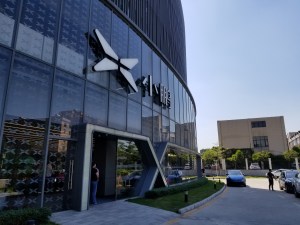
While there I met the guy in charge of developing Xpeng’s distribution locations. Former real estate guy. Xpeng isn’t going to be spending money on outlets in expensive areas such as Xintiandi, he said. Another startup, WM Motors, is aiming to be the EV for the masses. I admit that I don’t know where its stores are located. But given its goal, I don’t think it will be opening any stores in Xintiandi either.
When I read about WM Motor’s idea to launch a trading platform for second hand electric vehicles, my initial thought was that it was doomed to fail. How will WM determine residual value for those vehicles, I thought? After talking with some experts I’m still not convinced it won’t end up being a total money suck. I do think it will serve a useful purpose, however, and may end up being a success.
Of course, the motivation behind launching this second-hand EV trading platform is to create a market for WM’s battery electric vehicles. The Shanghai-based startup currently offers one model, the EX5. It starts at less than 200,000 RMB before a government subsidy. It has delivered more than 9,000 units.

WM EX5 in garage under building where EV maker has an office.
Make no mistake, however. WM Motor aims to be a volume brand. Big volume. “I want to become the Volkswagen or Xiaomi of the EV sector,” co-founder Freeman Shen told me when I interviewed him at the WM Motor headquarters in Shanghai in February. “I don’t want to be Mercedes.”
WM’s goal is to be the best-selling BEV in China in terms of delivery 2021, he said. It plans to launch two more models this year and two in 2020. So, launching the second-hand EV trading platform makes a lot of sense. But it is risky.
To get an idea of how risky this endeavor could be, I talked with Cari Crane, director of industry insights at ALG, a division of TrueCar. ALG is a residual value specialist. Crane has a lot of insight into residual values for the U.S. used EV market, which is a lot more mature than China’s.
One thing that put a lot of downward pressure on used EV (and here I am referring only to BEVs), she said, is incentives. In the U.S., BEVs can qualify for up to $7,500 in federal tax credits. Those incentives reduced residual values a lot, she said, up to 20 percentage points. So, for example, if an ICE vehicle was at 50 percent of the original value, a BEV would be up to 20 percentage points lower, or 30 percent lower than the original price.
The arrival of the Chevrolet Bolt was a turning point, she said. It offered a comparable range to an ICE vehicle, and it wasn’t weird looking (not her exact words). Now, luxury performance BEVs such as the Audi e-tron are also coming on market. People will pay a premium for performance. Those trends — longer range, less polarizing design, and performance — are helping EVs maintain more residual value.
Leasing is a another negative for EV residuals, said Crane. Since most of the leases are 36 months, that creates a flood of EVs coming back onto the market at the same time. But more consumers are now buying the highe- range BEVs, she said.
One thing Crane didn’t talk about until I asked is how fear of a shortened battery life impacts the residual value of an EV. Nissan LEAFs and Tesla Model S EVs have been on the road for a long time and their batteries seem to be holding a lot of range. So consumers are becoming more confident, said Crane. Hefty OE warranties help, too, though they can increase the price.
In the end, it seems incentives are the biggest drag on residual value for EVs. While China is now phasing out its NEV purchase incentives, all the models on the road now were heavily incentivized. That will put a lot of downward pressure on their resale value. That’s something WM must deal with as it grows its second-hand EV trading platform.
The platform could do what WM aims for it to, however, which is create consumer confidence in its vehicles and thus a market for them. A consumer who buys a WM EV will be able to check its second-hand value beforehand, and feel comfortable (or not, depending on the market, I guess) that he or she can re-sell it. There isn’t a lot of historical information in China on residual values for second-hand EVs, but apparently a Tesla retains 60 percent or more of its value after three years. Once a lot more Teslas are on the road in China, of course, that may change. The trading platform may help create a market for second-hand EVs in smaller cities, as well. The lower price will appeal to buyers there.
Education will be crucial to the platform’s success, however. Some consumers who have bought second-hand EVs reportedly had a lot of trouble recharging because they weren’t allowed to install chargers at their place of residence, or other road blocks. WM will need to pay a lot of attention to educating buyers.
I think WM should open this platform to all brands of EVs. A lot of second-hand EVs will be coming on the market in coming years. Allowing many brands to be traded will benefit all, in my opinion. If WM’s vehicles are as good it claims, it will get a bigger piece of a bigger pie. But, WM Motor also needs to make sure the platform pays as much attention to educating buyers as it does to selling them EVs.
China EV maker Seres adjusts U.S. plan to fit reality
Several Chinese EV makers have recently scaled back their U.S. market plans. One, Seres Automotive, at least has a Plan B, its new co-CEO Jim Taylor tells ChinaEV. It aims to be both a contract manufacturer at its U.S. plant and a supplier of electric vehicle drive train technology. Launching an electric vehicle in the U.S. is on hold for now, he says.
Seres is the new name – and brand name, it seems — for the vehicles produced by SF Motors, which is a subsidiary of Sokon Industrial Group, a large privately-owned manufacturer in China. More on Sokon later.

You may be familiar with Seres, though you didn’t know it. The EV maker opened an office in Santa Clara, CA, in Silicon Valley, in 2016 under the name SF Motors. Like many Chinese automakers it started out with a very ambitious plan, and moved quickly. It opened an research and development center in Silicon Valley in March of 2017. In October of 2017, Seres acquired battery startup inEVit, Inc. In November of 2017, Seres acquired the former AM General manufacturing plant in Mishawaka, IN. In April of 2018, it established a second Silicon Valley R & D center. Then reality set in.
Taylor is not new to working for Chinese companies. Most recently, he has held various positions at Karma and Fisker, two EV startups with Chinese owners, albeit radically different types of Chinese owners. That is for a different blog, however.

That experience may serve him well. Taylor came on board as Seres co-CEO in May; he shares the CEO role with Hu Xindong, who established the U.S. operations. Hu had a long career with Dongfeng, with whom Sokon has a joint venture. Hu has an MBA from the Maastricht School of Management in the Netherlands.
I know, I’m thinking the same thing. This may be a tricky relationship given that Taylor is completely re-doing Seres’ U.S. strategy, which Hu created. Also in the mix is John Zhang, son of the owner of Sokon Industries Group. John Zhang is listed as CEO of Seres on the U.S. website while Taylor is co-CEO of Seres Automotive. I guess John Zhang is in charge of the brand in China?
Taylor had a long career with General Motors, including a stint as CEO of the Hummer brand. (That surely helped put the Indianapolis plant on his radar as AM General manufactured Hummers there.). Taylor was also with GM’s Cadillac brand for more than 10 years, including as general manager and chief marketing officer. The Chinese press really talks about the Cadillac experience a lot.
When he came on board at Seres in May of this year, Sokon Group was already ready re-thinking its aggressive schedule for the U.S. market, says Taylor. That schedule called for launching the Seres brand in China and the U.S. at almost the same time, This is a new brand, mind you. And, Sokon has little experience selling passenger cars, much less electric vehicles.
Sokon Industry Group is listed on the Shanghai Stock Exchange. Its vehicle portfolio in China consists primarily of small ICE commercial vehicles, which it manufactures through a joint venture with Dongfeng. Sokon also manufactures its own line of small electric vans and manufactures “energy-saving and eco-friendly engines” which it sells to other manufacturers.
As for the change in the U.S. business plan, Taylor says he helped Sokon/Seres “see the situation” more clearly and add some momentum to the business plan change. “To try to launch simultaneously in two countries when it is a new brand in both is more what an enormous company could handle,” he says. “Seres needs to get the brand off the ground (in China), then come back with a second launch in a new country.”
On top of that, add the downturn in China’s economy and the “messy,” as Taylor termed it, relationship between the U.S. and China right now (the economic downturn in China is not helped by the trade situation but is also not the cause. And in any case, China takes the long view, as Stephen Roach points out in an excellent blog posting.)
To Zhang’s credit, though Sokon has invested millions in the U.S. plant and R&D facility, had “strong intentions to manufacture vehicles here” and was “going full-speed towards that,” according to Taylor, it has put the brakes on the U.S. vehicle manufacturing for the time being.
“We had to let a few people go (who were) lined up to execute the old business plan, says Taylor. It laid off 30 employees in Mishawaka and 17 in Santa Clara., says Taylor.
Though Seres won’t be producing EVs in Indiana right now, that doesn’t mean Seres has no commercial opportunities in the U.S., Taylor says. It will, to use a painful-to-type word, pivot. “Just because we had a prior business plan doesn’t mean we have to stick with that,” he says.
One business area Seres is pursuing now: supplier. “We have a very large powertrain team in Santa Clara,” says Taylor. He says he is spending 80 percent of his time in Silicon Valley.
Engineers at Seres took a vertical approach to developing the EV powertrain. “They started from the bottom,” says Taylor, including designing the gear box, the motor, and building their own inverters. Since the powertrain is already incorporated into vehicles in China, it has been undergone millions of kilometers of testing, he adds. Taylor figures Seres could turn into a Tier 1 supplier of EV components or an entire drivetrain.
The Santa Clara R&D center (or maybe the Milpitas location…) has “legitimate IP,” says Taylor. “They are not integrating other’s products.” Taylor claims the Seres electric powertrain is as good or better than anything on the market, “better than the current Tesla systems.”
Sokon Industry Group, based in the southwest China municipality of Chongqing, introduced the first Seres model, the SF5 SUV BEV, in April of this year at the Shanghai Auto Show. The SF5 (below) will be intelligent and connected, natch. It will be on the market by the fourth quarter of this year, says promotional material. It is also developing a second model, the SF7.

Alas, I didn’t know I’d be blogging about this or I would have attended the Seres presser at the Shanghai show. I did manage to attend, or at least take photos of, electric SUVs being launched by Bordrin, Aiways, Evolve, Gyon, Hozon, Lixiang, Singulato, Xiaopeng, Qingyuan, NIO, WM, Red Flag (FAW), Venucia (Dongfeng), and JAC, among others.
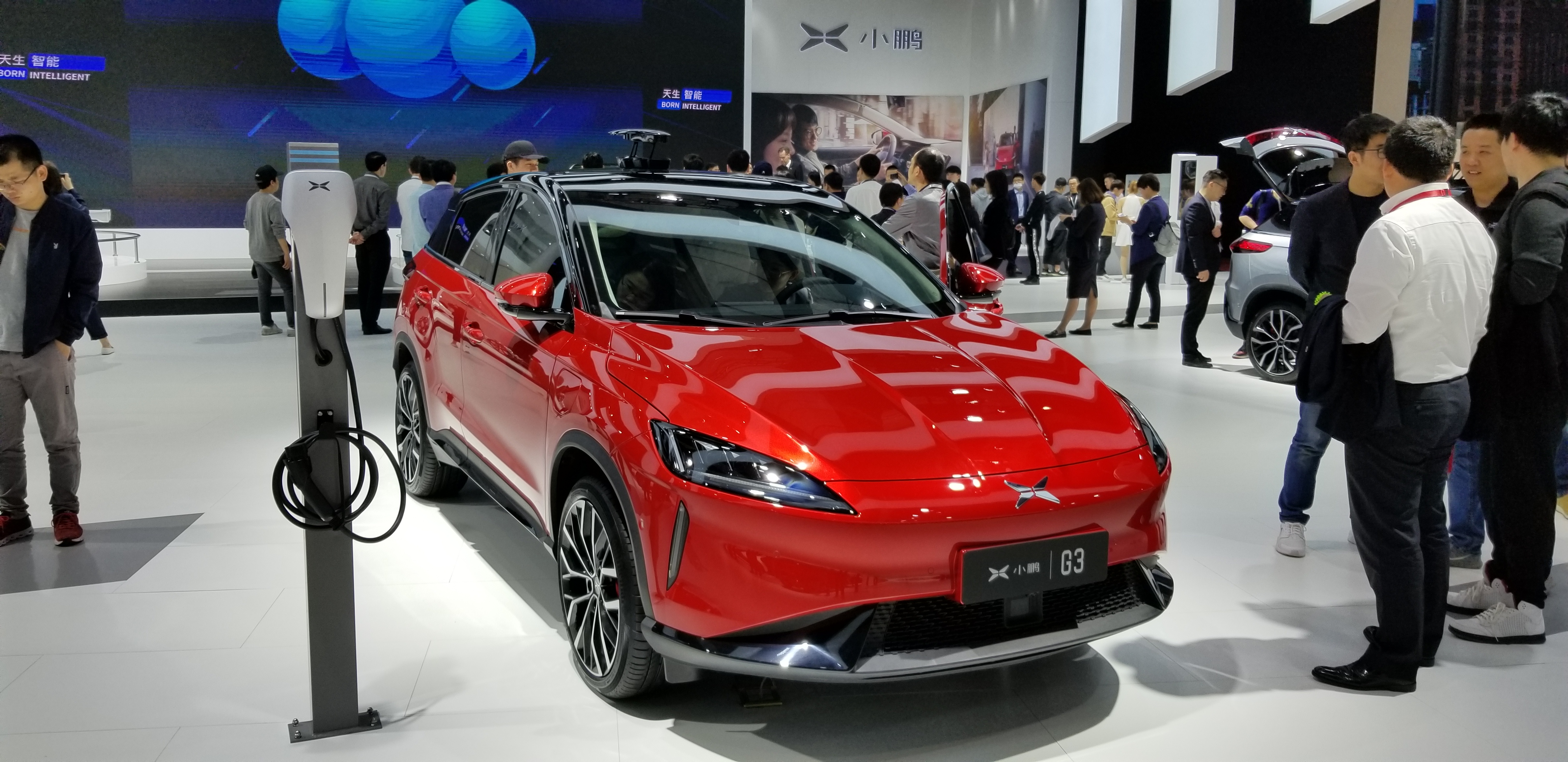
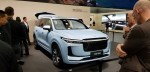

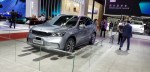
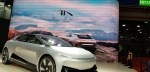
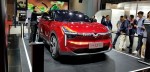
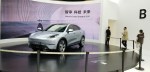
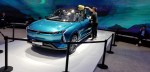
Get my point? The segment is pretty crowded. Seres faces a challenging market in China. As establishing the brand there is a bit of a prerequisite for launching it here, it’s a good thing Seres is currently pursuing Plan B.
As for the second part of Plan B, i.e. selling manufacturing capacity at its Indiana plant, Taylor figures there is a place for contract manufacturing, in the U.S. “There hasn’t been a lot of contract manufacturing in the U.S. since AM General,” he says. The Indiana plant has a 50,000 unit annual capacity running two shifts daily, and an experienced workforce, Taylor points out.
Customers could include established automakers who need temporary capacity, want to do small-volume manufacturing with a model, or have other limited scale production needs, he says. Startups are another potential customer pool. Many of them are looking not only to fund a product program but also to find a plant to manufacture the product in. Buying or building a plant at such an early stage is expensive. Seres’ capacity could be a “bridge plan” for the startup’s first two or three years, says Taylor.
There are a lot of uncertainties in Seres’ U.S. future right now, Taylor admits. One of the biggest is when China and the U.S. “shake hands.” That will help determine when the brand can launch here (though that is predicated on a successful China launch, so another uncertainty…). Even if China and the U.S. resolve some differences, there will be local content requirements to manufacture here. So Seres will need to localize some sourcing in the U.S. almost immediately.
Meanwhile, Taylor is hopeful his new approach, involving contract manufacturing and selling EV powertrains, will succeed. “We have bites for both lines of business. This might have some legs,” he says.
 Alysha Webb
 Alysha Webb's ChinaEV Blog