Volkswagen aims to source electric vehicle batteries from China in just a few years.
As I mentioned in my previous posting, Volkswagen Group’s Dr. Tobias Giebel, head of the Volkswagen Research Lab in Shanghai, sounded quite optimistic about the potential to develop a battery supplier base in China at the EV Battery Forum in Shanghai in November. Of course, it behooves him to sound optimistic—it is his job to develop that supplier base and one always likes to feel as if they are successful at their job.
Volkswagen www.volkswagenag.com is working closely with about 20 of China’s than 100 battery producers, and is already seeing improvement, he said. “We think in a couple of years we will have really strong suppliers in fully domestic companies,” said Giebel. http://www.evbatteryforum.com/tobias-giebel-china/ When they are up to global standards, Volkswagen will use the same Chinese source for its Asia, Europe, and the United States operations, he said.
Today, China’s lithium-ion battery makers are focused on consumer technology, said Giebel. Its automotive-grade batteries are not up to the high-level vehicle traction battery manufacturers in Korea or Japan, he said.
But, “we are observing in these days our first success of the Chinese suppliers,” said Giebel in a later email communication. “Therefore we are optimistic that Chinese vehicle traction battery cells will become competitive soon.”
He added: “We will not accept lower safety, quality, or performance for our Chinese business.”
A Chinese company that can meet Volkswagen’s standards could have the opportunity to facai le (get rich). That’s because VW Group will use the same battery module design for all its electric vehicles globally across all its brands, said Giebel. And the battery modules (and cells in them) are likely to be sourced from China, he said.
“The module shape and number of cells will be the same,” said Giebel. “The module is not part of any international norm. It is a company internal standard.”
That means all hybrids, plug-in hybrid electric, battery electric, and fuel cell vehicles produced under the Volkswagen Group’s 10 nameplates, which include Volkswagen, Skoda, Audi, Seat, Bentley, Porsche, Scania, Bugatti, Lamborghini, and Volkswagen commercial vehicles.
Inside the module, Volkswagen might adapt the connection between the cells to vary the number of parallel and serial cells, said Giebel. The module is a company internal standard, he added.
As Volkswagen’s current parallel hybrid models, including the Tuareg SUV, have a different technology, Volkswagen will use the standard module concept first on battery electric and plug-in hybrid electric models, said Giebel. “The extension to parallel hybrid (HEV) will be decided later,” he said.
Giebel may be feeling a bit or pressure to bring those Chinese suppliers up to speed. Volkswagen recently said it would begin producing two electric vehicles with its Chinese partners as soon as late 2013. http://tinyurl.com/73skkao Volkswagen partners with SAIC www.saicgroup.com/ and FAW www.faw.com.cn in China. Both are large state-owned enterprises. Each has produced a prototype electric vehicle with VW and launched its own EV sub-brand. http://tinyurl.com/7cvzd5q http://tinyurl.com/6p9defu Each also has its own captive supplier group, but I’m sure that won’t play a role in supplier selection….
Take on quality of China’s battery cos depends on what you want from them, it seems
In mid-November I attended the EV Battery Forum in Shanghai. www.evbatteryforum.com The event was great from a networking standpoint—participants included representatives from utilities, battery producers, battery materials suppliers, auto makers, and battery associations. They hailed from China, Hong Kong, India, Finland, and other countries. And, it revealed an interesting divergence in opinion on the quality of China’s domestic electric vehicle battery manufacturers.
Dr. Wang Ying (Sherry), deputy CTO of Shanghai Advanced Traction Battery Systems Co, SAIC’s battery joint venture with Massachusetts-based A123, http://tinyurl.com/7qhal9m was a speaker. So were Dr. Tobias Giebel, http://tinyurl.com/c9prgnx head of the Volkswagen Research Lab in Shanghai, and Ray Bierzynski, executive director electrification strategy for General Motor’s China Group. http://tinyurl.com/bv4st63
Their views of the quality of the local battery supply base were quite different, illustrating that a company can see what it wants to see in the China market. VW and GM, who aim to source batteries from China for their global operations, believed that China would produce world-class batteries in the not-too-distant future. Wang was not so optimistic.
I agree that China will become a global supplier for the batteries that power electric vehicles. But I don’t think it will be become the global source. Timing is important here. When will Chinese domestic battery producers be able to make world-class products? And how many companies will actually achieve that standard? And how many of those companies will be able to do it without a lot of help from foreign firms?
Wang Ying wouldn’t say batteries produced by China’s domestic battery manufacturers were not good enough for electric vehicles. What she did say, however, was that China’s battery companies were new to the new energy vehicle battery market and that “battery suppliers in China don’t really know vehicles.” The packaging is the real challenge for China’s domestic battery makers, said Wang without elaborating. In any case, the fact that SAIC chose to partner with a foreign battery company when China has more than 100 battery producers itself speaks loudly and clearly.
Meanwhile, Dr. Tobias Giebel had a much more sanguine view of China’s domestic battery producers. “We believe the future of battery cell sourcing is in China,” he said. Volkswagen http://tinyurl.com/bpl9dp8 is working closely with about 20 domestic battery producers in China to bring them up to Volkswagen’s global standards, said Giebel. VW figures it will have “real strong” suppliers in China within “a couple of years,” he told the conference.
When I talked to him during a coffee break, that sounded more like up to five years. But, Giebel confirmed his confidence in China’s domestic battery manufacturers in a later email exchange. “The supplier in China needs some time to catch up with the high level vehicle traction battery products in Japan and Korea,” Giebel wrote. “But they are on the way, and we are observing in these days first successes of the Chinese suppliers. Therefore we are optimistic that Chinese vehicle traction battery cells will become soon competitive.”
General Motors www.gm.com is also looking to source batteries from China for its electric vehicles. GM’s wholly-owned China Science Lab in Shanghai can test local batteries for quality, said Bierzynski. The batteries can be validated – that is, certified that they meet GM’s standards—at the Pan Asia Technical Automotive Co., or PATAC, the 50/50 design and engineering venture between GM and SAIC in Shanghai. http://www.patac.com.cn/ That means a battery made in China would have the stamp of approval for use in GM; s global operations. “We need a (battery) supply base. It is a good bet that will be here in China,” said Bierzynski.
So, does this mean the domestic electric vehicle battery companies in China will elbow out battery producers in the U.S. and Europe? Perhaps. Companies such as Ener1 www.ener1.com , LG Chem www.lgchem.com , and A123 www.a123systems.com are hedging their bets by forming partnerships with Chinese companies.
Of course, if the government actually passes a draft law it has circulated that would require foreign companies wanting to produce electric vehicles and key EV components including batteries in China to form joint ventures that are at least 50% locally-owned, then Chinese battery producers would have access to battery technology that they may lack, right? In theory, yes. But the Chinese government forced foreign automakers to form 50/50 joint ventures with local companies in order to produce cars in China and how many domestic automakers do you see producing world-class cars?
I predict the number of Chinese battery manufacturers able to produce world-class batteries will be very small. Most of China’s domestic battery producers will never make it there. So will China one day be the source of most of the world’s electric vehicle batteries? Maybe, but don’t count battery companies from the U.S., Europe, and other Asian countries out.
To hear another view on China’s EV future (which may or may not differ from mine; this is not an endorsement of the view that will be presented in this seminar), check out the live online seminar “The Green Dragon: Will China be at the forefront of the New EV Revolution?” Marc Norcliffe, a U.K.-based consultant who has been involved with China’s auto industry since 1996, will present live via the internet and cover the advent of China’s new energy vehicle industry (as alternative powertrain vehicles are known in China) from the industry, government, and consumer perspectives. For more information or to register, visit http://tinyurl.com/7m2z7pv
Visiting BYD in China: It does a lot more than electric vehicles, but EVs are what I care about!
BYD www.byd.com is really taking up a lot of my time these days. After attending the opening of its North American headquarters here in Los Angeles, on a recent trip to China I visited its headquarters in the south China city of Shenzhen. I have been skeptical of BYD’s technology, and of its chances to succeed here in the U.S. I still think it will need skill and a big dose of good fortune to succeed here. But after touring the headquarters in Shenzhen, I was truly impressed at the scope of BYD’s businesses and fairly convinced that it will not be destroyed by the recent dramatic decline in China of its vehicle sales. http://tinyurl.com/7m2u34s Success of its cars here in the U.S. is still unsure, however.

I knew BYD got its start producing batteries for mobile phones and laptops, and that it now produces batteries for electric vehicles. And that it also produces solar panels. But I didn’t know it also designs and produces laptop computers and mobile phones for third parties. It also produces the casing for mobile phones and laptops.
Then there are the batteries. BYD holds 65% of the world market for nickel metal hydride batteries that go into consumer electronics, Leona Zhang, of BYD’s public relations department, told me. It produces batteries for Amazon, Energizer, Phillips, and others, BYD also produces lithium ion batteries for mobile phones for Samsung, LG, Motorola, and others. It holds 25% of the worldwide market for cell phone batteries, said Zhang. It has 11 plants across China.
But you probably don’t want to hear about its solar farm or the cool home energy battery storage device I saw in Shenzhen.

Or its test track, which I unfortunately didn’t get to drive an e6 on, though I did drive an e6 around the HQ grounds. Even if you do, I am not going to talk about them anymore. I’m going to talk about BYD’s electric vehicles, mostly. I saw a lot of them in Shenzhen. But the BYD EVs I saw were all electric buses and taxis. (Except the e6 that the BYD people picked me up in, and which they gave me a ride to the airport in.) BYD has 600 battery-electric buses on the road in Shenzhen and 300 e-6 taxis.
Just as in the U.S., demand in China for battery electric vehicles is hampered by consumers’ doubts about a new technology, lack of a charging infrastructure, and a higher price than for a comparable gasoline-powered car. For now, BYD and other automakers here are counting on government subsidies that can reach RMB 120,000 or more per vehicle to create a market for electric vehicles. So far, however, the subsidies haven’t convinced the general public to buy electric.
To be sure, BYD’s e6 pure electric crossover vehicle just became available to consumers in China in late October. But at RMB 369,800, or $58,125 at current exchange rates, before rebates, it is pretty pricey compared to similar gas-powered vehicles. So far, demand has been small. BYD seems to understand that consumers aren’t going to warm to pure electric vehicles very quickly. That’s why it is initially pitching the e6 as a fleet vehicle.

There are 300 e6 taxis on Shenzhen's streets. This one is recharging at the Futian recharging station.
Another potential pothole in the near-term growth of China’s battery electric vehicle market: The government’s focus seems to be shifting to hybrid and/or plug-in electric vehicles in the near and medium term. China’s premier Wen Jiabao recently said that China lacked key technologies to develop BEVs, and so China should look to more mature electric vehicle technologies right now to grow the EV market. http://tinyurl.com/7vmgn8l
Fortunately, BYD is positioning to take advantage of growth in the hybrid market. BYD SVP Stella Li told me via email that BYD will focus on both pure electric vehicles and its dual-mode hybridm called the F3DM. BYD thinks the dual mode model will see higher sales than the pure electric vehicles, she said. So BYD is upgrading both the F3DM’s engine—making it turbo-charged– and the interior design, she said. http://tinyurl.com/6s8vcud
Of course, BYD’s sales of gasoline-powered vehicles have seen a huge downturn recently. Right now, the bright spot is healthy sales of its new gas-powered SUV; the S6m launched last May (or maybe June. It was introduced in April at the Shanghai Auto Show). In the first ten months of this year, the S6 has sold 32,890 units, according to LMC Automotive, the former forecasting unit of J.D. Power and Associates. In October, it sold 9,647 units, the months’ biggest mover in the SUV segment.

The S6 is the first of BYD's upscale models to be launched. Sales are good so far.
I sat in an S6 in the BYD showroom at the headquarters. Not bad for a starting price of RMB 89, 800 or $14,115 at current exchange rates . It is rather nice looking. In fact, the S6’s appearance is similar to a Lexus SUV. But hey, all those premium SUVs have a similar appearance. In any case, Chinese consumers seem to think the S6 offers xinjiabi, or value for money, an important selling point in the China market.
A steady stream of such improved models will not only help BYD’s cash flow, but will improve its overall image, which may encourage consumers to consider its hybrid or electric models when they buy their next car. I hope the next model launched is nice as the S6. And that we see some e6 electric vehicles on the road here in the U.S. soon.
China EV maker BYD does good job of opening N. American office. Now comes the hard part.
Chinese automaker BYD opened its North American headquarter in Los Angeles this week. I’d have to say the event was a success. Some 150 people attended, including LA Mayor Antonio Villaraigosa; BYD Chairman Wang Chuan-fu; Charlie Munger, vice chairman of Warren Buffett’s Berkshire Hathaway, which is a BYD investor; the mayor of BYD’s hometown Shenzhen; the Chinese Consul General; and a plethora of lesser beings, including journalists, the contractor who redid the building, and three future candidates for Villaraigosa’s job.
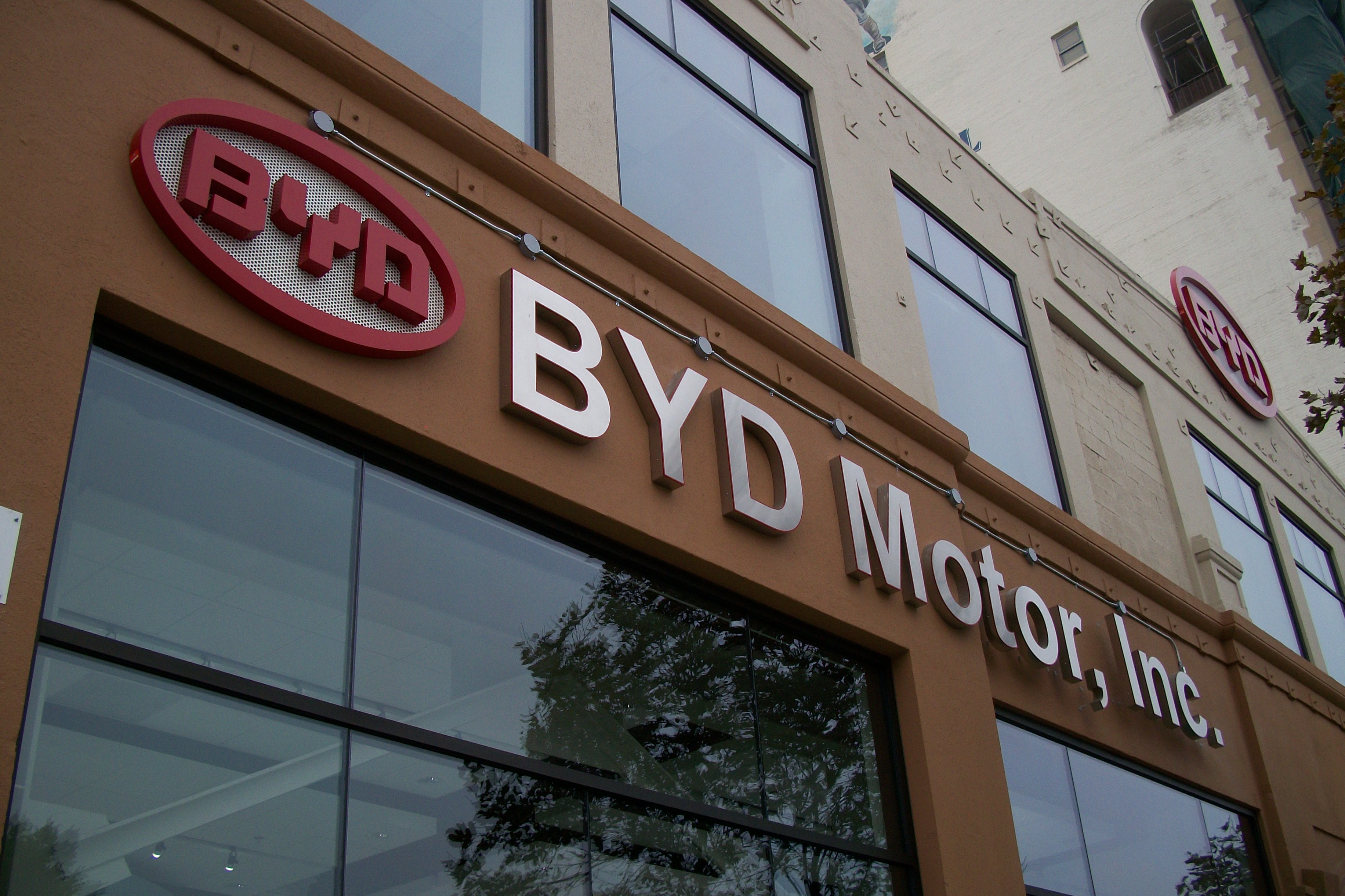
After such a rocky start in the U.S. market, which included missed launch deadlines, I was happy to see something go smoothly for the Chinese
automaker, which aims to begin selling its electric vehicles to consumers here in the U.S. starting next year. That isn’t a predicator of future success, of course. That will depend on the company’s actual vehicles.
One of BYD’s e6 electric crossover vehicles was parked in front of the building, located just south of downtown Los Angeles in an area with multiple car dealerships. This building is not a dealership, however. At least not yet. It will house BYD’s administrative and engineering staff.
I had the chance to drive the e6 last week. It’s not a bad car. To be sure, the e6 is a bit sluggish compared to a smaller electric vehicle such as the Nissan Leaf. But then the e-6 is 179.53 inches long with a curb weight of nearly 5.060 lbs. The Leaf is only 175 inches long with a curb weight of 3,354 lbs.
But that size—and the vehicle’s roominess– will give the e6 a lot of utility that smaller EVs don’t have. Also, I drove it in “economy” mode. BYD business development director Bill Wang told me later it also has a “sporty” setting that improves the acceleration. “But that uses up the battery faster,” he said. BYD claims the e6 can travel up to 186.41 miles on a single charge with a top speed of 87 mph.
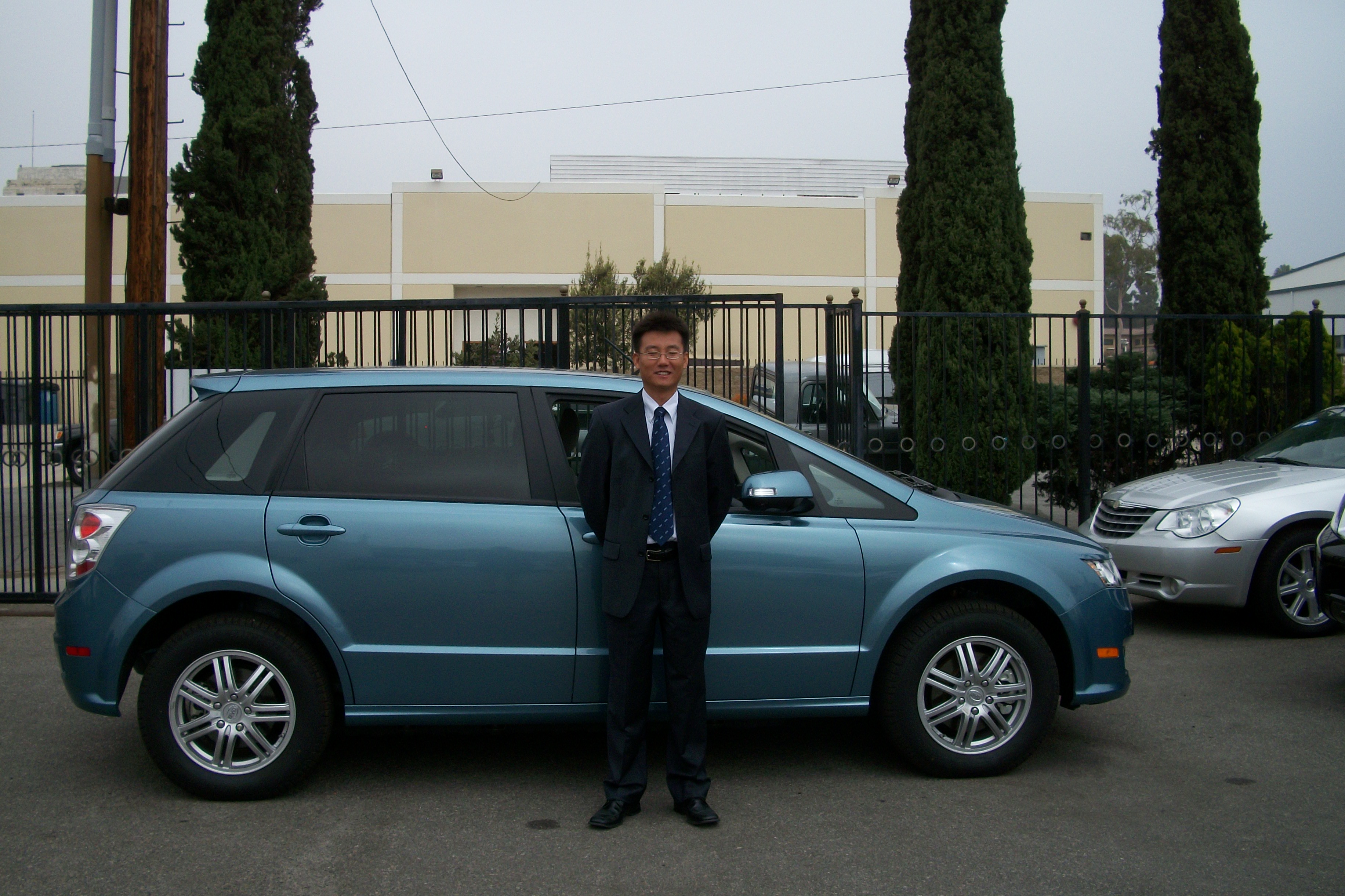
The interior is blandly acceptable. One thing I didn’t like was the placement of the instrument panel on the console. It is in the middle rather than directly behind the steering wheel so the driver has to look down and to the right to see speed etc.

The electric car will be available for fleets later this year. Consumer sales will begin in the second quarter of 2012, BYD senior vice president Stella Li told me in an interview a few months ago.
As for dealerships, BYD will open two dealerships in Los Angeles this year, Bill Wang told me. One will be Glendale; one in El Monte. It will also open a dealership this year in High Point, NC. Next year it plans dealerships in New York City, Chicago, Washington, D.C., Hawaii, Las Vegas, and Miami, FL, he said.
The dealerships will sell BYD’s all-electric e6 crossover and hybrid F3DM sedan. Ten f3DM hybrids are currently part of the Housing Authority of the City of Los Angeles fleet. They will also sell its solar panels, batteries, recharging stations, and LED lighting.
BYD is also bringing its electric buses to the U.S. Indeed, one of its electric buses began operating last month as shuttle between the Hertz Rent-a-Car lot and the terminals at LAX. Jack Hidary, global EV leader for The Hertz Corp., was at the BYD event in Los Angeles. So far so good, he said. Customers like it because it has three doors and is very quiet, said Hidary. It has lived up to expectations thus far, he said.
Hertz is sharing the performance data with BYD.

In this pilot phase, Hertz is using just bus. If all goes well, it will add several more electric buses at LAX and use the electric buses at airports nationwide, said Hidary. This is the first long-range electric bus to be used this way at LAX, he added.
Hertz chose to use BYD’s bus because of its range of 155 miles per charge, said Hidary. That was critical because it must travel between the Hertz lot and all the LAX terminals many times each day. Another attraction: BYD has engineers and staff here in Los Angeles so the support is good, he said. Then there is the cost savings. It costs 65% less to fill up the bus with electricity versus diesel fuel, said Hidary, and “we are always looking to improve our bottom line.”
California EV drivetrain firm eyes China’s medium and heavy commercial vehicle sector
At the Alt Car Expo in Santa Monica, CA a few weeks ago, I took a ride on a battery electric bus produced by Balqon Corp. www.balqon.com, a small company in Harbor City, CA. Harbor City is near Torrance, which is by Redondo Beach. Which is next to Hermosa Beach. Which is next to Manhattan Beach. Ah ha, do you finally recognize one of these towns?
Anyway, Balqon is in the Greater Los Angeles area. Its seven engineers design electric drivetrains for medium- and heavy-duty commercial vehicles.
I learned the company is providing the drivetrain for electric buses in China. So I went to Harbor city to talk with Balqon CEO Balwinder Samra. It turned out to be yet another example of a U.S. company that is turning to the China market after not finding much of a market for its technology in the U.S.
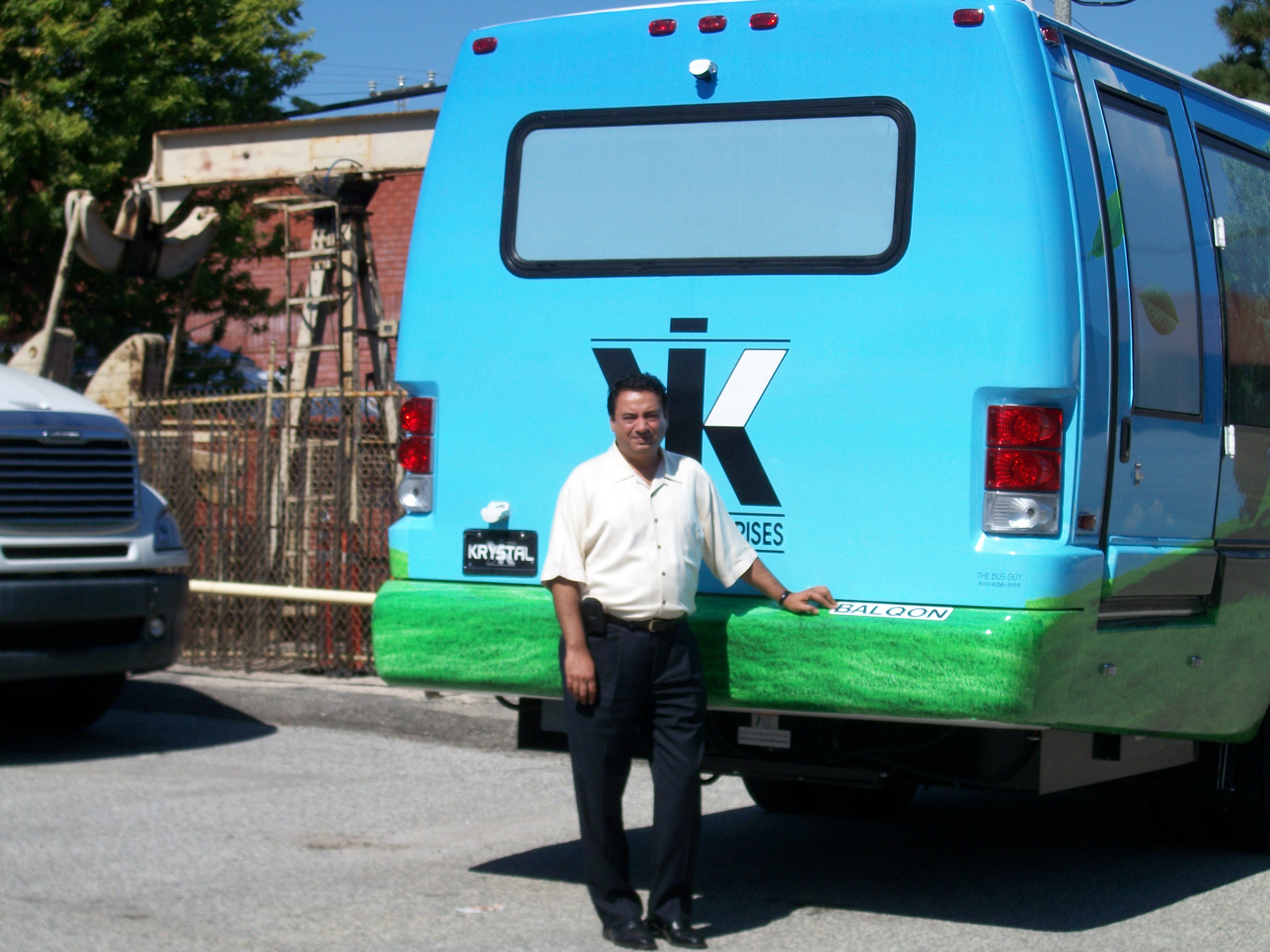
Balwinder Samra's company is providing electric drivetrains for buses in China. This is one of Balqon's electric buses at the HQ in Harbor City.
Last February Balqon inked a $16 million deal with Winston Global Energy, a lithium-ion battery maker in Shenzhen, China, to provide drivetrains for 300 buses. http://tinyurl.com/3lkkonx A few drivetrains have already been shipped to Shenzhen, says Samra. The buses are for the domestic market.
Here’s how the agreement to supply electric drivetrains for Chinese buses came about:
Balqon’s U.S. customers include the Ports of Los Angeles and Long Beach. Business wasn’t good last year. Revenue plunged 82% to $677,745, with a net loss of $4.3 million.
CEO Balwinder Samra says the U.S. market hasn’t been very welcoming to his electric drivetrain technology. “We did take our technology to most OEMs (in the U.S.), but it didn’t seem like anyone was interested,” he says.
However, a Chinese businessman with investments in the U.S. was interested in Balqon’s drivetrain. Balqon was already buying batteries from Winston Global Energy, http://en.winston-battery.com/ located in the southeast China city of Shenzhen. At the suggestion of the U.S. distributor of the battery, last November, Samra attended the EVS25 electric vehicle forum and exhibition in Shenzhen, China (I was there too!).
At EVS25, he met Winston Chung, owner of Winston Global Energy. Though Chung, from south China, doesn’t speak English, he and Samra both speak the language of business. “It became a strategic relationship,” says Samra.
Chung was looking for an electric drivetrain for a recreational vehicles to be produced at MVP RV Inc., www.mpvrv.com a company Chung owns in Riverside, CA, near Los Angeles. One 44-ft RV using Balqon’s drivetrain was produced, and worked well. “It was proof of concept,” says Samra.
If the electric drivetrain could handle a 44-ft RV, it could clearly handle a 22-ft passenger bus, says Samra. Thus, last February Balqon signed an agreement with Winston Global Energy to provide electric drivetrains for the 300 buses in China.
In December of 2010, Winston Chung also made a $5 million equity investment in Balqon, with an option to invest another $5 million.
Is Balqon worried about its intellectual property being stolen in China, I asked Samra? Since Winston Global Energy is also an investor in Balqon, it is in Winston Global’s interest to prevent IP theft, points out Samra. Like most companies, however, his main strategy to fight IP theft is to keep making his technology better. “We are obsoleting our technology,” says Samra. “By the time they have copied us, we have innovated.”
Samra seems optimistic about Balqon’s future. He is also targeting OEMs in Europe and India. Currently, 82% of Balqon’s business is international, says Samra.
He has no plans to move any time soon from the small warehouse in the industrial area of Harbor City that serves as Balqon’s office and assembly plant. Samra figures electric drivetrains have a great future in the medium- and heavy-duty commercial sector. But it depends on improvements in battery technology. Mass adoption will occur when battery capacity equals the range of about six gallons of gas, figures Samra. Right now it is at about four gallons.
“We know we need to stay small and weather this thing out,” he says. “We have always believed battery-powered zero emission will be the future. We will be in our little niche until it becomes general use.”
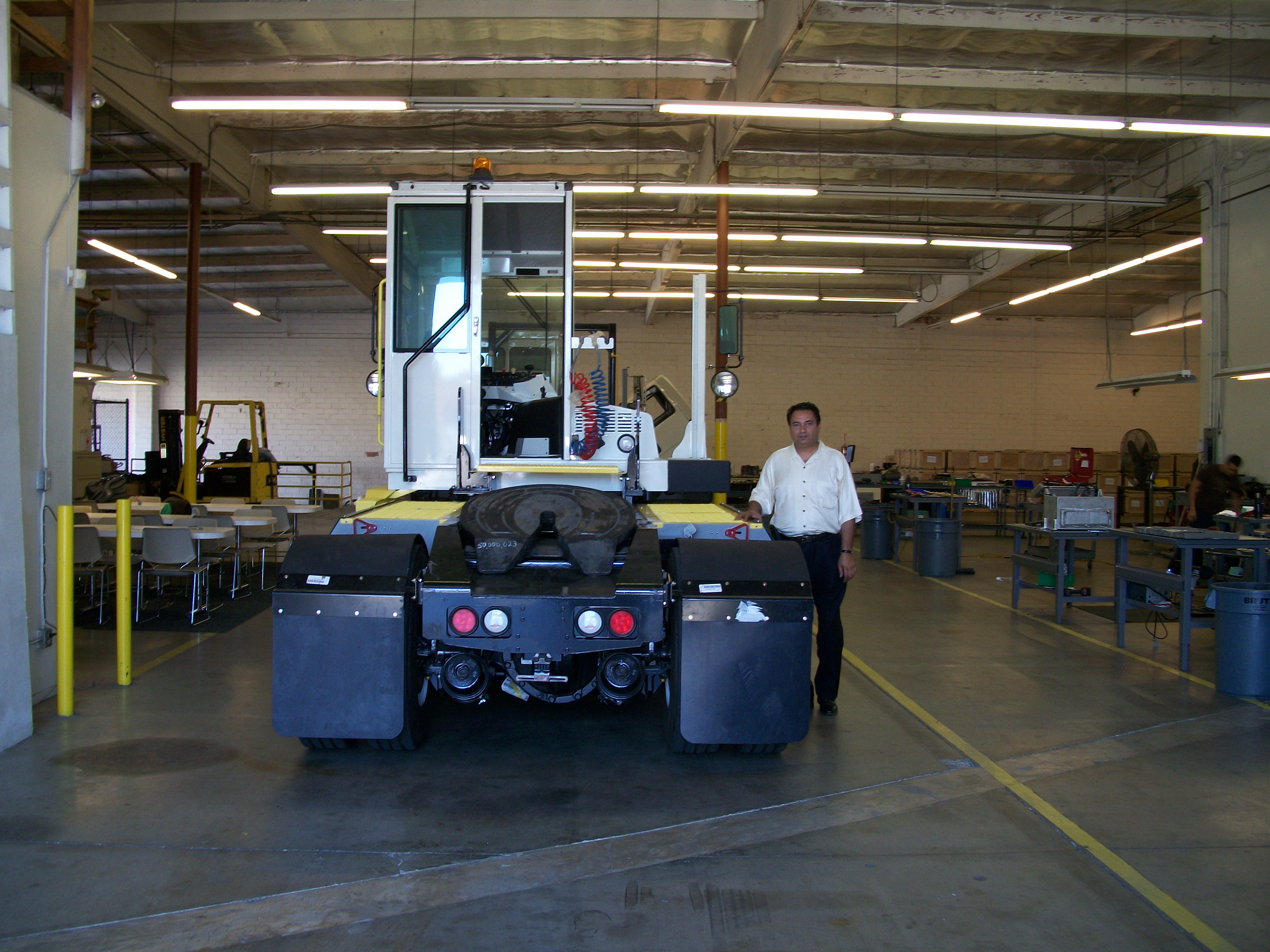
Samra sees opportunity for his electric drivetrain in China's heavy and medium duty truck market.
Balqon is already looking at the medium and heavy truck market in China. Samra figures it could use Balqon’s electric drivetrain, too. Oh, and he has his eye on Turkey “because of the cost of diesel there,” he says.
Hey, wadda ya know. It appears the Chinese government is looking overseas for good battery technology. And putting its support where its mouth is.
Does this herald a new electric vehicle sector development strategy for China? Will we see more support from the Chinese government for foreign companies with electric vehicle technology? Is this a way to get some technology without trying to force foreign automakers to fork it over?
In late September, Boston Power, a Massachusetts-based producer of lithium-ion batteries, www.boston-power.com announced it had received a US$125 million investment, and that it was moving to China. http://www.autoobserver.com/2011/09/new-investor-refocuses-boston-power-on-china.html
The investment includes cash from private investors and support from the Chinese government. The deal was arranged by GSR Ventures, a venture capital firm with offices in Silicon Valley and Beijing. www.gsrventures.cn GSR managing director Sonny Wu told me via email that the Chinese government is providing “significant support for the company.” He wouldn’t elaborate. According to the press release, the government’s investment came in the form of grants, low-interest loans, and financial and tax incentives.
The money will be used to build a plant near Shanghai with capacity of 400 megawatt hour of lithium-ion battery cells per year cells by the end of 2012, more than tripling Boston Power’s production capacity. To put that in perspective, that equals batteries for some 20,000 passenger cars.
I talked to Boston Power founder Christina Lampe-Onnerud about the big move for her company. Lampe-Onnerud (below) is now Boston Power’s international chairman. Sonny Wu of GSR Ventures is the new chairman.

Lampe-Onnerud figures China is Boston Power's future.
Why would the Chinese government chose to invest in foreign battery company given that there are so many battery makers in China, I asked Lampe-Onnerud? “It was a merit-based award,” said Lampe-Onnerud. “The technology is rock solid. Our stuff works.”
Is Lampe-Onnerud worried about a glut of batteries on the China market? Overcapacity, that is? “I think there is always a huge need for high quality battery,” she said. “I think there is an overcapacity of cheap batteries,” she said. I guess not.
Boston Power claims its lithium-ion battery delivers the holy grail of EV battery technology: High energy density, long life, fast charging, and safety. Oh, and environmental sustainability. Who could ask for more?
Why China, I asked Lampe-Onnerud? She said: “We recognize that China is taking the lead in transportation. We are extremely well positioned in that; we are outperforming our competition in transport.”
Okay, but isn’t she worried that Boston Power’s intellectual property will get nicked by a Chinese competitor who will then start producing similar batteries? “I’m not particularly nervous,” said Lampe-Onnerud. As a young company, Boston Power’s number one intent is to grow, she added.
Boston Power wanted to grow in the U.S., but its request in 2009 for $100 million in federal funding was rejected. Why, I asked? “Our company was maybe a little young” to get an award from the U.S. government, said Lampe-Onnerud. Boston Power’s focus in China will be on batteries for vehicles, said Lampe-Onnerud.
She wouldn’t say if it would focus on passenger cars or commercial vehicles. And though she said it is already talking to Chinese companies about using its battery, Lampe-Onnerud wouldn’t reveal any names. It will make an announcement regarding its customers in China within the next six months, she said.
This is not Boston Power’s first foray into China. It has a trading company in Shenzhen, said Lampe-Onnerud. She has long seen China as a destination for Boston Power. Though she doesn’t speak Chinese, and had never been to China before, in 2005 Lampe-Onnerud went to Shanghai to visit several battery manufacturers to try to talk them into doing a test run of her battery. One of the companies finally agreed, and Lampe-Onnerud paid for the run with her own money. When the Shanghai company wouldn’t agree to large-scale production, she produced the battery in Taiwan, said Lampe-Onnerud. The Shanghai battery maker has gone out of business, she said.
Lampe-Onnerud is ballsy and that impressed me. But there are still many questions surrounding Boston Power. Is its technology really as good as she claims? Who are these Chinese customers? What, exactly, is the Chinese government’s interest in Boston Power? Is it offering the same deal to other foreign companies?
I’ll sniff around when in China in November. Stay tuned! .
Coda first store is nice, but the brand still faces some hurdles to succeed in the EV world
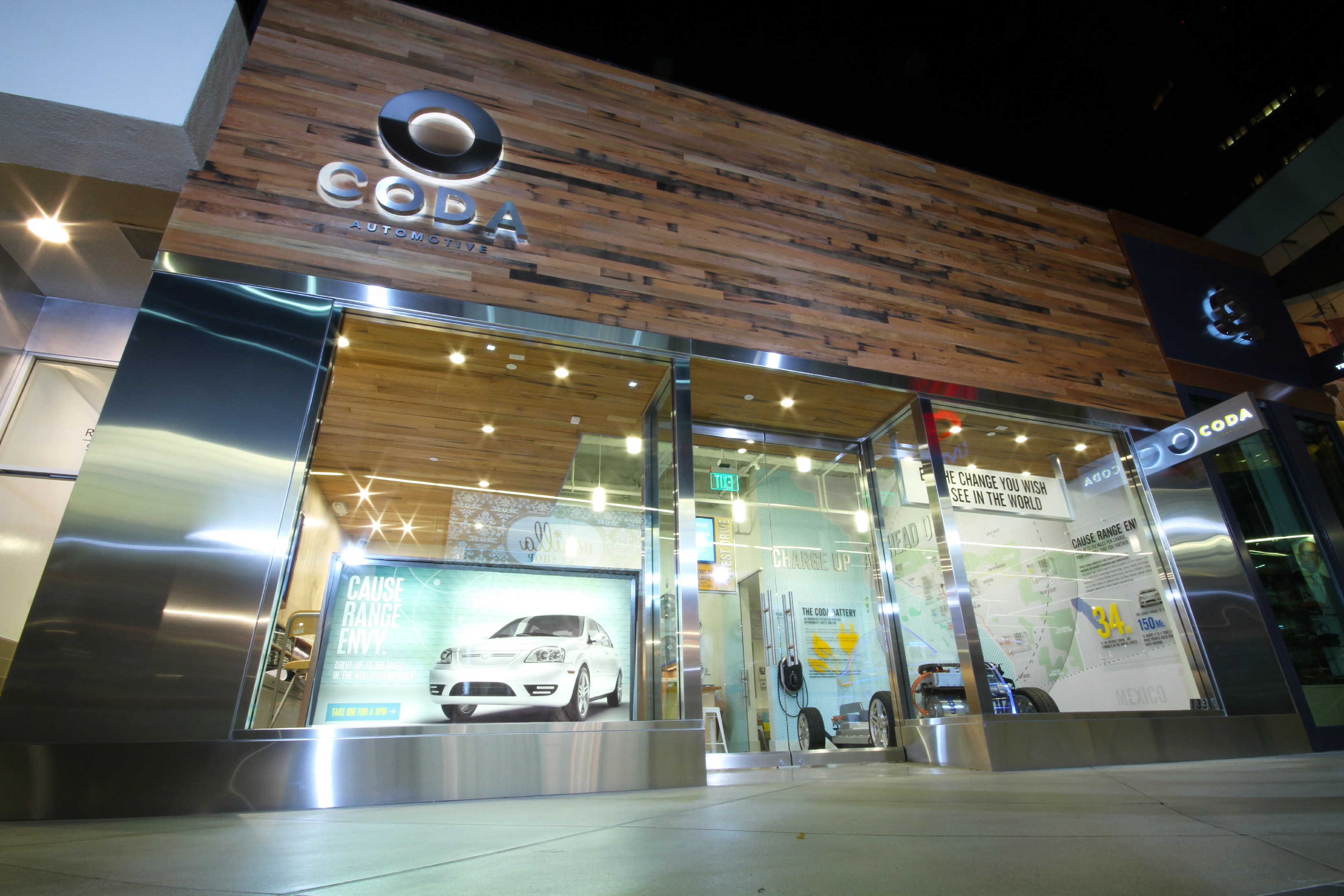
I recently visited the first Coda electric vehicle store. It opened here in Los Angeles early in September. The store is a teaser—a way to introduce the company and its products to a target group of consumers and hopefully build demand ahead of the vehicle’s arrival. http://prn.to/rmdo0z
The question is: Can an unknown brand succeed in a segment that has yet to catch consumers’ fancy in large numbers, especially agains competitors such as Ford Motor Co. and others who have name recognition, a dealer network, and momentum? I hope the answer is yes but fear it is no.
The good news for Coda is that it got more money. http://aol.it/o1WF8y It seems to be using that cash injection to hire people—the job websites are full of ads for various Coda positions. The bad news (maybe, I don’t know how good the guy was) is that Coda is still experiencing executive churn.
Sean Blankenship, Coda’s former VP of automotive marketing, recently left the company to “pursue other opportunities,” Larkin Hill, Coda’s director of corp comm told me. Coda, founded in 2009, is alread on its third president—well, its second permanent president, to be fair.
Kevin Czinger, the first, left the company in 2010. The second, interim, president, Mac Heller, left a few months later. (Though he is still Coda’s chairman, Hill emailed me to point out after reading this blog. Makes sense as I believe he has skin in the game i.e. he is an investor.) Phil Murtaugh, the current president and CEO of Coda Holdings, is certainly exactly what Coda needs, a car guy who had impeccable China connections. Hopefully he will stick around. But he faces formidable challenges, as I have written in previous blogs.
Also, Coda is produced in China at Hafei Motor, http://www.hafeiauto.com.cn/ and based on an old Mitsubishi model. While Coda Holdings www.codaautomotive.com has updated the look, it is still very bland. And, the body (and the battery) is made in China. That may give some consumers pause.
More good news. I drove Coda’s pure electric sedan. It definitely drives better than the version I drove last year. Much more pep. The interior looked about the same, but this was not a production version car. And the car I saw at the Alt Car Expo www.altcarexpo.com in Santa Monica recently did have a much nicer interior.
Coda doesn’t plan to begin delivery of its pure electric sedans until late this year. While you can’t buy a car at the store, you can put down a deposit on one. The store aims to provide “a unique learning experience for consumers interested in the electrification movement,” Sean Blankenship, Coda’s former vice president of automotive marketing, told me a few months ago. Despite his departure, I think that still holds true.
There is a Coda EV parked on the sidewalk in front of the small store.

Inside, you can read about the company on a large computer screen immediately inside the door.

The left wall has a bar with computer terminals so visitors can read all about the Coda movement, and also Coda t-shirts and hats so people can be walking advertisements for Coda. Coda wants its stores to appeal to consumers the way an Apple computer store does—that is, people come in just to play with the cool stuff and maybe buy a computer. Amusingly, there is an Apple store next to the Coda store, and a guy came in and started asking questions about the Apple computer screen at the front of the Coda store. The Coda employee had to tell him this wasn’t the Apple store.
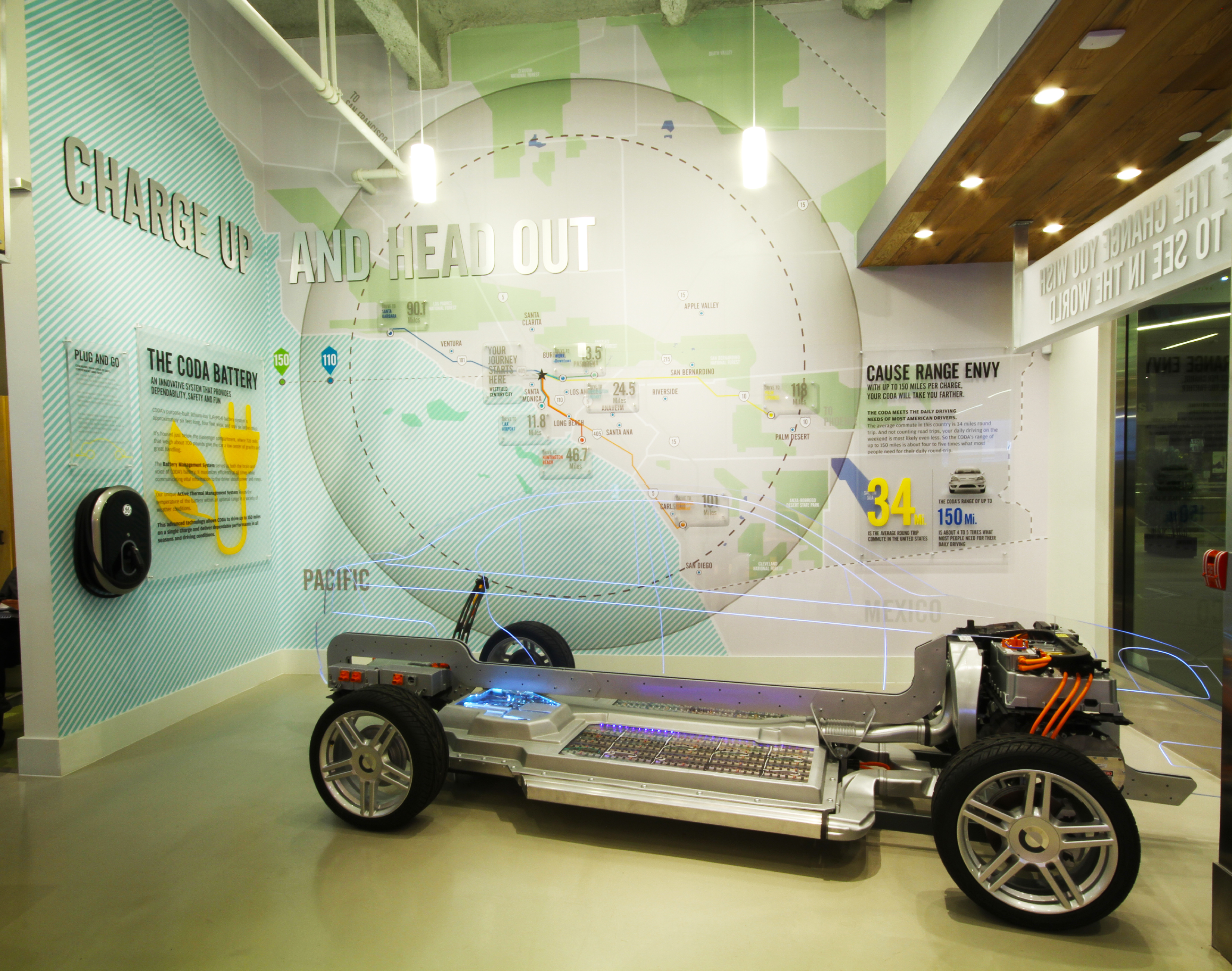
On the back wall are examples of the car color choices, and wheels, and another computer terminal so visitors can design their future Coda EV. On the right side of the store is a pretty cool thing—a Coda EV chassis with the batteries installed. On the wall is a map of the Los Angeles area and circles illustrating how far you can drive on a single battery charge. Coda claims a range of up to150 miles (241 km).
The Westfield shopping center where the store is located is in Century City, a high-class part of Los Angeles between Santa Monica and Beverly Hills. It is not a traditional enclosed shopping mall. Rather, it is open air. So the Coda EV in front of the store is actually outside. This works in Los Angeles, where it seldom rains and the temperature –in that part of Los Angeles, at least—seldom climbs above 80 degrees F (27 degrees C).
Plenty of people are going to walk past the Coda store, that’s for sure. Westfield Century City, the shopping center where the store is located, has 13 million visitors a year, said marketing director Karla Villatoro. The average household income is $150,000, she said. Westfield Century City shoppers tend to be very environmentally-conscious, Villatora said, adding “Coda is a really nice fit for this customer.”
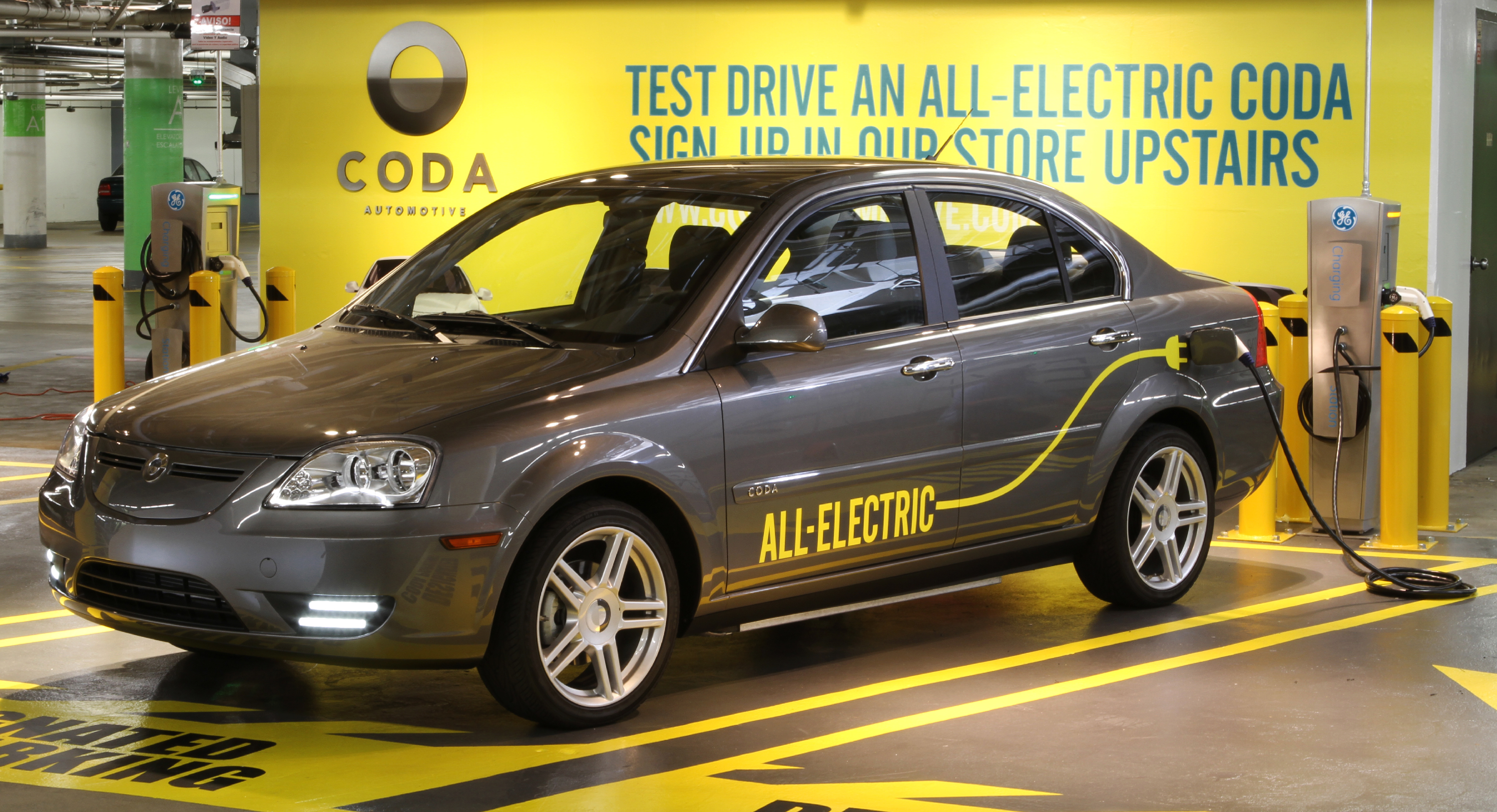
In the parking garage underneath the shopping center, Coda has a handful of its electric vehicles for test drives. They are in their own little area with ample signage advertising the car. There are several charging stations in the area, so consumers see the entire package.
It all looks great. And I know that Coda is only trying to bag the early adopters with the store. It does plan to add traditional dealerships, though it won’t say when. I heard from a Coda exec at the Alt Car Expo that it was signing up dealers. I would like actually talk to some of those dealers confirm some had signed on the dotted line.
I also heard that the price will likely be coming down. That’s good because the Coda EV is pricey– $45,795 before state and federal tax credits. And the Coda sedan is pretty bland looking. It is based on the Hafei Saibao, after all. People who pay extra for an electric vehicle still want to stand out as special because they bought an electric vehicle, according to some studies. Unless Coda buyers put a big EV sticker on the side of their car, which would be pretty ugly, it looks just like a regular car.
A bigger problem is that there still isn’t a big market for pure electric vehicles here in the U.S. and Coda will be competing against some worthy opponents such as the Ford Focus EV, due out in several states late this year.
Coda’s best bet, at least in the near term, may be fleets. It is larger than many of the EVs out there, and its conventional looks won’t hurt it in rental or taxi fleets. I ran into Coda’s vp of fleet sales at the fleets conference on the first day of the Alt Car Expo. Coda clearly is also eyeing fleets for its early sales.
It’s those later sales I worry about. But hey, maybe Coda will be helped by the arrival of new competitors in the segment such as Ford and (maybe) BYD, who also offer conventional looking pure electric vehicles. That could grow the customer base for all of them. I hope it does.
Is China trying to coerce U.S. companies into to handing over electric vehicle technology? The U.S. press has been full of indignant stories recently saying China was doing just that as the price of market entry. http://www.npr.org/templates/story/story.php?storyId=140620106 Maybe the Chinese government has been pressing for foreign technology, I wouldn’t put it past them. GM vice chairman Steve Girsky says China never asked for Volt technology, but for as long as I’ve covered GM in China—which is about 10 years—the U.S. automaker has been pretty obsequious towards the Chinese government in order to smooth its way in China. http://detnews.com/article/20110920/AUTO01/109200383/GM–Chinese-partner-to-develop-electric-vehicle
Even if China is asking for EV technology, however, so what? Chinese automakers still have to take that technology, integrate it with a lot more technology, and turn out a quality electric vehicle. And most Chinese automakers don’t have the knowledge or skill to do that right now. (As an aside, according to my sources in China, Chinese OEs are losing their enthusiasm for producing pure electric vehicles as it becomes apparent they can’t do it without foreign help, and as the government wavers on its policies to support such development.)
The main issue for GM seems to be the lack of subsidies for the purchase of the imported Volt if it doesn’t hand over technology. Even with a subsidy, the Volt would still be pricey, however. And do you think GM thought it would sell lots of Volts in China? Not. As I blogged about months ago, GM is only using the Volt to test the market. GM’s Girsky said as much recently.
So what is GM up to in China as far as electric vehicles are concerned? It plans to use China as a low-cost electric vehicle technology development site, and export that technology globally. That started to become apparent to me when I interviewed John Du, head of GM’s China Science Lab, last year. The Science Lab is part of the GM China Advanced Technical Center, which just officially opened. (see my April 22 blog for more on that interview.) http://media.gm.com/content/media/us/en/buick/news.detail.html/content/Pages/news/cn/en/2011/Sep/092102
Using China to develop technology for GM globally became official GM policy at the recent opening of the Advanced Technical Center in Shanghai. Said GM chairman Dan Akerson : “As one of GM’s most important and comprehensive technical and design facilities, it will lead GM’s global research and development efforts in targeted areas.” Such as electrification.
The opening of the Center followed the announcement on September 20 that GM and SAIC will jointly develop an electric vehicle at the Pan Asia Technical Automotive Center. http://www.insideline.com/chevrolet/gm-and-saic-will-jointly-develop-evs-in-china.html
PATAC, http://www.patac.com.cn/ as it is known, is a 50/50 research and engineering venture between GM and SAIC. That was not unexpected. The two did announce at the Guangzhou auto show last November that they would jointly develop new energy vehicles with architecture “appropriate” for China i.e. lower cost.
According to GM, the electric vehicles developed at PATAC will be sold under Shanghai GM and SAIC brands. That is no surprise. But the press release also contained this tell-tell sentence: “SAIC and GM will also use the architecture to build electric vehicles around the globe for their own purposes.” So, we might see a China-made, GM-brand electric vehicle on the road here in the U.S. one day, though developing countries are the more likely target markets.
So, GM has always planned to bring electric vehicle technology to China, as anyone who followed GM’s strategy in China would know. Far from giving its technology to China in return for market access, GM is using China to develop lower-cost electric vehicles for the global market.
GM’s Girsky said the jointly-developed vehicle will be a dedicated electric vehicle, not based on current model. (I’m not sure what that means for the future of the Chevy Sail electric vehicle that SGM showed at the Guangzhou auto show last year.) http://green.autoblog.com/2010/12/22/general-motors-sail-electric-concept-guangzhou-auto-show/
What does GM’s plan to develop a pure electric vehicle with SAIC mean for local auto makers such as BYD that are already trying to market pure electric vehicles in China? An executive at a local automaker producing battery electric vehicles said he welcomed new entrants into the market. “GM-SAIC doing an EV only brings more credibility to this growing market,” he said. “I like all green products — even those from competitors.”
There is a crucial element missing in all this, of course—a market for the EVs. Will Chinese consumers actually buy electric vehicles? It isn’t happening in the U.S. yet. When will it start happening in China?
Are plug-in electric vehicles now China’s destiny? Government adjusting ambitious plan
Ah, how a year can change things. Or more concisely, reality bites. That’s what China is discovering regarding the overly-ambitious new energy vehicle development program that first appeared in the Chinese media in October of 2010. That plan called for huge numbers of battery electric vehicles to be on the road by 2020. http://wardsauto.com/ar/china_pushes_plan_101110/
Now, however, a top executive at a foreign supplier told me “the wheels are coming off” the government’s EV plans. Executives at several of China’s domestic automakers have told him the plans “will just not work,” said the foreign supplier executive.
For sure, the original plan—which basically assumed China would dominate the battery electric vehicle sector by 2020—is not tenable. The plan will change; the plan will be revised, multiple times if necessary. (The old “crossing the river by feeling for the stones” strategy.) But China is still committed to growing its new energy vehicle sector.
And, the government’s admission that China needs foreign technology to develop its EV sector will mean lots of opportunity for foreign firms who are willing to take their technology to China. (And possibly leave it there. The old risk and reward equation.)
China started out with a false assumption regarding its ability to produce electric vehicles. Since no nation was producing large numbers of battery-electric or plug-in hybrid electric vehicles, and China already produced most of the world’s lithium-ion batteries for consumer goods, China figured it could lead the world in applying that know-how to the electric vehicle sector and be a leader there, too.
Well, that hasn’t happened. China has thrown a lot of money at the sector—100 billion RMB in the program announced in 2010, but much more if the “863” tech funding program http://www.most.gov.cn/eng/programmes1/200610/t20061009_36225.htm is included. I hear much of that initial 100 billion RMB has already been allocated.
But, China’s indigenous firms lack crucial electric vehicle technologies that prevent them from producing safe, good-quality electric vehicles. And by that I mean passenger vehicles, not low-speed EVs. So in the past few months, numerous articles questioning the goal have appeared in the Chinese press—including an essay by premier Wen Jiabao. I just read a piece taken from Caijing Guojia Zhoukan suggesting that a new NEV plan expected–or hoped?– to be released later this month or in September would have a “small adjustment” i.e. it would be more realistic where the goals are concerned. Declared the author: “Battery electric vehicles are our destiny, but PHEVs are just transitional.” http://www.china4auto.com/news/show.aspx?id=263977
But who knows how long that “transition” will last?
Also noteworthy—many of these articles have suggested that China will need to turn to foreign technology, especially in the areas of batteries, electric motors, and electronic control systems. Of course, foreign firms may be reluctant to bring that technology to China, fearing intellectual property theft. But let’s face it, that is sort of the price of doing business in China.
And, foreign firms can adopt the strategy (and attitude) of battery maker Ener1 Inc. www.ener1.com of New York. It formed a joint venture with China’s largest automotive component maker, Wanxiang, www.wanxiang.com in February. At the time, I asked Tom Goesch, president of the transportation group at Ener1, if Ener1 worried about intellectual property theft. He said: “We feel the strategy of having a partner like Wanxiang, a China-based company, will provide us the best protection we can find. Wanxiang has all the reason in the world to protect that intellectual property.”
Foreign firms with good plug-in hybrid electric vehicle technology can also benefit from the apparent shift in focus of the government’s NEV plan. Efficient Drivetrains Inc. http://www.efficientdrivetrains.com/ of Dixon, CA is hoping that will be the case. EDI already is working with Ankai Bus Co. of Anhui, China to develop PHEV buses. And, it just landed a $1 million investment from Silicon Valley China Venture Management LLC to further develop its China business.
Many other foreign suppliers are trolling China’s EV water for business, as well. There is a potential glitch. The government floated a draft law earlier this year that would call for foreign firms with certain key EV technology—mainly in the areas mentioned above—who wanted to manufacture their products in China to form a 50/50 joint venture with a Chinese partner. That hasn’t been mentioned since then though it could still rear its ugly head. But the government seems to positively hunger for foreign EV technology these days, and issuing a law such as that would not be a good way to feed that hunger.
The main casualty of China’s shift in NEV development strategy looks to be those forecasting firms who swallowed the government’s initial announcements without looking behind the façade. I won’t name names, but you know who you are. As I’ve written here before, China will likely be the world’s largest market for electric vehicles one day. But just how it will arrive at that point is still being worked out, like so many other elements of the whole electric vehicle story.
Coda Great Wall letter of intent–filing for divorce from Hafei?
I am going to make a prediction about Coda Holdings, www.codaautomotive.com the Santa Monica-based company that has for what seems like years—probably because it started saying it in 2009—that it will sell electric vehicles assembled here in the U.S. http://www.codaautomotive.com/news-press-release/2009/060309-unveils-2010-all-electric-cars-consumers.html The glider (i.e. body) was to be produced at Hafei Motors in China; the battery produced at a Coda joint venture with Tianjin Lishen www.lishen.com.cn in China. Other drive train parts would come from U.S. supplier companies (but some of those parts are probably made in China, too.)
Those EVs still aren’t here. But, on August 15, Coda announced it had signed a letter of intent with Great Wall Motor Co. www.gwm.com.cn to develop electric vehicles. http://www.prnewswire.com/news-releases/coda-and-great-wall-motors-enter-into-electric-vehicle-agreement-127798853.html Coda will contribute the EV drive train and Great Wall the rest, I assume. Though Phil Murtaugh, CEO of Coda, told me the deal with Hafei was still on, I predict that Hafei will soon be little more than a bad memory and that Coda and Great Wall be happily married.
One only need consider the two potential partners to arrive at that conclusion. Great Wall is one of China’s fastest-growing automakers. Its sales grew 76% in 2010 to 397,362 units, according to J.D. Power and Associates. www.jdpa.com Great Wall exports to some 120 countries, according to Murtaugh. That includes European countries and Australia. It expects to export some 80,000 units this year, according to Great Wall’s website.
Great Wall is privately-owned, sort of. The chairman, Wei Jianjun, owns a big chunk of the company. But the Baoding government, where Great Wall is based, owns a chunk, too. Or used to. And, part of Great Wall is listed on the Hong Kong stock exchange. In any case, it operates somewhat like a private company. And by that I mean it is very open to new ideas and flexible in its thinking. And of course, Wang Fengying, the president of Great Wall, is a woman, which can only mean the company is very forward-looking!
Great Wall started out producing pickups, then added SUVs. In recent years, it has added a line of passenger cars that have a reputation for being
quite well made. At least I read that in a J.D. Power report, and would JDPA say it if it wasn’t true? Great Wall has a technical center, designs its own vehicles, and works with a number of foreign suppliers.
I visited Great Wall back around 2005, before it has really started to grow. It was only producing pickups and SUVs at that time. Then, Wang told me about its expansion plans, including hiring engineers from other countries. Baoding isn’t exactly the most exciting place to live, I countered. Do you think it will be hard to attract them? (Baoding is a small, non-descript city about an hour and a half from Beijing. Maybe less now; a very nice highway connects the two cities.) Oh, she said, they can live in Beijing. They can even live overseas. I thought that was pretty flexible. Overall, I was impressed.
So for years I’ve said good things about Great Wall. And I’m pleased that my initial impression seems to have been correct. Murtaugh said he
has known Great Wall since 2002, during his days at General Motors. www.gm.com It seems he has been looking for a way to work with Great Wall every since. “I approached them when I was at General Motors, with Chrysler, www.chrysler.com with Coda. They are a good company, they are trying to do EVs, they showed me their EV. ‘I said I think we can help,’” he told me.
Now let’s consider Hafei. Hafei Motor Co. is a subsidiary of state-owned Chana (aka Changan) Group, www.chanaglobal.com China’s fourth largest auto group. Chana bought Hafei Motor Co. in 2009. Hafei sold 220,330 units in 2010, down 10% on the previous year, according to J.D. Power.
You be the judge. Where does Coda’s future lie?
 Alysha Webb
 Alysha Webb's ChinaEV Blog