I’ve been reading a lot of comments lately about how the market in China for electric vehicles is going to be the world’s largest in somewhat short order. I suppose people come to that conclusion because of the fast growth of China’s automotive market and the government’s wholehearted support—for now—for electric vehicles.
My friend and former colleague Yang Jian, managing editor of Automotive News China (Which I’m fond of since I launched it. Everyone subscribe! It’s free!) wrote a nice column about the government’s EV fixation. http://www.autonewschina.com/en/article.asp?id=5397
I’m my usual skeptical self about this latest government crusade. But, it seems to have given one U.S. company, Efficient Drivetrains Inc., an opportunity to finally see its technology commercialized. And maybe even get paid for it.
First, my skepticism. At one time, China was going to be a first mover in fuel cell technology. Fuel cell technology was targeted for special funding under the National Hi-Tech R&D Program, which goes by the (very Chinese) nickname of 863 because it was initiated in March, 1986.
I think back to 2004, when I was working for Automotive News in China. General Motors and Shanghai Automotive Industry Corp. announced they would jointly develop a fuel cell vehicle. The vehicle “will serve as an important point of reference for government decision makers in the creation of regulations and standards,” I quoted GM’s then-CEO Rick Wagoner as saying.
In 2005, General Motors unveiled its Sequel fuel cell vehicle (the one that sort of looked like a fish) at the Shanghai auto show. In an interview at that show, a GM executive told me China might be the first place GM built a large number of fuel cell vehicles.
That plan, like Rick Wagoner, is gone. That’s no surprise, because China’s government isn’t talking much about fuel cell vehicles now, though some local automakers such as Chery and SAIC have demo models. Nope, now electric vehicles are the thing.
That’s just fine with Andy Frank. Frank is a professor at the University of California at Davis and the founder of Efficient Drivetrains, Inc. www.efficientdrivetrains.com

Frank is the “father” of the modern plug-in hybrid electric vehicle. Among other accomplishments, Frank worked on General Motor’s EV1 project, building a plug-in version of its pioneering electric car. The car “went like a rocket,” said Frank. It was crushed along with all the other EV1s.
Frank founded Efficient Drivetrains Inc. (hereafter EDI) four years ago to commercialize the technologies he had developed. But he is the chief technology officer at EDI rather than the CEO. “I would rather be the technology guy,” said Frank. “I’ve never really run a business. I would be sort of a duck out of water.”
Frank has met with U.S. automakers about his technology, with little result. “They have their own technologies,” he said. “I’ve visited all the companies, they want to do it themselves. They don’t want to pay you a nickel for it.”
Chinese companies are interested, however, especially now that the government is pushing (and funding) electric vehicle development.
EDI is closing in on some deals with Chinese companies to commercialize EDI’s plug-in hybrid technology, said Frank and EDI president Joerg Ferchau. They wouldn’t name names. But the first uses in China would be in commercial fleets, they said.
Frank relentlessly promotes the suitability of plug-in hybrid electric vehicles for China. The infrastructure already exists, he insists. As proof, Frank offers up that there are already thousands (more probably) of electric scooters in China.
PHEVs don’t require the high-power infrastructure that battery-operated EVs do, he said. “If the cities really want to get the movement going, all they need to do is install the three point plugs. That is doable and possible.”
That’s a bit too optimistic. Most urban Chinese live in high-rises, or at least multi-floor apartment buildings. A scooter can be pushed into an elevator and taken up to be recharged inside a home. Not so a PHEV. So, infrastructure would still be a problem for consumer use. For commercial use, however, it is more plausible.
EDI is working with several Chinese bus companies, said Ferchau. It also has a proposal for a taxi fleet of plug-in electric hybrid electric vehicles. The taxi fleet owner is just interested in the possible cost savings, said Frank. For China’s central government, the objective is to displace the use of oil. “There is an intersection of those two objectives, and that is where we are trying to fit,” said Frank.
Working with Chinese companies requires a lot more handholding than in the U.S., said Ferchau. “Virtually 100% of the projects want us to build the first PHEV,” he said. “So we are not only providing tech, we are also building vehicle. They could build the vehicle, but it is new technology. People in these companies are fairly conservative. They don’t want to take the internal political risk of starting a project that won’t be finished.”
EDI is working with Chinese companies on building a limited number of demo vehicles, and the beginning of commercialization would be in 2011, said Ferchau. Initially only two to three companies would be involved, with fleets of a dozen vehicles each, he said. “All will lead to mass production,” said Ferchau.
Well, maybe. Words don’t always lead to actions. At least EDI has actually started getting paid–a bit– for some of its work in China.
Said Ferchau: “We got our first project deposit.”
That didn’t happen overnight, however. Frank has been talking to China for nearly 8 years about EDI technology. That should be a warning for foreign companies with EV technology looking to cooperate with Chinese companies.
“It takes an awful lot of talk with a lot of people,” said Frank. “The point is you really don’t have a project until money crosses the ocean.”
I’ll watch hopefully for EDI technology to appear in vehicles in China. And hopefully, the Chinese government’s attention span has gotten longer. It probably has. Reducing dependence on foreign oil is a national security issue to Beijing, and China would love to be a leader in electric vehicle development (just as it once wanted to be a leader in fuel cell vehicle development).
Who knows, maybe it hasn’t flaked out on fuel cells, either. Secret fuel cell vehicle research may be going on. A friend of mine heard (from an admittedly not entirely reliable source) that SAIC has a huge fleet of fuel cell vehicles.
For now, however, I’m waiting to see how Beijing’s electric vehicle fixation plays out.
BYD hopes the sun will shine on its new line of business
I’m still skeptical about the chance of success for Chinese automaker BYD’s pure electric and dual mode vehicles, both here and in China. BYD wasn’t especially happy with the tone of this story I wrote for Automotive News.
http://www.autonews.com/article/20100524/OEM05/305249999
But it may have hit on something with its latest line of business, solar energy.
In China, people joke that BYD makes everything that goes into a car except glass and tires. It is taking the same vertically-integrated approach to the solar business. BYD mines the silica that is used in its own solar cells, and it sells silica to other solar cell makers. It manufactures solar cells that are sold under its own brand and other brand names.
In January, BYD announced it would invest 22.5 billion RMB (US $3.32 billion at current exchange rates) to build a solar power battery plant in China. It also manufacturers solar panels and LED lighting, and makes home chargers ranging from 110 to 480 volts for electric vehicles.
Most of those products were on display on July 13 in Lancaster, CA, an exurb of Los Angeles. Lancaster is out in the desert, so lot’s of sunshine. Ideal for showcasing solar technologies, and BYD and KB Homes built a home in Lancaster they claim creates more energy than it uses.
BYD is known in China as a manufacturer of affordable (i.e. economy, okay, cheap) cars. Its F3 compact sedan (powered by a traditional internal combustion engine) was the best-selling light vehicle in China in 2009. The F3 starts at around 56,000 RMB, or US $8,270 at current exchange rates.
But BYD began life as a supplier of batteries for consumer goods such as mobile phones, and is still one of the world’s largest manufacturer of mobile phone batteries. BYD founder and chairman Wang Chuanfu is widely revered (in some circles) as a business genius. I reserve judgment. But, he is certainly ambitious.
BYD supplied solar panels, energy storage batteries, and LED energy-saving light bulbs to the Lancaster home. BYD also supplied a recharger for an electric vehicle in the home’s garage. A BYD e6 battery electric vehicle and an F3DM hybrid were also out front. But KB wouldn’t go along with providing a BYD electric car with each home sold, joked Micheal Austin, vice president of the North American business region for BYD America.
It’s considerably easier to make a solar panel than an electric car. And the batteries that store the energy in the home use the same lithium iron phosphate technology as BYD’s car batteries. But the energy discharge rate of the home solar energy storage battery is slower, so the demands on the battery considerably lower. The batteries that store energy gathered from the solar panels for the home have a 25-year life span, compared to a 10 year warranty for a car battery, said BYD senior vice president Stella Li, who was also in Lancaster.
The drawing on the front of the BYD Solar Energy booklet I received at the event is of a solar panel farm, but the photo on the second page is of Wang Chuanfu and BYD investor Warren Buffett. Wang is handing Buffet a toy car in exchange for Buffet’s wallet. (A joke photo, says Austin. Sort of.)
So, is BYD an automaker that dabbles in solar tech, a battery maker that also makes cars and solar panels, or what, I asked Li?
“We will be an automaker, but a unique automaker,” said Li.
Good answer! Clearly, BYD is learning the U.S. PR game. Another indication the Chinese are learning what U.S. politicians want to hear: In her speech to the gathering of Lancaster, CA city officials, BYD people, KB Homes execs, reporters, and a bunch of LA County Sheriffs (inexplicable to me as this didn’t appear to be a high-crime area), Li stressed how BYD’s “cost-efficient” technology could create more green tech jobs in the United States.
(She also somewhat jokingly pitched the idea of selling the excess electricity the home generated.)
Though I will remain skeptical about BYD’s pure electric and hybrid cars until proven wrong, I think the company could be on to something with the solar business. The technology involved is a less complex than a vehicle. And as Duan Chengwu, a Shanghai-based analyst with IHS Global Insight points out, “The rhythm of BYD’s massive renewable energy program is very harmonious with the Chinese governments’ initiatives.” So, federal and local government support is pretty much guaranteed.
Indeed, Andrew Pan, the North American rep for the south China city of Shenzhen that is home to BYD, was at the Lancaster event (which was really hot, I guess because it is the desert…). Shenzhen’s local government is the first customer in China for BYD’s e-6 all electric cars. Already, 50 have been delivered. Another 200 are on order for a taxi fleet, says Austin.
Few of BYD’s new energy vehicles (to use the Chinese term) have yet been sold to ordinary consumers. No e6 EVs are in consumer’s hands. And BYD’s F3DM hybrid vehicle has just gone on sale to consumers in China. BYD figures early adopters will be the first buyers. Which will be more like trying to sell hybrid vehicles in Detroit than in California.
BYD isn’t going to bring its internal combustion engine cars to the U.S., says Austin. “We will only ship all electric or dual-mode vehicles to the U.S.,” he says.
Austin told me that the F3DM and the e6 will be sold to fleets in the U.S. starting this year, and that the F3DM hybrid would likely arrive here first.
I think BYD will need to upgrade the fit and finish on its cars for the U.S. market. I drove an e6 around the block in Lancaster. The exterior is boring, the interior pretty cheesy. Reminded me of the Coda EV I saw a few months ago. Both were so non-descript my only memory is of the colors blue for the exterior and tan for the interior.
But, BYD has time to make improvements. The fleet sales here in the U.S. are information-gathering excursions. Li said BYD is aiming for sales to consumers in the U.S. to begin in the next two years. Plenty of wiggle room.
It will be interesting to see if, and when, BYD’s electric cars enter the consumer market here. I’m waiting for that to happen in China, too. I’m not sure how long the wait will be. But, I admit to being a little impressed with BYD’s excursion into the solar side of things.
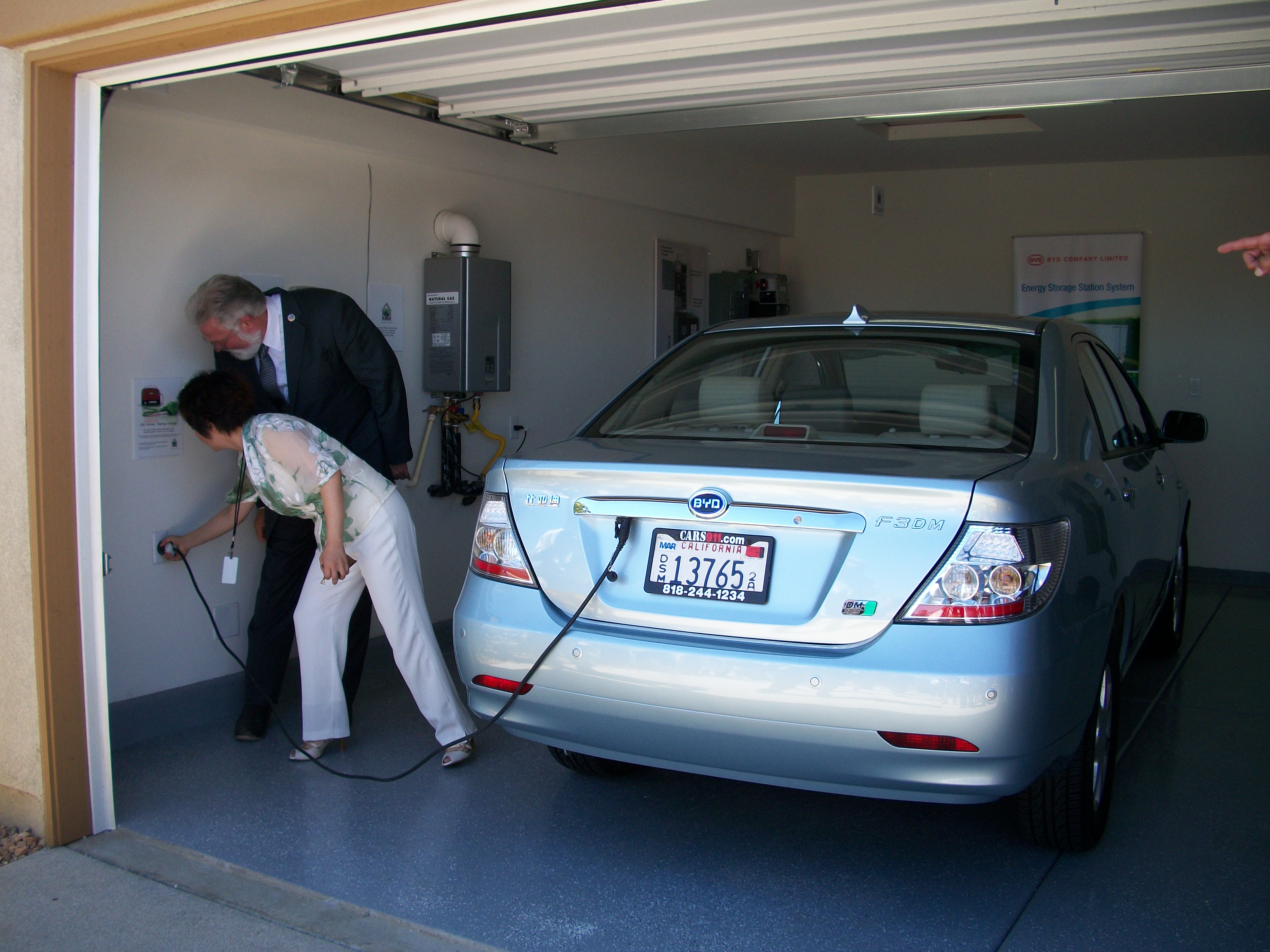
Plugged in in Lancaster
Check this out…
General Motors Europe president Nick Reilly recently fretted that Asian suppliers would dominate the market when it comes to supplying electric vehicles. Perhaps, but it won’t happen without help from foreign technology.
A few weeks ago I met Andy Burke, a professor at the University of California Davis, at the Electric Vehicle Consumer Adoption Summit in San Francisco. Burke is connected to the UC Davis Institute of Transportation Studies, and specializes in hybrid vehicle technology.
He visits China often, and the Institute of Transportation collaborates with Chinese universities. http://chinacenter.its.ucdavis.edu/activity.html
Burke says he is amazed at the poor quality of some Chinese EV batteries. “They’re useless for hybrid electric vehicles,” says Burke. Chinese batteries tend to be high resistance batteries with relatively low power, he says. They are designed for the kind of electric vehicles China has a lot of—low performance, neighborhood EV types.
Well, despite all the talk about pure electric vehicles, just about everyone thinks that hybrid vehicles will account for the bulk of electric vehicle sales, at least in the medium term.
So, Chinese suppliers will miss the boat, right?
No. Because they are acquiring the technology to build better batteries for all types of electric vehicles, hybrid and otherwise, Foreign companies are giving it to China through their collaboration with Chinese companies.
Take Maxwell Technologies Inc. of San Diego. Maxwell makes ultra-capacitors, which allow a battery to charge and recharge very quickly without wearing out. In 2007, it began cooperating with Tianjin Lishen Battery Joint Stock Co. Ltd. to develop applications combining Maxwell’s ultra-capacitors and Lishen’s lithium ion batteries for hybrid vehicles. (This is the same Tianjin Lishen that recently formed a joint venture with Coda Automotive to manufacture lithium-ion batteries). Lishen also assembles ultra-capacitor products for Maxwell.
Lishen produces lithium ion batteries for consumer electronics for Apple and Motorola. But the state-owned company is “very focused on automotive now,” says Mike Sund, vice president of investor relations and communications at Maxwell.
Maxwell has proprietary electrode technology. Maxwell president David Schramm assured investors in an earnings call in February of 2010 that fabrication of Maxwell’s proprietary electrode material “remains under lock-and-key inside Maxwell and won’t be going offshore.” Precautions aside, however, as Maxwell deepens its cooperation with Lishen some tech transfer is bound to occur, admits Maxwell.
Producing in China does save money, and the supply chain in China for batteries of all kinds is very well developed. But it also comes with the hidden cost of creating your future competitors.
So Nick Reilly’s fears aren’t unfounded. Asian suppliers may dominate some sectors of the EV supply chain. But foreign firms will be complicit in that process.
 Alysha Webb
