China’s EV policy keeps automakers guessing
This is a story I wrote for Wards Auto. Reposting here. The media writes about China’s NEV policy is such a shallow way. For example, I didn’t even get into it here but the whole eight percent requirement for automakers doesn’t really mean eight percent of all the cars they produce. There are “multipliers” applied to the PEVs and fuel efficient models produced that mean one BEV, for example, will count for more then one unit. Like California’s ZEV rules, however, trying to understand China’s policy would make my head explode. Also, as I note in this story exactly what the policy will be is as yet undecided.
Here is my story:
SHANGHAI — China wants electric vehicles to account for a significant portion of the vehicles sold in this country in the future, and it wants automakers to produce a growing number of those vehicles. That much is clear.
What isn’t so clear is exactly what the market wants, and what the policies related to EV production will be. That forces automakers to adopt somewhat unfocused future product plans.
Take Ford Motor Co. It plans to eventually offer electrified versions of every model produced at Changan Ford, its joint venture with Chongqing Changan Automobile Co.
Seventy percent of its models will be electrified by 2025, Trevor Worthington, vice president of product development at Ford Asia Pacific says at the Shanghai auto show.
The “vast majority” will meet the Chinese government’s definition of an electric vehicle, he says. “In order to compete in the world’s largest market, you have to be there with the right product at the right time,”
The problem can be knowing just what the right product will be. For example, “I don’t know that anyone understands the Chinese customer (battery) range demands,” Worthington says.
Just before the April show, Ford announced it would begin producing a plug-in hybrid vehicle, the Mondeo Energi, at Changan Ford in 2018. It will also bring to market within five years an all-new fully-electric SUV with a range of more than 450 miles, Ford announced.

Ford Mondeo Energi PHEV will begin production in China in 2018.
Carrot to stick
Then there is the issue of shifting government policies.
Sales of battery electric vehicles in China rose 9.7 percent in the first four months of 2017 to 72,895 vehicles. Plug-in hybrid electric sales fell 27.4 percent to 17,507 vehicles, according to the Chinese Association of Automobile Manufacturers.
Hefty government subsidies underpinned much of that demand. Chinese drivers haven’t shown any real passion for electric vehicles unless accompanied by cash.
But in January, the government announced it will phase out those subsidies. They are expected to be eliminated by 2021. At the same time, Beijing still says it wants electrified vehicles to account for 20 percent of passenger vehicle production and sales in 2025.
In place of the purchase subsidies, China’s central government is planning a carbon credits program similar to California’s Zero-Emission Vehicle program.
China is switching from using a carrot to using a stick to promote electric vehicle sales, says Jason Forcier, CEO of battery maker A123 Systems,
“It is going to shift the burden (for creating demand) to the manufacturers,” he tells Wards Auto during the Shanghai auto show.
Auto makers will likely be forced to produce electric vehicles at a loss to meet the government requirements, he says.
In theory, the carbon credits the automakers receive will offset the losses, says Robin Zhu, senior analyst in Hong Kong at investment research firm Sanford C. Bernstein.
“But you essentially go from a system where there are government subsidies to a system where OEMs cross-subsidize each other via the credits system,” he says.
All automakers face the same cost issues, says Worthington. “You have to be ready to go.”
In any case, the policy is likely to change, pretty much everyone agrees. That often occurs here.
Government mandates “are in flux,” says Worthington. “You don’t always know what is going to happen.”
Says Forcier: “It wouldn’t be shocking to me if we get to the end of this year and this policy gets updated. It happens in China a lot, and it happens rapidly.”
Indeed, exactly what form China’s ZEV mandate will take is as yet unknown. Two government offices, the National Development and Reform Commission and the Ministry of Industry and Information Technology, have each published their own version.
Bernstein, in a November 2016 report, calls it “a riddle, wrapped in a mystery, inside an enigma.”
The industry consensus now, says Zhu, is that the EV credits target will be delayed by either a significant phase-in period or lower 2018/2019 quotas.
“It is a source of frustration” for automakers,” he says.
Chinese ownership has its perks for A123
Correction: Karma, the former Fisker, is A123’s only high-voltage customer in North America. Forcier wrote me to say that outside of North America: “We have high voltage programs with many OEMs including SGM, SAIC, Chery, GAC, Haima and several bus companies.”
It’s about time I wrote another ChinaEV blog and given my penchant for revisiting companies I have written about before, I thought battery maker A123 Systems Inc. would be a good topic. I met with A123 CEO Jason Forcier last month during Auto China in Shanghai. The battery maker has been through some big changes since we last spoke, including a bankruptcy filing. But A123 looks to be on a good path now.

Forcier says A123 is on a tear nowadays. 48V is its sweet spot.
As you likely know, A123 was in January of 2013 acquired by Wanxiang, one of the largest (if not the largest) auto components maker in China. That gave it financial security, but that is not the most valuable benefit of being owned by Wanxiang, as it turns out. Read on to learn more.
The battery maker reorganized in February of 2013, says Forcier. “The company has been on a tear since then,” he says. Its 2018 revenue will be close to $500 million, he told me, compared to less than $100 million in 2012. As you might expect given the opportunities in China, A123 is investing heavily in its China footprint, to the tune of $200-250 million a year. That is primarily to support the China market but China is also the base of A123’s battery cell production and it aims to export cells to Europe from China.
Though we hear mostly about the BEV or PHEV markets in China, which require fairly large batteries, China is the largest 48V battery market in the world, says Forcier, and half of A123’s 48V battery business globally is in China. 48V batteries are used in mild hybrids – vehicles with start-stop systems – and improve fuel efficiency quite a bit. China is mandating fuel economy of 5.0 liters per 100 K by 2020. “That will be really hard to meet without a battery on board,” says Forcier.
The market for electrified vehicles with larger batteries is primarily policy-driven in China. That has meant government purchase subsidies, but those are now expected to be phased out by 2021. Replacing subsidies will be a program resembling California’s Zero-Emission Vehicle policy, which compels automakers to produce and sell a certain number of BEVs/PHEVs. Even with that change, however, China will still remain a huge 48V market because meeting the fuel economy standards will require a mix of engine types. Of course, A123 still serves the larger battery market as well but its main (only) customer is Karma Automotive, which is also owned by Wanxiang.
Forcier has some interesting observations on Chinese automakers’ battery technology. They are investing in it, he says, but they are not on the same level as global OEs such as GM or VW. And, “BMW knows way more about batteries than Chinese OEs,” he says. It surprised me a bit that things haven’t changed that much since I started blogging about China and EVs. Sure, the local manufacturers have made great strides in electrification compared to five or six years ago. But, they are still focused on cost, says Forcier. Most aren’t making the R&D investments that the foreign automakers are in battery systems. Instead, they are sourcing entire battery systems out to suppliers, says Forcier. Same old story.
To be sure, he says, some Chinese automakers, such as SAIC, are engineering the systems themselves, and own the technology. But they are still playing catch up. “Over time, the idea is they leapfrog the rest of the industry,” says Forcier. “I am not sure I see that happening.”
Speaking of SAIC, I asked Forcier what became of A123’s joint venture with SAIC called Advanced Traction Battery Systems. “It is doing very well,” he says. “Still producing and growing.” For background of that JV see my blog of March 28, 2012. ATBS is now a captive battery supplier to SAIC.
The benefits of Chinese ownership
The SAIC JV was going to be A123’s approach to the China market, says Forcier. But, “our thinking changed.” I’m sure it did since A123 was acquired by Wanxiang. And that’s a good thing. The Chinese government in 2016 released a list of approved battery suppliers i.e. those that will receive subsidies. One criteria, it seems was that the company have significant manufacturing capacity in China. No foreign firms made the cut. A123, by virtue of being owned by a Chinese company and manufacturing in China, does qualify. “We have the best of both worlds,” says Forcier. “We are certified in China, have global technology, automotive knowhow, and a quality mindset.”
That has really paid off with General Motors, which is one of A123’s best customers, says Forcier. It also doesn’t hurt that A123 has a tech center in Michigan, where GM has a battery plant and its global headquarters. A123 also works with many other global OEs who do business in China. “We booked a lot of business in the last 18 months,” he says.
With a lot of business, Chinese certification, and a Chinese owner who is not lacking for cash, Forcier seems pretty satisfied with A123’s situation. The Chinese certification is really A123’s ace in the hole, it seems. “We get calls from our competitors all the time because they are locked out” of the China market, he says.
General Motors looks to snatch EV lead in China away from BYD
General Motors China has long had a knack for elbowing in to segments domestic automakers are doing well in and taking market share from the domestics. Its electrification road map, announced in late August, is the next chapter in that strategy.
Local automaker BYD is China’s top seller of electrified vehicles. Its Qin and Tang plug-in hybrid electric vehicles are selling like gang busters. That hasn’t escaped GM’s notice.
“The Qin and Tang are very viable in Shanghai,” Martin Murray, deputy director, electrification engineering at GM China tells ChinaEV. “That has given SAIC and GM the motivation to compete.”
BYD sold 19,134 Tang SUV plug-in hybrid electric vehicles in the first six months of 2016, and 11,129 Qin D segment units. They were the top two electrified vehicle models in China, according to electriccarsreport.com. Total PHEV sales in China for the first six months were 126,950. (BYD also recently began to produce pure electric versions of the Qin, hence the photo below, which I took at the BJ show in April.)
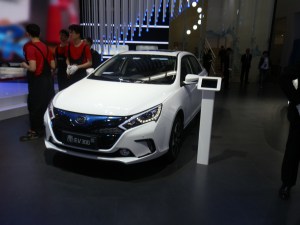
BYD Qin EV 300 pure electric vehicle at the Beijing Auto Show in 2016
The Qin and Tang buyers are “real people” (as opposed to ghost companies and government employees, I suppose), says Murray. But he sees a weakness. “We think those cars can be better,” he says.
GM China is out to prove that.
“We are looking at GM technology which has the safety and performance people like, and GM’s affordable models, and putting the two together in China,” he says. “The object is to make these high volumes. We are going protect these (GM) brands; these are going to be super high-quality products.”

Murray didn’t say it, but implicit in his comments is the idea that foreign automakers -or at least GM — can still produce a better car than local automakers in China. Chinese automaker’s quality and safety has improved a lot, so it is not a sure thing that GM China can produce a much more high-quality, much safer electrified vehicle than BYD.
But even an equally good, equally safe product would draw its share of buyers because the GM name in China does carry the connotation of a good, safe vehicle. And Chinese consumers often still trust foreign automakers more than local ones. So BYD better watch out.
Battery production localization – woohoo!
I think the most interesting, and indeed most crucial, part of GM China’s electrification road map is the plan to fully localize its battery pack production. It will build a new battery plant in Shanghai to accomplish this. That will help it compete with BYD on price and to produce a vehicle that consumers will still want to afford even after the government subsidies for electric vehicles run dry.
Murray says much of the current demand is driven by government subsidies, but GM figures that the subsidies will end at some point. But the need for GM to sell electric vehicles in China will not because of China’s aggressive fleet fuel economy standards. Given that, “the key point is to have affordable (electrified) cars,” says Murray.
The battery is the most expensive component in an electrified vehicle. Local production should help keep the cost down.
Murray has significant experience producing batteries, including leading battery pack engineering at GM’s battery operations in the U.S. He tells ChinaEV that GM will duplicate the entire battery production process at Brownstone Charter Township in Michigan at the planned Shanghai plant.
That means, among other things, that the plant will produce a full range of EV batteries, from power packs for hybrids to high-density energy packs for extended-range EVs such as the Volt. “We will make all the products in China that we now make in Brownstone,” says Murray.
Interestingly, he didn’t mention pure electric vehicles. And a pure electric vehicle isn’t included in the products GM mentioned in the electrification roadmap press release. The first electrified products that will be localized are the Chevrolet Malibu XL hybrid and Buick LaCrosse hybrid, and the Cadillac CT6 PHEV.
Why no pure electric vehicle, I ask Murray?
GM’s GFE electric propulsion system is scalable, he says, without really answering my question. He mentions the Springo BEV, a derivative of the Spark small car that GM China produced in limited volume. “We have plans,” says Murray a bit mysteriously.
Local production usually means local sourcing. What will GM China source locally and has GM identified the suppliers, I ask? There are 60-90 parts for each battery pack, says Murray. GM went through the list and identified parts that “made sense” to source locally, he says, mentioning sheet metal, harnesses, hoses, and the like.
Those are components that all vehicles use. What about EV-specific components such as battery cells, I ask? GM purchases cells from partners, he says, and “we are going to make packs here in China with cells from our friends.”
Some friends are more equal than others, it seems. LG is GM’s partner at its battery plant in Michigan. “But not necessarily in China,” says Murray.
GM’s long-time partner in China, SAIC, has a joint venture with A123, Shanghai Advanced Traction Battery Systems Co that produces battery cells in China. Will GM be sourcing form ATBS, I ask? “We do stay in close touch with SAIC, says Murray. “They have a lot of interesting ideas.” Sounds a bit like a no to me.
The planned battery plant in Shanghai is, in any case, a joint venture with SAIC (or perhaps with Shanghai GM, the press release is a bit unclear and I forgot to clarify). GM has licensed “all the necessary” intellectual property to SAIC GM, says Murray. The battery plant project is being driven by the Pan Asia Technical Automotive Center, a 50/50 GM/SAIC research and engineering center in Shanghai.
“Our goal at PATAC is to leverage ideas in China, (and) leverage good ideas from local suppliers,” says Murray.
Finally, I asked Murray if GM China would be producing China-specific electrified vehicles. His reply leads me to believe GM is taking the Chinese approach to planning, i.e. “crossing the river by feeling for the stones.” Which is a good idea as that is the way China’s central government is making its NEV policy, so best to be flexible.
GM will have some products that are specific to China, but have common solutions under the hood, he says. More details will come out over the next four to five years, he says.
“We are going to set the industry trend for driving experience,” says Murray. “We are here for the long run.”
I recently had a conversation with Rebecca Hough, CEO of Evatran, the maker of the Plugless Power wireless charging system for electric vehicles. Seems her company is making inroads in China, sort of. I still await the Chinese government’s commitment to building a wireless EV charging infrastructure, however.

About a year ago, I also spoke with Hough (and blogged about it). At that time, Evatran had just announced an investment from Zhejiang VIE Science and Technology Co, a Chinese supplier.

The relationship between VIE and Evatran continues to grow; the next tranche of investment from VIE just occurred. I thought it was a good time to check back with Hough about the JV and her overall take on China’s electric vehicle market.
The most recent investment of $2.3 million occurred in July, and it was the final tranche of the $5.5 million initial investment by VIE in the U.S. Evatran entity. The two earlier tranches, or $1.6 million each, occurred in mid- and late-2015.
Additionally, Evatran and VIE will invest $5 million in the China-based, Hong Kong-registered joint venture. Evatran’s portion will consist of a limited amount of capital plus assignment of intellectual property, as well as technical and engineering support, Hough tells me. Evatran will have a 25 percent ownership stake in the JV.
The target customers for the wireless charging system – known as Plugless Power, in the U.S. – are Chinese automakers, many of whom are already VIE customers, says Hough, Hough indicated the target product was passenger cars, and based on VIE’s website, it seems to supply all the major domestic OEs as well as SGMW.
Rather than sell Plugless Power as an aftermarket product, Evatran and VIE hope to become suppliers to the auto makers themselves. That requires automakers to have plans to produce electric vehicles with wireless charging technology installed. So I guess part of the plan it to use the VIE connection to convince automakers to begin producing electric vehicles that can be charged wirelessly.
As with most things China, there is an issue. China doesn’t yet have a national wireless charging standard. SAE in the U.S. is currently evaluating the J2954 wireless charging standard for light duty plug in/electric vehicles. It is expected to be standardized “after the 2016 timeframe.” But China doesn’t want to use that standard. As Hough pointed out, “China often has its own standard, but close.” Meaning rather than just adopt the same standard as the U.S., China wants its own. Sigh.
Hough figures the lack of a standard in China isn’t a problem. She says that China will likely be similar to the U.S. in that after automakers begin to produce electric vehicles that use wireless charging, a standard will follow.
“In China, we have an opportunity to use what we learned in the U.S.,” says Hough. “We go to the OEMS, says ‘we can put this in the field without having a standard, then develop a standard.”
It could be three to five years before a standard is developed and rolled out in China, she says.
Is the China market ready for wireless charging? Yes, says Hough. And I do hear from my industry contacts there is a lot of interest in wireless aka inductive charging. But as I said at the top, I await a sign from Beijing.
To be sure, sales of new energy vehicles – which includes PHEVs, BEVs, and HFCVs though we can disregard HFCVs for now – is growing. In the first six months of 2016, some 126,000 battery electric vehicles were sold in China, and some 44,000 plug-in hybrid electric vehicles. BEV sales rose 126 percent on-year; PHEV sales rose 62 percent, according to the China Association of Automobile Manufacturers.
It is uncertain if Chinese consumers actually feel any enthusiasm for electric vehicles of any kind, of course. They do like the hefty government subsidy that comes with the purchase, however. One thing is clear – Beijing isn’t backing down on its plan to make China a big market for electrified vehicles.
That is why Evatran is working with VIE, says Hough. Evatran figures it can’t be a global player if it doesn’t have a presence in China, she says.
As it has developed relationships with manufacturers over the last year, “the real eye-opener is looking at the work done by the companies themselves (on EV development). You get pretty bullish about what the company can do and the market not just in China but globally.”
For the next six months Evatran will work with VIE on getting the JV up and running. The VIE can handle manufacturing the actual charging pad. Evatran’s expertise will be vital to adapting its standard Plugless Power charging system to the Chinese vehicles.
The JV aims to start manufacturing by the end of 2017. It should have a customer lined up by then, says Hough. “We have a front runner,” she says.
The Evatran/VIE venture is focused on passenger vehicles. Meanwhile, other Chinese entities are going after the bus market. Chinese telecom equipment company ZTE last year said it was developing wireless charging for buses, and focused on public infrastructure. So it must smell government support. I haven’t seen or heard much about it lately, though.
Wireless charging is a great idea for China. Most people don’t have a drive way, much less garage. But the government hasn’t even made good on its plan to install a lot of regular charging posts yet. So I’m skeptical that it will rush to install wireless charging pads. Perhaps the automakers themselves will do this. Someone will have to.
China considers combining carbon credits and CARC in one policy — what could go wrong?
China is still struggling with how to implement a Zero Emission Vehicle-like credit program. Concurrently, it is working on a new fuel economy CAFÉ-type regulation, and aims to implement an industrial carbon credits program. As usual, China won’t simply borrow California’s ZEV program, or copy someone else’s carbon credit program. The ministries in Beijing want to come up with their own, one with Chinese characteristics. And that could be a problem.
Back in November of 2014 I blogged about how China was interested in putting together a program similar to California’s Zero Emission Vehicle program, or ZEV. The program requires automakers to sell a certain number of zero emission vehicles in the state, a number determined by the total volume of vehicles that automaker sells in California, where I live.
I wrote about China’s ZEV plans again in November of 2015. At that time, An Feng, co-founder of the non-profit Innovation Center for Energy and Transportation (iCET) told me ICET wants to establish four pilot cities in China to try out the ZEV program, An told me back then — Beijing, Shenzhen, Chongqing, and Shanghai. The caveat, he said, would be enforcement. “California has worked because it has a very high penalty,” said An “In China, who has the authority to introduce the penalty and manage it?”
That is still a good question. A number of ministries in China have their toe in the transportation/energy policy pond. That has slowed implementation of any ZEV-type programs. As well, ZEV programs, with their multiple levels of credits for various types of low- or zero-emission vehicles – are complicated enough (just try reading the details of California’s ZEV credits regulation without having your eyes glaze over), but China wants to make such a program even more complex. It wants to combine an automotive carbon credits program i.e. a ZEV-type program with an industrial carbon credits program. A two-track carbon credits program under one umbrella, as it were.
Meanwhile, a new corporate average fuel consumption program (China’s version of CAFÉ) is being created. And this is where it gets tricky. The Ministry of Industry and Technology (MIIT) is working on the CAFC standards. The National Development and Reform Commission (NDRC) is working on implementing the carbon credits program.
“There is a consensus now that some form of mandate will be adopted,” said one of my sources. And there is an agreement between MIIT and NDRC that the policy should be a national one to avoid local protectionism, he says. But, MIIT wants the CAFC regulations and ZEV/carbon credits program to be part of the same policy. This is very problematic, says the source.

BYD and Daimler have combined to produce an EV
“A ZEV mandate is futuristic. If the future is a cliff, you can pay someone to jump off the cliff for you,” he says. “CAFÉ is like high school graduation; you either make a passing grade or you fail. With ZEV you can buy your way out, CAFÉ is not tradeable.”
What is the danger if China combines the two? Well, the CAFC details haven’t been worked out as to how many credits each kind of alternative fuel vehicle will be worth. And, each automaker will almost certainly have to produce a certain number of EVs to meet CARC, but Beijing is considering also requiring them to produce some EVs to meet the carbon credits requirement.
The source posits a hypothetical situation that shows how problematic combining the two policy goals may be: A local automaker that produces mainly SUVs has several possible strategies. It could innovate with its ICE vehicles, using lightweight materials and the like, to improve the vehicles’ fuel economy. Or it could produce a lot of hybrids. Or the automaker could go all-in on EVs, founding its own EV manufacturing company which produces “some garbage EVs” which the automaker then sells to its own leasing company, thus meeting the quota. None achieve the government’s goal of making China a production center for high-quality EVs.
Another possible outcome: The EV quota is set very high. The automaker can’t meet the quota for the stringent standards. That forces the automaker to either produce trash EVs or cheat and bribe its way into compliance. “How do you know in a mixed system what is the proper level of EV requirements for the quota?” he says.
The debate continues regarding a combining CAFC and ZEV/carbon credits under one policy. I guess the good news is that MIIT and NDRC have agreed that any policy needs to be nationwide to avoid local protectionism. The bad news is it could be a bad policy.
So let me say right up front that I wrote a pretty mean blog in December of 2013 about Kai Johan Jiang, the Chinese-Swedish founder of National Electric Vehicle Sweden AB, or NEVS. Not about him personally. But about his purchase of Saab. I mean, Saab isn’t that sexy a brand and NEVS was making some pretty bold claims back then. NEVS is still making some bold claims. But I’m ready to eat crow if I turn out to be wrong. So I’m taking a second look at NEVS.
This second look was prompted after a friend of mine visited NEVS in Tianjin and had some positive things to say about the Chinese-Swedish company. The most positive thing he reported, admittedly, is that NEVS seems to have excellent connections with China’s central government and also a steady stream of funding via private investment and also incentives from the Tianjin Binhai Hi-Tech Industrial Development Area (THT), which is building a new factory for NEVS and has given them the land for free, he said.
My friend was also very impressed with Kai Johan Jiang, who made a fortune from biomass. Jiang founded a company in China that uses Swedish technology to produce electricity using biomass. The company, called (apparently, I am still trying to envision the org chart for Jiang’s companies) National Bioenergy Group, has no trouble selling every kilowatt hour it is generating to China’s State Grid, said my friend. “It appears (Jiang) has extremely good connections with the State Grid,” said my friend.
But, said my friend, Jiang sold that business three years ago and used the proceeds to buy Saab. On his LinkedIn page, Jiang is listed as Chairman of State Holdings. State Holdings is based in Beijing. And his company, National Modern Energy Holdings (NME), is described as the main owner of NEVS on the NEVS website. NME also owns State Holdings. Got that?
Jiang’s good relations with State Grid paid off in March of this year. NEVS signed a contract to provide “mobility solutions” and supply electric vehicles to the State Grid. That is a sweet contract. In fact, NEVS has been on an acquisition trail ever since it was founded in April of 2012. It acquired the main assets of Saab in August of that year. You can see the rest of its acquisitions on its timeline. Clearly NEVS has funding.
Headquartered in Sweden, NEVS has production facilities in Sweden, invested in a production facility in Fujian, and is building one in Tianjin. It plans to use the Saab 9-3 platform to produce several pure electric vehicles, and is developing a platform of its own for another lineup of EVs.
Let me digress a bit. I must say that NEVS has been a pleasure to deal with. For one, its website is lovely. Nice looking, and more importantly full of useful information. And its public relations people are actually helpful! Though I didn’t get the interview I requested, they did answer my questions in a timely manner. So that also makes me think well of NEVS.
So, back to its production plans. It will launch the 9-3 EV sedan, using the Saab platform, in China in 2017. NEVS plans to start to produce painted bodies in Sweden then ship them to China for final assembly. It will also manufacture a limited number of 9-3 EV sedans in Sweden for sale there.
Meanwhile, NEVS is developing its own Phoenix architecture, a scalable and modular platform that “makes it possible to manufacture cars from the B to the E segment,” said NEVS director of communications and public affairs Mikael Oestlund (there is an umlaut on the O but I can’t reproduce it. So one puts an e, right?) In an email.
In 2019 or 2020 NEVS plans to launch a lineup of EVs based on the Phoenix architecture. It will include: Distinctive Family SUV, D segment; Active All-rounder D segment fastback; Urban Adventurer D fastback x (I am reproducing what NEVS sent me. Not sure what x stands for); Sporty Urban SUV, C segment SUV. He sent some sketches, which are not of actual models, he said, rather they are examples of the types of vehicles NEVS plans to develop.



Quite ambitious. And they will be entering an already crowded SUV segment in China. I asked the spokesman why NEVS thought it would be successful in China. He replied: “We think we can deliver a high quality EV product, based on the innovative Swedish Saab car heritage. We have already interesting framework agreements for fleet sales in China.”
By framework agreement I assume he is referring to the $12 billion agreement with Panda New Energy Vehicle to deliver an initial 150,000 EVs, and later an additional 100,000 EV “products and services.” Those deliveries will begin in 2017, said Oestlund, beginning with the 9-3 EV sedan, and also transport and logistics vans. The vans will be produced at the plant in Fujian.
The deal with Panda was announced in December of 2015. I am skeptical. Panda is a new energy vehicle leasing company “cooperating with many chauffeured car service platforms in China.” I think it must have ties to large SOEs or local governments that are going to be required to include new energy vehicles in their fleets going forward. So a captive market of sorts. Nonetheless, I am skeptical.
I asked Oestlund if NEVS was confident the agreement would be executed. “We have a framework agreement that we are planning for to be able to deliver upon,” he wrote in his reply. Good luck.
In any case, because NEVS is a very professional company that, as mentioned, seems to have excellent connections in China, it may have a chance. I will reserve judgement and follow its progress with interest.
One thing was the same at Auto China this year – I was a bit dazed by the end. Part of it is the sheer size, but a larger factor is that I generally have flown in from California one or two days before nowadays and am super jet-lagged.
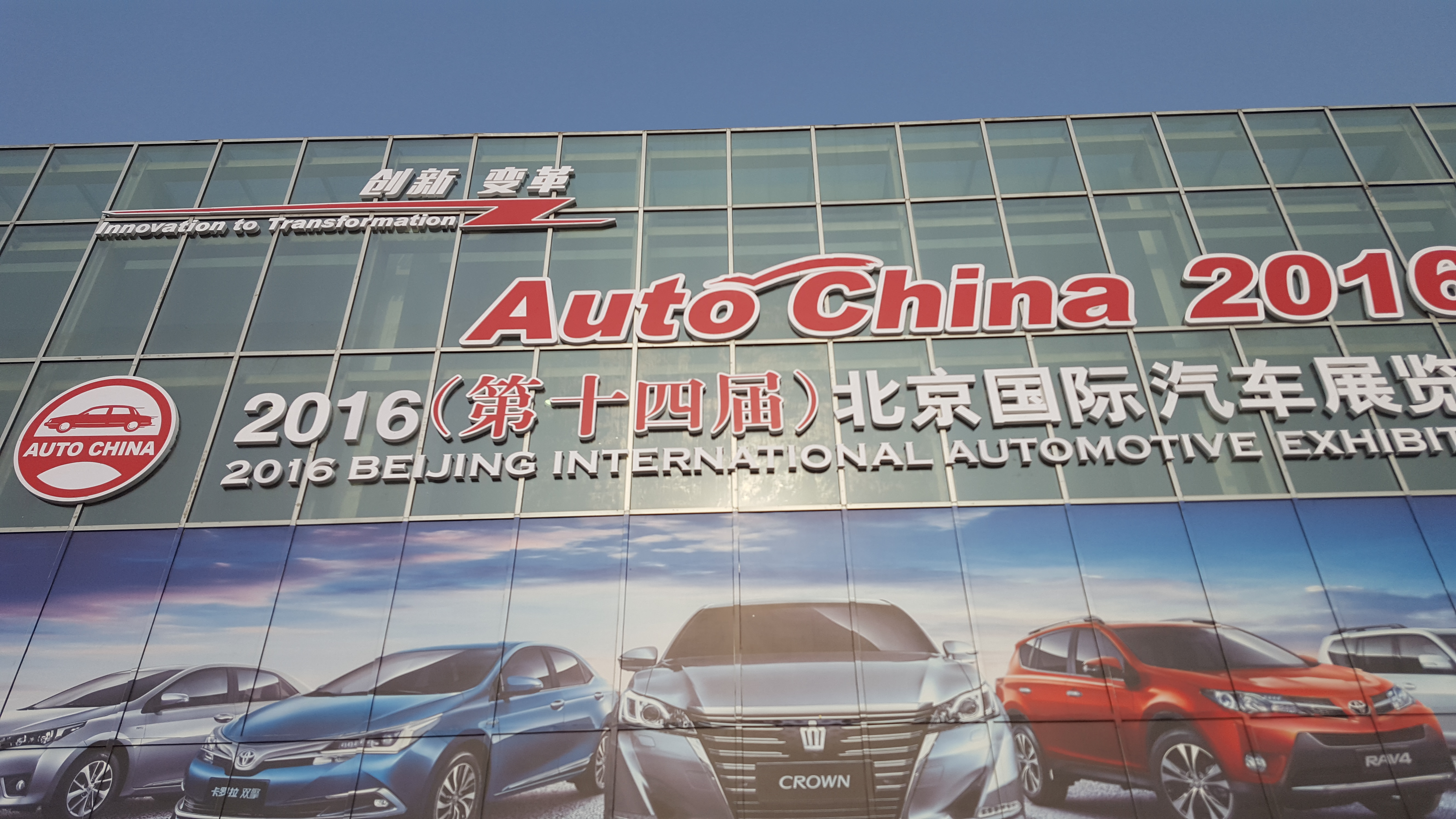
This year’s show was in Beijing. I used to dislike the Beijing venue intensely. The Shanghai venue, out in Pudong, was easier to navigate and in general more pleasant. Sadly, I now favor Beijing over Shanghai. The new Shanghai venue out in Hongqiao is horrid. I spent about 20% of my time there lost last year. But I rant.
The mood was good at the Beijing show despite all the doom and gloom in the U.S. media about how China’s economic growth is slowing and along with that growth in the auto market. As Lars Danielson, SVP of Asia Pacific for Volvo said to me, the China market is expected to grow five to seven percent this year and “you don’t find that” in developed markets.
Electric vehicles were everywhere, natch. Interestingly, EVs (including PHEVs and BEVs) seemed to be a bit more prevalent than at the Shanghai show last year. But, as my friend and former colleague Yang Jian pointed out in his column in Automotive News China, hybrids were the real story. Hybrids don’t receive subsidies in China, but automakers have to produce them in order to meet China’s fuel economy requirements. But I am not writing about hybrids.
Before the show, my friend Frank O’Brien at Magna had told me the two automakers that seemed the most serious about actually producing EVs were BYD and BAIC. BYD is a given. EVs are its ace in the hole. And it had plenty of electrified vehicles on show at its booth, a mix of PHEVs and BEVs.

The latest generation of the BYD Qin
BAIC is a bit more interesting.
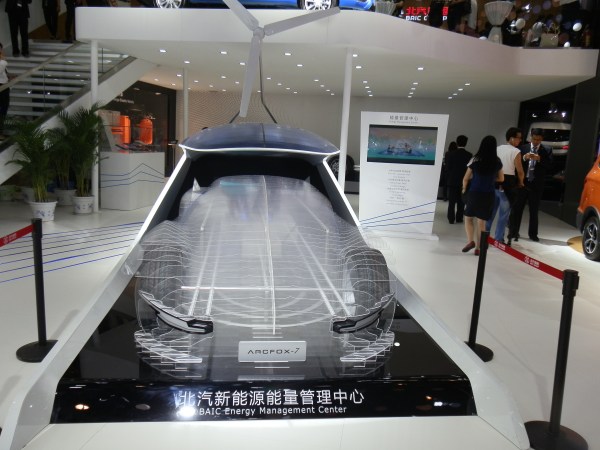
BAIC had a fairy large EV technology exhibit.
It is selling a lot of EVs – and in BAIC’s case I mean BEVs.
BAIC has gone all-in for BEVs. That is likely because its owner, the Beijing Municipal Government, is pushing it to do so, and rewarding it for doing so. The incentives are higher for BEVs. Importantly, the technology underlying BEVs is also easier for a domestic OE to produce. PHEVs require that tricky integration of the electric and non-electric drivetrains.
I figure Beijing Municipality having a lot of EVs is a good thing. If the capitol of China isn’t committed to electrification, why should the rest of China care about it?
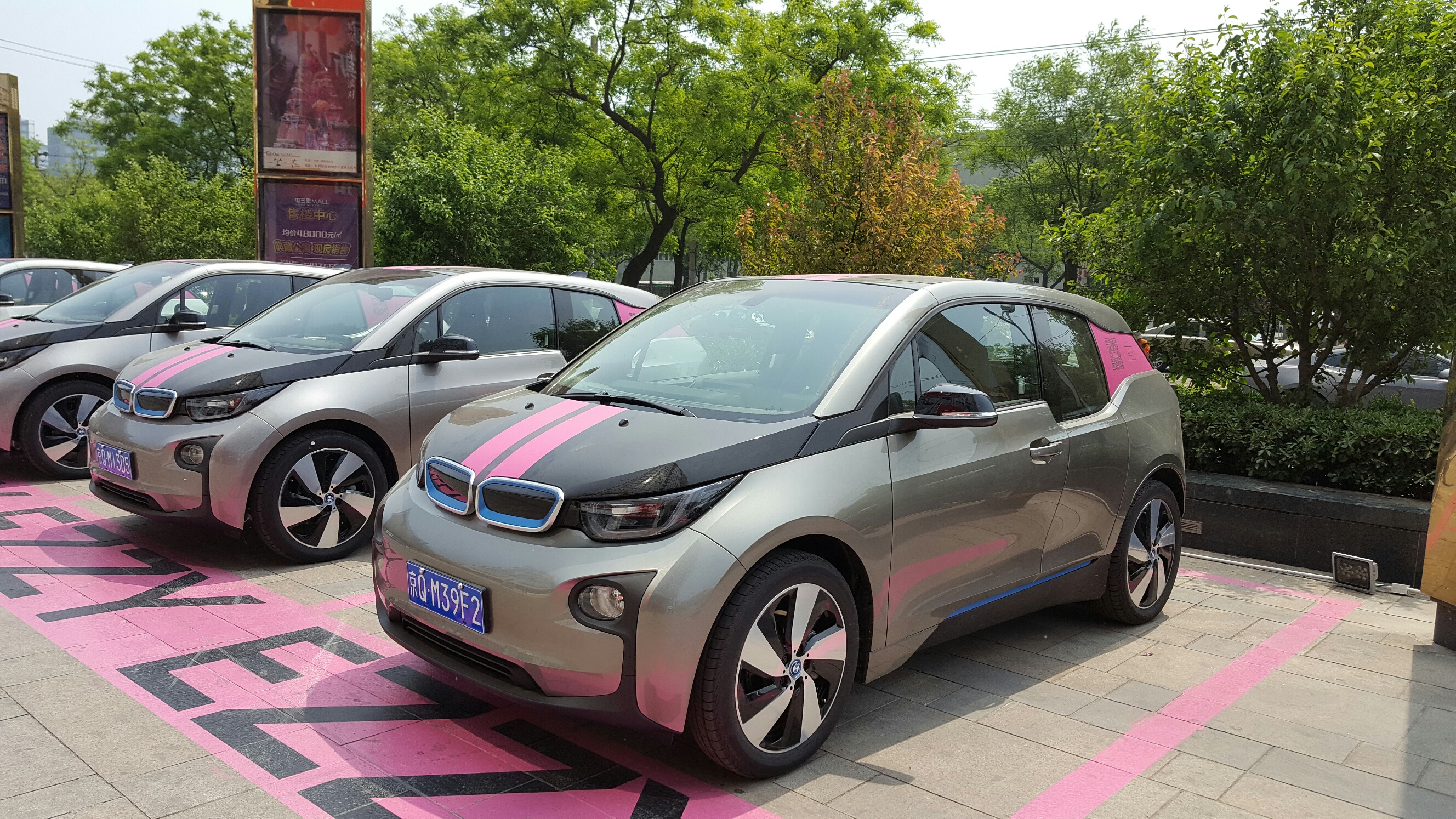
BMW i3’s available to rent .
Li Feng, president of BAIC, told me that BAIC would sell 70,000 EVs this year, up from 20,000 last year. That’s a big jump but Li “comes from marketing, so he is always thinking about the marketing angle,” one of his underlings on the sidelines told me. (Li said this to me personally. I talked to him while wandering around the show floor. He was doing an interview and I snagged him afterwards….).
The thing is, there really are a lot of BEVs driving around Beijing. Many, many BAIC E150 BEVs, a cheap little basic EV. But my friend Rob Earley, who lives in Beijing and is COO of MotionECO, a company turning waste cooking oil into biodiesel, tells me there is a Tesla in his complex, and that poorer folks with lesser EVs run extension cords down from high floors to charge their EVs. And I did notice some other EVs,
Of course, Beijing has a lot of sticks and carrots to encourage EV ownership. I wrote about these in an earlier blog – perhaps my last one, I’ve gotten so lazy. Owners of EVs can drive any day on BJ’s clogged freeways, which might not seem like a reward but regular old ICE vehicle owners are restricted according to license plate numbers. BEV buyers also receive nice subsidies towards the purchase.
China won’t reach its rather large New Energy Vehicle (including PHEVs and BEVs) sales target with subsidies alone. But they are necessary to give the segment a boost in the beginning. Or, as Lorraine Yan, CEO of Shenzhen BYD Daimler New Technology Co. Ltd, the manufacturer of the Denza brand of EVs, said at Denza’s presser, though the EV sector can’t depend on government policy alone, or forever, the segment is like a toddler and the incentives are helping it learn to walk.
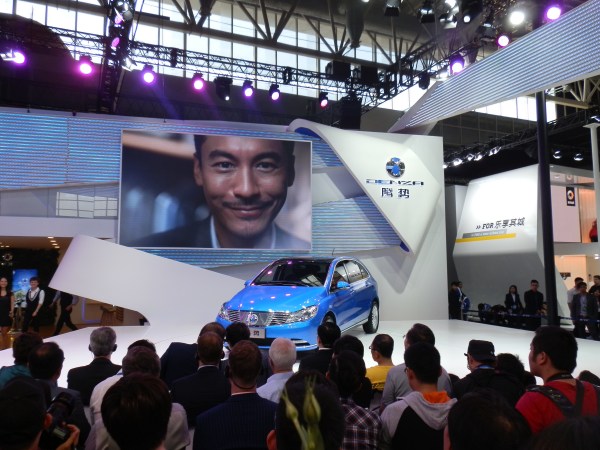
Denza, a JV between BYD and Daimler, is still alive.
If there was a theme at the show, beyond EVs, SUVs and luxury cars (both separately and as one segment i.e. luxury SUVs) it would have been car-sharing, or ride-sharing. I heard those words from numerous automakers, including LeEco/LeSEE, Denza, and BAIC. Well, to be honest I didn’t actually attend the BAIC presser so didn’t hear an executive utter those words. But I personally experience BAIC’s car sharing experiment.
My friend Rob and I rented a BAIC E150 for a few hours the day before the show.BAIC works with a company named YiDuYongChe. Rob has an app that looks a lot like the one used to track your Uber driver on his phone. It tells him where pickup sites for Yidu EVs are located and how many units are available at that site. We found a site near my hotel and Rob reserved the one BAIC E150 remaining.
We descended into the parking garage at a high-rise commercial building and found the EV. Rob used the app to unlock the car and we took off. We decided to drive out to the suburbs to see a battery swapping station that is about to open in the Beijing suburbs.
The station was built by Beijing Dianba New Energy Technology Co. Ltd. with the backing of a taxi company and BAIC. Guys from Dianba were replacing the floor in the battery swap bay when we were there.

A new floor was being installed in the battery swapping building.
We tried to recharge our EV at one of the stations on the site, but they didn’t work.

The charging stations were not quite ready for prime time.
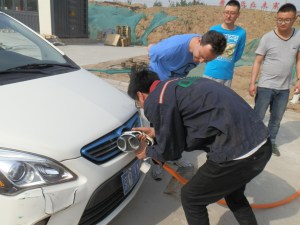
A fruitless charging attempt.
Good thing we tried them out because the guys there couldn’t get them to work. That would have been embarrassing had it happened on the official launch day which was two days after we visited. Still, it was impressive. And looking online, Dianba seems to have applied for many patents. Now if Beijing, and China, can multiple at least the charging stations 100,000 times.
Protean Electric gives Tianjin, China a try
Oh how time flies. I have been very, very negligent regarding ChinaEV blogs. But I promise to do better in 2016. And right now I have plenty of good material because I just interviewed a handful of companies with EV technology for a story for Automotive News, a follow-up to a similar story I wrote way back in 2012.
One person I spoke with is KY Chan, CEO of Protean Electric. Protean produces in-wheel electric motors which, according to the company’s website, can boost fuel economy by more than 30 percent. The motors are drive-train agnostic, i.e. they can be used in pure electric or plug-in hybrid electric vehicles
Protean has gone through some changes since 2012, but is still moving ahead. Some significant changes: In 2012 I interviewed then-CEO Bob Purcell, who was jazzed about an agreement with the Chinese city of Liyang to build a plant. Didn’t happen. I am not surprised. Chinese cities are not always the most constant of partners. “Liyang didn’t pan out for one reason or another,” Chan told me.
Yes, that’s another change at Protean. Bob Purcell left the company. Chan joined Protean in early 2013 to set up the China base and has been CEO for two and a half years, he says. Chan says Purcell is his mentor. Bob “felt that the next phase of the company’s growth would require someone who was ethnically Chinese,” say Chan, who is from Hong Kong.
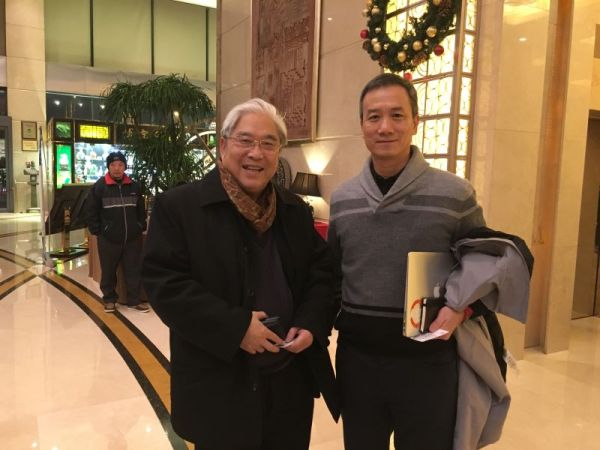
KY Chan with Professor Guo Konghui, renowned expert in vehicle dynamics.
Protean is a seven-year old company but it is still in start-up mode. That means Chan’s main goal since becoming CEO has been raising money, finding customers, and finding a “landing pad” for manufacturing since the Liyang deal fell through. “All three of these items are coming to a very good milestone,” Chan tells me.
China is where is Chan seems to be finding all three, money, customers, and land, that is. There are two driving forces in China that benefit Protean: Beijing has stuck to its goal of having 5 million new energy vehicles on the road by 2020, whether or not it is obtainable. And, Beijing mandates a fleet fuel efficiency standard of 5 liters per 100 kilometers – about 47 mpg – that all automakers must achieve by 2020.
“The government is very serious about (the standard),” says Chan. “Don’t cheat. The market is now going in a fashion that no matter what, even if losing money, the OEMs have to produce a number of new energy vehicles in order to lower the overall (fleet fuel efficiency) below 5 liters.”
He is talking to several potential customers now, says Chan, and he is feeling positive. “The amount of resources flowing into (the EV sector) is just unimaginable,” he says.
Chinese companies are interested in Protean’s in-wheel motors because they offer high torque and high power in a small package, says Chan. Plus they are easy to install. Protean is targeting logistical vehicle builders who are producing EVs for local government fleets. Local governments are under a central government mandate to make 50 percent of new fleet vehicle purchases new energy vehicles. So there’s a market there.
Another selling point: The in-wheel motor doesn’t take up much space so the vehicles can carry larger batteries. Since subsidies for the local government fleet vehicles are based on KwH, they can get more money from the central government!
Chan feels confident. “We will be a very significant b2b electric vehicle components supplier in the future,” he says.
Of course, as the Liyang situation – a promise that didn’t pan out – illustrates, China can be a frustrating place to do business. But, this time around Protean seems to be on the right track. Consider the third area that Chan is concentrating on: Land. Protean is now building a plant on a “sizeable piece of land” in the Tianjin Binhai Hi-Tech Industrial Development Area. It received a mid-sized company incentive package from the zone – Chan didn’t say what that included. But of course there are a variety of incentives to locate in the zone. Outright grants is one, I’m sure. The land is free, I’ll wager. Etc.
While the plant is being built, Protean is already tuning various production line stations at a temporary location in Tianjin, says Chan.
Tianjin is a better bet than Liyang, in my opinion. It already has a number of hi-tech companies based there. And Chan says: “Tianjin itself is a very outgoing city, very industrial. The government decided to focus on new exciting state-sponsored industries. New Energy Vehicles are one of them. The government is very aggressively investing in enterprises that have a history in electric vehicles. “
All in all Chan is pretty optimistic. Chinese companies/local governments are in a hurry to turn out new energy vehicles, and Protean’s in-wheel motors can facilitate that, he says. The proof is in the pudding, of course. How many times have I typed that sentence? I am as always cautious. But Tianjin is a much more outgoing city than Liyang, and it already has a high-tech base. So we shall see.
A side note: Battery maker Boston Power is manufacturing in Liyang. GSR Ventures, a Beijing-based venture capital firm with an office in Palo Alto which invests in both Boston Power and Protean, seems to have close ties with Liyang, which is in the east China province of Jiangsu.
EV sales and a command economy not a good pairing
China’s leaders are feeling frustrated regarding electric vehicles. They have set a target of 5 million battery-electric and plug-in hybrid electric (and hydrogen fuel cell but we will just forget about those for now) vehicles on the road by 2020 and are very far from that target. They have been taking the “crossing the river by feeling for the stones” approach to boosting EV (which for the purposes of this blog will refer to BEVs and PHEVs) sales, announcing a rash of incentives and policies to try to convince Chinese consumers to go electric. such as allowing EVs to drive on China’s congested highways all the time — unlike gas-powered cars, which face restrictions in some cities — and free licenses plates for EVs.
It hasn’t worked. To be sure, production of New Energy Vehicles, as China likes to call EVs, surged in November. China’s automakers can’t ignore more or less direct orders from the Central government to produce EVs. So production rose sixfold, to around 30,000 passenger BEVs, 7,509 passenger PHEVs, and a bunch of commercial PEVs as well. Sales figures haven’t been released yet, but I’m sure they will also show impressive growth.
BAIC is giving away charging station to buyers of its EVs to alleviate a shortage of charging infrastructure.
But the numbers are still far short of what is needed to hit the magical 5 million by 2020. So Beijing has fallen back on what it knows best – a command economy. As my friend Yang Jian wrote in Automotive News China, the Central government has now assigned each province a sales quota for EVs. (go to http://www.caam.org.cn/zhengceyanjiu/20151216/1605181551.html and click on link at bottom of story).
Of course those quotas will be met. As Yang Jian points out, local government officials’ promotions are tied to meeting central government targets. Exactly how local government officials will achieve those sales quotas given the lack of enthusiasm for EVs is unclear. My bet is on some numerical slight of hand plus a lot of pressure on local government-owned companies to buy EVs.
This kind of policy isn’t entirely new. Beijing a few years ago issued a mandate for all local governments to buy NEVs and to make 30 percent of their new fleet purchases NEVs. That didn’t work. The same policy required 30% of those purchases to be from an auto manufacturer not in the same region. This was meant to prevent local government from just buying a bunch of EVs from the local automaker, which would have suddenly begun producing EVs. Or from the newly-formed EV manufacturer in town. Both would likely be invested in by the local government. So the money would stay local. But neither mandate seems to have been enforced.
Which brings us to a real problem with the most recent quota move — enforcement hasn’t been specified. Implementation is frequently the weak point in Central government policies in China because enforcement is weak. That is because of push back from vested interests. China’s central government has no problem enforcing a policy if it really wants the policy or regulation or law to be followed.
When enforced, these kind of command economy quotas haven’t worked so well for China in the past. Overcapacity, shoddy workmanship, and huge waste of resources is often the result. I predict that will also occur with EVs, and could have some dire consequences since a shoddily-produced car going even 50 km/hour is dangerous. Which reminds me to ask, will low-speed vehicles be included in the quota? If so, meeting the sales quota may be possible. But I doubt LSEVs will be included.
The other recent EV-related command is to build charging infrastructure. This is desperately needed and much less expensive. Plus, there isn’t a huge downside to too many charging stations (which will never happen anyway). But how different is this from the numerous earlier policies aimed at boosting EV charging infrastructure? In 2014 the government was going to spend 100 billion RMB on charging infrastructure and promoting EVss. That was supposed to happen in 2015, as well. Okay, that is the same policy, I suppose. But there isn’t anything very new about the recent pronouncements and they haven’t worked yet.
One thing I will say for China’s Central government, it hasn’t wavered in its commitment to EVs. (For an excellent overview of the entire history of China’s legislative and policy efforts to boost NEVs check out this report.)
China faces the same issues as the U.S. in expanding its EV fleet, mainly high cost, lack of charging infrastructure, and consumer uncertainty (produced by the previous two issues). Is commanding provinces to sell more EVs the answer? I don’t think so but I do understand why China is trying this approach. I am just skeptical it will work. But the it is better than just giving up, I suppose.
I was in Beijing from September 19-26 and did some on-the-ground research into the EV market situation. My conclusion? Beijingers are buying electric vehicles to avoid taking the subway to work. Okay that is an assertion that may not hold for 100% of those buying EVs. But a bunch of them are for sure buying EVs to be able to drive every day in China’s capitol. That’s one thing I learned in my recent visit to Beijing.
Sales of plug-in electric vehicles are growing by leaps and bounds in China. But only because the central government and local governments are rolling out all kinds of incentives to entice China’s wary consumers to try the EV way of life. Its working for now, but like the sales boost the entire car market in China got in October from the tax cut for vehicles with 1.6 liter and less engines, this jump in EV sales is only a short-term fix. Longer term China needs the same thing we need here in the U.S. to boost EV sales – lots more charging stations and better battery technology/longer range/lower price (which are all connected).
Still, I must admit that Chinese are apparently buying some EVs now. According to the China Association of Automobile Manufacturers, some 126,733 plug-in electric vehicles were sold in China in the first nine months of 2015, an increase of 2.3 times. Battery electric vehicles accounted for more than half the sales, at 87,531 units. It is taking some pretty serious policy moves on the part of the central and local governments to produce these kinds of numbers, however.
Since I was just in Beijing, and talked to people about the Beijing market for a story for Wards Auto, let’s consider Beijing a representative of all local governments in China. Actually, more like most local governments. Shenzhen has a bit of a head start because BYD is based there and it has pushed BEV sales for longer than most local governments. Not surprisingly, China’s local governments prefer to boost sales of PEVs produced by local companies, of which they are often part owner (though not in BYD’s case, but Shenzhen surely benefits from BYD making more money).
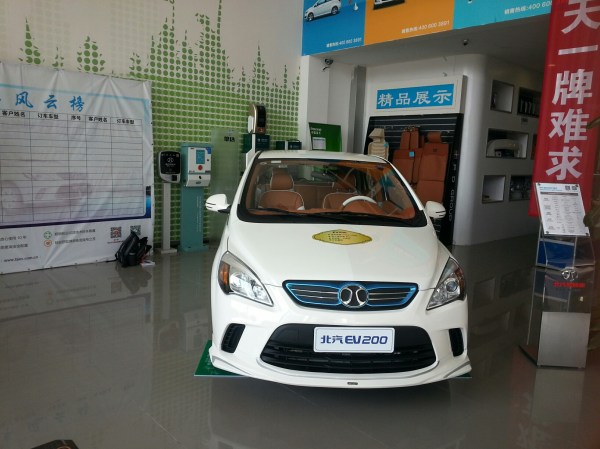
The best-selling BEV in Beijing is made by BAIC, which is owned by the Beijing Municipal government. There’s also a bit of local pride involved in the burst of BAIC EV sales, apparently. I visited a dealership selling BAIC-brand battery electric vehicles while in Beijing. Jing Li, the manager, said some 30 percent of his sales were because people cared about the environment and/or wanted to support a local company.

Mr. Li has sold 180 BEVs a month for the last three months.
But I am getting ahead of myself. Finding the dealership was tough. I had the telephone number, but my cab driver seemed to have trouble following the dealer’s directions, or perhaps the directions were bad. After some detours, we arrived. It was in a row of three EV dealerships by different automakers, I think. I was pretty jet-lagged. The manager of the BAIC EV dealership, Li Jing, said sales have been very good the last three months. That coincides pretty closely with a new government policy that allows PEVs to drive any day, any time, on Beijing’s crowded freeways. Otherwise, cars are restricted from driving one day a week. “They are buying EVs as a second car,” said Li. “They use them to drive to work.”
The vehicles Li sells are produced by a special BAIC subsidiary that produces battery-electric vehicles called BAIC BJEV. Prices for the handful of models it sells vary according to battery range. But, BAIC said recently it would extend the electric vehicle selection to its entire self-owned brand lineup i.e. BAIC Motor Co. will produce EVs as well. And, it will produce a PHEV model. Like all of China’s domestic auto manufacturers, BAIC is being pushed by the central government to produce electric vehicles, whether or not there are customers to buy those vehicles. I wonder if Mr. Li will get the PHEVs to sell as well. Or will they be sold through regular BAIC dealerships? My bet is on Mr. Li and others like him, at least initially. If sales grow, other BAIC dealers will clamor to sell PEVs, however.
For now, sales are growing but are still a tiny, tiny part of total passenger vehicle sales in China. Like drivers in the U.S., Chinese are wary of the price of an EV (and by EV I am referring to battery electric vehicles). They are worried about the cost – which is offset to some extent by local and central government subsidies – and, more importantly, they fear running out of “gas” i.e. they don’t want their battery to run out of electricity.
Beijing is a sprawling city with epic traffic jams. Such a fear is not unfounded. Despite some grand-sounding targets issued by the central government regarding charging stations, there are few charging posts in Beijing compared to the total number of drivers. A new regulation requires all public parking areas to have some chargers, and new residential complexes to allot 13% of new spaces to electric vehicles. BAIC isn’t waiting for that to happen. It offers a free charging post with every BEV purchase, says Li.
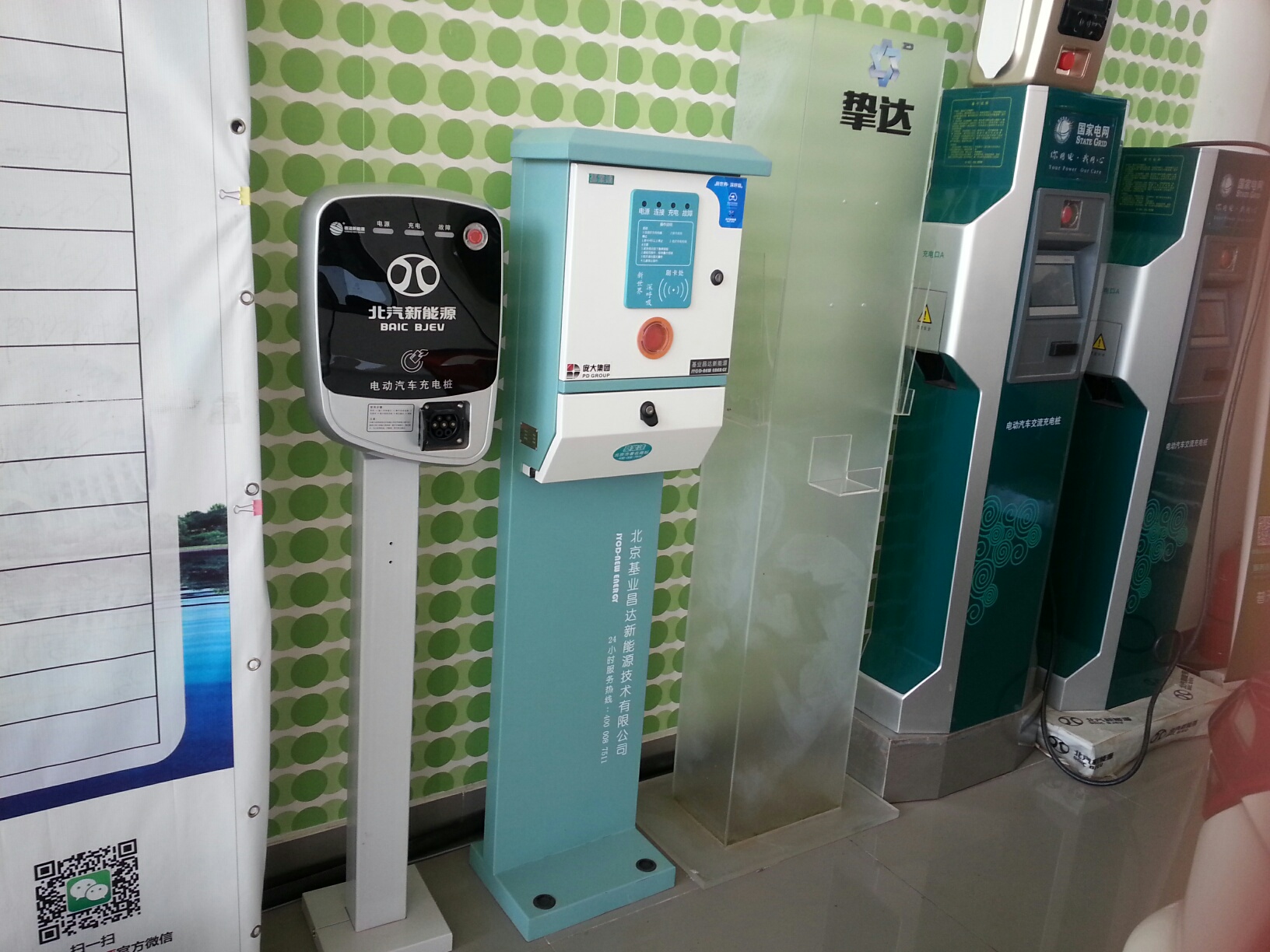
Buyers of a BAIC BEV have a choice of free charge posts.
Thought charging posts are still a fairly rare sight in Beijing, I saw some evidence of public charging installation growing. After some sleuthing, I found a row of EV chargers in the underground garage of Taikoo Li, one of the huge shopping complexes that have arisen on Sanlitun Bar Street in Beijing. There was a row of chargers – electricity in China is 220V so they are effectively Level 2 chargers – and a Tesla charger. All were empty. But heh, they were there.
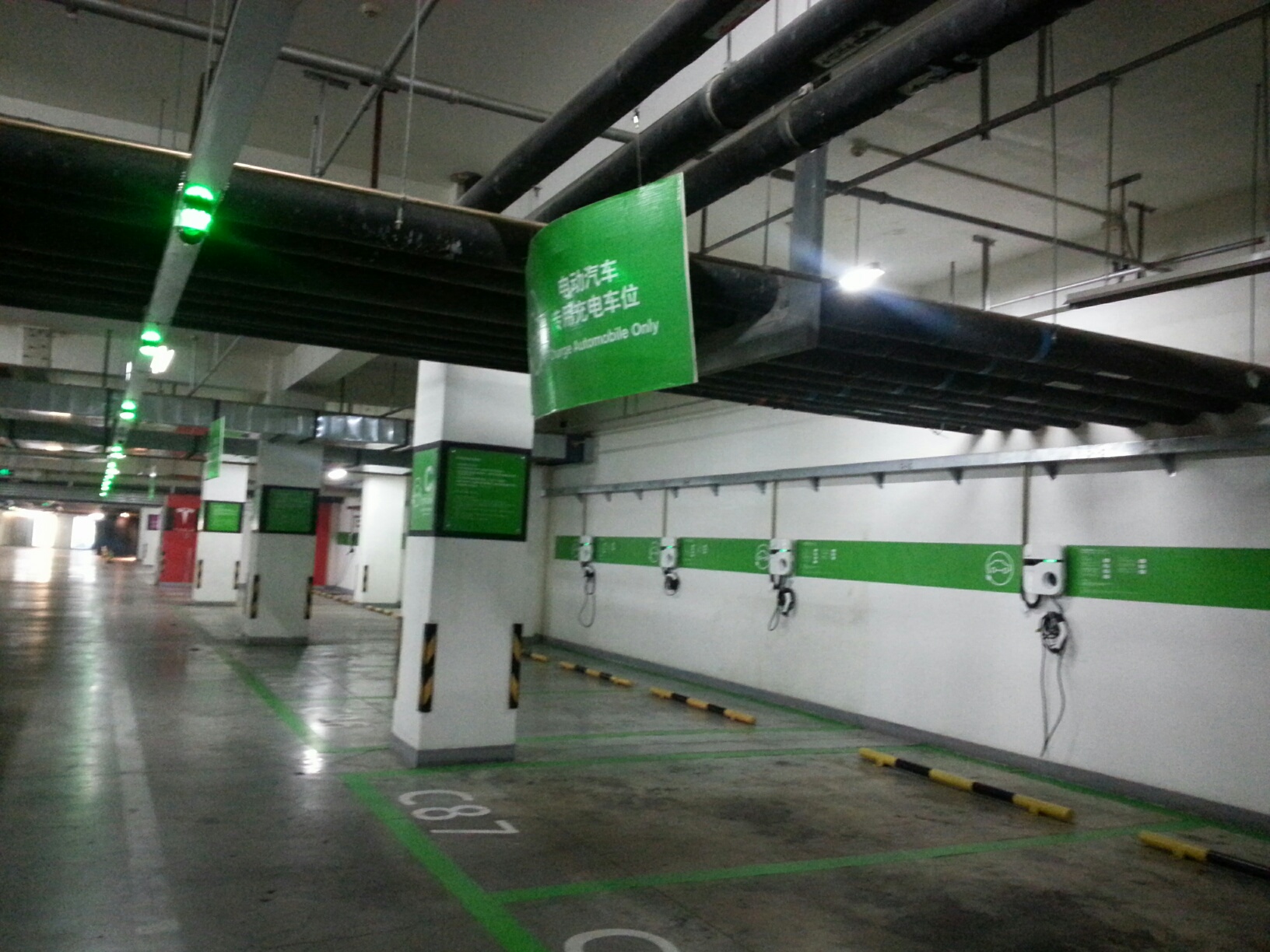
 I always stay in the Holiday Inn Express Dongzhimen when I am in Beijing. It is in my old ‘hood – I could see my old apartment when I looked out my hotel room window! – and is very convenient to many things, including the Great Leap Brewery, which is just around the corner. Newer hotels in Beijing – including the Holiday Inn Express — now have underground parking garages, a reflection of how times have changed. I went down to the HIE parking garage and was surprised to find not only a charger, but an advertisement for a GoGreen program that allows one to rent an EV! It may have been just a tease, however, as you will read below.
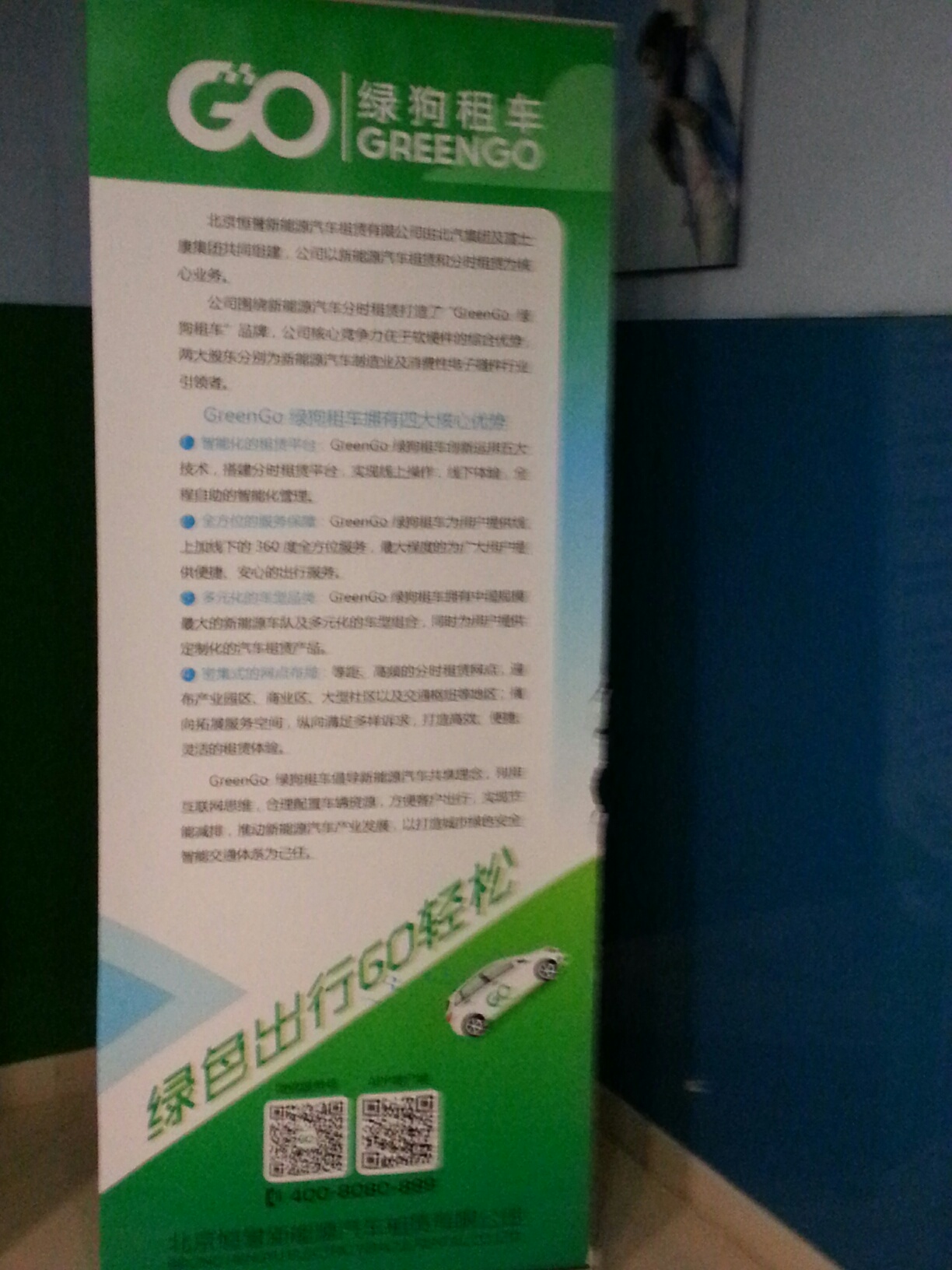
Beijing Hengyu Electric Vehicle Rental Co. Ltd., which was the company behind the Go Green offer, is jointly owned by BAIC and Foxconn. Foxconn aka Honhai Electronics Precision Co. Ltd. is a contract manufacturer of electronics, most famously Apple mobile phones. The EVs can be rented by the hour and many different brands are, or were offered for rental, apparently. There are reportedly 1,000 EVs for rent and 196 charging spots (i.e. parking spots with charging) available around the city. The rental car program is a great idea. But I’m not sure how successful it has been given that the site where one is supposed to register to rent a car — greengo.cn – produced a “domain name for sale” announcement.” It was initially a Spring Festival program, perhaps it no longer exists.
A ZEV program for China?
While in Beijing, I met with An Feng, co-founder and president of the Innovation Center for Energy and Transportation (iCET). iCET, a non-profit with offices in Los Angeles and Beijing, is working with local officials in Beijing and the south China city of Shenzhen to implement rules similar to the California’s Zero Emission Vehicle, or ZEV program.
I don’t want to develop a migraine, so I’m not going to try to go into any detail about the ZEV program. Suffice it to say that under California’s ZEV rules, automaker must produce a certain number of zero-emission vehicles to be sold in California or be fined. Automakers earn credits for each ZEV vehicle produced, and if an automaker doesn’t earn enough ZEV credits, additional credits can be bought from other automakers who have excessive credits, such as Tesla. So, ZEV sales can also be a source of income for automakers beyond the profit on the vehicle.
An figures a program like this might encourage automakers in China to produce more EVs, giving Chinese consumers more choice. The ZEV program in California has resulted in a larger selection of EVs here than in other states. California also accounts for a huge majority of all EV sales in the U.S. Though that is mostly because of subsidies and High-Occupancy Vehicle lane access, the larger selection does help boost sales. It may also encourage Chinese automakers to “get serious” about producing EVs, An told me.
iCET wants to establish four pilot cities in China to try out the ZEV program, says An. Beijing, Shenzhen, Chongqing, and Shanghai. It is currently working with Beijing and Shenzhen. “Government subsidies are going to come down as the volume of EVs increases,” he says. “The ZEV program is the best way to promote EVs.”
The caveat, he says, is enforcement. “California has worked because it has a very high penalty,” says An “In China, who has the authority to introduce the penalty and manage it?”
 Alysha Webb
 Alysha Webb's ChinaEV Blog