Western media was all a flutter over the latest new energy vehicle production numbers out of China. Okay, production of NEVs did increase immensely. But let’s put those numbers in perspective. For one, they are production numbers, not sales. Secondly, they represent less than one percent of all vehicle sales in China.
Still, judging from the models on display at the Guangzhou Auto Show automakers have gotten the message that they need to offer new energy vehicle choices to Chinese consumers. There were plenty of NEVs there. As in the past, of course, they could be just for show, not for volume production.
First the numbers. According to the China Association of Automobile Manufacturers (CAAM), in November China produced 3,540 passenger battery-electric vehicles (EVs), 1,640 commercial EVs, 2,469 passenger plug-in hybrid electric vehicles (PHEVs), and 1,977 commercial PHEVs. That’s a total of 9.626 plug-in electric vehicles in November. Yes, a ten-fold increase over the same month in 2013 but still a tiny drop in a large sea.
Sales figures hadn’t been released at the time of writing, but let’s consider who is buying PEVs in general. The Chinese media, which is somewhat more realistic about the market than many foreign media outlets, quoted the assistant general manager of the BAIC New Energy Co. as saying only about 65 percent of the PEVs it sold were to private consumers. The rest were government buyers or BAIC employees. The APEC meeting in Beijing helped boost PEV sales, said the BAIC manager.
I think that customer base is probably similar for many PEVs, that is, mostly governments and related individuals. However, some cities in China are offering special considerations to PEV buyers such as no registration fee. A CAAM official was quoted as saying consumer interest in PEVs might be a bit higher in cities that offer those perks i.e. a higher percentage of buyers may be consumers.
Shanghai, for example, offers free registration to PEV owners. That’s quite a perk when a license plate can cost nearly 100,000 RMB. (Shanghai auctions off a limited number of plates each month). BYD”s Qin PHEV seems to be the biggest beneficiary of the preferential policy. BYD sold 1,700 units in November and 1,212 of those were sold in Shanghai.
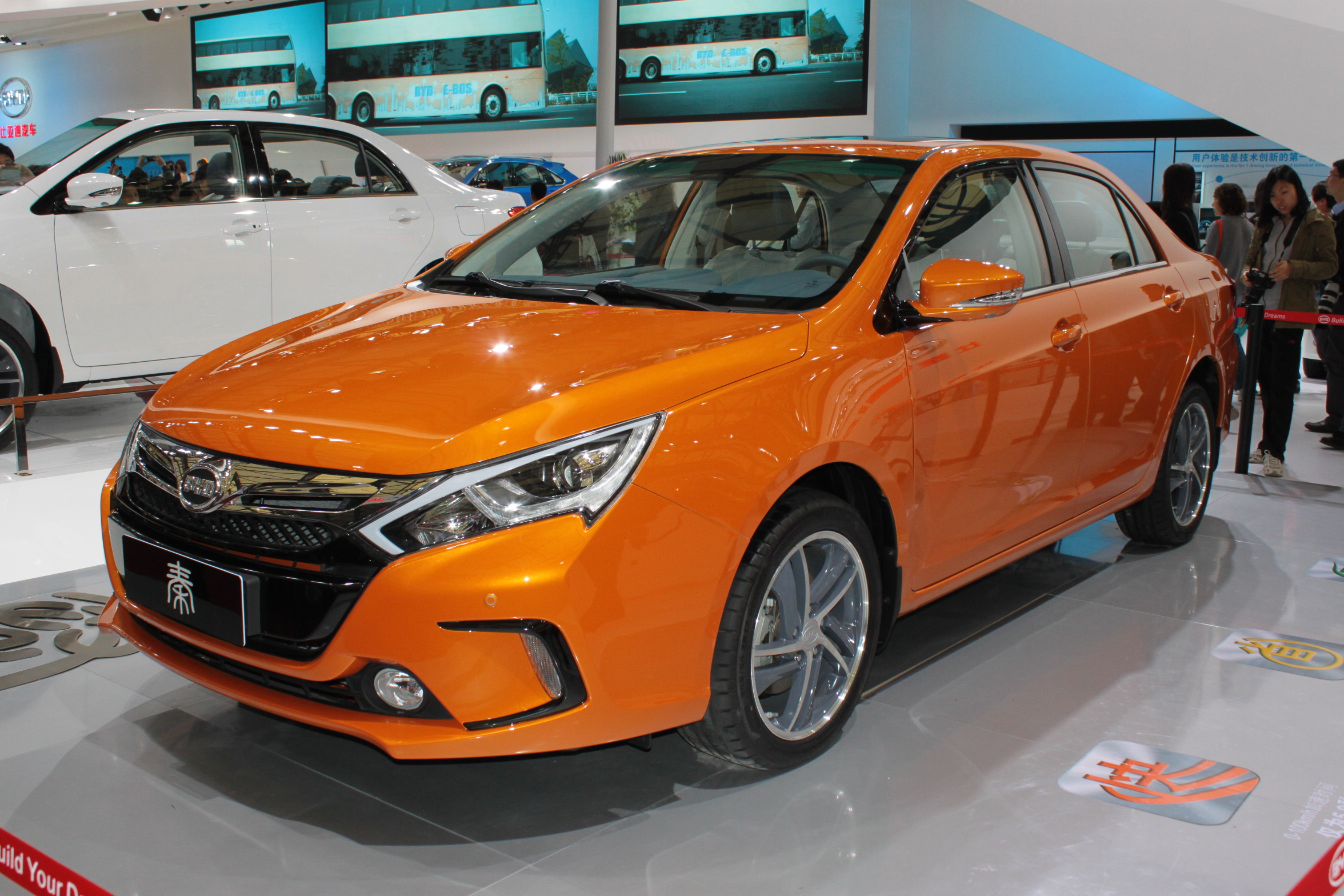
That has caused some annoyance among non-PEV owners in Shanghai, however. It seems that the Qin PHEVs, which have a 70 kilometer all-electric range, are running on regular old gasoline 95 percent of the time. If that is the case, grumpy non-Qin owners have asked, why should Qin owners get free plates?
The BYD model has nonetheless remained the darling of some central government advisors and officials. Ouyang Minggao, head of the automotive engineering department at Tsinghua University, at a conference on December 11 praised PHEV technology and singled out the Qin as a fine example. A few months ago Wan Gang, minister of science and technology, also praised the Qin.
Ouyang noted that some have complained that PHEV owners are mostly using gasoline to power their vehicles. But he put the fault squarely on the lack of charging stations rather than the technology.
To be sure, that is one problem. But not one that will be solved any time soon.
A plethora of PEVs
There were plenty of plug-in electric vehicles, both EVs and PHEVs, at the Guangzhou Auto Show, held in that south China city in late November. Thanks to WAYS Consulting in Guangzhou for the information regarding the various electrified models at the show.
There were some 29 EVs on display there including models by domestic, foreign, and joint venture companies. Their range varied from a low of 100 km (62 miles) for an EV produced by Leahead (领志) to a high of 310 km by a model produced by MAXUS (大通). Leahead is a sub-brand produced by the Guangzhou Toyota JV. MAXUS is a sub-brand of SAIC that produces vans. So you can see that all variety of producers have their EV to show off.
In the PHEV segment there were some 16 models on display. Interestingly, all but six were produced by foreign brands. Of those six, three were the BYD Qin, Tang, and Shang, variations on a theme. So let’s say all but four were foreign brands.
I think that is because a PHEV is much harder to produce than a pure EV. As an executive at a foreign supplier pointed out to me, most Chinese automakers can’t produce a PHEV on their own.
Regular old hybrids are gaining some traction in China, it seems. Automakers will need to have some hybrids in their mix to meet the stiff 5l/100 km standard by 2020. Still, local automakers have been slow to launch HEV models. There were only 12 on display in Guangzhou. Of those, five carried a Lexus badge.
So, what is my conclusion regarding the current state of China’s PEV market? It is oddly similar to the U.S. market. Still very little demand from consumers but automakers are being pushed to produce PEVs by regulations and stiffening fuel economy standards.
As in the U.S., demand will grow very slowly but at some point will speed up. As in the U.S., the timing of that depends on battery technology (which means price) and on charging infrastructure. China’s central government may be able to prod and incentivize local governments to install charging. But they won’t be able to speed up technology so consumers will remain reluctant to buy PEVs for some time to come.
Beijing wants to be China’s California. At least where electric vehicles are concerned….
Last year eight states in the U.S. signed a Memorandum of Understanding calling for cooperation among the states, and alliances with the private sector to speed up deployment of plug-in electric and fuel cell vehicles in their states. The goal is 3.3 million zero-emission vehicles, or ZEVs, on the road by 2025.
The plan works with carrots rather than sticks. There are not quotas, rather the state governments are buying PEVs themselves, offering rebates to buyers, and building charging infrastructure. The Beijing Municipal government is studying that cooperative model, especially California’s measures to promote ZEVs, Yunshi Wang, China Center director at the University of Davis Institute of Transportation Studies told me recently.
“They want be China’s California,” says Wang.
The Beijing Municipal government is already working to expand the use of new energy vehicles in its borders. New Energy Vehicles refers to plug-in electric vehicles and fuel cell vehicles. But things aren’t moving quickly enough, apparently. The Beijing government wants to make raise the profile of its NEV plan by linking with California, says Wang.
California accounts for more around 40 percent of all plug-in electric vehicles purchased in the United States. That is partly because its citizens tend to be more “green” than those in many other states. But those tendencies are magnified by state policies supporting ZEV ownership and requiring automakers who sell cars in the state to produce and sell ZEVs here.
Those policies often come out of the California Air Resources Board, usually referred to as CARB. It is a high-level state government body that works on improving California’s air quality. The Institute for Transportation Studies at UC Davis works closely with CARB. In China, a similar role is played by the China Automotive Technical Research Center, or CATARC, located in Tianjin, a coastal city near Beijing.
“CATARC provides intellectual support to the National Development and Reform Commission and the Ministry of Information Industry Technology,” says Wang. The UC Davis Institute for Transportation Studies China Center at UC Davis works closely with CATARC. Indeed, in September the ITS and CATARC signed an agreement to help speed the commercialization of PEVs and fuel-cell vehicles.
CATARC also suggests to the central government some new ideas for developing the new energy vehicle segment, he says.
For example, the Tesla-inspired idea of allowing non-automotive companies to produce new energy vehicles originated at CATARC. (Any company in China wanting to produce vehicles of any kind requires a permit from the National Development and Reform Commission.) “Existing automakers, especially plug-in vehicle makers, are strongly opposed,” says Wang.
CATARC is also promoting allowing wider usage of low-speed electric vehicles, especially in provinces such as Shandong and Jiangsu, where there are companies that produce LSEVs (especially Shandong, where it is hard to throw a rock without hitting an LSEV maker).
As for the city of Beijing working more closely with California, CATARC is talking with the city’s Science and Technology Commission about it and the Commission is “very positive” about the idea, says Wang.
Beijing vs. California: Okay, they aren’t exactly alike
To be sure, Beijing is unlike California in many ways. The government structure is very different, naturally. And Beijing’s population is not known for being exceptionally green in their thinking (though there are of course greenies in Beijing).
Also, as an attendee at a lunch presentation I gave last month in Hong Kong for Macquarie on China’s NEV sector pointed out, Beijing’s climate is very different from California’s, or at least from Southern and Northern California, where EV ownership is concentrated.
Beijing is much hotter in the summer – making car air conditioning use a necessity if one has it – and winters are much colder ergo heaters are needed. That drains a PEV battery
But like California, Beijing has set NEV goals. It aims to have 200,000 NEVs on its streets by 2017. Of that, 50,000 will be public vehicles, 150,000 privately-owned. Among the public NEVs will be some 10,000 taxis. Half of mail and sanitation trucks will be NEVs. (This is more aggressive than the central government call for 30 percent.)
Beijing has allocated license plates that will go to NEV owners free of charge, and that bypass the municipality’s registration lottery. Beijing also has its own subsidies on top of the central government subsidies.
So Beijing already has some policies that are similar to California’s, says Wang. But the Chinese city is looking at how California’s policies have been implemented and considering some tweaks to its own, as well as additional perks such as high-occupancy lane stickers to NEV owners and the like.
China’s capital city favors one technology over another – Beijing’s policies are more focused on battery-electric vehicles, says Wang, and perhaps fuel-cell vehicles in the future.
As for plug-in hybrid electric vehicles, the municipal government worries that owners of those vehicles are mostly driving on liquid fuel rather than using the battery capacity, says Wang. The lack of a widespread charging infrastructure is seen as the culprit. (This is also a concern of other city governments such as Shanghai. It nonetheless subsidizes PHEVs at near the same rate as BEVs.)
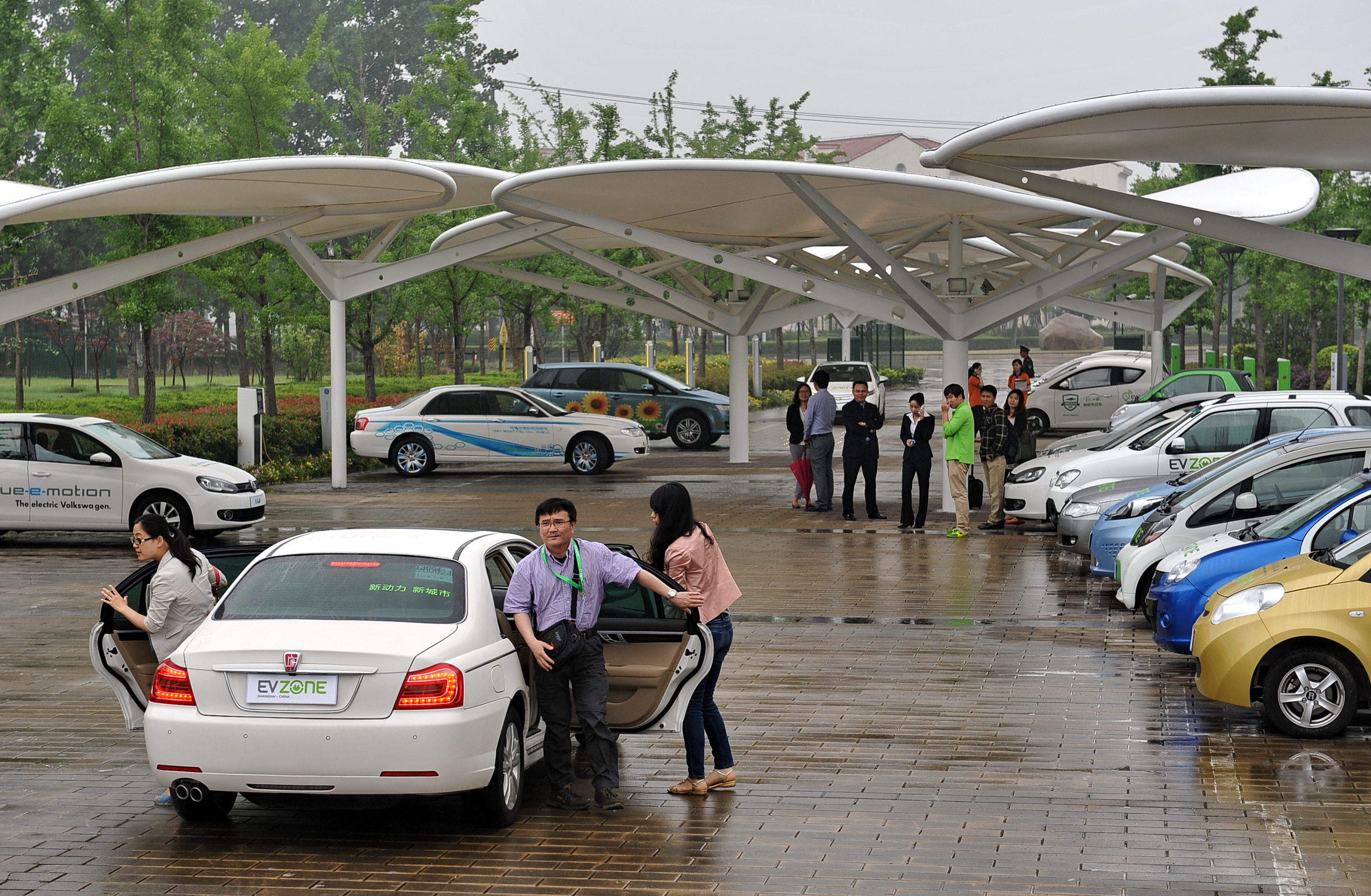
More than 80,000 people have taken test drives in EVs at the SIAC in Jiading.
The ITS at UC Davis also aims to work with other cities in China on new energy vehicle policies, says Wang. For example, he wants to work with the Shanghai International Auto City (see my November 5, 2013 on SIAC’s EV efforts) to see how much time the PHEVs there run on pure electricity, who is driving and where, and what their expectations are. That will help the government know where to place charging stations, he says.
Adds Wang: “You can’t blame PHEV drivers (for not running on pure electricity). If there is an appropriate charging infrastructure, there will be no problem. You need to provide infrastructure so you don’t force drivers to use the gasoline engine.”
China’s Wan Gang praises PHEV technology. BYD rising? Maybe but let’s not get ahead of ourselves.
Wang Chuanfu, chairman of BYD Co. should be a happy man. Wang complained in 2010 that the central government was not offering enough consumer incentives for purchasing electric vehicles. Now, Beijing has extended rebates for battery electric and plug-in hybrid electric vehicles beyond 2015 and exempted buyers from paying a purchase tax, among other measures.
But it gets better, much better. BYD’s “dual mode” plug-in hybrid electric vehicle technology recently received an endorsement from Wan Gang, China’s Minister of Science and Technology.
Speaking at a recent conference in Tianjin, Wan used the technology to rebut those who say that range anxiety – the fear of running out of “fuel” – will stop Chinese from buying EVs. Range anxiety won’t be a big problem, said Wan, because of plug-in hybrid technology.
He illustrated his point with a story: I have a friend who owns a BYD F3 Dual Model electric vehicle, said Wan. He said that in half a year he has hasn’t even used one tank of gas because he recharges at home. “Why do you need to use gas sometimes?” Wan asked his friend. “If I need to go to Tianjin,” his friend explained, “when I run out of electricity I use gas.”
Wow! Could BYD have created a better commercial for its technology? No, because BYD’s commercials are pretty lame. But I digress. Why pay for advertising when the nation’s top science guy gives your company’s EV technology a free plug?
Wang Chuanfu didn’t miss a chance to tout BYD’s PHEV technology and why should he? At the same conference he mentioned that sales of BYD’s current generation Dual Mode vehicle, known as the Qin, sold close to 8,000 units in the first half of 2014 (the F3 is the older generation Dual Mode model.).
Next year, he said, monthly sales of the Qin could reach 3,000 units. These buyers were consumers, not government or corporate fleets, said Wang. And, he added, later this year BYD will launch a Dual Mode SUV model.
So will 2014 be the “First Year” of electric vehicle commercialization in China, as some at the conference apparently predicted (thanks to AutoHaus China for its story on the conference, which provided many of the Wang details.)?
To be sure, plug-in electric vehicle sales in China this year will be much larger than last year. Perhaps by the 300 percent some are predicting. They will still, however, represent a tiny percentage of total sales. And despite Wan Gang’s big talk on China issuing standard related to batteries and charging, there is still has a long way to go in that area.
As for Wang and Wan’s apparent belief that PHEVs have the magic technology to convince Chinese consumers to buy an electric vehicle, I prefer to wait until BYD’s Qin has been on the road a bit longer to crown it the range anxiety savior. Problems may arise with the technology. More PHEV models will also need to come on market so consumers will become more familiar with the technology and have more choice. And those will need to be at the right price point.
Also, consider the U.S. market’s cautionary tale. Sales of PHEVs rose 44.3 percent in the first eight months of 2014 to 40.748 units. But in August they fell 7.4 percent compared to the same month in 2013 to 5,935 units, according to Edmunds.com.
PEV sales in the first eight months accounted for less than 1 percent of the overall market of 11.2 million vehicles, pointed out Edmund’s analyst Jessica Caldwell.
“Electric vehicle sales were basically a rounding error in terms of the overall market,” said Caldwell.
The market share of all-electric drive vehicles in the first eight months – including BEVs and PHEVs – fell by 4.8 percent compared to 2013.
Remember, a few years ago analysts were predicting that PEVs, including PHEVs and BEVs, would at least have market share of single digits.
So in China is the glass half empty of half full? For Wang Chuanfu and Wan Gang it appears to be half full. But how quickly it moves past the half-way mark – if it does — remains to be seen.
China EV policies and the law of unintended consequences
The law of unintended consequences is at work in China’s somewhat haphazard formation of electric vehicle policy. I call it haphazard because let’s face it, the plan has some holes in it and has progressed by fits and starts and occasional backward moves.
Talking recently with a friend whose company works with bus companies in China on EV technology, I heard about an unintended consequence of the section of the EV subsidy policy that defines the all-electric distance needed to qualify for some government largesse.
If you are from California you are very familiar with the “compliance” car. Automakers produce and sell in small volumes various types of zero-emission vehicles to meet the state’s strict emission control standards. In California, the compliance cars are produced to avoid fines. My friend told me that local governments in China are producing “compliance” EV buses to get subsidies!
Here is how it works. In order to qualify for the central government’s subsidy, which is up to RMB 250,000 for PHEV buses, a vehicle must be able to travel at least 30 kilometers on pure electricity. That distance, and the necessary battery size, was chosen, it seems, because it is not too expensive. Not cheap, but at a cost the central government figured was bearable. Another large expense associated with a fleet of plug-in electric vehicles is, however, a network of charging stations.
Some local governments have found an easier and cheaper way to qualify for the subsidy, a method that does not involve any pure electric propulsion or the need for a network of charge posts. Here is how it works: The local governments install a battery and a super capacitor on their diesel-powered buses. A super capacitor can store and discharge energy very quickly. They are often used on hybrid buses for storing energy created by regenerative braking.
On these compliance buses, the battery pack is built to the minimum spec to go 30 km on a charge. There is a connector socket on the side, or at least what appears to be a connector socket. That is never used, however. The bus is driven like a regular hybrid bus, never on pure electric power. “The main thing the battery does is allow the engine to be downsized,” my friend said. That cuts costs.
The battery is recharged while the bus is in operation, but that occurs using the diesel fuel. The battery can, as my friend put it, last forever. And while the fuel economy does improve on the hybrid bus, it is still running mainly on diesel.
Why did the government make the all-electric bar so low – 30 kilometers – that it could be met by in effect cheating? Because the policy was made using the crossing the river method. The battery is the major cost in an electric vehicle. The 30 kilometer battery was a compromise. It wasn’t that costly and still replaced liquid fuel use (when used properly). Of course, adding the super capacitor was an additional cost. But the super capacitor was small enough that the additional cost wasn’t that great, my friend figures.
Charging stations also hit by LOUC (Law of Unintended Consequences)
Another big area of cost savings under this scheme is the elimination of the need for a charging network. Charging stations for buses have to be very powerful, roughly four times the power of Level 2 charging in the U.S., my friend said. They are expensive. By producing the “compliance” buses the local governments eliminate the need for that expense, at least for now.
My friend is optimistic, however. He figures that the central government will eventually see that its current policy is ineffectual and will make the requirements for pure electric range much stiffer (that will be the next stone…).
“The thinking in the bus companies,” he figures, “is that someday, if the government changes its regulation and ups the range requirement, at some point it is going to be cost effective to use the battery. Otherwise they are hauling around 4,000 pounds of dead weight.”
That is charitable. The local governments have saved themselves money by fudging their PHEV buses and also by not building out a charging network. If they need to produce buses that have a longer pure electric range, they will cross that bridge when they come to it. Or throw down that stone.
Of course, the news lately is that the central government will throw 100 billion RMB towards funding a charging infrastructure. That may encourage some of the local governments to build out charging networks since they can nab some government funds to do that. Then they can continue to use their compliance E buses as hybrid buses and save costs on recharging.
According to the Ministry of Information Industry Technology, in June 673 commercial plug-in hybrid vehicles were produced in China, a more than four-fold increase compared to the same month in 2013. Production of commercial battery electric vehicles in June rose 85 percent to 362 units. How many of those were true PHEVs, however, and how many were in fact compliance PHEVs?
Meanwhile, true hybrid production plummets….
The latest EV policy does not subsidize regular hybrid vehicles. A consequence, perhaps unintended, perhaps not, of this omission, is that production of actual hybrid commercial vehicles has virtually ceased. And while foreign and Chinese company executives told me last year that they expected hybrid subsidies to eventually be announced, that has not occurred.
The slowdown in hybrid bus production has had a huge impact on the China sales of Maxwell Technologies, Inc. The San Diego-based company produces super capacitors, which is another name for an ultra-capacitor. Its China sales of super capacitors are down 50 percent to $25 million in the first half of 2014 compared to the same period in 2013, Mike Sund, vice president of communications and investor relations at Maxwell, told me.
Now wait a minute, you say, shouldn’t Maxwell’s sales go up if what Frank is saying is true? My best guess is that there is no need for a super capacitor of the quality that Maxwell produces to make a hybrid bus appear to be a PHEV. Also, the number of compliance buses being produced is no doubt small.
China is down on regular hybrid buses because Toyota owns most of the intellectual property associated with hybrids and China doesn’t figure it can make any breakthroughs in that area. Plus Chinese companies might end up paying to use Toyota-owned technology. So why subsidize them?
Another law of unintended consequences result. Regular hybrids do improve fuel economy and thus could be a stepping stone to China’s goal of reducing dependence on imported fuel. Indeed, some Chinese officials even called hybrids an interim step to full-electric vehicles. That step wasn’t big enough to warrant government support, apparently.
Let’s see if the latest subsidy bone the government is throwing the PEV sector has positive results i.e. more charging networks. And if that actually increases the number of PEVs on the road, both commercial and private.
Ever wonder where the 100+ electric vehicles that Coda delivered ended up? Well, I found five of them in a warehouse in Davis, California. Efficient Drivetrains Inc., a company with plug-in hybrid electric vehicle and continuously variable transmission technology bought five of the Coda all-electric sedans for a China-related project. Full disclosure: I do some business development work for EDI.
EDI is doing some other interesting China-related stuff as I discovered when I visited a few weeks ago. It seems all manner of Chinese companies and even research institutes are looking to benefit from the government’s electric vehicle policy. As I discuss in a blog I’ll post after this one, however, some elements of that policy are not very well-thought out.
But I digress. EDI’s warehouse is filled with vehicles in various stages of having some form of electric drivetrain or CVT installed. Imagine my surprise to see some familiar faces on the lifts! EDI has been asked by the Dongguan Research Institute to produce some pure electric vehicles that also have CVTs. This research institute, contained within one of Dongguan’s many universities, is surely owned by the local government.
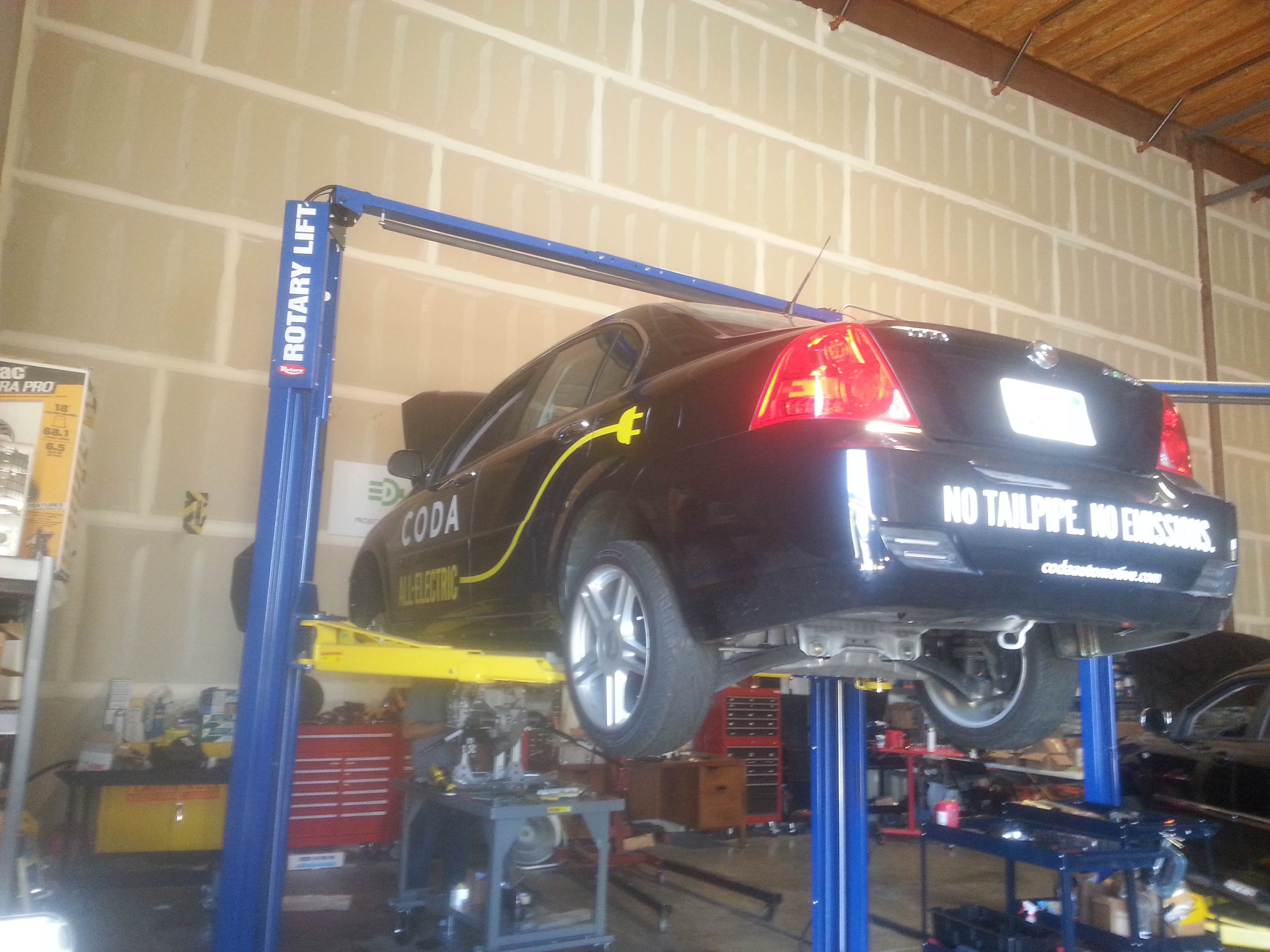
A Coda having a CVT installed. I
EDI procured the five Coda’s for this project. Why? “They are cheap,” said Andy Frank, EDI founder and chief technical officer. Frank explained that the Institute wants an EV that is inexpensive but also shows good performance (doesn’t everyone?). It “wants to design something different than the conventional EV manufacturer,” said Frank. “They have to show some uniqueness.”
Pure electric vehicles aren’t the ideal application for CVTs, admitted the engineers at EDI. A CVT allows a car to change gears without steps, and electric vehicles do that anyway, I believe…. But the Research Institute is the customer, so EDI will install a CVT in the Coda sedans’ pure electric drive, which will add cost. EDI has a cost-cutting strategy, however: Source parts from China.
Coda sourced most of the components for original EVs from multinational suppliers. Think UQM motors and Borg Warner transmissions. EDI is replacing those high-cost components with less-expensive components sourced in China. EDI will then add its secret sauce — software and a management system that will make all the parts work together in a superior way.

The replacement CVT is from Hunan Jianglu Rongda.Vehicle Transmission Co. On the company’s website is a Chinese saying that, according to Rongda’s English translation says: “Ocean holds precipitation; acceptance makes greatness.” A better translation might be “The ocean accepts a hundred rivers, and that makes it great.” It is a saying that urges tolerance for diversity because diversity produces greatness. I guess that is meant to promote acceptance for a CVT. And it is a play on the characters in Rongda’s name.
Rongda is China’s only volume CVT manufacturer. Since its CVT can be bought off the shelf, EDI is using one in the prototype. How good are the Rongda CVTs? “We don’t really know; we have to build one and test,” said Frank. “In order to get real economics (in fuel economy) we (will) have to design a special CVT for this application,” he added. If the vehicle goes into volume production, EDI will design a CVT specifically for the vehicle, either on its own or with Rongda, said Frank.
The motor will come from Beijing-based Jing-Jin Electric. The company, founded by a General Motors China alum, supplied motors to the ill-fated Fisker Karma. It produces motors of all sizes for electric vehicles, said Frank. And its motors may show up in the Fisker-based car that Wanxiang produces.
Another interesting project in the EDI garage was a Ford F550 truck that is a PHEV with exportable power being produced for Pacific Gas & Electric. In a blog last year, I talked about how exportable power is what PG&E, one of the largest utilities in the U.S., really wants in its PHEV trucks. It can use that power, said Dave Meisel, director of transportation for PG&E, to light up a neighborhood while it does repairs, or during emergencies such as hurricanes when power has been lost.
I talked with Meisel recently about the PHEV that EDI is producing for PG&E. It has exportable power, it seems, and a lot of it. PG&E will test it soon. Why has EDI apparently been able to achieve levels of exportable power that others haven’t, I asked Meisel? “It is technology related,” he said. “EDI’s software and onboard management system has done a really good job.” I guess we will know if that proves true in a few weeks as PG&E is planning to test the EDI truck then.
China could certainly benefit from some exportable power. Although the brown-outs that were common when I lived in China in 1984, and even when I was there in the early 1990’s, they aren’t so common now. The grid in China is strained, however. Imagine if a fleet of trucks could serve as power plant in a pinch.
So that’s what I saw during my EDI visit. I’m still laughing at the Coda sedans. Never thought I would run into them in such a place. And they’re going home! The body came from China, after all, and now the components will, too. Is the fact that such disparate entities – such as a research institute — are looking into producing electric vehicles good news for China? Or is it a waste of resources? Will it produce innovation that doesn’t emerge from the big automakers? That is what China is hoping. The government thinks that by giving non-automotive entities licenses to produce EVs, a Chinese Tesla could emerge. That seems a stretch. But there may be a Chinese Elon Musk out there.
 Electric vehicle enthusiasts here in the U.S. are all a flutter over the news that China has announced several policies aimed at creating a market for electric vehicles.
They are also excited about the news that a Chinese businessman decided to build his own charging network when he couldn’t drive his Tesla Model S from Guangdong to Beijing because of a lack of charging stations.
The businessman, Mr. Zong, bought 20 220V charging stations from Tesla and installed them at businesses on the roads to Beijing. http://tinyurl.com/n7zxx5l Now he can drive to Beijing in his new Tesla, it seems. Other Tesla owners can use the chargers too, he says.
Tesla http://www.teslamotors.com thanks him for his contribution to China’s charging network. “We welcome any efforts from the private or public sector that promotes the widespread adoption of electric vehicles,” a Tesla spokesperson here in the U.S. wrote to me in an email.
This has little significance where widespread adoption of electric vehicles in China is concerned. It may promote more sales of Telsa vehicles in China. That’s about it. The stations can’t be adapted to charge other EVs, though the press has mistakenly reported that Mr. Zong will adapt them so other EVs can use them. Per the Tesla spokesperson: “Mr. Zong did not modify the wall connectors to fit other EV brands. He installed the Tesla ones for Tesla only.”
Even if Mr. Zong had wanted to modify the connectors to fit other EV brands, he couldn’t have. Well, perhaps he could, but they might only fit one other EV brand, in one city. That’s because, despite all the stories that China puts out (and the foreign press eats up) about producing and selling millions of EVs, and about all the charging standards it has issued, and the mandates to make local governments buy EVs and install charging posts, there are still no finalized standards in China for the connector configuration, the communication standard, or DC charging. Without those, China is creating a huge problem by urging widespread adoption of EVs. Instead of a nationwide industry, it is creating many local industries.
Here’s the lowdown on the state of charging standards in China:
First, the AC standard. That’s the slower charging method, and the one that will be used most widely. Chinese voltage is already 220V (versus the common 110V and less common 240V here in the U.S.) so plugging into a wall socket gets you Level 2 charging in China.
China in 2011 released an AC standard, GB/T 20234.2-2011. GB stands for “Guobiao” or “national standard.” T stands for “tuijian,” or “recommended.” How does that really translate? China hasn’t settled on a final standard yet. The Tesla spokesperson put it well. She wrote: “It lacks definition of some important parameters, resulting in the incompatibility of EV products with different brands and charging facilities in different cities. So it is still a voluntary standard, not mandatory.”
The central government is pushing automakers in China to produce EVs. People won’t buy them without a charging network. So localities come up with their own charging station parameters including connectors and communication. Local automakers produce EVs that can use those charging stations but can’t safely charge anywhere else.
And what about that mandates that 30% of local government fleet purchases must be EVs? And that that 30% of their purchases be made from manufacturers outside their area? (Which are not new, by the way. Both were included in the policy issued in September, 2013. http://tinyurl.com/nl8amgg ) Well, the EVs from outside the area won’t be able to charge on the local stations.
I talked with my old friend David Reeck, who recently retired from his post as Manager of Electrification Strategy for GM China, about the state of standards in China’s EV world. This is a man who spent years trying to rationalize China’s charging standards. Reeck is living in Oregon now, working as a consultant. He was not optimistic. “I would say by the end of the year China will realize it has really messed up,” he said.
He is especially pessimistic about the DC standards, which are the most contentious and thus the most difficult to decide. “From end of this year until about 2016 China won’t have a DC standard formalized,” said Reeck. China has a DC connector plug that it is promoting. But that lacks safety features that the European, U.S., and Japanese standards include. Also, the male and female parts on the Chinese DC connector are reversed, added Reeck.
There is disagreement among the Chinese about this standard, he says. Some figure it is safe for passenger vehicles — though perhaps not for trucks — and should be released. Others think it better to wait for a standard that works for all kinds of vehicles.
This is an argument that has been going on a long time. I attended the global EVS25 electric vehicle conference in Shenzhen in 2010 and executives from the U.S. Society for Automotive Engineers (SAE) told me at that time of their safety concerns regarding the Chinese plug standard. SAE is now working with China’s CATARC on a DC standard. But SAE declined to comment when I asked about the safety issue.
What do all these internecine battles mean for the industry? Let’s go back to Mr. Zong and his Tesla charging network. No, let’s drop Mr. Zong and just consider Tesla’s attempt to build a charging network in China. Remember, this is a company that has charging stations that only work with its vehicles. But the issues Tesla faces are those that the whole industry faces.
Tesla’s 220V charging stations in China have connectors that are based on the EU standard, which shares a communication standard with J1772, the U.S. standard. Those two are therefore compatible even if the connectors aren’t exactly the same.
When China does finalize the AC charging standard, “Tesla Model S in China will be compatible with the new GB AC standard,” said Tesla. That means all the charging stations that are installed up until then probably won’t work with future Tesla vehicles.
Meanwhile, the U.S. and Europe are moving ahead. In October of 2012, they unveiled a combined AC DC plug standard. It was created through collaboration between engineers in the U.S. and in Europe. “This new standard reflects the many hours that top industry experts from around the world worked to achieve the best charging solution – a solution that helps vehicle electrification technology move forward.” Gery Kissel, the combo plug Task Force Chairman, said. That didn’t include Chinese engineers, it seems. Or if it did, China didn’t collaborate. No, it wants to create its own DC standard.
Foreign automakers in China haven’t been sitting idly by while EV charging standards moved forward in the rest of the world. A group of foreign automakers – collectively known as the Charging Interface Initiative Asia – that includes BMW http://www.bmw.com.cn, Volkswagen Group http://www.vw.com.cn, Daimler http://www.daimler.com/dccom/nea, Ford http://www.ford.com.cn, and General Motors http://www.gmchina.com has been encouraging China to adopt a combined plug standard similar to that just adopted by Europe and the U.S..
So far China insists it wants its own standard. But in 2015, the Germans will “aggressively” demonstrate a combined China GB standard plug, says Reeck. Still, he figures China won’t have a DC standard formalized until 2016. And whether or not that will be compatible with international standards remains to be seen.
A Tesla spokesperson got back on some questions I had regarding the RMB 1 million price tag for a Tesla in China as well as the unavailability of navigation and other features in China. Tesla is working on a China nav system “as Google maps are not supported” in China, said the spokesperson. I wonder if Tesla knew this when it went in and decided to deliver models without fully functioning infotainment? Perhaps. Will be interesting to see who it worked with in China for a nav system and when it is released.
See below for full Tesla response. I await details from China on what extras the RMB 1 million Model S had….
Tesla response:
Our goal is to ensure Model S remains fairly priced and our margin is consistent in every market worldwide. We begin with the US price of $81,070 (85 kWh), add shipping and handling ($3,600), Taxes and duties ($19,000), and VAT ($17,700) and then convert at an exchange rate of 6.05 to reach our base 85kWh price of 734k CNY.
While I obviously don’t know the configuration of your friend’s Model S, if they have already taken delivery of their vehicle, they purchased the 85 kWh or P85 kWh Model S (although we’ve started selling 60 kWh Model S, deliveries of this car have not yet started in China). The P85 starts at RMB 852,500 (85 kWh starts at 734K). These prices are inclusive of all VAT, import duties, and transportation costs.
However this is only the base price without any options. Even if the customer bought the 85kWh, he/she most likely added some options. Here are just a few available to give you an idea of additional costs:
– Dual charger (RMB 13,200)
– Tech Package with Air Suspension (RMB 42,600)
– Parking sensors (RMB 4,400)
– Nappa leather interior (RMB 21,900)
– Alcantara headliner (RMB 13,200)
– Hi-fi sound system (RMB 21,900)
So in terms of the pricing, even if the customer bought the 85kWh, the price is close to RMB 900K with a few options. If the customer bought a P85, the price can become RMB 1 million.
Regarding the second part of your question, currently there isn’t a navigation system in Chinese Model S as Google maps are not supported in the country. However, teams are currently working on a solution with Chinese text and voice recognition. We plan to introduce navigation to Chinese cars later this year (as already communicated to our customers). Once it’s available, maps will be pushed to customers’ vehicles through software updates.
In regards to your final question, remote over-the-air software updates are not yet supported in Chinese Model S. Software updates are pushed to customers’ vehicles through our backend system, and owners then receive notification of available updates on the Model S touchscreen. In fact, we’ve already released a couple minor updates which add additional functionalities to Chinese cars.
BMW flogs its BEV in China and Tesla hits some potholes
I was in Chongqing a few weeks ago. Boy has that city changed since I first visited it in 2003.

Chongqing is quite a bit more developed than in 2003!
But that’s not what I want to talk about. I was on an EV panel at the 2014 China Auto Summit http://mktsummit.org , and also visited the Chonqqing Auto Show on media day.
What a pleasant change from Auto China. I could actually walk around without shoving through crowds of “journalists.” Of course, the Chongqing show is considerably smaller than Auto China and also is consumer-oriented – visitors can actually buy cars there. Since I was in town anyway, however, it was well worth the visit.
I went to a few press conferences, but mainly I just walked around and looked at car and for electric vehicles. I saw lots of cars, but found only one EV, the Zinoro E1, a pure electric vehicle produced by the BMW Brilliance joint venture. http://tinyurl.com/qf4lpbu

(I do not count the Lexus CT200h regular hybrid in the EV category but it had a big stand all to itself in Chongqing.)
Oliver Liang, Brand Management Director for BMW Brilliance Zinoro China, was a fellow panelist at the Summit so I already knew something about the marketing plan for the 1E. I picked up several pamphlets at the show, as well. The car itself is nice-looking enough. But what impressed me is the thought BMW Brilliance has put into the marketing plan, which centers on the concept of “worry free.”
The vehicle is only available to be leased. It offers 1, 2, or 3-year or daily rental plans. Costs are respectively RMB11, 000/month, 9,000/month, 7,400/month, or RMB 400 a day. “We have prepared a range of convenient, worry-free services and flexible rental plans tailored to meet urban and individual needs,” said the pamphlet.
It includes a free maintenance package and warranty since Chinese consumers worry about the maintenance costs of a car with new technology such as an EV. “You will be able to keep your Zinoro 1E in optimal condition without incurring additional maintenance costs,” said the pamphlet.
If the car does need to go into the shop, Zinoro provides a free loaner car, and in the “rare event” of a breakdown, offers year-round, 24-hour roadside assistance as part of the lease.
China has few public charging spots. And who wouldn’t rather charge at home anyway? So the lease includes a wall-mounted charging unit and free installation (up to RMB 12, 0000).
The 1E became available for lease in December of 2013. It is currently only available in Shanghai and Beijing though I suppose someone from another city, say Hangzhou, could lease one in Shanghai and drive it home. If they could find charging stations along the way….
It will be interesting to see if this plan succeeds in moving some electric metal for BMW Brilliance Zinoro.
Tesla discovering China’s special characteristics
Meanwhile, I’ve been getting a stream of Chinese-language messages from Tesla on my Weixin feed concerning launch plans and services in China. But remember a blog I wrote a while back regarding issues Tesla would likely face in China, especially where building a charging infrastructure was concerned?
Well, anecdotal evidence and actual evidence suggests Tesla is off to a bit of a rocky start in China.
First the actual evidence. An e-commerce entrepreneur in Inner Mongolia smashed the windshield of his new Model S to protest glitches in the delivery process. Now that was a bit silly. But this is China. Buyers of an RMB 1 million BEV don’t like to feel slighted. http://tinyurl.com/mb2asho
Now the anecdotal stuff: A friend has a neighbor who bought a Model S with the 85 kWh battery. Charging does not seem to be a big issue for this new owner, for now. He lives close to Hongqiao Airport, and works in Anting, which is not that far from Hongqiao. One of Shanghai’s two fast-charging stations is in Anting (the other is in Pudong). So the Tesla owner can charge while at work, for now.
That may change if Tesla ownership reached the levels Tesla has predicted and competition for charging spots emerges. But I guess Tesla plans to add more charging stations if permitted. The owner also has a garage, so he can charge at home overnight.
Other aspects are not so sanguine. First, some interesting details about the licensing and tax: He was exempt from the license plate cost, which is at RMB 70,000 in Shanghai right now. But he did still have to pay the import tax. So the total cost of the Model S was RMB 1,000,000! Tesla touted its fair price policy of charging only RMB 734,000 for the Model S based on the following breakdown. So I guess there was an extra expense Tesla missed.
$81,070 US price
$3,600 Shipping & handling
$19,000 Customs duties & taxes
$17,700 VAT
734k CNY @ 6.05 exchange rate
Also a problem Tesla may not have anticipated – the touchpad for the infotainment control system doesn’t fully function in China. GPS, traffic, mapping of locations don’t work, said my friend. Neither does over-the-air updates, which will be a real problem as Tesla issues those rather frequently.
I sent an email to Tesla here in the U.S. asking how it planned to resolve these issues and hadn’t heard back at time of posting. I will add that info if/when I get it.
Will the requirement that 30% of municipal government purchases of new energy vehicles in the most recent Chinese government’s policy result in a mismanagement of resources? It will if automakers adopt BYD’s http://www.byd.com strategy. The Chinese electric vehicle manufacturer is building plants all over China to gain customers.
While the strategy may grow BYD’s sales both locally and globally, it could result in a massive waste of what is apparently dwindling capital. And as BYD’s missteps here in California prove, it may also sap a lot of BYD’s human capital as it works to resolve problems.
I started thinking about this as I read a story in Automotive News China regarding BYD’s plan to assemble buses in the central China city of Wuhan in order to convince the Wuhan government to buy BYD’s K9 electric bus for its local fleets. http://www.autonewschina.com/en/index.asp
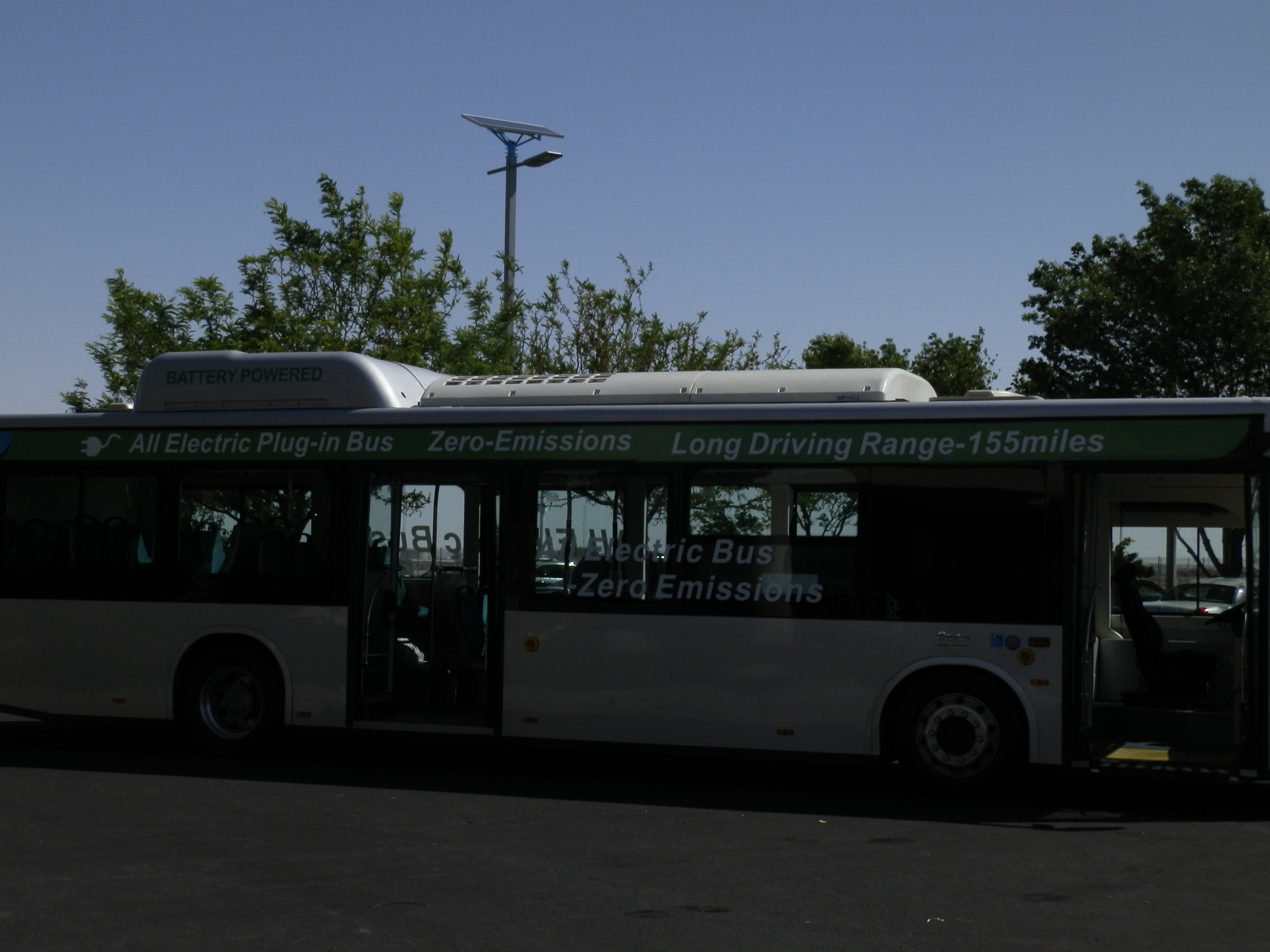
BYD electric bus at Lancaster, CA plant launch
This strategy is wrong on several levels. BYD will spend 3 billion yuan, or $480 million at current exchange rates, to build the plant, according to Chinese media. It will initially produce 1,000 K9 buses and, in a second phase whose cost was not revealed, it will assemble other BYD electric vehicles.
Selling to the Wuhan government is a challenge. The city is home to Dongfeng, one of China’s largest state-owned automakers (the former Third Auto Works). Dongfeng http://www.dfmc.com.cn is China’s largest producer of medium- and heavy-duty trucks. It just announced a partnership with Volvo to produce commercial vehicles. http://tinyurl.com/mr58azo And it partners with Nissan http://www.dongfeng-nissan.com.cn and PSA http://www.dpca.com.cn/ to produce passenger vehicles.
And, of course, Dongfeng has an obligatory Dongfeng EV Co. subsidiary. http://www.dfev.com.cn/dfev/publish/ According to its website, Dongfeng EV Co. produces hybrid electric buses as well as a range of small low-speed EVs and a tiny passenger EV. But I’ll bet it will start turning out plug-in hybrid electric vehicles, or battery electric vehicles, in the future as the central government pressures local governments to boost purchase of EVs. Why not produce those vehicles right in Wuhan so the money stays at home?
BYD may argue that the latest new energy vehicle policy from the central government requires at least 30% of such purchases be from automakers outside of the area and having a plant in Wuhan makes it the most likely company to grab those sales. Is that worth a $480 million bet?
If Wuhan were the only city where BYD has employed this strategy, it might be worth it But Wuhan will be the sixth city in China where BYD plans a bus plant. According to the press report, BYD also has agreements with Changsha, Nanjing, Tianjin, Dalian, and Hangzhou to assemble electric buses.
BYD is based in the south China city of Shenzhen, where it also produces electric buses, naturally. Will these additional plants merely assemble buses from kits sent from the Shenzhen plant? Probably. Then why not just drive the buses there from Shenzhen? No jobs or investment in the local where BYD hopes to sell buses, of course.
Internationally, BYD is also quickly expanding its manufacturing footprint. This is not a bad strategy. But does BYD have the human and financial capital to support this kind of expansion?
I am most familiar with BYD’s plans to produce electric buses in the city of Lancaster, near Los Angeles, where I live. That plant, the launch of which I attended in May of 2013, has encountered a series of potholes on the road to selling it buses here in California. Most recently, the southern California city of Long Beach announced it would cancel its contract to buy 10 BYD electric buses because BYD violated a California Labor Commission law in producing the buses. http://tinyurl.com/kkgjplp
BYD will be allowed to re-bid for the contract when the violation is corrected. BYD America senior vice president Stella Li said in a statement: “We are confident we will prevail in any competitive re-bid in the future for the same reason we prevailed last year: Our superior technology.”
This was not the first problem for the Lancaster plant, however. In July of 2013, cracks appeared above the rear door in a BYD bus undergoing federally-mandated tests. http://tinyurl.com/ltpdbd2 The cracks were a result of faulty welding at the plant in China where the bus was produced, said BYD. “There were no major design flaws discovered. However, there were some minor findings that we wanted to evaluate and review,” said Michael Austin, vice president of BYD America.
In November of 2013, BYD was hit with a $99,245 fine from the California Labor Commission for allowing workers to take one 20 minute break rather than two 10-minute breaks. BYD was also charged with under-paying some Chinese employees. The under payment charge was later dropped; the labor fine was reduced to $37,803. http://tinyurl.com/l97tzr3
None of these problems derailed BYD’s Lancaster plant plans. But they delayed the launch are costing BYD time and money to fix. Will they be repeated in other countries? BYD is also expanding its manufacturing footprint in other parts of the world. In 2012 it announced it would build electric buses in Bulgaria. It has also talked of plans to build a plant in Brazil and in Europe.
It might seem as if BYD has endless funding to build all these plants. That is not the case. The Hong Kong-listed company is raising money through stock sales. In late May it raised 3.4 billion yuan in its largest stock sale since the company’s 2002 initial public offering, according to Bloomberg.
Says Bloomberg: “The funds give Shenzhen-based BYD room to step up investments and bolster production of electric vehicles as governments worldwide step up efforts to fight pollution. Selling shares will also help alleviate the strain on a balance sheet saddled with surging debt.
The company has reason to raise funds via shares over bonds or loans. BYD’s net debt, or interest-bearing borrowings minus cash and equivalents, climbed 34 percent to a record 20.3 billion yuan ($3.3 billion) at the end of last year.”
BYD is betting that its electric vehicles will be its future. http://www.reuters.com/article/2014/05/23/china-byd-sales-idUSL3N0O915T20140523 Meanwhile, sales of its gasoline-powered vehicles have plunged, along with its profits. In the first quarter of 2014, BYD’s profits were down 89 percent. BYD also engages in other “green” industries, including solar panels, LED lighting, and batteries.
To be sure, profits did surge last year after BYD reduced its auto dealership network and reduced losses at its solar business with the help of government incentive money. That is not a sustainable growth plan, however. BYD’s belief that electric vehicles are the future may pay off. But building plants all over China and the world is a dangerous way to back up that belief.
China pushing auto JVs and suppliers to invest in EVs while it lags in infrastructure buildout
Suppliers and automakers are being forced by the Chinese government to take a leap of faith where electric vehicles are concerned. That is what I came away from Auto China thinking.
The companies are investing millions of dollars to supply and produce EVs in a country where the market for such vehicles is currently tiny. They don’t have much choice – Beijing is leaning on them very heavily to do so.
Many of those companies are keeping their fingers crossed that Beijing will pull some policy rabbit out of its hat to incentivize regular hybrid as well as electric vehicle sales, thus adding to the market for their products.
They also are also hoping Beijing will compel local governments to build out of charging station networks, without which there is little chance of a consumer market for EVs taking off.
An example of such investment: Siemens AG announced at the show that it had formed a joint venture with Chinese automaker Beijing Automotive Industry Holding Co. (BAIC) to produce components for electric vehicles.
Siemens holds 60 percent of the JV, which will start with small volume production this year at an existing Siemens plant in China while building a greenfield plant near Beijing, due to start production in 2015. No amount for the investment was announced, but it must be the equivalent of at least US $100 million.
“We believe in a new energy future, not just for pure electric vehicles but hybrid as well,” Jorg Grotendorst, CEO of Inside e-car, part of the Drive Technologies Division at Siemens AG told reporters gathered in a tent outside one of the giant exhibition halls at the Beijing International Exhibition Center.

Jorg Groendorst, CEO of Siemen’s Inside e-Car department, sees hybrids and EVs as the future.
He was part of a group of Siemens executives that had come to China to announce the formation of Beijing Siemens Automotive E-Drive Systems Co. Ltd., as the JV will be known. It will produce “highly efficient” inverters and motors for hybrid and battery electric vehicles, says Siemens. http://tinyurl.com/n8nwj6j
The new plant, which Siemens http://www.siemens.com says will begin volume production in 2015, will have an annual capacity more than 100,000 units per year. But exactly what kind of vehicles those components will go into isn’t clear, even to Siemens itself apparently
I asked the execs how they saw the market panning out in terms of BEVs versus PHEVs versus hybrids. Siemens didn’t know, said Grotendorst, but it believed PHEVs would be the interim technology.
They said Siemens is interested in BEVs and PHEVs (and hybrids as well judging by Grotendorst’s remark) and would supply BAIC, its initial customer, with power-electronics and electronic motors for its S, C, and L series cars.
However, the JV would start by supplying commercial vehicles, said an executive. Indeed, the plant’s components represent a hedging move on Siemen’s part – the performance scale of the models BAIC will use the components in ranges from 45 to 200kW says Siemens.
Size does matter and in this case it is small
Despite hyperbolic plans by the Chinese central government regarding electric vehicle production and sales, and incentives for BEVs and PHEVs, sales have thus far been miniscule.
In 2013 sales of battery-electric vehicles in China were 14,604 units according to the China Association of Automobile Manufacturers. Plug-in hybrid sales were 3,038 units. The total vehicle market was nearly 22 million. Most of those BEV and PHEV sales were likely to government fleets, which would include local bus and taxi fleets as those companies are generally owned by the local government.
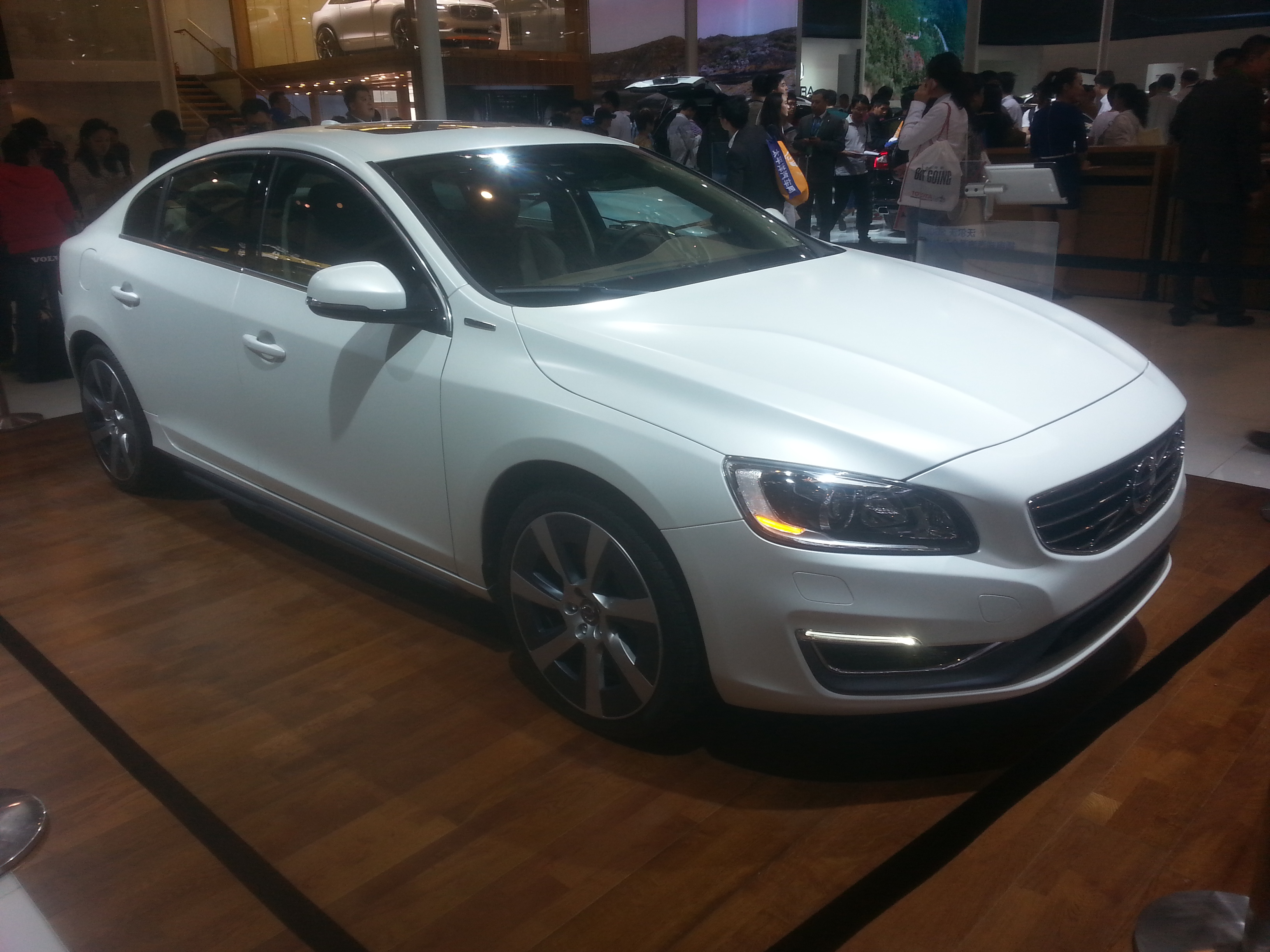
Volvo, now owned by China’s Geely Auto, showed this S60L PHEV concept at the Beijing show. But when it will come to market is unclear.
Siemens is right to place its near-term hopes in an expansion of PHEV sales, however. The charging station network in Chinese cities – even in Beijing, where you would think the government would try to set an example – is abysmally small. As my friend and former colleague Yang Jian pointed out in his column in Automotive News China, http://www.autonewschina.com at the end of 2013 Beijing had only 69 charging stations.
Yang, too, figures that PHEVs will be the most-utilized type of EV in the near term despite the fact that central government subsidies for BEVS are as high as 57,000 RMB (not counting local subsidies) and PHEVS only 33,500 RMB.
China recognizes that until battery costs come down and/or range comes up (which are linked since you can get a lot of range if you are willing to pay for it…) – and when that will occur is uncertain — a PHEV, which offers some pure electric range combined with an engine that runs on some liquid fuel, will be the most useful form of EV.
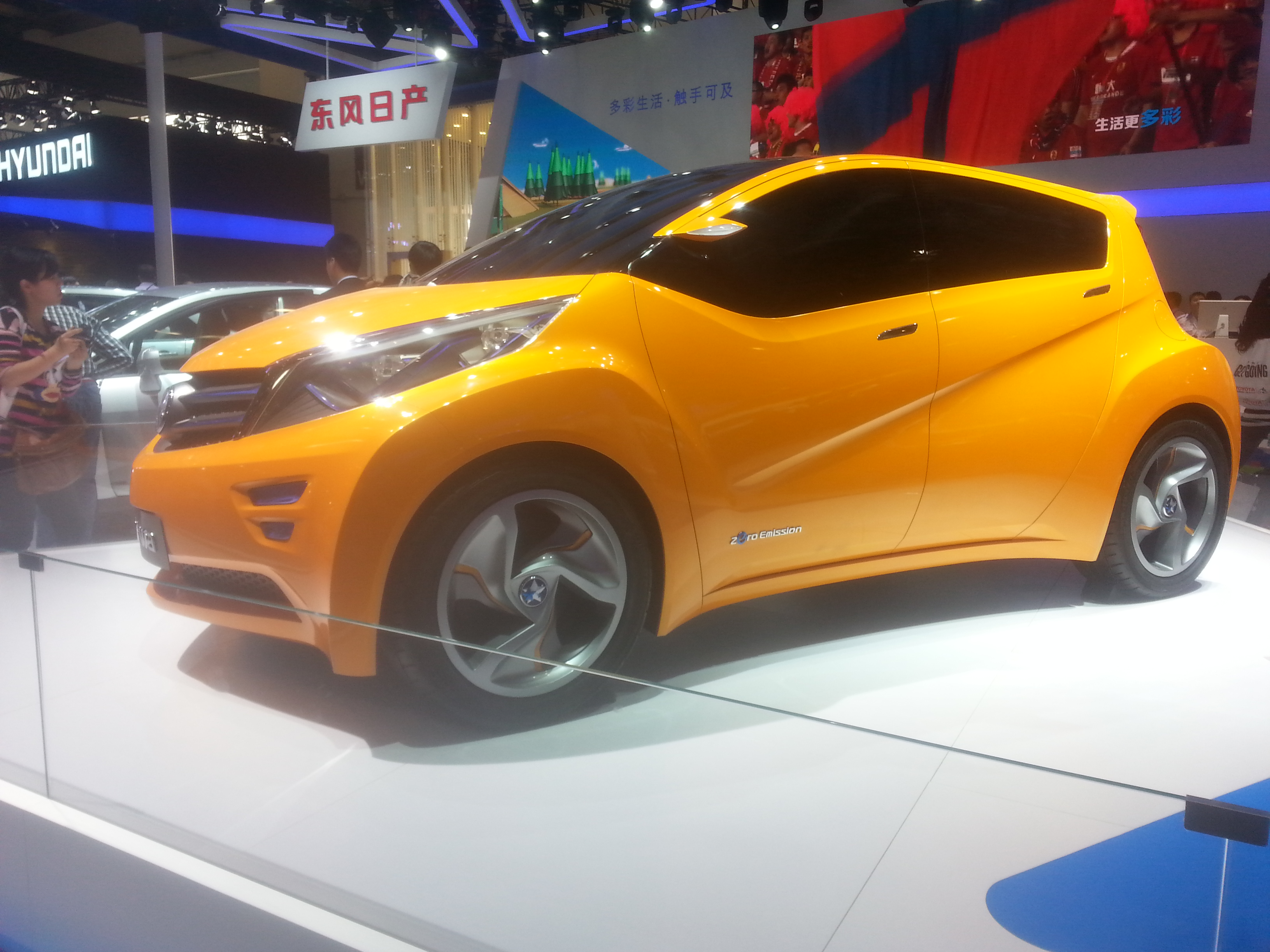
This BEV concept from Nissan partner Dongfeng might look familiar.
Suppliers recognize that some form of electrification is in China’s future. China has strict fuel economy deadlines looming in the future – the most intimidating the 2020 deadline for 5 liters per 100 kilometers. “This is a huge challenge for everyone right now,” David Xu, EVP at Bosch China, http://www.bosch.com told me at the show. Indeed, it is nigh impossible to achieve that without some form of at least mild electrification.
Bosch sees gasoline technology that boosts fuel efficiency — such as gasoline direct injection and turbocharging — as its biggest business opportunity in China in the near term. But it is also pushing its 48V mild hybrid system, which includes start-stop and a booster for starting and can boost fuel economy by 15 percent, says Xu.
Of course, Beijing hasn’t incentivized mild hybrid technology though that would help it achieve its goal of cutting back dependence on imported oil (though the western press seems fixated on the pollution in China and convinced that Beijing’s push for
EVs is tied to reducing pollution, much of China’s electricity is produced by burning coal so more EVs won’t necessarily have much impact on air quality. Cars are a convenient and visible scapegoat, however.) Nor is it currently incentivizing regular (i.e. non plug-in) hybrid cars. The Japanese hold too many patents in that area and Beijing doesn’t want incentive money to go to the Japanese automakers.
Meanwhile, Xu says new energy vehicles, which includes BEVs, PHEVs, and fuel-cell vehicles, won’t account for more than six percent of the market in 2020. Beijing’s inaction on building out a charging network – or even enforcing a national plug standard – is part of the problem, says Xu. “Talking about mass production to make a profit, it is really a struggle for everybody,” he says.
Still, automakers will continue to talk about investing, and actually invest, in EVs, he says. “This is kind of a political task for them,” he says. “They have to do it.”
An executive at another European supplier tells me that the joint venture automakers are telling him that Beijing is coming to them and saying, “You show us a plan to build an EV, homologate it here, and we will approve your expansion.”
Of course the individual consumer isn’t the only customer for EVs. Indeed, as I have written in this blog many time, fleet vehicles are the best market for both BEVs and PHEVs.

It is a problem that China has not standardized charging station plugs, but Siemens Industrial Sector CEO Siegfried Russwurm says the future is wireless.
Siemens recognizes that fact. It will start by supplying commercial vehicles, says Siegfried Russwurm, CEO of Siemens Industry Sector. As for the charging station issue, and the lack of standards where that is concerned, “The future is wireless,” he says.
 Alysha Webb
 Alysha Webb's ChinaEV Blog