Follow up: My visit to Shanghai EDrive in China.
I visited Shanghai EDrive on October 24 as part of the Clean Truck and Bus Forum www.http://www.calstart.org/Projects/US-China-Clean-Truck-Forum/US-China-Clean-Truck-Summit-Agenda.aspx , sponsored in part by CalStart. The visit confirmed what I had heard about EDrive www.chinaedrive.com from industry sources; it is a well-run company. The visit also confirmed my and many others’ suspicions that the growth of the electric vehicle sector in China will fall far short of the government’s goals, at least for the next few years. The most recent New Energy Vehicle policy, which incentivizes commercial vehicles more generously than non-commercial vehicles will also result in a lopsided growth pattern. But that is not necessarily a bad thing.
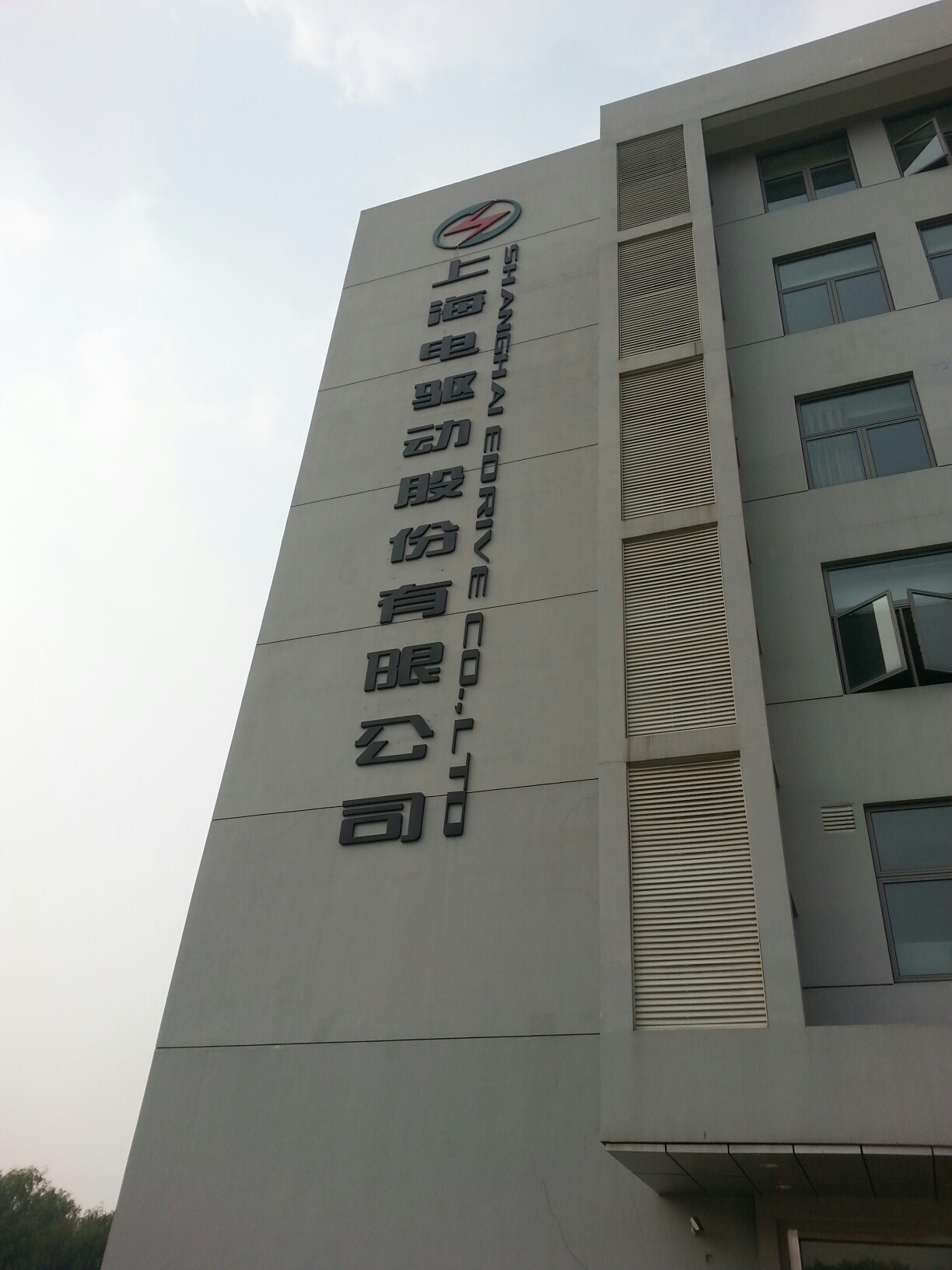 The building, on the outskirts of Shanghai, looks like all the other white-grey multi-story buildings in the industrial zone. Inside are clean rooms for manufacturing electronic controls and less-spotless but still clean rooms for the permanent magnet motors themselves.
We were greeted and given an introduction and tour by Dr. Zhang Zhouyun, vice general manager and senior engineer. EDrive has been growing like gangbusters since its establishment in 2008, with staff increasing 30-50% annually, he said. It has devoted 20% of its budget to R&D each year and holds 10 patents in China as well as many overseas patents. In 2013 EDrive aims for 400 million RMB in sales.
Interestingly, it seems EDrive sees the market for mini BEVs taking off much more quickly than that for larger vehicles. Not low-speed BEVs, but those able to achieve higher speeds than the 25 mph or so LSEVs are typically capable of. Some 180,000 units will be produced in China in 2014, EDrive figures. The company aims to supply 28% of that market, or 50,000 units.
Shandong is currently conducting a test project with such mini electric vehicles, says Dr. Zhang. Shandong already dominates China’s low-speed electric vehicle production; it seems Shandong figures that expertise can be leveraged into higher speed models.
Chery www.cheryinternational.com and Geely www.geelyauto.com.hk are two companies that are planning volume production of the mini-BEVs, says Dr. Zhang. Some domestic manufacturers are testing in-wheel motors on the mini EVs, he says.
As for passenger car PHEVs, five or six companies plan to produce them starting in 2015 and EDrive has contracts with some, including FAW www.faw.com and Chery. But the EDrive folks seemed to think the production levels would be very low. They will mainly be test vehicles.
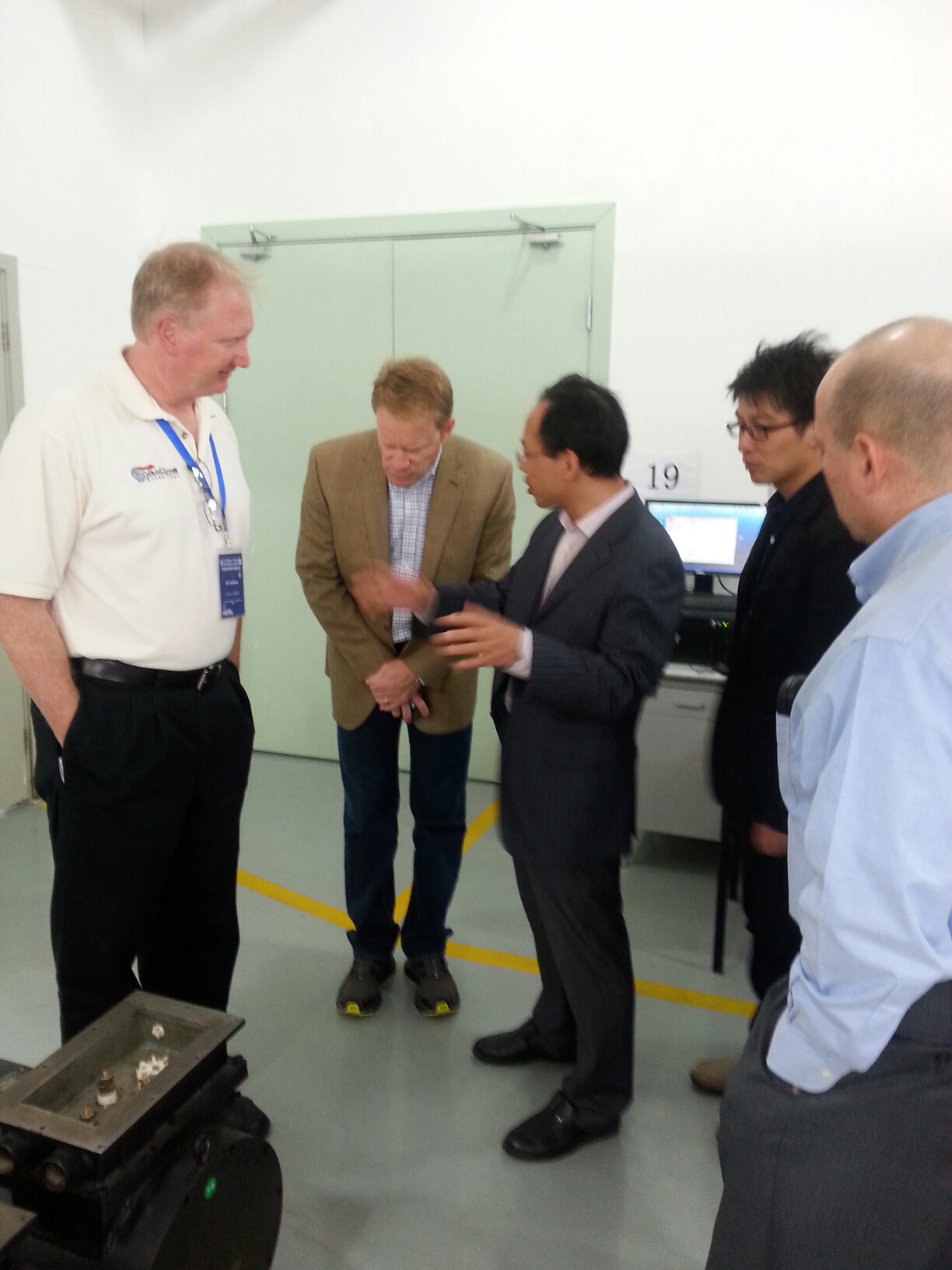
Dr. Zhang explains EDrive’s technology to visitors from CalStart’s Clean Truck and Bus Forum in Shanghai in October, 2013.
The big growth in NEVs over the next few years, as EDrive CEO Dr. Gong mentioned in our interview, is commercial vehicles, the EDrive guys confirmed.
So, an interesting visit to a company that should do well if the Central government sticks to its guns and enforces the latest NEV plan. http://www.bloomberg.com/news/2013-09-17/china-renews-electric-vehicle-subsidies-without-adding-hybrids.html But even at EDrive, an admission that all those announcements about NEV passenger cars are mainly for show and that volumes will be quite small for at least the next few years. Still, as I mentioned up top, the new policy’s focus on commercial vehicles/ fleets is a good thing. Applications are more apparent and with volume production some breakthroughs, or at least cost reduction on some components, should be possible.
While the Chinese government may be intent on growing the electric vehicle segment, Chinese consumers are not so keen to buy electric vehicles. But that doesn’t mean companies in China that produce components for electric vehicles aren’t counting on the sector growing. The just-released New Energy Vehicle policy is a big reason for that optimism. Local government support also plays a role.
The history of one of those companies, Shanghai EDrive, http://www.chinaedrive.com/index2.asp is a micro-history of China’s quest to be a global player in the electric vehicle field, and proof that the Chinese government is taking a long-term view in developing the sector. If EDrive succeeds, it will mean China is succeeding in its electric vehicle ambitions as well.
Shanghai EDrive produces electric motors, controllers, and invertors for both traditional gasoline-powered vehicles and electric vehicles. It has long benefited from government support for the electric vehicle segment. I recently spoke with Dr. Gong Jun, president of EDrive, by phone and also exchanged emails with Jimmy Lin Renjie, who works with Gong, about the recent policy and EDrive’s future.
“Of course the new policy is good for our company,” Gong told me.
Now, I’m a skeptical person. And I am certainly no engineer so can’t evaluate EDrive’s technology. But several industry friends have spoken well of EDrive. Its growth strategy is, however, based on the belief that electric vehicles, first regular hybrids, then plug-in electric hybrids, then battery electric vehicles, will take a growing share of the vehicle market. And of the government supporting companies that serve that purpose.
EDrive’s support from the government started with the 863 program. http://www.most.gov.cn/eng/programmes1/200610/t20061009_36225.htm The 863 program was launched by the central government in 1986 and has been part of every Five-Year Plan since. Its goal is to help China “leapfrog” in certain technologies to become a world leader. EDrive has also received funding from the Shanghai government.
The components it produces are used in both traditional internal combustion engine vehicles and electric vehicles, from hybrids to low-speed electric vehicles to regular battery electric vehicles. EDrive is already profitable. Its motors are in hybrids cars produced by companies ranging from Dongfeng www.dfm.com.cn and FAW www.faw.com.cn to Brilliance www.brillianceauto.com , Geely www.geelyauto.com.hk , and Chery www.cheryinternartional.com ; and in hybrid buses from just about every large Chinese bus maker you can name, according to materials EDrive sent me. Ditto with the few pure electric vehicles being produced (but not BYD, which is highly vertically integrated) and many micro cars such as the QQ, it seems.
Eventually, when his company is big enough, Gong figures it will want to export. One way it aims to grow is by listing on Shenzhen’s Growth Enterprise Market next year. EDrive is preparing the materials right now.
EDrive has been in business since June of 2008. It manufacturers to a client’s specifications and also does what Lin called “cutting edge” research and development of components in cooperation with universities. It is receiving a growing number of orders related to components for battery electric and plug-in hybrid electric vehicles, mainly buses right now, says Gong. “Due to the new policy, we expect that will grow,” he says.
Gong is right, the recently released NEV policy should be good for EDrive. If the central government is effective in implementing the policy, that is. Gong mentions in particular the mandate for 30% of new vehicles in municipal fleets to be New Energy Vehicles, which in practice will mean BEVs and PHEVs. For details see my earlier blog on the policy.
What about the consumer market for electric vehicles? That is more uncertain because of the lack of a charging infrastructure, Lin told me. “The bottleneck for the development of passenger cars is the infrastructure such as the charging point,” he says. “If the infrastructure is developed, the EV of passenger car will have a bright future.”
And it seems EDrive will be along for the ride.
.
China could learns from PG&E’s electric vehicle program
In July of 2012, I wrote about the just-released policy in China to promote new energy vehicles and fuel-efficient vehicles. At the time, I mourned the lack of incentives for producing new energy fleet vehicles and suggested the government would have better served its cause with a policy that did that. In the same blog, I talked about what Pacific Gas & Electric www.pgande.com , a huge utility in Northern California, was doing to further alternative fuel vehicle research here in the U.S.
Well, a bit more than a year later the Chinese government has come out with a new policy to promote new energy vehicles and it focuses mainly on fleet vehicles, especially buses! http://www.miit.gov.cn/n11293472/n11293832/n11293907/n11368223/15629319.html Glad Beijing got the word. This blogging platform (i.e. WordPress) is blocked in China but those government officials and fagawei types probably have VPNs.
I wrote about the new policy in my recent ChinaEV blog, so in the interest of symmetry I’m going to talk about what PG&E is up to now re: alternative fuel vehicles. Rather than reiterate everything I said last July, let’s just look at an event that just occurred, the unveiling of what PG&E says is the utility industry’s first plug-in electric hybrid Class 5 work trucks.

PG&E aims to convert all its Class 5 trucks to PHEVs
Those trucks were produced by Electric Vehicles International, www.evi-usa.com or EVI, a manufacturer located in Stockton, CA. The transplant – it was based in Mexico – is a good example of how government support can help expand the commercial electric vehicle industry. PG&E’s participation shows how the private sector can both take advantage of and propel development of EV technology.
EVI is a 20-year old company that moved to the California central valley city of Stockton from Mexico after current EVI president Ricky Hanna bought the company. He switched EVI’s focus from light-duty EVs to heavy-duty EVs and moved operations to California about five years ago because of the state’s generous subsidies for electric vehicle makers. Smart move – EVI has received $7 million in grants from the California Energy Commission. It produces both range-extended electric vehicles (a type of PHEV) and battery-electric vehicles.
Just so you don’t have to re-read the previous blog (though of course you should), here is a bit of background on PG&E’s alt-fuel vehicle quest taken straight from that blog: As one of the largest public utilities in the U.S., PG&E has a huge fleet—some 14,000 vehicles. That’s a pretty big Petri dish for testing out new alternative fuel technologies, and PG&E has been doing that for years, says Dave Meisel, director of transportation for PG&E.
The utility has gotten much more active in testing alternative fuel technology vehicles in the last four or five years, he says, which makes sense because finding replacements for gasoline as a vehicle fuel has become a much hotter topic in the last four or five years. PG&E isn’t doing this out of the goodness of its heart. Partly, it is compelled by California law to have a certain percentage of low-emission vehicles in its fleet. But PG&E is also looking to save money.
Now, back to the present: PG&E started working with EVI about four years ago, says Meisel. It wants to try out EVI’s Class 5 vehicles – that’s like a Ford F450 or F550 truck. PG&E works with other companies in the EV space including VIA www.viamotors.com , Efficient Drivetrains Inc www.efficientdrivetrains.com ., and Altec www.altec.com . All are located in California.
“We prefer to spend our money locally,” says Meisel. (That’s nice since I pay taxes here and I prefer they stay in the state as well….). “In 2013 we are going to buy $221 million worth of new vehicles, all purchased from somebody in California.”
PG&E has purchased four EVI REEV trucks. PG&E estimates each truck will save PG&E over 850 gallons of fuel per year. So the utility’s alt-fuel vehicle quest isn’t just to meet state government requirements, it also makes business sense. Indeed, PG&E hopes to replace all of its Class 5 vehicles with REEVs, says Meisel.
“I think clearly that if we can validate the technology and we believe we can, if it delivers the results we believe it will deliver, we will be moving that tech into our fleet on large scale,” he says. “It is too early to say who will supply the vehicles.”
As I wrote about before, what PG&E really likes in its trucks is exportable power, and it works with its EV manufacturers to up their exportable power capability. Though the EVI trucks can export up to 100 kilowatts, the “holy grail” is really 125 kilowatts. “If we can get a vehicle up to that it opens up a lot of possibilities for us,” says Meisel.
PG&E can use the fleet to provide power to a neighborhood when it does repairs instead of having planned outages. Also, in emergency response situations the fleet could provide power.
“I handled the response to hurricane Sandy,” he says. “We found that we were trying to move in larger generators. When we tried to move them in from all over the U.S., we couldn’t put a dent in the amount requested vs. what was available. If we had sent 400 hybrids, that is like moving a small power plant into New York.” China take note….
China’s latest new energy vehicle policy may result in fresh EV tech for the world
The Chinese government just issued its latest New Energy Vehicle subsidy policy. http://jjs.mof.gov.cn/zhengwuxinxi/tongzhigonggao/201309/t20130916_989833.html Seems like the government has pretty much given up on trying to create a consumer market for new energy vehicles, which include battery electric, plug-in hybrid electric, and hydrogen fuel cell vehicles. That isn’t so bad, actually. Because the government’s focus has turned to the area where NEVs have real potential — public transportation and fleet vehicles. http://www.bloomberg.com/news/2013-09-17/china-renews-electric-vehicle-subsidies-without-adding-hybrids.html
One technology has been completely left out of the current policy – regular hybrid vehicles. My friend Yang Jian mourns this omission in a column for Automotive News China. http://www.autonewschina.com/en/article.asp?id=10788 But I don’t think it is so bad. The price of hybrids will soon come close to that of regular gasoline-powered cars. And if the hybrids can offer significant fuel economy then Chinese will buy them, just as Americans have.
Some details of the new NEV policy:
The policy covers 2013-2015.
The subsidies for NEV passenger vehicles are no larger, and decline over the next two years. Battery electric passenger cars are eligible for incentives of up to 60,000 RMB, plug-in hybrid electric passenger vehicles up to 35,000 RMB in 2013. Those amounts will decrease by 10% in 2014 and by 20% in 2015.
Hydrogen fuel cell passenger cars are eligible for incentives of 200,000 RMB. That amount will also decrease in 2014 and 2015.
Battery electric public transportation buses are eligible for up to 500,000 RMB in incentives. Plug-in hybrid electric vehicle bus incentives top off at 250,000 RMB.
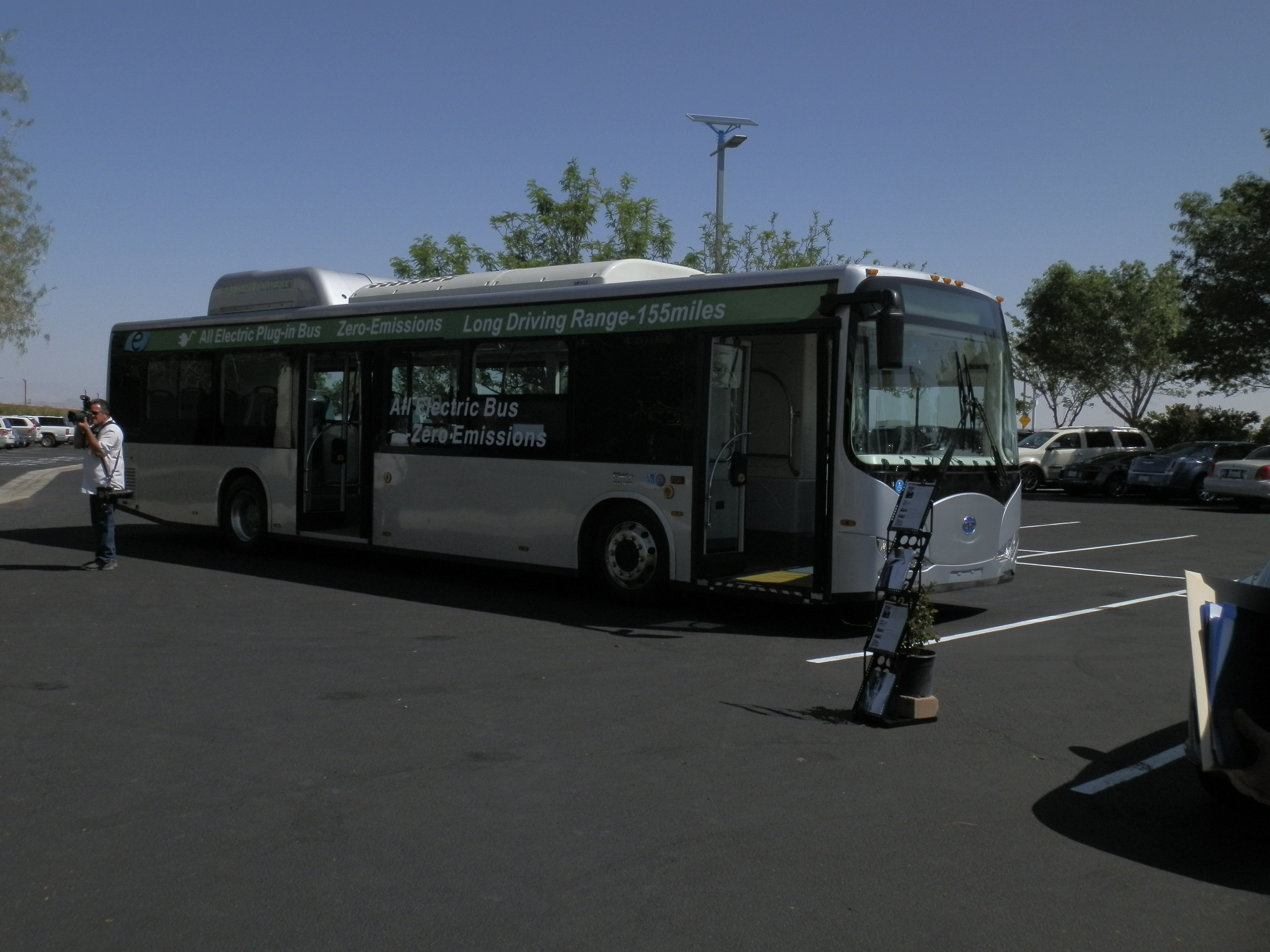
BYD’s ebuses should do well under the new policy.
Commercial vehicles in public fleets are another important inclusion. Mail, sanitation, garbage, and general goods battery electric vehicles receive a 150,000 RMB incentive.
There are target purchase volumes and guidelines for municipal governments:
In large cities and areas – mainly Shanghai, Beijing, and Guangzhou it seems – the number of NEVs should reach no fewer than 10,000 by 2015. All other cities and/or areas should have no fewer than 5,000.
When buying new vehicles for municipal fleets, at least 30% of the purchases should be NEVs.
In an important nod to the huge problem protectionism presents in growing the public transportation and fleet market for NEVs, the policy also says at least 30% of the purchases should be from companies outside of the region.
Those are the main points. While it remains to be seen how rigorously the policy will be enforced, the subsidies may kick-start production of NEVs by the regional and national vehicle manufacturers. Of course, they don’t have all the necessary technology to product BEVs and PHEVs. That could present a business opportunity for foreign firms with battery management system technology, for example. And for companies that can integrate the electric drivetrains into the rest of the systems, which has been a problem for Chinese companies.
Sure, it also shows that China’s central government hasn’t given up on becoming a leader in some kind of electrification technology. Otherwise, why totally exclude regular hybrids from the policy? As Yang Jian points out, China still hasn’t given up on trying to be a leader in some electrification area and hybrids are already mature technology.
But Chinese automakers will need plenty of help from outside China to produce quality BEVs and PHEVs, so they are unlikely to become leaders in those areas anytime soon. The volumes envisioned for local fleets could, however, result in new technologies being developed for China, technologies that the rest of the world could benefit from. At the very least, volume production of some components should help bring the price down.
So, the new policy should benefit both China and the rest of the world. Now to wait for the level of enforcement….
If you wonder what BYD is up to lately outside of China, electric buses seem to be the Chinese automaker’s thing these days. It is also still hawking its much-maligned e6 pure electric crossover vehicle as a taxi. Development of the dual-mode Qin (the current generation of BYD’s hybrid) seems to be treading water, however. Perhaps BYD, www.byd.com like most Chinese automakers, is waiting for news of what the government subsidies for hybrids will be. http://usa.chinadaily.com.cn/china/2013-08/05/content_16869956.htm
As I blogged about many months ago, BYD is focused on fleets for its electric vehicles here in the U.S. Also,, it seems worldwide. “BYD is in no rush to launch U.S. consumer sales,” BYD spokesman Micheal Austin told me via email. “We are finding great success offering our long-range EVs for high-utility fleet applications.”
By high-utility, Austin means long-range so I guess that sentence is a bit redundant. BYD’s website claims a 155 mile range for the Li-iron phosphate battery in its pure electric ebus. It has a 3-hour or 6-hour, or perhaps 5-hour, recharging time depending on the type of charger used. I say perhaps 5-hour because the website cites both 5- and 6-hour times. In any case, that’s nitpicking. Around 5 hours.
The ebus is already rolling around various cities and campuses worldwide.
BYD has been pretty successful at getting its electric bus into fleets around the world, including one in Quebec in Canada, one in Israel, 10 in Long Beach, California, five in Los Angeles (with an option to buy up to 25), and 35 in Amsterdam.
A few months ago, BYD had the grand opening of a plant to produce electric buses in the city of Lancaster, CA, about an hour east of Los Angeles. http://www.fleetsandfuels.com/fuels/evs/2013/04/byd-battery-buses-in-los-angeles/ BYD’s contracts with Long Beach and Los Angeles use some federal funding so both have a Made in the USA requirement, meaning BYD must source at least 60% of the bus components from the U.S.A. Stella Li, SVP of BYD and head of its North America operations, told me the local content may even higher.
I hear from a friend who works in logistics that BYD has just arranged to ship its first batch of batteries to the U.S. for those buses. She speculates more shipments of other parts will follow. And, other sources in the EV bus industry figure that BYD will likely source the glass, seats, and air conditioners from China. I might add the wheels/rims given China’s large number of rim manufacturers.
BYD may make a decent electric bus. I have always said the ebus was a good-looking bus, at least. Nice interior, too. As usual, I prefer to wait until the buses in international markets have been running for a while until I start gushing over them the way some EV sites have been. But as I have stated before, I hope BYD succeeds with the buses. I like BYD despite the belief by some executives there, whose names will remain unwritten, that I hate the company. Nonetheless, the proof, as they say, is in the pudding.
What of the e6 crossover, which is the current incarnation of BYD’s original pure electric vehicle, the e6 sedan? Well, it seems the e6 is also destined for fleets for the time being, as I wrote about last year. https://chinaev.wordpress.com/2012/02/10/byd-now-focused-on-fleets-for-its-bev-strategy-smart-move/
The order form is out there –Austin emailed me one. They are available to order for fleet use here in the U.S. though I do not believe BYD has gotten any orders here. I asked to test drive the latest e6 and Austin said it wasn’t significantly changed from the version I drove a few years ago.
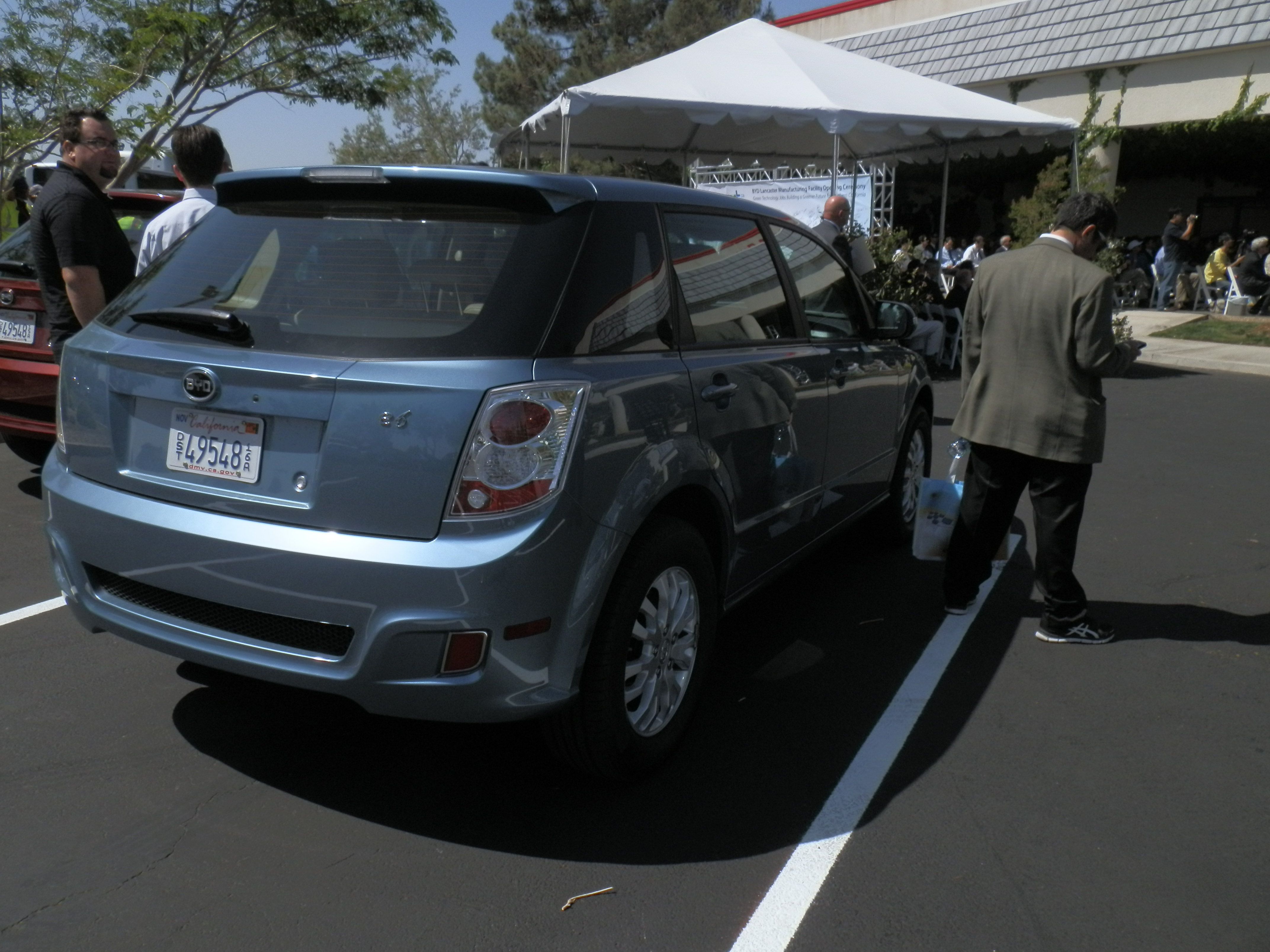
The latest generation e6 hasn’t changed much compared to the last generation. BYD seems to still be working on it.
There are e6 crossovers in taxi fleets outside of China, however. There are a few in Hong Kong http://www.reuters.com/article/2013/05/15/us-byd-hongkong-idUSBRE94E0CB20130515 and Thailand reportedly ordered three last year, though I don’t know if they are actually in use now. Bogota, Columbia also recently ordered 45 e6s as part of its Biotaxi project, according to a press release. http://online.wsj.com/article/PR-CO-20130902-905855.html Hope those taxies have bullet-proof sheet metal. No, that’s not fair. I’m sure Bogota is safer than it used to be….
That leaves the Qin dual-mode aka hybrid vehicle. http://www.byd.com/la/auto/qin.html It seems to be in a state of limbo. Perhaps BYD has joined most Chinese automakers in waiting to launch any new electric vehicles or hybrids until the central government issued its overdue updated new energy vehicle subsidy policy. The new policy will reportedly subsidize regular hybrids at a higher rate than the current policy. But no one know.
In any case, the Qin isn’t listed on BYD’s website. BYD showed the Qin, which is the latest generation of its hybrid vehicle, at the Shanghai auto show this year after it debuted at the auto show in Beijing in 2012. Reports appeared in the gullible U.S. press about the Qin being launched in June 2013 with a sub-$30,000 (which I guess was converted from an RMB price the reporter heard somewhere) price tag. http://online.wsj.com/article/PR-CO-20130902-905855.html
There do seem to be some Qins driving around in South America, based on some comments from BYD execs here in the U.S. But the Qin likely won’t be seen in the U.S. this year or in 2014, said Austin. So not sure if/when it will make an appearance here.
So how is BYD doing in the EV arena? Okay, I’d say. If we look at what it is actually doing now rather than what it said it wanted to do a few years back, BYD seems to be farther along than any other Chinese automaker – or any automaker when it comes to electric buses — in terms of getting its electrified vehicles onto the world market.
I still wish someone would do an independent analysis of BYD’s electric drivetrain, however….
I have ridden in what should be China’s future. It would save countless hours stuck in traffic and countless lives.
A few days ago I was at the Nissan 360 media event here in California at the lovely Pelican Hill Resort in Newport Beach. Automakers always host media at super-lux places. That way at least we are in a good mood when we check out their vehicles, the thinking must be. I had my own bungalow. Larger than an apartment I lived in back in Hong Kong. But I digress.
One of the vehicles available to drive, or in this case ride in, was the autonomous LEAF electric vehicle. http://www.nissanusa.com/electric-cars/leaf/?next=header.vehicles.postcard.vlp.image It looks a lot like the regular old LEAF, but it has 6 sensors arrayed at strategic points on the exterior. Why did they chose the LEAF as the first autonomous vehicle, I asked the Nissan engineer who was not going to drive the vehicle. “The technology is okay for an internal combustion engine car,” he said, “but the electric vehicle is easier to control because the motor is more reactive. It is a better combination.”

For those of you dreaming of well, dreaming, away a trip to the office in traffic-chocked Beijing or Los Angeles, forget it. The “driver” does have to at least be alert – in this autonomous vehicle. How about drunk drivers, I asked? Not in this version, but Nissan is working on technology that will detect if a driver is drunk, said the Nissan engineer.
Still, the LEAF Autonomous Vehicle detected and read speed limit signs, avoided a large truck entering traffic in front of us, a pedestrian stepping out in front of us, and a lot of road furniture including cones and barriers, and of course detected a red light and stop sign. The valet function was pretty cool as well. The “valet” had the key fob. The “driver” simply left the car with the valet, he pressed the key fob, the car went and found a spot and parked itself. Then, when the driver returned the valet pressed the key fob and the car returned. How cool is that?
This version is not ready for prime-time. Among other improvements needed, said the Japanese engineer, is sensors with finer resolution. The current sensors on the LEAF only detect at 30 to 40 centimeters, he said. Nissan wants plus or minus 1 centimeter. “We are looking for a partner” with that technology, he said.
The autonomous vehicle is “an important step in a world of zero fatalities,” said Roel De-Vries, Nissan’s global corporate vice president of marketing. Nissan’s has its twin zeros marketing thing – zero emissions and zero fatalities. As I sat in the Nissan LEAF and it drove though the highway and urban courses, I got to thinking “Gee, this would be really great in China!” It is about as far from zero fatalities as any country in the world. http://www.washingtonpost.com/blogs/worldviews/wp/2013/01/18/a-surprising-map-of-countries-that-have-the-most-traffic-deaths/
Imagine it. Cars would actually stop at stop signs and red lights. They would know how to merge on to a highway. They wouldn’t feel obligated to cut in front of you just because that space was there and needed to be filled in. They would stop before they hit a pedestrian or bicycle or another car. They would know how to park. It gave me shivers.
Nissan CEO Carlos Ghosn has said autonomous vehicles will be in Nissan showrooms by 2020. http://www.forbes.com/sites/danbigman/2013/01/14/driverless-cars-coming-to-showrooms-by-2020-says-nissan-ceo-carlos-ghosn/ Please get them to showrooms in China sooner. I didn’t ask if China was a target market, but no automaker can bypass China with a significant new product, so assume the autonomous vehicles will be there, too. China is one of the top two countries in the world for traffic fatalities; India is right up there, as well. The Chinese authorities put the number of traffic deaths in China in 2012 in the tens of thousands, but even the Chinese press says that number is low. A more dependable source, Bloomberg Philanthropies, puts the number at 220,000 annually. Bottom line: A lot of people die in cars or because of cars in China each year.
If you live there, you know why. Most Chinese are first-generation drivers. Chinese driving schools don’t teach defensive driving. Road rules, including stop signs, are treated more as suggestions than rules. After all, if one stops at a stop sign too long, someone else might get to a some goal that the driver desires first. In China, it’s all about taking advantage of opportunity when it presents itself.
Nissan has said it may produce the LEAF in China. Please do, and please make it an autonomously-driven LEAF! But also produce an autonomously-driven version of your best-selling model in China. And price it so people will buy it. And make it impossible to override the system at stop signs! Otherwise it will be useless…..
There is no doubt I am somewhat obsessed with Shanghai GM Wuling. www.sgmw.com.cn Every since I visited it back in 2001 (the first foreign journo to do so!) I have followed it with great interest. Let’s face it; investing in Wuling will go down in history as one of General Motors best strategic moves. GM has Phil Murtaugh to thank for that. He negotiated the deal with Wuling’s then-president Shen Yang.
When Ray Bierzynski, the former head of electrification strategy for GM China, was sent to Wuling to become an EVP (sent down to the countryside, that is 😉 ), I speculated that GM was going to produce electric vehicles at SGMW. It may still, but it seems that first GM plans to use Wuling to rule the minivan market in the developing world. I wrote about that several times in late 2012. The latest announcement from SGMW only confirms that.
The JV between SAIC, GM, and Wuling just launched an upgraded version of its best-selling vehicle, the Hong Guang. Called the Hong Guang S, the new van is priced at 61,800 RMB for the 1.2L engine version and 65,800 RMB for the 1.5L engine version. http://media.gm.com/content/media/cn/en/gm/news.detail.html/content/Pages/news/cn/en/2013/Aug/0806_wuling.html The little seven-seater is squarely aimed at China’s burgeoning class of private businessmen who need a car they can use for the family and for business. Or as the Chinese press release says (they are always more fun than the English-language ones), change “help business, help family” to “help family, help business.”
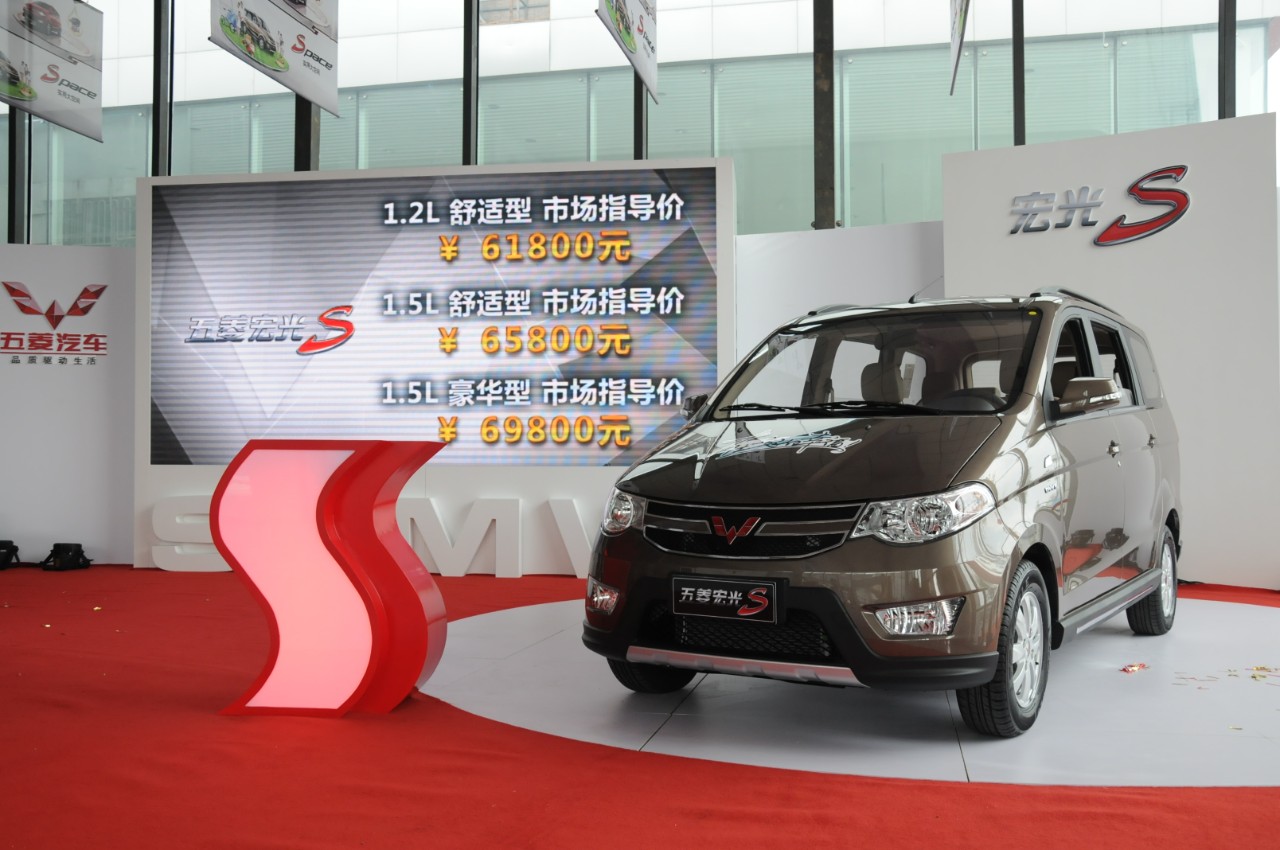
In a savvy marketing move, rather than launch the Hong Guang S in Tier One cities such as Beijing and Shanghai, GM launched it in two second-tier cities at opposite ends of the country – Kunming in the southwest China province of Kunming and Harbin, in the northeast China province of Heilongjiang. Those cities will have thriving small private business sectors, the target market for the Hong Guang S.
In a nod to the growing sophistication of Chinese consumers in all cities, not just coastal areas, GM touted the “refined, spacious” interior of the Hong Guang S compared to its poorer cousin, the Hong Guang. In a recognition that consumers want choices even in a minivan, the Hong Guang S is offered in (don’t you love these names?) Desert Gold, Sandy Gold, Coral Red, Ocean Blue, Storm Gray, Earth Brown, Twinkling Silver, and Candy White.
The website for SGMW makes it clear the family is first. The Hong Guang S features a young family of three standing on the side. http://www.sgmw.com.cn/hg/ Click through the various links for outward and interior appearance, the engine and the specs. The interior is shown against the backdrop of an upscale stylish apartment. For the specs proving the roominess, the family is shown by a tent – great for the outdoors! This may not be the vehicle for the Shanghai sophisticate (would it even be allowed on the highways in Shanghai, where some smaller-engine vehicles are restricted?), but for upwardly-mobile young families in those neidi (interior) cities, the Hong Guang S is the bees knees.
The regular old Hong Guang, which is the best selling minivan in China, has sold nearly 750,000 units since its launch a few years ago. http://media.gm.com/content/media/us/en/gm/news.detail.html/content/Pages/news/us/en/2010/Sept/0914_wuling.html With the addition of the larger and roomier Hong Guang S model, GM is aiming for more than one million a year on the platform. Whew, that’s a lot of little vans (or Multi-purpose vehicles, as the HG is called. But let’s call a spade a spade. It’s a minivan, or “compact commercial vehicle” as one older press release referred to it.).
The Hong Guang S will be badged Wuling in China. But, the regular old Hong Guang is sold as a Chevy Enjoy in India. I wonder if the Hong Guang S will also be sold in India?
Launched in May of this year in India, the Chevy Enjoy is available with a gasoline or turbo diesel engine! According to IndianCarsBikes.com http://www.indiancarsbikes.in/cars/wuling-hongguangchevrolet-enjoy-mpv-is-the-third-largest-selling-car-in-the-world-during-february-2013-70790/ the Hong Guang was the third best-selling vehicle in the world in February of this year. That may be true. In any case, according to the GM China spokesperson, the regular old Hong Guang sold 217,000 units in China in the first six months of 2013, taking 1/3 market share. In India, from the launch in May through July 21 6,651 units were sold.
GM is certainly getting a lot of use out of that platform. SGMW’s Baojun brand will launch its own version of the Hong Guang in 2014, said the spokesperson. I wonder how SGMW will position it? Should be less expensive than the Hong Guang or Hong Guang S? That’s pretty cheap…. Let’s conjecture: 35,000 RMB to 42,000 RMB. Can’t wait until the Baojun version launches to see if I’m right.
What does this have to do with electric vehicles, you might ask? Well, this is my blog where, as I say, I can pontificate about whatever I chose.
I did ask the GM China spokesperson if SGMW planned to sell the Hong Guang S as an electric vehicle. “Currently there is no such plan,” was the reply. At least that leaves the door open….
China is committed to having an electric vehicle industry. But just what kind of EVs it wants, and when, is still being decided. Meanwhile, investors looking to cash in on China’s EV industry seem to be looking for a good way to benefit from a yet-to-be-finalized government policy.
Take vehicle producer Kandi Technologies (KNDI). www.kandivehicle.com Its stock price has surged recently. http://www.nasdaq.com/symbol/kndi/stock-report The stock, traded on the Nasdaq exchange, closed up 11.41% as I write this on July 26. What prompted this surge? News of Kandi’s delivery of 100 pure electric vehicles to the Hangzhou EV sharing system. http://www.nasdaq.com/press-release/kandi-technologies-announces-the-delivery-of-first-100-kandi-geely-co-developed-pure-evs-for-the-official-launch-of-hangzhous-public-ev-sharing-system-20130726-00318 That’s a pretty small number. But, Kandi said it will deliver up to 10,000 EVs within a year. This from a company that sold fewer than 4,000 low-speed electric vehicles in 2012.
So is the stock surge that justified? No way. We have no proof yet that Kandi is able to turn out a quality BEV. It is better to wait and see with Kandi, methinks, unless you have a big appetite for risk.
I sent a rash of questions to Kandi’s New York-based IR folks to try to get a better feel for the company and its products. Besides asking if the 100 BEVs were low-speed (“we don’t have such information available to the public yet” I was told), I asked these questions:
- China’s central government has not issued new guidelines for subsidies for electric vehicle purchase. How important are subsidies to Kandi’s growth?
- How large do subsidies for pure-electric vehicles need to be to significantly boost demand?
- Does Kandi think leasing or selling electric vehicles is the best business model?
- Will individual buyers or fleets ultimately be the largest market in China for pure electric vehicles?
- Does Kandi have plans to enter the fleet market and if so with what type of vehicle?
- ZZY EV, the company that is buying some BEVs from Kandi to use in Hangzhou, expects to deploy 5,000 to 10,000 rental EVs within one year. So is it closer to 5,000 or 10,000?
- Will all these vehicles be provided by Kandi?
- Go-karts still represent the majority of Kandi’s production. Yet Kandi has been aggressively adding EV production capacity at a several locations. What makes Kandi think it can produce high-quality pure electric vehicles in volume?
- When might we see Kandi EVs for sale in the U.S.?
The IR folks answered none of my questions. The reply: “Many of your questions are not yet publicly disclosed. We are now in the preparation for upcoming 10Q. Our legal counsel doesn’t encourage us to participate in any interview at this moment.”
I am not sure that the 100 BEVs Kandi delivered to Hangzhou are the same as the Super-mini cars like the one below. But they probably are.

I await with great interest the next filing from KNDI. Do I think all my questions will be answered? Hardly. Next time I am in Shanghai I must try to arrange a visit to Kandi in neighboring Zhejiang. Meanwhile, Kandi’s existing filings offer some a somewhat disturbing picture, or at least it disturbs me. Maybe I have spent too much time in China and seen too many big words from companies followed by small actions. Nonetheless, I take the caveats in Kandi’s filings with the U.S. Securities and Exchange Commission very seriously.
A little background: Kandi is a vehicle manufacturer based in the east China province of Zhejiang. Its primary business is still the production of go-karts, with a healthy serving of All-Terrain Vehicles thrown in. The two accounted for 81% of Kandi’s revenue in 2012.
Its electric vehicle business does seem to be picking up, however. Although sales to Hangzhou have just begun, according to the numbers in Kandi’s SEC filing for 2012, revenues from its pure electric Super-mini cars nearly tripled to $19 million in 2012 compared to 2011. I’m pretty sure the Super-mini cars are low-speed urban BEVs.
I am not sure who bought the 3,915 EV units Kandi reports selling in 2012 (compared to 1,077 units in 2011). But, says the 2012 10K, “this increase (in EV sales and revenue) is primarily a result of certain beneficial local government policies that encourage the development of EVs.” Indeed, the price of the Super-mini cars decreased in 2012 because Kandi “adopted a new battery exchange business model” and started selling BEVs without the battery, says the 10K. How much, then, of the EV revenue was government subsidies? Hard to know.
Kandi does warn that that China’s EV market is heavily dependent on government policy: “The Company’s EV products currently are mainly sold to Chinese domestic market, and the EV industry is supported by the Chinese central and local governments. Therefore, our EV products performance is significantly affected by the policies adopted by Chinese central and local governments. Any significant adverse changes in the Chinese governments’ supporting policies may negatively affect our results.” http://blogs.worldwatch.org/revolt/chinas-electric-vehicle-development-failing-to-meet-ambitious-targets/
So the growth of the EV market is uncertain. Still, Kandi has added production capacity quickly. In April, it announced the establishment of two plants with 100,000 unit capacity each to products EV key components and parts. Does that mean EVs? Not clear. At the same time, Kandi also announced a 100,000-unit EV production line opening.
Additional red, or at least pink, flags in the SEC filings: Kandi funds a substantial portion of its operations through short-term bank loans, a pretty expensive way to grow. And risky given the current crackdown on risky lending by China’s central government.
According to Kandi’s SEC filing for Q1 2013 operations:
“As of March 31, 2013, the Company has credit lines from commercial banks for $54,126,337, of which $32,794,193 was used at March 31, 2013.”
It continues: “Historically, the Company has financed itself through short-term commercial bank loans obtained from PRC banks. The terms of these loans are typically for one year; upon our payment of all outstanding principal and interest in a respective loan, the PRC banks have typically rolled over such loans for an additional one-year term, subject to interest rate adjustments to reflect prevailing market rates. The Company believes these lending arrangements have not changed and that short-term bank loans will continue to be available on customary terms and conditions.”
Then there are the off-balance sheet obligations: Kandi serves as guarantor for some $20 million in bank loans to other companies. It has also pledged some $6.2 million in land rights, plants, and equipment as collateral for other loans. Those companies also guarantee Kandi’s loans. Sort of like a pyramid scheme.
Said the SEC filing: “It is a common business practice among companies in the region of China where Kandi is located to exchange guarantees for bank debt with no consideration given. It is considered a “favor for favor” business practice and is commonly required by the lending banks as in these cases. These companies provided guarantees for the Company’s bank loans as well. The banks involved in these guarantee transactions typically allow a maximum loan amount based on a 30% to 70% discount on the net book value of the pledged collateral.”
Kandi isn’t going it entirely alone in the EV world. A few months ago it announced a joint venture with Maple Guorun, a subsidiary of China’s Geely Automobile Holdings Ltd. to produce electric vehicles. The JV just received government permission to produce an electric sedan, which qualifies it to receive purchase subsidies. http://green.autoblog.com/2013/03/30/geely-kandi-ev-partnership-electric-vehicles-china/
That didn’t move its stock as much as the 100-EV delivery, however. Investors may have realized they were exhibiting irrational exuberance. It is a few days later (Monday) as I finish this blog. Kandi’s stock is down 0.38%. Perhaps the market is also becoming skeptical, but not very….
China’s Beijing Automotive Industry Corp – BAIC – is owned by the Beijing Municipal government. Given the central government’s plan to produce millions of electric vehicles, an automaker owned by its hometown should be at the forefront of electric vehicle production right?
Yeah, it should be, but it isn’t. That is likely partly due to technical restraints, but also because BAIC executives are likely also unenthusiastic about producing a product they see little demand for. Even state-owned enterprises like to make money. And since BAIC wants to list its passenger car subsidiary in Hong Kong, it would like to have a product portfolio that appeals to investors. http://www.bloomberg.com/news/2013-03-06/beijing-auto-to-list-car-unit-in-china-after-hong-kong.html
Even if it isn’t actually producing many EV, however, BAIC has been throwing money at the EV sector over the past few years including construction of a huge R&D center and a battery plant and an EV production plant, according to my industry friends in China. They aren’t sure if BAIC is actually producing much in those plants, however. And now BAIC apparently wants to waste even more money by purchasing Fisker Automotive. www.fiskerautomotive.com Not exactly a way to build investor confidence, I’d say. http://www.autoweek.com/article/20130717/CARNEWS/130719842
BAIC said in November of 2012 that it would invest 1.7 billion RMB through 2015 in research and production of new-energy vehicles. http://www.chinadaily.com.cn/china/2012-11/08/content_15891837.htm That would be used to construct three plants with total production capacity of 150,000 units. The plants would produce hybrids, PHEVs, BEVs, and fuel-cell vehicles. That’s pretty ambitious, but as no details were given it leaves plenty of wiggle room as to what type of EV the plants will actually produce. BAIC can wait to see what technology is most supported by the central government. Meanwhile, BAIC already has a plant in the Beijing suburbs to produce key components.
According to the local media, BAIC in 2012 produced 1,200 new energy vehicles. In 2013 it aims to produce 3,000 to 5,000. http://www.chinaknowledge.com/Newswires/NewsDetail.aspx?Cat=RND Those aren’t hugely ambitious production targets, but it also aims to have sales revenue of 1 billion RMB, which seems pretty much impossible given nobody wants to buy new energy vehicles. The central government should buy them, setting an example for the country. But it has not been especially vigorous in electrifying its fleets, indicating that it doesn’t have much confidence in the technology either.
What would BAIC obtain if it bought Fisker Automotive? Fisker laid off most of its engineers and other staff, so BAIC wouldn’t get that. It is most interested in the Atlantic, the sedan that Fisker wants to produce next, say reports. Henrik Fisker or the company itself must own the patents for some of the vehicle’s design. That could be useful to BAIC. I hear that Fisker doesn’t own much of the IP for its electric drivetrain, however. That is what made it less appealing to other Chinese suitors including Geely and Dongfeng. And the Fisker brand name isn’t exactly stellar given that the company failed.
BAIC could, however, rehire some of Fisker’s engineers. Or use its own engineers to re-start the production process. And it could turn out some nice looking – if not top-notch in quality – plug-in hybrid electric vehicles. Perhaps BAIC figures that it could enter China’s luxury segment with a PHEV using Fisker’s designs. The luxury segment is showing stronger growth than the auto market as a whole, and should continue to do so. But the BAIC brand doesn’t carry much cachet. And Chinese who could afford to buy a BAIC Fisker would know Fisker’s history, which includes quality problems. Is that worth the millions BAIC would have to pay for Fisker? I’d say not.
Then there is the question of whether BAIC would be allowed to buy Fisker. The PHEV maker received $192 million in federal funding. http://articles.latimes.com/2013/apr/22/autos/la-fi-hy-fisker-misses-federal-loan-payment-20130422 Would BAIC have to pay this back if it bought Fisker? In any case, if Wanxiang’s purchase of A123 is any indication, some congressmen would raise a real outcry at any move to allow BAIC buy Fisker. It might eventually succeed in buying Fisker, but BAIC should consult with Wanxiang America’s president Pin Ni before making any moves…. Actually Ni might welcome a BAIC purchase of Fisker. Fisker was the main customer for A123’s batteries. He could give BAIC free advice re: navigating congressional shoals. http://www.a123systems.com/about-us-asset-purchase-agreement-and-chapter-11-filing.htm
BAIC deputy general manager Zhang Xin recently said he aims to have an EV that can compete against the Tesla Model S by 2015. http://english.peopledaily.com.cn/90778/8330202.html Some in the U.S. press seems to be under the impression that Zhang mean compete against Tesla in the U.S. Of course he didn’t mean that. He means he wants to build a car that can compete with the Model S, but sell it in China. A Tesla spokesperson said “we plan to enter the (China) market in Beijing when we are ready.” When Tesla does enter the China market it seems unlikely that BAIC can compete against it. Technology aside, there is the question of brand name, marketing, and customer experience. At least Zhang has a high benchmark. Will buying Fisker advance that goal? I don’t think so.
Is China backing off its push to have millions of electric vehicles on China’s roads in the next ten years? Not exactly. But recent statements by government officials do signal a change in strategy.
China is moving towards a plan which doesn’t see purchase incentives as the best way to encourage the EV market in China. Instead, it will aim for more support for research and development of fuel saving technologies. There are caveats, however.
That may come as a surprise to some readers who don’t obsessively follow China’s EV adventures. After all, wasn’t China going to have 5 million EVs on the road by 2020? http://www.nytimes.com/2009/04/02/business/global/02electric.html?_r=0
Well, just because the China’s central government declares something will happen doesn’t mean it will. There are barriers such as oh, science and technology, to overcome. And since this isn’t 1958 and this isn’t the Great Leap Forward, China’s leaders sensibly altered their plan. Crossing the river by feeling for the stones and all.
More recent policies have more strongly supported (in words, anyway) plug-in hybrids and even regular hybrids. No leapfrogging there, but the technology is mature and consumers will more readily accept it. And it will result in more fuel economy more quickly. Meanwhile, China can work on pure electric vehicle technology.
If you are a Chinese automaker, or a foreign automaker producing cars in China for that matter, this method of policy making can be annoying to say the least. Product cycles are not a stone in the river. So China’s automakers have paid lip service to producing electric vehicles while doing little. That is still pretty much the case, according to my sources in China. They aren’t rushing to produce EVs.

Great Wall was showing a PHEV drivetrain at the Shanghai show this year but isn’t producing them.
China’s domestic automakers ought to stop waiting around for the government to make a decision and start developing their own regular hybrid technology, scolded Dong Yang, secretary general of the China Association of Automobile Manufacturers, in mid-May. (Which calls to mind, my mind anyway, a saying: “Either s*** or get off the pot.) They are getting left behind, he said.
“As far as energy savings are concerned, for the next ten years hybrid technology is the most important area in new energy vehicles. The domestic brands shouldn’t just keep staring at the direction of government support policies, they ought to grasp research and development of hybrid technologies,” Dong was quoted as saying. http://news.xinhuanet.com/auto/2013-05/15/c_124713039.htm
OMG! Wasn’t the government negative on regular hybrids just a few years back since that technology has already been developed by foreign companies?!? Well, yes. But the goal is not just to make China a technical leader in the EV world; it is also to reduce its dependence on foreign oil. China’s government now realizes that those two goals will not be achieved simultaneously. China’s leaders – including former premier Wen Jiabao – even said that China should get the alternative fuel vehicle from foreign companies if necessary.
In late May, Wan Gang, head of China’s Ministry of Science and Technology, said almost exactly the same thing as CAAM’s Dong, that R&D was more important than subsidies. The China Daily quoted Wang as saying: “The government is unwavering in its commitment to the industry, but EV makers should never count on subsidies to survive.” Wan, who was speaking at an international forum on electric vehicle pilot cities in Shanghai, said it is “imperative” for companies to boost their research and innovation capabilities. http://europe.chinadaily.com.cn/business/2013-05/31/content_16550740.htm
And, in a statement equivalent to the U.S. Federal Reserve saying it would stop pumping money into the economy (well, not quite the equivalent, but in the China EV world still pretty significant), Wan said purchase subsidies would likely be phased out by 2020. Like the Fed — which later clarified its policy by adding that stimulus would end only if the economy continued to strengthen – Wan said EV incentives would be phased out if operating expenses could be lowered and the market could be expanded. Still, his words were a clear indication of where the government wants the EV market to go. http://www.chinadaily.com.cn/bizchina/motoring/2013-03/18/content_16317590.htm
Meanwhile, word is out that the central government will soon announce a new electric vehicle subsidy policy. (Wan declined to comment on this.) The old policy, which offered subsidies of 60,000 RMB for pure electric vehicles and 50,000 RMB for certain hybrid vehicles, is expected to be expanded to include more substantial subsidies for plug-in hybrid electric vehicles and even regular old hybrids. The new policy will incentivize vehicles based on how much energy usage is reduced rather than the technology used, Miao Wei, head of the Ministry of Industry and Information Technology (MIIT) was quoted as saying. Of course, he also said the policy would be out in June. I write this on July 1 and no policy yet…. http://www.theicct.org/blogs/staff/china-shifting-performance-based-incentives-vehicle-efficiency
Still, it is step in the right direction. Choosing technology winners hasn’t worked for the Federal government here in the U.S.; nor has it worked for the central government in China.
Local efforts
Here in the U.S., some local governments have been trying to expand EV ownership by installing charging stations and the like. China’s local governments have also been trying to encourage EV ownership, but with more heavy-handed policies. The jury is still out on how effective those policies will be.
Shenzhen comes to mind first. As it is home to BYD, the government has a vested interest in growing EV sales. BYD pays taxes in Shenzhen and employs people, after all. So the Shenzhen government has been buying (I guess) BYD EVs. The Shenzhen police are driving about in 500 BYD battery-electric vehicles. They join 300 BYD e-taxis; Shenzhen aims to increase that number to 3,000. E-buses are planned to hit 7,000. Those are big plans; right now there are only 3,850 new energy vehicles in the city’s fleets, or 12.6% of the total. http://www.businesswire.com/news/home/20120224005686/en/World%E2%80%99s-Largest-All-Electric-eBus-eTaxi-Fleets-Expanding
Among the other measures Shenzhen has taken: Banning high-polluting vehicles from the road between 7:30am and 7:30pm on designated days; additional subsidies on top of the central government subsidies; and preferential access to special lanes.
Shanghai, where the government-owned SAIC produces electric vehicles, will waive license plate fees owners of a pure electric vehicle. Coincidentally, Shanghai Auto began selling the Roewe E50 EV around the time the policy was announced. Waiving the license fee is a significant perk. Shanghai has long limited the number of license plates available; a limited number are auctioned off monthly in Shanghai and can cost more than a small car. The municipal government also offers electric vehicle purchase subsidies of up to 40,000 RMB. http://english.eastday.com/e/121229/u1a7095509.html
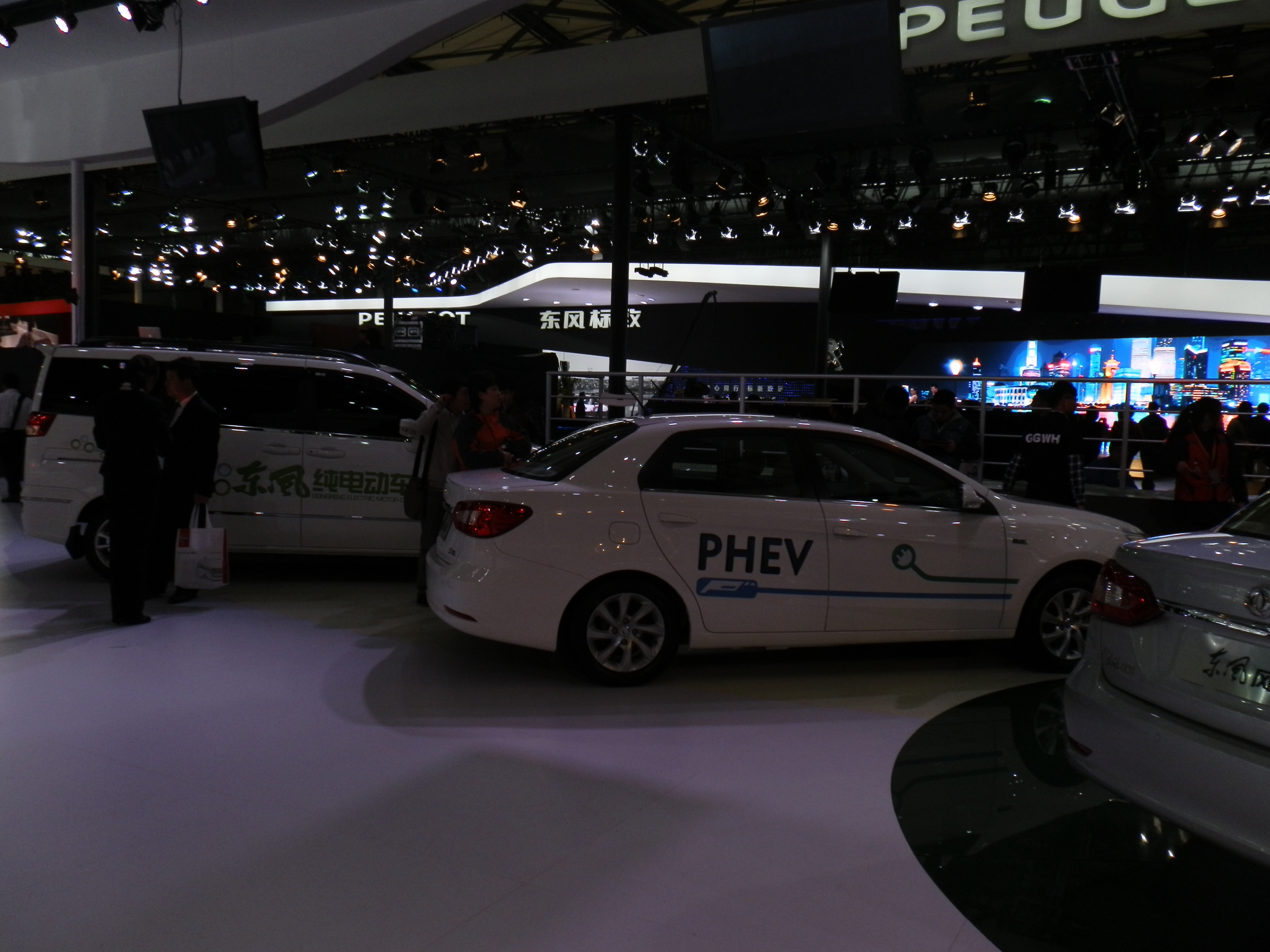
Dongfeng had many EVs on display at this year’s Shanghai Auto Show, but few actually in production.
Other local governments are also implementing regulations aimed at reducing congestion – and sometimes encouraging EV purchases by exempting EVs from those regulations. In Guangzhou, the right to register a car is now handed out by lottery; only 10,000 a month are allowed to register. http://www.chinadaily.com.cn/business/2012CEWC/2012-12/11/content_16007414.htm Beijing and Guiyang have similar restrictions. And electric vehicle owners can bypass the lottery system in some cities. Beijing has said electric vehicles will soon be able to get license plates without a lottery and be eligible for a 60,000 RMB rebate, for example. http://www.chinaev.org/DisplayView/Normal/News/Detail.aspx?id=16516
I doubt these policies will make much difference, however. A story in China’s Sohu Auto (which I found reproduced on the site ChinaEV.org) summed up the problem well. It focused on Beijing’s plans to implement various policies to boost EV uptake.
The three big failings of efforts to “marketize” EVs are: EVs aren’t dependable; EVs have limited range; EVs price is high, it said. “The chance that electric vehicles will be able to replace traditional vehicles in the short term is remote,” the story concludes.
If they replace a few of the traditional vehicles, however, China may claim victory. And why not?
 Alysha Webb
 Alysha Webb's ChinaEV Blog