Enova finds China EV market doesn’t live up to advance billing, but orders trickling in
In case you hadn’t noticed, the market for electric vehicles has not taken off quite as quickly as the Chinese government predicted it would. So for U.S. (and other non-Chinese) companies China has been somewhat of a disappointment, John Mullins, chief operating officer of Enova Systems www.enovasystems.com told me last week. In 2008, his company supplied hybrid systems to First Auto Works for 25 buses that were used in the Beijing Olympics. Then, it 2009, it provided components for 200 hybrid systems to First Auto Works. Enova thought it was the start of something really big. “We were pretty excited to get into the program,” said Mullins. “The Chinese government had this mandate for 1000 alternative energy vehicles in 25 cities. But we really haven’t seen the progress at the rate everyone expected it to.”
“Everyone” includes electric drivetrain providers such as Eaton Corp., which hopes, or hoped, for big things to happen in the China market. http://tinyurl.com/7kwsdcs Enova has shipped a little over 500 electric drivetrains to China over the past three years, says Mullins. It expects sales of about only 200 annually in the medium term, he says.
Enova’s foray into the China market started with promise. It shipped 50 electric drivetrains to FAW www.fawcom in December of 2011, and in January of 2012 Enova received another order from FAW for 50 drivetrains. Rather than reinvent the wheel, here is what Enova’s press release said: “The Enova drive system will be integrated and branded under the name of Jiefang CA6120URH hybrid. The Jiefang 40 ft long hybrid city bus can carry up to 103 passengers and travel at speeds of over 50 miles per hour. With the Enova hybrid system’s components, the Jiefang bus meets Euro III emission standards, consumes only 7.84 miles per gallon, and achieves a reduction of 20 percent in harmful emissions.” Jiefang is the First Auto Works large commercial vehicle brand. Jiefang means liberate, as an aside.
Enova is based in Torrance, CA, a Los Angeles suburb near Redondo Beach. It produces power electronics for pure electric and hybrid electric commercial vehicles. Specifically, it designs the electronics that enable the battery’s DC current to be changed into AC current so it can be used by the motor. Enova also designs and produces entire drivetrains. It buys the components such as the motor, gearbox, wiring harness, safety disconnect, etc. and assembles the drivetrain in the warehouse portion of its small office on a back street of the industrial city.
Though its chairman, John Wallace, was head of the Think electric vehicle program at Ford, http://tinyurl.com/6paerxq Enova focuses on heavy duty commercial vehicles, says Mullins. (Yes, Think wasn’t always a failing Norwegian EV maker. Ford sold it in 2002.) Enova is too small to compete with the big companies in the car segment, says Mullins. In any case, “we believe commercial vehicles are a much better application for full EVs and in some cases hybrids because the routes are specific and the drivetrain can be chosen specifically for the vehicle” in terms of range requirements, he says.
Fortunately for Enova, unlike some companies it hasn’t put most or all of its eggs in the China basket. It already has several customers here in the U.S., including Navistar’s IC Bus division www.icbus.com . Enova supplies a bolt-on post-transmission plug-in hybrid system for school buses to Navistar www.navistar.com . The program started in 2005 and about 100 of the hybrid buses are on the road now, says Mullins. Enova is also the exclusive supplier to Smith Electric’s Newton pure electric route delivery, and it is working with Smith www.smithelectric.com to develop light and medium vehicle applications for Smith’s U.K. fleet customers.
The problem, says Mullins, is the cost. Without government subsidies there wouldn’t be a market, he says. The Navistar electric buses cost $210,000 each versus $70,000 for a regular gasoline-powered bus, says Mullins, with the battery pack accounting for most of the price premium. And since an average school bus only runs 9 months out of the year, it is hard to reach payback. As for the Smith EVs, in 2009, Smith received a $10 million Department of Energy grant to develop all-electric, emission-free commercial vehicles. The grant was expanded to $32 million in 2010. http://tinyurl.com/768sehs The battery pack in the vehicles Smith now produces will push a Class 6 or 7 commercial vehicles (which cover vehicles from 19,501 lbs/8,846 kg to 33,000 lbs/14,969kg) for up to 150 miles, says Mullins. But the cost is $190,000 (For battery pack alone? He didn’t specify and I haven’t heard back from him yet. ). The subsidy cuts that in half, he says. Even FAW relies on government subsidies to keep the cost of its electric vehicles within range, says Mullins. “Our challenge is to find customers that don’t depend on government grants.”
Enova hopes it has done just that with Freightliner Custom Chassis Corp., http://tinyurl.com/7y7qdmw a division of Daimler Trucks North America. Enova is the exclusive supplier for Freightliner’s’ all-electric delivery van, the kind of vehicle used by Fedex and UPS. Mullins figures this market is the sweet spot for pure EVs because the routes are set so the battery size (and thus cost) can fit the necessary range.
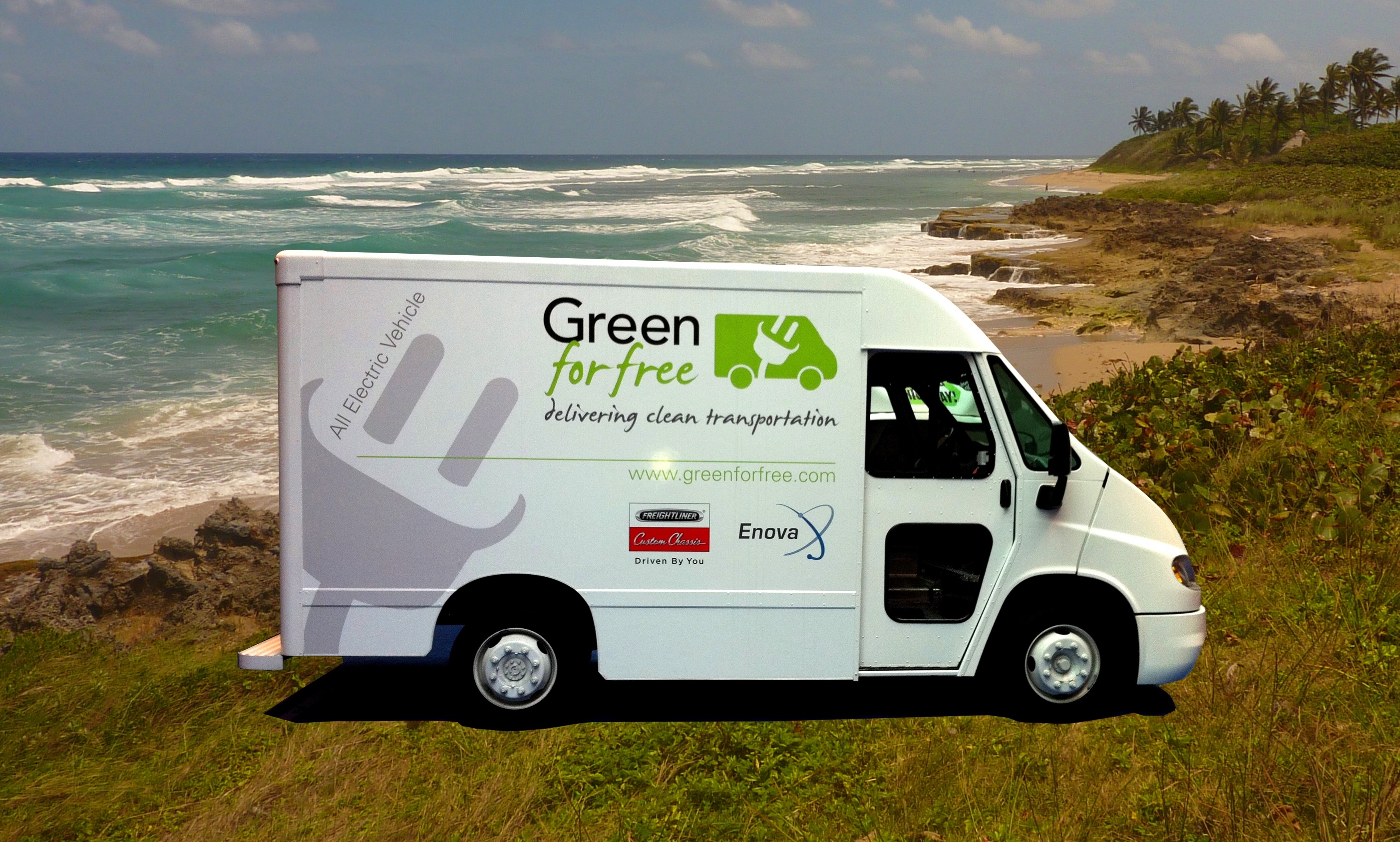
The Freightliner Pure EV delivery Van use Enova components.
Daimler has 80% of the market for such vans, so it can offer real volume potential, says Mullins. Therefore, “we have been able to attract very competitive pricing,” he says. “We are about to finalize the final battery supplier.” I don’t know who that will be. But Enova works with battery makers Valence and Dow Kokum on some of its other projects.
Pure EVs is where Enova figures the real commercial market is, says Mullins. Hybrids come with less of a premium than pure electric, but are still more expensive than gasoline-powered vehicles. Customers expect to use a hybrid like a regular gas vehicle and still see a big improvement in fuel efficiency. But only under certain conditions are those huge improvements realized, he says. “They are not seeing the payback they expected in the fleets for hybrids because the expectation wasn’t in line with what the technology is capable of achieving,” says Mullins. That isn’t the case with a pure electric vehicle, he figures. The fuel savings is built in, though the price premium is greater. “Pure EVs become promising because a commercial customer is smart, and makes decision on finances rather than emotion,” says Mullins. “There is a commercial reason to buy one, not an incentive reason. We have plenty of hybrid capability but the real commercial potential we see right now is full electric.”
Of course, China’s government has just shifted its near and medium-term focus to hybrids and plug-in hybrid electric vehicles. So Enova can expect to see slow growth there for a while there in the pure EV sector. As for the U.S., I guess we will have to wait to see the outcome of the presidential election to determine how the market for EVs will go here. Unless more companies with fleets start doing the math and figure out pure EVs make sense for them. .
PowerGenix CEO admits pairing with Chinese firm to make batteries in China won’t be easy
I got a press release a few weeks ago about a new battery joint venture in China that caught my attention. http://tinyurl.com/87eleqq For one, the battery chemistry was nickel zinc, something I hadn’t seen before. And, the Chinese partner was a company called China City Construction Corp., http://www.cccc-6.com/En/mana/shownews.asp?id=152 based in the central China province of Anhui. I looked up CCCC, or at least I think I did. It is a big state-owned infrastructure developer that apparently used to be owned by the People’s Liberation Army. The PLA was ordered to stop owning commercial businesses in 1998. The army divested itself of companies like CCCC, but left an army guy in charge. So it is not only a state-owned enterprise, it is one with a military background. Kinda interesting.
To learn more, I talked with Dan Squiller, CEO of PowerGenix. I came away thinking he has some rough months ahead that will surely be eventful but maybe not too fun.

Dan Squiller, CEO of PowerGenix, felt a bond with the head of a Chinese infrastructure company
First the basics. PowerGenix, based in San Diego, CA, produces rechargeable Nickel Zinc batteries. From the PowerGenix website: “Its high energy density and high discharge rate capability make it an ideal solution for applications that demand large amounts of power in a small and lightweight package. Cordless power tools, premium UPS systems, electric scooters, specialty military equipment, and high-intensity DC lighting are among the applications in which rechargeable NiZn batteries are best applied.” In the automotive world, PowerGenix aims at the hybrid market, especially mild hybrids that use stop/start technology, which stops the engine when a car is, for example, at a traffic light, then starts it again when the accelerator pedal is pushed.
Its China joint venture will focus on the hybrid applications, said Squiller. PowerGenix will own 49% and CCCC will own 51% of CCCC-PowerGenix Clean Energy Co., as the JV will be known. It will be more than just a manufacturer, insisted Squiller. “The idea is we are building out a fully functional company with sales, manufacturing, and after sales support,” he said. PowerGenix will contribute intellectual property and CCCC will supply capital to build the plant and guanxi—literally “relations” but in this case connections. It was a strategic decision to give CCCC majority ownership, said Squiller. “We will be doing business primarily in China,” he said. “It also helps with (government) grants and incentives.” Well, as I learned, CCCC is eyeing overseas markets, as well. But more on that later.
The JV will build a greenfield plant – locations are being scouted and local governments are courting them, said Squiller. It will likely be in Anhui, he adds. Anhui is one of China’s poorest provinces, but it does have a substantial automotive production base, and thus a well-developed supplier base. Chery Automobile Co., www.cheryinternational.com China’s eighth largest automaker based on sales, is based in Anhui, as is Jianghuai Automobile Co. http://jacen.jac.com.cn/
The plan is for three phases of construction, each adding the same amount of capacity. According to the plan, production will begin by the end of 2012 with an initial capacity of 400,000 batteries annually. But, admits Squiller, that is dependent on business licensing and government approvals being completed in a timely manner. “There is the plan and there is the reality,” he said ruefully.
CCCC-PowerGenix Clean Energy Co., as the JV is known, doesn’t have any customers yet (Which is a good thing since it is unclear when it will actually begin producing batteries.). But it has batteries being tested at “all the usual suspects,” said Squiller. Okay, but there are lots of battery makers in China, I said. What will allow PowerGenix to succeed? Its battery chemistry, said Squiller. Only a few companies are producing NiZn batteries, and those are usually the small AAA batteries for consumer goods, he said. PowerGenix spent 10 years creating a NiZn battery with a long enough life cycle, good enough energy yields, and a low enough cost for the automotive world, said Squiller. That is what made it attractive as a partner to CCCC, he said. “CCCC is just not interested in getting into the energy storage fray with lithium ion,” he said. “They picked something unique.”
Stop/start systems, which is where PowerGenix sees a market in China, are not new. They are ubiquitous in Europe, and some automakers in China are already installing them. The Buick LaCrosse launched by General Motors in China in August of 2011 uses a lithium ion battery in the stop/start technology in its e-Assist system, http://tinyurl.com/7c6kuav as does the Chevy Malibu due in China in Q1 this year. Audi has said that all its models in China will have stop/start systems by 2012. http://tinyurl.com/7au2nok Local automakers are also using stop/start. Geely plans to install stop/start on an Emgrand model, and Hafei will introduce it on a minivan model. But there is no guarantee it will spread.
Squiller said adding stop/start to a car adds from $400 to $600 to the total cost, and the battery represents 1/3 to ½ of that amount. He claimed the PowerGenix battery was smaller (and thus lighter) than the batteries currently being used, and could be dropped in without major changes. “The voltage on the alternator needs to be tweaked,” he said. But “we are compatible with all engine systems.” But, pointed out Michael Omotoso, senior manager for global powertrains at LMC Automotive, www.lmc-auto.com the engine has to already be designed to work with stop/start technology. So CCCC-PowerGenix Clean Energy Co. will be fighting for a share of a small (albeit growing) share of the market…when it actually starts producing batteries in China.
Strange bedfellows
Exactly how does a San Diego battery maker get hooked up with an Anhui-based former PLA construction company? Through a business associate’s company that helps identify Chinese partners, said Squiller. CCCC and PowerGenix had the “same priorities in the green space, and the same management perspective,” he said. “There is a corporate culture and DNA,” he said, “but at the end of the day it is the two leaders and their personal relationship and how they think and operate.” I can’t help but wonder how Squiller’s thinking and modus operandi could resemble a Chinese (and likely) ex-PLA head of a state-owned enterprise.
To be sure, Squiller is no stranger to China. He made his first business trip to China in 1982, he said, even earlier than I was there! (I first lived in China in 1984). Squiller said he had started R&D centers and JVs in China, and was even in Beijing during the Tiananmen protests in 1989. Still, a friend who worked on a real estate deal with a former PLA company described it as “impossibly opaque, non-communicative, uncooperative, and self-interested to an unbelievable degree—even for China.” Squiller did admit that “it is exceedingly difficult to work cross culture.” The joint venture with CCCC would require “a great deal of patience and expertise,” he said. “We don’t think this will be like selling ice cream from a stand across the street.” Well, at least he seems to know what he is getting into.
China to be first test of GM’s mini-EV project
I ran into Ray Bierzynski, director of electrification strategy at GM China, on the floor of Cobo Hall last week at the North American International Auto Show. We chatted a bit and he mentioned GM’s EN-V project in the northeast China municipality of Tianjin. We didn’t have much time to talk there—Bierzynski had come straight from the airport to Cobo. But I was intrigued by his comments and sent some questions to GM when I got back to California. 
Turns out it is kind of old news. GM put out a press release about it late last year. http://tinyurl.com/7w844m7 But it was news to me, so I’m writing about it. What GM’s EN-V project in Tianjin—indeed, the whole Eco-City project—reminds me of is a concept car. Or of the clothes designers show on the catwalk. They aren’t something consumers will buy in that exact form. But they do offer tantalizing glimpses of the direction the styling—or in this case urban planning – may be going. And in this case it is a direction I like. I will definitely have to visit Tianjin next time I am in Beijing to check it out.
Some background: GM www.gm.com calls the EN-V “a radical change in mobility to address growing urbanization issues.” Well, that’s timely because China just became a majority urban country. In mid-January, China’s National Bureau of Statistics announced there were twice as many people living in cities in China as living in the countryside. http://tinyurl.com/7c8p6n3 That’s a momentous change for a country that was 81% rural in 1989, nearly a decade after Deng Xiaoping launched his Reform and Opening program. But anyone who has been to China lately knows that while urbanization may be raising the living standards of millions, it is also eroding the quality of life for just as many. Cars are a big part of that erosion. Traffic congestion and pollution are plagues in China’s largest cities.
The pod-like EN-V, which GM debuted at the World Expo in Shanghai in 2010, http://www.gmexpo2010.com/en to quote GM’s boiler plate, “is a two-seat electric vehicle that was designed to alleviate concerns surrounding traffic congestion, parking availability, air quality and affordability for tomorrow’s cities.” Besides being fully electric, the EN-V is connected. So the EN-V (which stands for Electronic Networked Vehicle) can sense other vehicles (and hopefully avoid collisions.). It can also drive itself, park itself, and be retrieved (which would put a lot of valets out of work and unemployment is a sensitive topic in China so maybe that would not be a popular feature with the government…). It has internet connectibility—and thus social networking capability. The first-gen EN-V was a low-speed vehicle—max speed was 40 kph (about 25 mph)—and its lithium-ion phosphate battery had a range of 40 km, or about 25 miles.
Frankly, the first generation EN-V wasn’t all that practical. It was supposed to be a two-seater, but look at it.
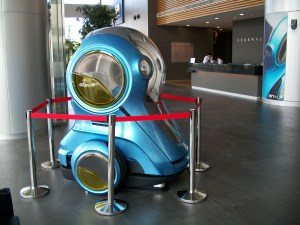
- The first generation EN-V doesn’t seem very practical. Wonder what Gen 2 will look like?
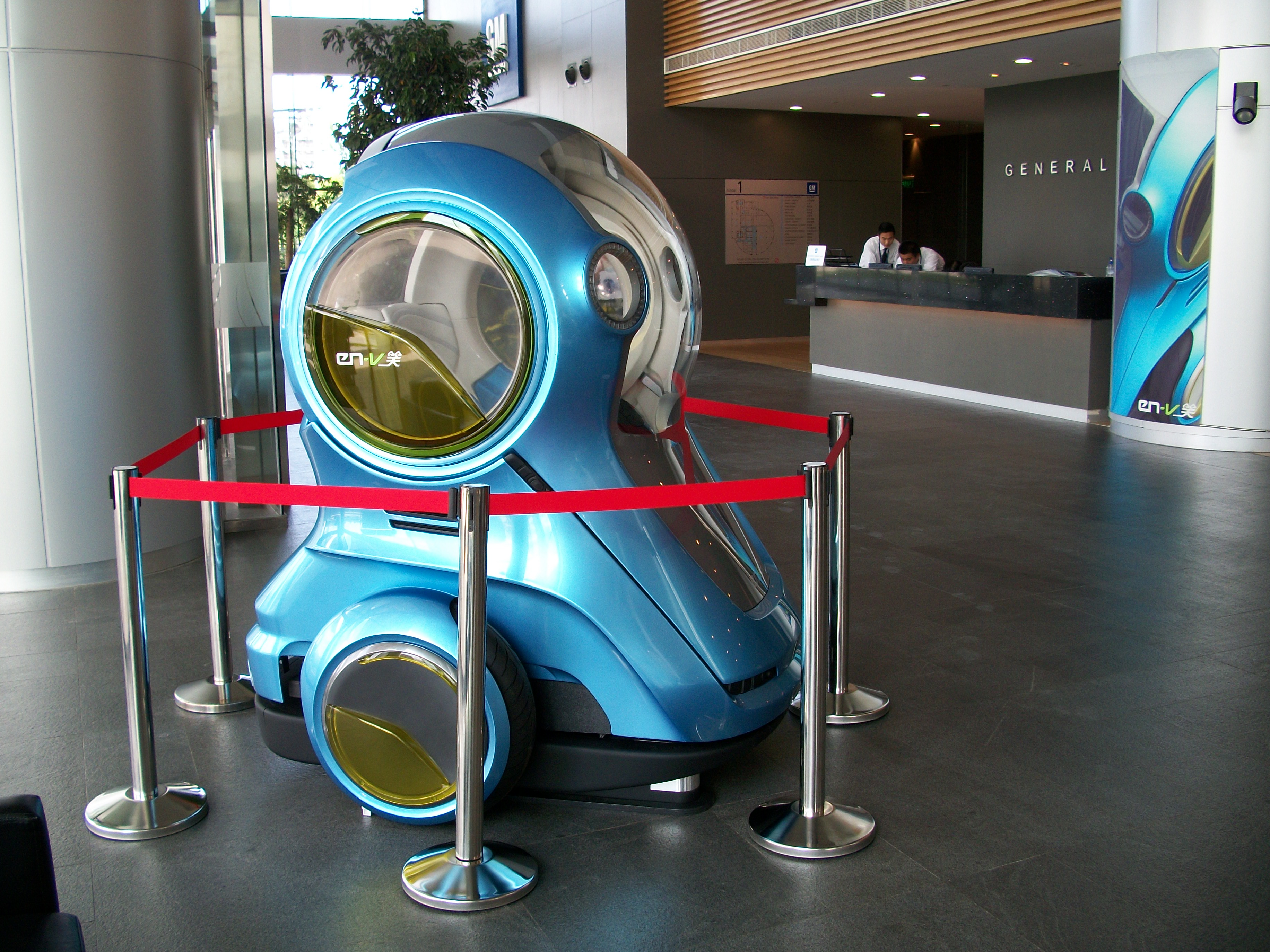
Would two Americans fit in that little cab? And Chinese are getting fatter. But, Chinese do seek easier ways to get around than a bicycle, or an electric bicycle. So GM figures the low-speed electric vehicle market in China could be low-hanging fruit for the right product. When I visited GM in Shanghai in September of 2010, the PR guy at the time (GM rotates PR people through China faster than the cartridges turn on a Six-Gun revolver) told me: “We need to figure out if the consumer (for an EN-V) is the one who already has a car, or is this going to be there is enough e bike riders to buy this. We don’t know. We are going to do research on this. We are pretty sure the 200 million e-bike riders will view (the EN-V) as like a TV upgrade. You could have a higher price, but has to be something they can reach.”
Now, at the time I challenged that, and I still do. An electric bike is pretty damned cheap. I mean, a little a 1,000 yuan, about US$158 at current exchange rates. I don’t see how the EN-V could cost that little. But the Tianjin project is still intriguing. The point is, GM is forging ahead with the EN-V project. From now on, the EN-V will be badged a Chevrolet. Woo hoo, a tiny electric Chevy! And China isn’t the only place the EN-V will be tried out. GM is aiming to test it in megacities around the world. GM Research—that includes the U.S. and China—has the technical lead for the next-gen EN-V. But, “GM China is managing the overall (Tianjin) project, specifically the electrification strategy and teams. I will be heading up the project development,” Bierzynski said in an email response.
GM signed a Memorandum of Understanding with the Tianjin Eco-City in April 2011, and has been conducting a technical feasibility study since then. Hence the press release in October 2011 rather than April, I guess. Now, a (very little) bit about the Tianjin Eco-City, the first place the next-gen EN-V will be tried out. The full name is Sino-Singapore Tianjin Eco-City. It is 50/50 joint venture between a Chinese Consortium led by Tianjin TEDA Investment Holding Co., Ltd. (Tianjin TEDA) and a Singapore Consortium led by Keppel Group. The aim is to create a sustainable mixed-use city. Rather than me re-typing all the info, check out this website. http://www.tianjineco-city.com/en/index.aspx
GM won’t say when the next-gen EN-V will appear. But it will be a step up from the original concept. Said Bierzynski: “Our plan is for the next generation EN-V design to retain key elements of the original concept EN-V, such as the small footprint and maneuverability. It would also retain the key technologies, such as battery electric propulsion and the networking (or connected) and autonomous capabilities. However, it will also add features that customers need such as climate control, personal storage space and all-weather and road operation that were missing from the original concepts.” But will it have On-Star? Okay, perhaps that is asking too much.
I’m not sure how GM is going to cram the extras Bierzynski mentioned into the little EV and keep it comparably priced with an electric bicycle. Maybe that isn’t a goal anymore. In any case, I wouldn’t mind driving one when the next-gen EN-V finally comes out!
In mid-December, battery-swapping promoter Better Place announced it had, with the China Southern Power Grid, http://eng.csg.cn/ opened China’s first Switchable Electric Car Experience Center in the south China city of Guangzhou. The Center aims to introduce people to the concept of battery swapping, an alternative to battery recharging as a way to refuel a pure electric vehicle. http://tinyurl.com/7qxlnm5
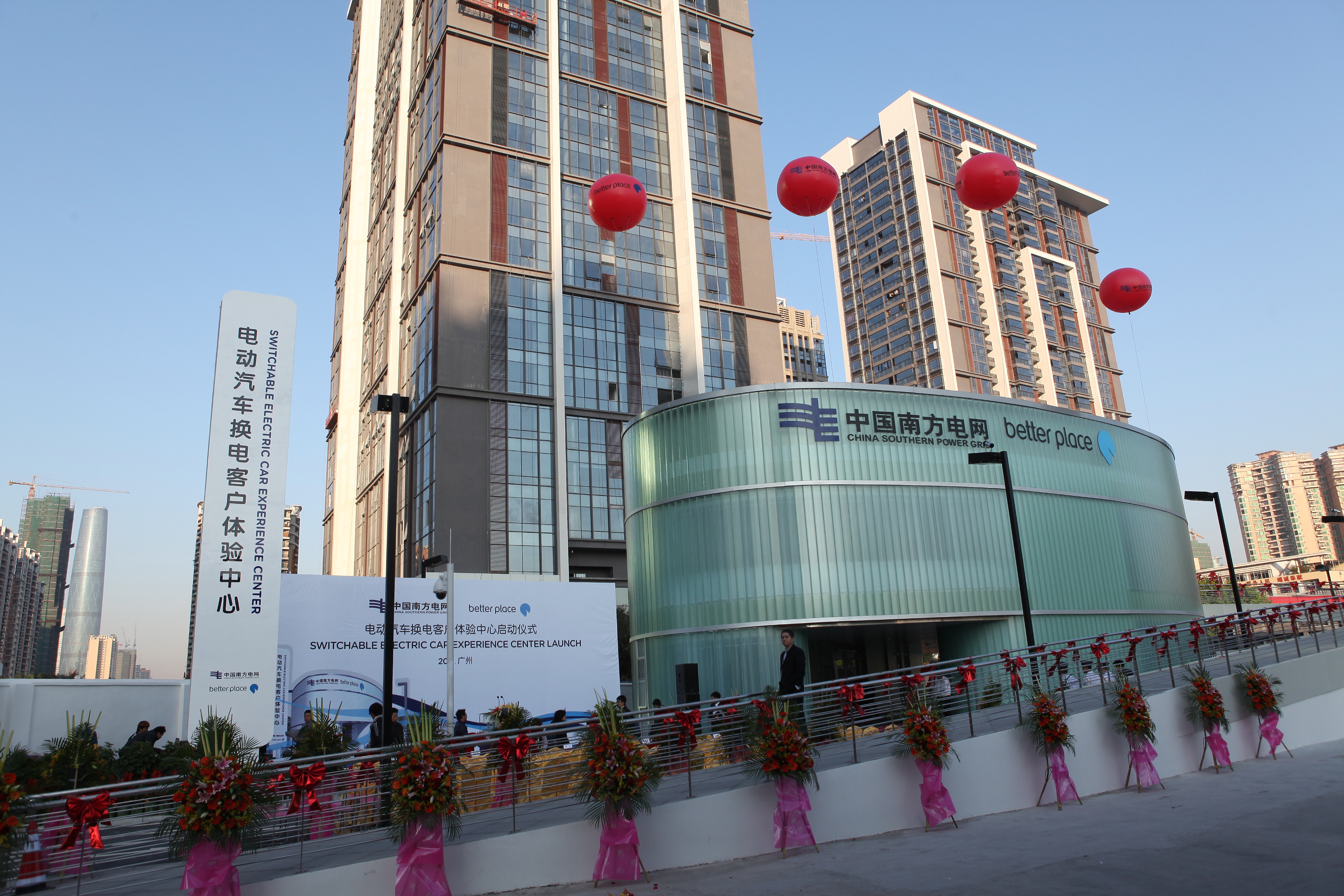
Better Place and China Southern Grid recently opened a battery swapping experience center in southern China.
I recently spoke with Dan Cohen, vice president of strategic initiatives at Better Place, www.betterplace.com about his company’s plans in China. As you might expect, he was optimistic about the possibilities for Better Place in China. To be sure, I have been hearing from various industry sources that battery swapping is gaining favor with the Chinese government. But I came away from my talk with Cohen thinking Better Place faces some pretty big obstacles in China. At best I think it will be a small player in China’s electric vehicle charging market.

Dan Cohen, who is probably one of the laowais in this pic, figures battery swapping is the right option for China.
As there are only a handful of pure electric vehicles on the road in China right now anyway, the country is still trying out different charging models. “We will still see for a while trials in different areas” of China, said Cohen. “What is very clear is that the swappable battery has gained a lot of traction and makes a lot of sense for them.”
First, a quick lesson on the concept of battery swapping. One of the big barriers to consumer acceptance of pure electric vehicles is range anxiety, the fear that one will run out of “gas” in some strange place and not be able to “refill” the battery easily or quickly. Better Place proposes battery swapping as a solution.
Using a Better Place battery swapping station is somewhat like going through a drive-through car wash. Your car (with or without you in it) is moved by a conveyor belt onto a spot where the battery is automatically removed and a new one installed in a matter of minutes. The depleted battery is placed on a storage rack for recharging. When that battery is full, it is placed in another electric vehicle.
Sounds simple, but first there is the consumer trust hurdle. Consumers have to believe the battery they are receiving is of the same quality as the one they gave up, and it truly fully-recharged. John Proctor, the Better Place PR guy, assured me that Better Place is focused on “taking the risk and worry out of it for consumers.” But this is China, the place where a company used substandard ingredients in baby formula to make a few bucks. I’m just saying.
Then there is the issue of having electric car models that are able to use the battery swapping model. Cohen said Better Place is “in discussion” with more than one automaker in China. “Hopefully we will have some real cooperation,” he said. Well, only one Chinese automaker, BYD, is thus far making pure EVs in China. www.byd.com A BYD source told me BYD didn’t like the battery swapping model because it didn’t want to risk having its battery technology intellectual property being stolen.
Of course, there are many other automakers in China. But I heard from a supplier source that few are actively pursuing pure electric vehicles right now because the government isn’t promoting them. Because battery technology isn’t mature, it has backed off from pure electric in the near term to focus on plug-in hybrid electric and hybrids. http://tinyurl.com/7a5z5vs
Next is the issue of who will supply the batteries for the swapping stations. Better Place uses A123 www.a124systems.com batteries in some other parts of the world. In China, Cohen said, “it will depend on who we work with. Probably a local battery manufacturer” will supply them. Chinese battery manufacturers are “advancing very quickly on quality,” he added. Well, sort of. Even the Chinese government admits the industry has a ways to go before it can meet global standards. At least Better Place will likely have the option of using batteries manufactured in China at the SAIC-A123 joint venture. http://ir.a123systems.com/releasedetail.cfm?ReleaseID=430981
On its website Better Place touts its commitment to promoting a global standard for an EV recharging plug. Meanwhile, China has yet to announce a national plug standard, much less sign on to a global standard. How does Better Place feel about that, I asked Cohen? He said: “You definitely you see more and more committees in China discussing standards. We are obviously engaged in trying to help China. This is a long process. We are in there. We hope to see it mature here as well.”
China hasn’t joined in any international standard groups or put forth a national standard of its own yet because various ministries in Beijing are fighting over who has the right to determine what the standard will be. Those same ministries fight over many other aspects of the electric vehicle industry. Cohen admitted that the plethora of government ministries—from the Ministry of Information Industry and Technology to the National Reform and Development Council– weighing in on EV policy was confusing. “In the beginning, it was hard for us to navigate,” he said. “It was hard for us to know what was policy and what was opinion.” The issuance of the 12th Five Year Plan, with its emphasis on promoting electric vehicles, made the direction much clearer, said Cohen. http://tinyurl.com/7vlamcy
In recent months, of course, the government has changed its emphasis in the sector from pure electric to plug-in hybrid electric and hybrid. So the direction, at least in the near term, isn’t all that clear.
Finally, the last hurdle I am going to talk about right now—the fact that Better Place’s partner, the Southern Grid, is not a national utility. In late 2002, China’s monolithic electric company divided in two. The Southern Grid, as its name suggests, assumed responsibility for providing electricity to five provinces in south China, Guangdong, Guangxi, Yunnan, Guizhou, and Hainan. The other utility, the State Grid www.sgcc.com.cn provides electricity for the rest—26 provinces, autonomous regions, and municipalities.
Better Place began talking with Southern Grid about seven months ago, said Cohen. Turned out Southern Grid was also looking for a partner. After some shuttling between Israel and Guangzhou, the two chairmen met and the deal was done. Better Place also talked with State Grid, but nothing came of those talks, said Cohen. What that means for now, of course, is that Better Place can only spread its battery swapping mantra in the five provinces where Southern Grid operates.
Of course, these are very early days in China’s recharging infrastructure market. And Better Place knows battery swapping will likely not be the only recharging solution in China. “It still is not a done deal in terms of a full China directive,” said Cohen. Better Place also has other services and products that could find a market in China, for example its EV network software that helps a utility balance the demand on the grid for electricity. “We provide a completely managed service. Better Place knows how to distribute that energy,” says Cohen.
And the new Experience Center in Guangzhou is mainly aimed at governments and businesses right now, said Cohen. So if Better Place can manage its expectations where its China business is concerned, and by that I mean keep them really low, the Guangzhou investment could turn out to be a good one. But don’t expect to see China covered with Better Place swapping stations anytime soon.
In the last decade many foreign automotive manufacturers have set up research, development , and design centers in China. Now, a Chinese automaker is taking a page from that play book. Chang’an Group, www.globalchana.com China’s third largest automotive group, has nine research and design centers in five locations around the world. The most recent addition is the Changan U.S. Research and Development Center in Plymouth, Michigan. www.changanus.com
Chang’an (or Chana, as it goes by in some circumstances) isn’t looking to design cars for the U.S. market there, however. At least not yet. It aims to design cars for China that are just as good as the foreign brands that still dominate the Chinese market.
“First Changan will make its own domestic vehicles competitive with joint venture products,” Su Hong, vice president of Changan’s U.S. R&D center told me. “Then we can talk about exporting.”
Chana recognizes what many domestic Chinese automakers refuse to admit—it lacks the fundamental knowledge needed to make a really good car. Partnering with foreign automakers was supposed to remedy that situation. Chana has joint ventures with Suzuki, Ford, and Mazda. But while those partnerships have given Chana a lot of manufacturing knowledge, they haven’t taught Chana enough about how to design and engineer really good cars, says Su.
“There is a huge gap in the performance and quality because the foreign products are designed by foreign company and they didn’t give Chana the design and engineering know how,” he says. “Particularly how to design performance.”
Performance seems to be Su’s mantra, and that make sense. Chana’s U.S. R&D Center will focus on the chassis, which certainly has a huge impact on performance. That includes chassis design and control, brakes, steering, suspension, and tuning and testing, says Su. It will concentrate on SUVs/CUVs and D-segment, or premium, sedans.
“Changan already has small vehicles in production,” says Su. “It needs D segment and SUVs. (Its engineers) don’t have this kind of design experience. Also we have to improve the quality, and enhance performance.”
The U.S. r&d center will also work with Tier One suppliers on motors, batteries, and engines for electric vehicles, says Su. But he doesn’t see the EV segment blossoming anytime soon. “There are two issues,” says Su, “battery and cost. We are still looking for a breakthrough in technology for larger market acceptance. There is still a long ways to go.”
The Chang’an Automobile Group is China’s fourth largest auto group. According to LMC Automotive Inc., www.lmc-auto.com in the first eleven months of 2011 it sold 705,551 light vehicles, down 21% on-year and 672,112 light commercial vehicles, down 29%. Chana’s passenger vehicles include Ford and Mazda-badged cars as well as a handful of Chana-badged cars.
The Group acquired two other Chinese brands, Hafei and Changhe, in 2009 as part of the central government’s industry consolidation strategy. http://www.chinadaily.com.cn/business/2009-11/11/content_8947483.htm Integrating those brands into its operations apparently took a lot of the Group’s time and energy. According to LMC’s November China report, “Chang’an found little time to improve its products and sales channel. This is why the company’s performance of passenger vehicles and light commercial vehicles performed poorly.”
That’s too bad because Chang’an has invested a lot in setting up a global R&D footprint. “Changan has an unique strategy for its global product development system,” says Su. “It has product development centers in five countries. “
In China, Chana has r&d branches in Chongqing, Shanghai, Beijing, Harbin, and Jiangxi. It also has four overseas centers. Six years ago, Chana established a center in Torino, Italy focused on interior design, says Su; four years ago it opened its Yokohama, Japan center focused on interior trim and modeling; a year and a half ago, it opened the Nottingham, U.K. center focused on powertrain and transmission. Almost exactly one year ago, the U.S. center opened in Michigan.
Why Michigan? Chana did its homework. Of the seven largest automakers globally, six have tech centers in Michigan, says Su. Many top Tier One and Tier Two suppliers also have tech centers here, he says. So there is plenty of engineering talent (such as Su). Also, are many specialized service firms that can do chassis testing and transporting, as well as proving grounds. “If you want to do vehicle development, Detroit is the place,” says Su.
So what has the new Center accomplished in its first year? Mainly hiring, says Su. He was one of the first hires. Su, who has a PhD in vehicle dynamics from a Canadian university and worked for years in the U.S. for Ford and Visteon, shares the vice presidential duties with another VP who is from China. “I am the local hire,” says Su. The Center has hired more than 20 engineers so far; it aims to grow its staff to 150 within five years. Nationality is not a consideration, expertise is, he says.
Chana’s strategy—drawing on international design and engineering talent—certainly has merit. `The real challenge for Chana, however, will be to take those designs and translate them into a world-class vehicles. That requires attention to process technology and quality control in the manufacturing process that many Chinese companies have had trouble achieving. Su says Chana’s foreign partners have passed manufacturing knowhow onto Chana. The proof will be in the vehicles Chana produces in the next five years.
Hertz sees EVs as 10% of its fleet in China one day. Right now, it just wants more than two.
I chatted with Edward Hu, China country manager for global car rental company Hertz, in Shanghai last month to learn more about Hertz’s promotion of electric vehicles in the China market. I was pleased to hear what sounds like a reasoned approach based on a realistic assessment of the problems and potential for electric vehicles in China.
First, a bit of background. Hertz www.hertz.com first set up shop in China in 2002. It was only promoting the brand to China’s international traveler set, however, as an option in foreign countries. In late 2009 Hertz decided to start renting to corporate customers in China, first in Beijing then in Shanghai. Its China business is still very small, says Hu, and the focus is on short-term rental and leasing to other businesses. Some 80% of Hertz’s business in China is business to business.
There isn’t a huge demand for electric vehicles from business in China. So why is Hertz jumping into the EV sea there? The global strategy at Hertz is to try to capture trends, says Hu. “And we do believe EVs will be the future,” he says.

Edward Hu, Country Manager for Hertz China, figures 10% of the Hertz fleet in China could be electric one day.
There is also a nice marketing benefit, of course. It allows Hertz to be a good corporate citizen, helping keep the air clean an all. Also, Hertz can’t win a price war with local car rental firms, who mainly compete on price, says Hu. Instead, “we try to differentiate ourselves by providing good quality service, a higher standard, and also we get into new trends like EVs,” he says.
It doesn’t hurt that the Chinese government is heavily promoting electric vehicles. Any foreign company in China that can help out a government goal is bound to earn some Brownie points. And though the Chinese government has dialed back its heavy emphasis on pure electric vehicles, at least in the near term, it does still aim to have a bunch of EVs on the road in the future. But, it has been having a hard time convincing consumers to buy electric vehicles, even with a hefty subsidy attached. Hertz figures it can help with that. “EV rental is a big help to the consumer acceptance for the EV (because) they can experience the car first hand,” says Hu.
The government welcomed the suggestion that Hertz could introduce consumers to electric vehicles by including EVs in its rental fleet in China, says Hu. “We approached the government. They didn’t have any idea about the car rental industry, “ he says. “They said, ‘wow, this is a good idea.’ They really like to cooperate with us.”
Not many consumers are being introduced to EVs by Hertz just yet. So far Hertz only has two BYD e6 crossover electric vehicles for rent in Shenzhen. http://www.nytimes.com/2011/08/24/business/global/hertz-to-begin-renting-electric-cars-in-china.html
They are in big demand, says Hu. “Within two hour of release, we had a customer,” he says. “Two days ago customer wanted to rent an e6 for ten days.” The EVs rent for less than 400 RMB a day if you drive it yourself; more if you chose the chauffer-driven option.

Hertz has two BYD e6 EVs available for rent in Shenzhen with or without a chaffeur.
Hertz plans to add EVs to its fleets in Shanghai, Beijing, and Chengdu for starters, says Hu. But BYD hasn’t been able to supply the vehicles yet, he says. Lack of charging infrastructure is also a problem, even in Shenzhen, where the government is building one out. Hertz is also finding it tricky to set up the meter to calculate how to pay at the charging stations, says Hu.
Hertz is working with General Electric to grow demand for the Hertz EV fleet in China. In August Hertz and GE Industrial Solutions announced they would bundle EVs provided by Hertz with GE’s recharging stations and offer the package to multinational companies and governments in China. http://tinyurl.com/ylj2ccx
Now, Hertz is talking with the government in the Shanghai suburb of Jiading (which includes the “Shanghai International Auto City”) http://english.jiading.gov.cn/ about leasing some EVs for use by city employees, and about ways to promote individual use of EVs. Not coincidentally, Jiading is a “pilot city” in China for development of an EV infrastructure. It is trying to create a platform so all the players in the EV supply chain can test their technology, says Hu.
Hertz has ambitious plans to grow its presence in China. It now has only 1,000 vehicles in its fleet in China, and all but two have internal combustion engines. They are spread out over five cities Beijing, Shanghai, Shenzhen, Tianjin, and Chengdu. But that will expand dramatically over the next five years, says Hu, to many more cities and up to 40,000 vehicles.
In December of 2010, Hertz launched its Global Electric Vehicle Program. Among its elements: Mitsubishi I-Miev EVs are part of the Hertz London fleet, Hertz plans to add 500 Renault electric vehicles to its European fleet beginning in 2012, and different types of EVs are already available at a number of cities in the U.S.
In China, EVs could be up to 10% of the Hertz fleet five years down the road, says Hu. That could include some hybrid electric vehicles, he says. “If there is some mature hybrid vehicle available in Chinese market we definitely consider buying them.”
Of course, that will depend on how quickly Chinese consumers warm to electric vehicles. Hertz doesn’t believe that will happen too quickly because the technology isn’t mature, the cost is high, and the infrastructure is not built out. But that is changing, and Hertz is doing its part to nudge EV adoption in China along.
“There will be no big change in the short term,” says Hu. “But this is the future.”
Volkswagen aims to source electric vehicle batteries from China in just a few years.
As I mentioned in my previous posting, Volkswagen Group’s Dr. Tobias Giebel, head of the Volkswagen Research Lab in Shanghai, sounded quite optimistic about the potential to develop a battery supplier base in China at the EV Battery Forum in Shanghai in November. Of course, it behooves him to sound optimistic—it is his job to develop that supplier base and one always likes to feel as if they are successful at their job.
Volkswagen www.volkswagenag.com is working closely with about 20 of China’s than 100 battery producers, and is already seeing improvement, he said. “We think in a couple of years we will have really strong suppliers in fully domestic companies,” said Giebel. http://www.evbatteryforum.com/tobias-giebel-china/ When they are up to global standards, Volkswagen will use the same Chinese source for its Asia, Europe, and the United States operations, he said.
Today, China’s lithium-ion battery makers are focused on consumer technology, said Giebel. Its automotive-grade batteries are not up to the high-level vehicle traction battery manufacturers in Korea or Japan, he said.
But, “we are observing in these days our first success of the Chinese suppliers,” said Giebel in a later email communication. “Therefore we are optimistic that Chinese vehicle traction battery cells will become competitive soon.”
He added: “We will not accept lower safety, quality, or performance for our Chinese business.”
A Chinese company that can meet Volkswagen’s standards could have the opportunity to facai le (get rich). That’s because VW Group will use the same battery module design for all its electric vehicles globally across all its brands, said Giebel. And the battery modules (and cells in them) are likely to be sourced from China, he said.
“The module shape and number of cells will be the same,” said Giebel. “The module is not part of any international norm. It is a company internal standard.”
That means all hybrids, plug-in hybrid electric, battery electric, and fuel cell vehicles produced under the Volkswagen Group’s 10 nameplates, which include Volkswagen, Skoda, Audi, Seat, Bentley, Porsche, Scania, Bugatti, Lamborghini, and Volkswagen commercial vehicles.
Inside the module, Volkswagen might adapt the connection between the cells to vary the number of parallel and serial cells, said Giebel. The module is a company internal standard, he added.
As Volkswagen’s current parallel hybrid models, including the Tuareg SUV, have a different technology, Volkswagen will use the standard module concept first on battery electric and plug-in hybrid electric models, said Giebel. “The extension to parallel hybrid (HEV) will be decided later,” he said.
Giebel may be feeling a bit or pressure to bring those Chinese suppliers up to speed. Volkswagen recently said it would begin producing two electric vehicles with its Chinese partners as soon as late 2013. http://tinyurl.com/73skkao Volkswagen partners with SAIC www.saicgroup.com/ and FAW www.faw.com.cn in China. Both are large state-owned enterprises. Each has produced a prototype electric vehicle with VW and launched its own EV sub-brand. http://tinyurl.com/7cvzd5q http://tinyurl.com/6p9defu Each also has its own captive supplier group, but I’m sure that won’t play a role in supplier selection….
Take on quality of China’s battery cos depends on what you want from them, it seems
In mid-November I attended the EV Battery Forum in Shanghai. www.evbatteryforum.com The event was great from a networking standpoint—participants included representatives from utilities, battery producers, battery materials suppliers, auto makers, and battery associations. They hailed from China, Hong Kong, India, Finland, and other countries. And, it revealed an interesting divergence in opinion on the quality of China’s domestic electric vehicle battery manufacturers.
Dr. Wang Ying (Sherry), deputy CTO of Shanghai Advanced Traction Battery Systems Co, SAIC’s battery joint venture with Massachusetts-based A123, http://tinyurl.com/7qhal9m was a speaker. So were Dr. Tobias Giebel, http://tinyurl.com/c9prgnx head of the Volkswagen Research Lab in Shanghai, and Ray Bierzynski, executive director electrification strategy for General Motor’s China Group. http://tinyurl.com/bv4st63
Their views of the quality of the local battery supply base were quite different, illustrating that a company can see what it wants to see in the China market. VW and GM, who aim to source batteries from China for their global operations, believed that China would produce world-class batteries in the not-too-distant future. Wang was not so optimistic.
I agree that China will become a global supplier for the batteries that power electric vehicles. But I don’t think it will be become the global source. Timing is important here. When will Chinese domestic battery producers be able to make world-class products? And how many companies will actually achieve that standard? And how many of those companies will be able to do it without a lot of help from foreign firms?
Wang Ying wouldn’t say batteries produced by China’s domestic battery manufacturers were not good enough for electric vehicles. What she did say, however, was that China’s battery companies were new to the new energy vehicle battery market and that “battery suppliers in China don’t really know vehicles.” The packaging is the real challenge for China’s domestic battery makers, said Wang without elaborating. In any case, the fact that SAIC chose to partner with a foreign battery company when China has more than 100 battery producers itself speaks loudly and clearly.
Meanwhile, Dr. Tobias Giebel had a much more sanguine view of China’s domestic battery producers. “We believe the future of battery cell sourcing is in China,” he said. Volkswagen http://tinyurl.com/bpl9dp8 is working closely with about 20 domestic battery producers in China to bring them up to Volkswagen’s global standards, said Giebel. VW figures it will have “real strong” suppliers in China within “a couple of years,” he told the conference.
When I talked to him during a coffee break, that sounded more like up to five years. But, Giebel confirmed his confidence in China’s domestic battery manufacturers in a later email exchange. “The supplier in China needs some time to catch up with the high level vehicle traction battery products in Japan and Korea,” Giebel wrote. “But they are on the way, and we are observing in these days first successes of the Chinese suppliers. Therefore we are optimistic that Chinese vehicle traction battery cells will become soon competitive.”
General Motors www.gm.com is also looking to source batteries from China for its electric vehicles. GM’s wholly-owned China Science Lab in Shanghai can test local batteries for quality, said Bierzynski. The batteries can be validated – that is, certified that they meet GM’s standards—at the Pan Asia Technical Automotive Co., or PATAC, the 50/50 design and engineering venture between GM and SAIC in Shanghai. http://www.patac.com.cn/ That means a battery made in China would have the stamp of approval for use in GM; s global operations. “We need a (battery) supply base. It is a good bet that will be here in China,” said Bierzynski.
So, does this mean the domestic electric vehicle battery companies in China will elbow out battery producers in the U.S. and Europe? Perhaps. Companies such as Ener1 www.ener1.com , LG Chem www.lgchem.com , and A123 www.a123systems.com are hedging their bets by forming partnerships with Chinese companies.
Of course, if the government actually passes a draft law it has circulated that would require foreign companies wanting to produce electric vehicles and key EV components including batteries in China to form joint ventures that are at least 50% locally-owned, then Chinese battery producers would have access to battery technology that they may lack, right? In theory, yes. But the Chinese government forced foreign automakers to form 50/50 joint ventures with local companies in order to produce cars in China and how many domestic automakers do you see producing world-class cars?
I predict the number of Chinese battery manufacturers able to produce world-class batteries will be very small. Most of China’s domestic battery producers will never make it there. So will China one day be the source of most of the world’s electric vehicle batteries? Maybe, but don’t count battery companies from the U.S., Europe, and other Asian countries out.
To hear another view on China’s EV future (which may or may not differ from mine; this is not an endorsement of the view that will be presented in this seminar), check out the live online seminar “The Green Dragon: Will China be at the forefront of the New EV Revolution?” Marc Norcliffe, a U.K.-based consultant who has been involved with China’s auto industry since 1996, will present live via the internet and cover the advent of China’s new energy vehicle industry (as alternative powertrain vehicles are known in China) from the industry, government, and consumer perspectives. For more information or to register, visit http://tinyurl.com/7m2z7pv
Visiting BYD in China: It does a lot more than electric vehicles, but EVs are what I care about!
BYD www.byd.com is really taking up a lot of my time these days. After attending the opening of its North American headquarters here in Los Angeles, on a recent trip to China I visited its headquarters in the south China city of Shenzhen. I have been skeptical of BYD’s technology, and of its chances to succeed here in the U.S. I still think it will need skill and a big dose of good fortune to succeed here. But after touring the headquarters in Shenzhen, I was truly impressed at the scope of BYD’s businesses and fairly convinced that it will not be destroyed by the recent dramatic decline in China of its vehicle sales. http://tinyurl.com/7m2u34s Success of its cars here in the U.S. is still unsure, however.

I knew BYD got its start producing batteries for mobile phones and laptops, and that it now produces batteries for electric vehicles. And that it also produces solar panels. But I didn’t know it also designs and produces laptop computers and mobile phones for third parties. It also produces the casing for mobile phones and laptops.
Then there are the batteries. BYD holds 65% of the world market for nickel metal hydride batteries that go into consumer electronics, Leona Zhang, of BYD’s public relations department, told me. It produces batteries for Amazon, Energizer, Phillips, and others, BYD also produces lithium ion batteries for mobile phones for Samsung, LG, Motorola, and others. It holds 25% of the worldwide market for cell phone batteries, said Zhang. It has 11 plants across China.
But you probably don’t want to hear about its solar farm or the cool home energy battery storage device I saw in Shenzhen.

Or its test track, which I unfortunately didn’t get to drive an e6 on, though I did drive an e6 around the HQ grounds. Even if you do, I am not going to talk about them anymore. I’m going to talk about BYD’s electric vehicles, mostly. I saw a lot of them in Shenzhen. But the BYD EVs I saw were all electric buses and taxis. (Except the e6 that the BYD people picked me up in, and which they gave me a ride to the airport in.) BYD has 600 battery-electric buses on the road in Shenzhen and 300 e-6 taxis.
Just as in the U.S., demand in China for battery electric vehicles is hampered by consumers’ doubts about a new technology, lack of a charging infrastructure, and a higher price than for a comparable gasoline-powered car. For now, BYD and other automakers here are counting on government subsidies that can reach RMB 120,000 or more per vehicle to create a market for electric vehicles. So far, however, the subsidies haven’t convinced the general public to buy electric.
To be sure, BYD’s e6 pure electric crossover vehicle just became available to consumers in China in late October. But at RMB 369,800, or $58,125 at current exchange rates, before rebates, it is pretty pricey compared to similar gas-powered vehicles. So far, demand has been small. BYD seems to understand that consumers aren’t going to warm to pure electric vehicles very quickly. That’s why it is initially pitching the e6 as a fleet vehicle.

There are 300 e6 taxis on Shenzhen's streets. This one is recharging at the Futian recharging station.
Another potential pothole in the near-term growth of China’s battery electric vehicle market: The government’s focus seems to be shifting to hybrid and/or plug-in electric vehicles in the near and medium term. China’s premier Wen Jiabao recently said that China lacked key technologies to develop BEVs, and so China should look to more mature electric vehicle technologies right now to grow the EV market. http://tinyurl.com/7vmgn8l
Fortunately, BYD is positioning to take advantage of growth in the hybrid market. BYD SVP Stella Li told me via email that BYD will focus on both pure electric vehicles and its dual-mode hybridm called the F3DM. BYD thinks the dual mode model will see higher sales than the pure electric vehicles, she said. So BYD is upgrading both the F3DM’s engine—making it turbo-charged– and the interior design, she said. http://tinyurl.com/6s8vcud
Of course, BYD’s sales of gasoline-powered vehicles have seen a huge downturn recently. Right now, the bright spot is healthy sales of its new gas-powered SUV; the S6m launched last May (or maybe June. It was introduced in April at the Shanghai Auto Show). In the first ten months of this year, the S6 has sold 32,890 units, according to LMC Automotive, the former forecasting unit of J.D. Power and Associates. In October, it sold 9,647 units, the months’ biggest mover in the SUV segment.

The S6 is the first of BYD's upscale models to be launched. Sales are good so far.
I sat in an S6 in the BYD showroom at the headquarters. Not bad for a starting price of RMB 89, 800 or $14,115 at current exchange rates . It is rather nice looking. In fact, the S6’s appearance is similar to a Lexus SUV. But hey, all those premium SUVs have a similar appearance. In any case, Chinese consumers seem to think the S6 offers xinjiabi, or value for money, an important selling point in the China market.
A steady stream of such improved models will not only help BYD’s cash flow, but will improve its overall image, which may encourage consumers to consider its hybrid or electric models when they buy their next car. I hope the next model launched is nice as the S6. And that we see some e6 electric vehicles on the road here in the U.S. soon.
China EV maker BYD does good job of opening N. American office. Now comes the hard part.
Chinese automaker BYD opened its North American headquarter in Los Angeles this week. I’d have to say the event was a success. Some 150 people attended, including LA Mayor Antonio Villaraigosa; BYD Chairman Wang Chuan-fu; Charlie Munger, vice chairman of Warren Buffett’s Berkshire Hathaway, which is a BYD investor; the mayor of BYD’s hometown Shenzhen; the Chinese Consul General; and a plethora of lesser beings, including journalists, the contractor who redid the building, and three future candidates for Villaraigosa’s job.
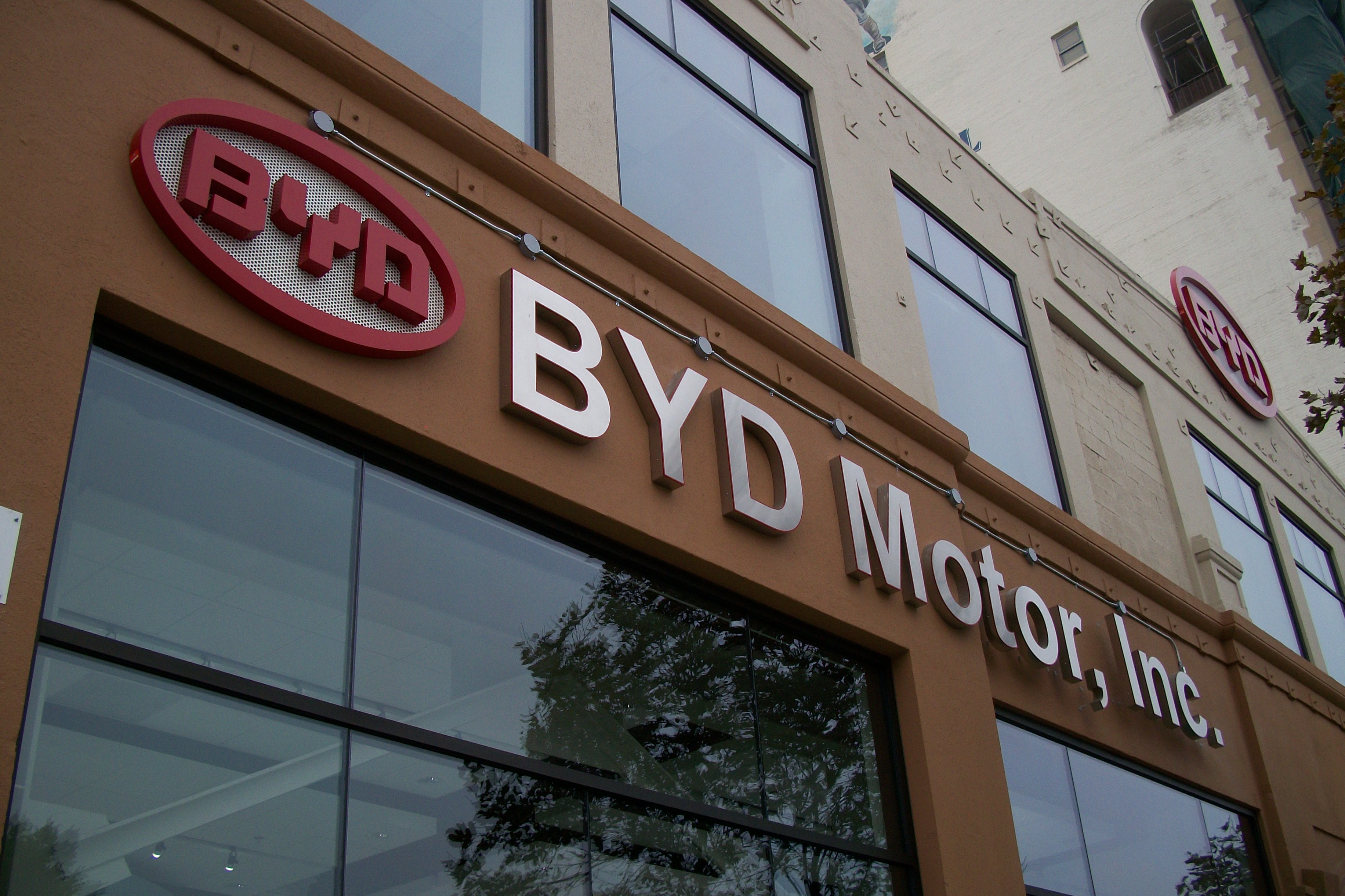
After such a rocky start in the U.S. market, which included missed launch deadlines, I was happy to see something go smoothly for the Chinese
automaker, which aims to begin selling its electric vehicles to consumers here in the U.S. starting next year. That isn’t a predicator of future success, of course. That will depend on the company’s actual vehicles.
One of BYD’s e6 electric crossover vehicles was parked in front of the building, located just south of downtown Los Angeles in an area with multiple car dealerships. This building is not a dealership, however. At least not yet. It will house BYD’s administrative and engineering staff.
I had the chance to drive the e6 last week. It’s not a bad car. To be sure, the e6 is a bit sluggish compared to a smaller electric vehicle such as the Nissan Leaf. But then the e-6 is 179.53 inches long with a curb weight of nearly 5.060 lbs. The Leaf is only 175 inches long with a curb weight of 3,354 lbs.
But that size—and the vehicle’s roominess– will give the e6 a lot of utility that smaller EVs don’t have. Also, I drove it in “economy” mode. BYD business development director Bill Wang told me later it also has a “sporty” setting that improves the acceleration. “But that uses up the battery faster,” he said. BYD claims the e6 can travel up to 186.41 miles on a single charge with a top speed of 87 mph.
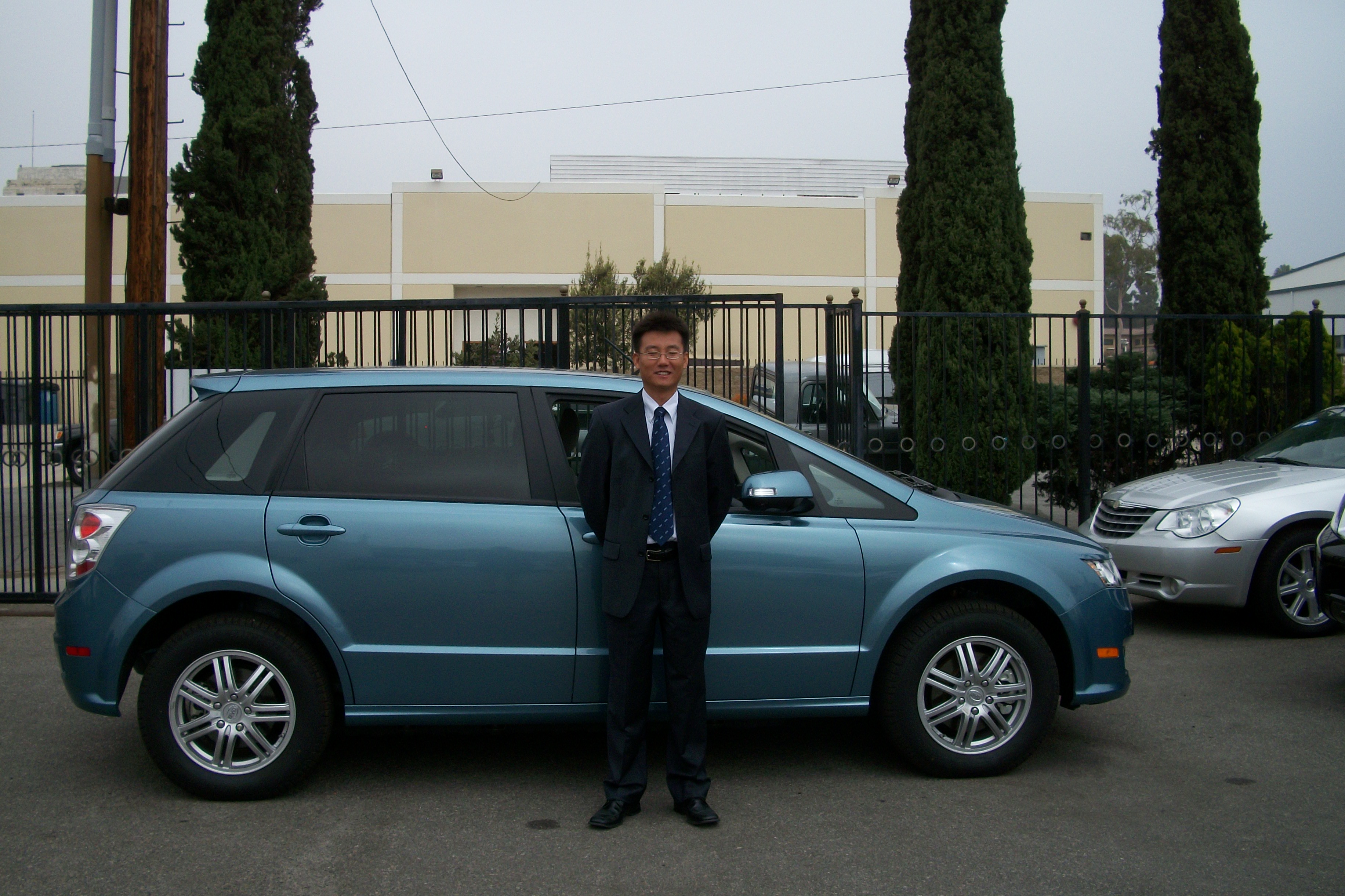
The interior is blandly acceptable. One thing I didn’t like was the placement of the instrument panel on the console. It is in the middle rather than directly behind the steering wheel so the driver has to look down and to the right to see speed etc.

The electric car will be available for fleets later this year. Consumer sales will begin in the second quarter of 2012, BYD senior vice president Stella Li told me in an interview a few months ago.
As for dealerships, BYD will open two dealerships in Los Angeles this year, Bill Wang told me. One will be Glendale; one in El Monte. It will also open a dealership this year in High Point, NC. Next year it plans dealerships in New York City, Chicago, Washington, D.C., Hawaii, Las Vegas, and Miami, FL, he said.
The dealerships will sell BYD’s all-electric e6 crossover and hybrid F3DM sedan. Ten f3DM hybrids are currently part of the Housing Authority of the City of Los Angeles fleet. They will also sell its solar panels, batteries, recharging stations, and LED lighting.
BYD is also bringing its electric buses to the U.S. Indeed, one of its electric buses began operating last month as shuttle between the Hertz Rent-a-Car lot and the terminals at LAX. Jack Hidary, global EV leader for The Hertz Corp., was at the BYD event in Los Angeles. So far so good, he said. Customers like it because it has three doors and is very quiet, said Hidary. It has lived up to expectations thus far, he said.
Hertz is sharing the performance data with BYD.

In this pilot phase, Hertz is using just bus. If all goes well, it will add several more electric buses at LAX and use the electric buses at airports nationwide, said Hidary. This is the first long-range electric bus to be used this way at LAX, he added.
Hertz chose to use BYD’s bus because of its range of 155 miles per charge, said Hidary. That was critical because it must travel between the Hertz lot and all the LAX terminals many times each day. Another attraction: BYD has engineers and staff here in Los Angeles so the support is good, he said. Then there is the cost savings. It costs 65% less to fill up the bus with electricity versus diesel fuel, said Hidary, and “we are always looking to improve our bottom line.”
 Alysha Webb
