UC Davis Institute for Transportation Studies looks to make China, and the world, a greener place
I visited the University of California at Davis Institute for Transportation Studies www.its.ucdavis.edu the first part of this week. It is doing a lot of interesting stuff that closely matches some of my interests. So naturally I enjoyed talking with Yunshi Wang, the director of the China Center for Energy and Transportation http://chinacenter.ucdavis.edu/ part of the Institute, and others there. Wang knows me through my blog, which reached him via Andy Burke, a professor at UC Davis whom I met last year at a conference. You get the picture. I also met Dan Sperling, director of the Institute.
Testing batteries is among the Institute’s many activities. Burke took me to see his (well, the University’s, but really it’s his lab) Hybrid Vehicle Power Systems Lab. The place is a battery nut’s dream. It is housed in a non-descript metal building on the edge of campus near where the farm animals hang out (Seriously. UCD has a huge agriculture science program. UCD sports team is called the Aggies, same as Texas a&M.).

Andy Burke's battery testing lab can handle everything from modules up to battery packs. Here, Burke stands proudly among his machines.
Inside a windowless room, Burke, who has worked at the Center for nearly two decades, proudly showed off high-tech machines that can test everything from a module to a full battery pack as large 400V and 500 amps. The Lab can even test battery/battery management system combinations. Battery manufacturers bring their goods to the lab to be tested, said Burke. A large battery pack from a Ford Escape Hybrid www.ford.com/suvs/escape was lying on the floor in the lab. But it came from Nissan www.nissanusa.com , said Burke. Nissan bought the Escape and didn’t need the battery anymore, he said.
Aside from the Ford battery pack, there were no batteries from the companies that supply major automakers. “Any battery maker that ships batteries directly to automakers isn’t about to ship a battery to a third party,” said Burke.
He walked to a metal cabinet and pulled out a box full of ultracapacitors. Ultracapacitors are able to quickly charge and discharge energy up to a million times. They look somewhat like very large regular battery (Think how big a rat is compared to a mouse. A really big rat that is). A capacitor is great for hybrid vehicles, and much smaller than the regular battery packs that are currently being used. Such as the one from the Ford Escape, which was flat and about the size of a collapsed card table. Ultr capacitors can also discharge 75% of their stored energy, said Burke. Okay, I’m getting into technical waters that I can’t even dog paddle in, much less swim. So I will say no more. It was fun to see the box’o apacitors, however.
Burke’s lab is only one of many endeavors at the Institute for Transportation Studies. It has a Plug-In Hybrid and Electric Vehicle Research Center that studies how marketable EVs are. It has a Sustainable Transportation Center. Etc. Look at the website. www.its.ucdavis.edu
The Institute also includes the Sustainable Transportation Energy Pathways (STEPS) www.steps.ucdavis.edu program. It is sponsored by a consortium of companies. The first STEPS program, which had 21 sponsors, ended in 2010. On Jan 1 the new program—predictably called NextSTEPS—started. It will run through 2014. Sponsors cough up $60,000 annually to be members. Up until April, NextSTEPS members included automakers such as Nissan, GM, Honda, and BMW; oil companies such as BP and Indian Oil; and government bodies such as the California Air Resources Board www.arb.ca.gov (of which Dan Sperling is a member). The Institute is seeking more.
Besides meetings two or three times a year, member companies can attend Institute seminars and have access to the Institute’s 100 research projects. And of course they can exchange ideas, pointed out Paul Gruber, the STEPS program manager.
The China Center at the Institute is involved in various projects with Chinese universities and assorted government bodies in China. Among the more interesting: A project to use Chongming Island, http://www.chinahighlights.com/shanghai/chongming-island/ near Shanghai, as a sort of new energy vehicle Petri dish. The idea is to slowly wean the island, which is small with a smallish population and a fairly undeveloped road system, from all but electric vehicles of various kinds.
That seems feasible. After all, the Shanghai Municipal Government (which I believe governs Chongming) can mandate it. But a proposed project to develop a low-carbon development in the heart of Beijing’s Central Business District seems too good to ever come true.
I know that area well—used to ride my bike through it a lot when I lived in Beijing. Already, it has changed immensely with older buildings torn down to make way for shiny new high-rise shopping, business, and residential developments. And the plan is for the CDB to double in size according to a presentation Wang showed me. (Of course, that would involve tearing down more old housing and making those people move to the suburbs so they would have to commute to their jobs. But Beijing has an extensive subway system now. And the new buildings and green space are prettier….)
The Center would advise on making the area livable, including lots of green space and good schools, etc., while making it increasingly carbon-free by migrating the inhabitants from private vehicles to NEVs to public transit to bicycles or walking.
Hmmm. Regressing (in many Chinese minds) back to bicycles. Maybe it will happen someday. But right now, even with the horrendous commute many Beijingers face (one slide in the presentation says there were a record 140 traffic jams on Beijing roads on September 17,2010.) they relish the freedom (?) and status driving to work confers.
The plan is long range. Bicycles don’t appear as the main form of transportation in the new CBD until 2030. And the chart is labeled “Idealized CO2 Reduction Source in CBD 2030.” Hey, it’s always good to dream.
BYD Co. www.byd.com is the world’s largest producer of mobile phone batteries, but it is better known these days for its cars. In China, the brand was first associated with cheap, small cars of so-so quality, and more recently with electric vehicles. BYD would, not surprisingly, prefer to be known as a high-tech firm that produces not just electric vehicles, but premium-brand EVs. And, it would like to tack solar panels and storage devices i.e. high-tech batteries on to that image.
Here in the U.S., the brand is not well known. But it wants to be known as a high-tech green company that produces—you got it, electric vehicles, solar panels, and high-tech storage batteries.
BYD senior vice president Stella Li and vice president Michael Austin talked with China-EV recently in Los Angeles about BYD’s brand strategy and the challenges it faces. An edited transcript follows.
China-EV: BYD is delivering 300 electric taxis to the 2011 International Universiade Games in Shenzhen this summer. http://www.hybridsevolution.com/2011/07/byd-signs-500-unit-electric-vehicle-deal-with-city-of-shenzhen/
And it already some 50 in another taxi fleet in Shenzhen.
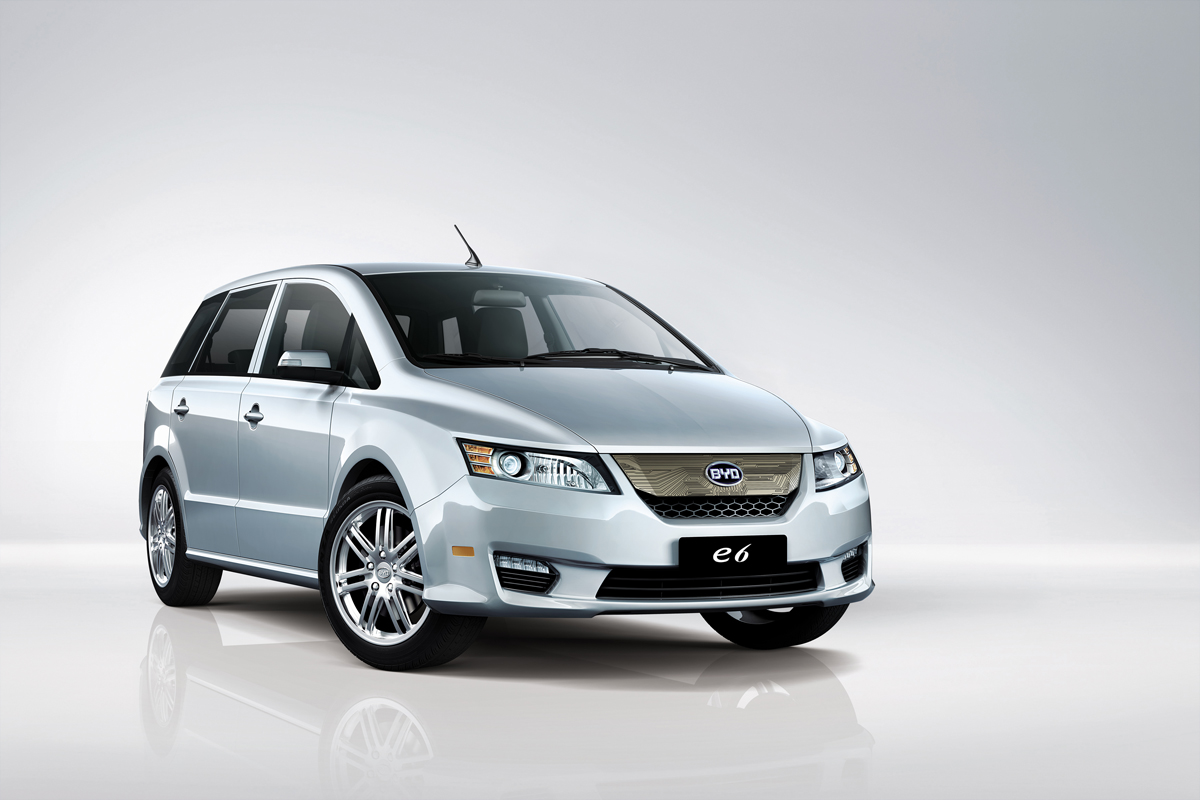
China-EV: But have you started selling your e6 electric crossover vehicle to consumers in China?
Li: Not yet. All the production is fully booked by the taxis. We plan to begin consumer sales in China in September or October of this year.
China-EV: You mentioned that you are capacity constrained where battery production is concerned. How will that impact your consumer sales?
Li: We invested in our battery—the IPO—to increase our battery capacity. (BYD raised 1.42 billion RMB, or US $220.7 million at current exchange rates, in an initial public offering on the Shenzhen Stock Exchange in mid-June.) http://www.autoblog.com/2011/06/21/byd-raises-219-million-in-china-ipo/
China-EV: BYD’s sales of regular cars have taken a hit in China recently—sales were down 24% for the first half of 2011, according to J.D. Power and Associates . Will that impact your ability to grow your EV operations?
Li: The sales for BYD … the company is in a transforming stage. In the past we are more focused on pushing the volume. Now we push the … now the focus will be maybe more on green car. In 2013-14 you will see BYD will introduce a different size, a series of EVs. We will also introduce new Dual Mode car and at the same time there will be more focus on technology and quality.
Now we are more strict on the car’s quality. Recently you see our launch for the f6 the fit and finish is very different. In the future you will see everything will be upgraded so you get into the car and it is more like a feeling of a luxury car, a high tech car.

Li says BYD's days of favoring sales volume over quality are gone.
China-EV: So you are upgrading your internal combustion engine cars as well?
Li: Yes, so we will be more focused on quality, fit and finish.
China-EV: Fit and finish has been a huge issue for Chinese cars in the past….
Li: Exactly, that is the mistake we made in the past. We would push volume, so our quality on fit and finish was not there. Now we will be more focused on that. Several times we have had an internal review; we talk about how we make it. You know we can make a lot of beautiful parts. All the cars we make, if we only use a small part of our high tech knowledge in building our autos, they will be super high tech.
China-EV: Yes, you have a high tech imagine but you also build cheap cars. There’s a contradiction….
Li: That is the mistake we had in the past three years, but when the new guy goes to the market we had to push some volume but sometimes we didn’t focus on bringing the good quality high tech image to the car. Now we are in the transforming stage to make our products to be more high tech.
I will share with you– when is the auto show? We are going to debut our “I”system. The I system—if I am here and my car is in the parking lot, I can call and say “can you unlock?” Then I can tell the car I need a repair and the car can set up the repair appointment. You can do all these
things with the technology in the new car. When we introduce the g6 we will have the I system. It’s a very intelligent car.
Austin: It links a lot of the information in electronic systems to the user. Like is it fully charged, is it not fully charged? How much longer will it take to fully charge? What is the remaining state of charge?
China-EV: What about your traditional cars?
Li: They will also have all these high-tech functions. They can plot locations, you can also send navigation information to other people’s cars. These kinds of cool things are in our I systems.
China-EV: Nonetheless, earlier this year when sales dropped in China BYD still resorted to price cuts to push cars. Once you start launching
these new lines of higher tech cars do will BYD still need this tactic?
Li: We have to deal with that. Chinese people pay a lot of attention to face, and to brand. If they have money, they want to get a foreign brand.
China-EV: Right, that is a whole branding issue….
Li: Now it will take some time for BYD to rebuild our branding to be a high premium car imagine. Then maybe we can improve our sales price.
Recently our s6 was introduced to the China market at only 90,000 RMB. It is an SUV, everyone wants to get that car. So you see this kind of car still sells, but it is starting to change our image.

BYD hopes the S6 SUV will aid the transformation of its image to a more upscale brand
China-EV: How long do you think it will take to change BYD’s brand image in China from a producer of cheap cars to a high-tech producer of premium brand cars?
Li: BMW, Daimler, they have 100 years. For good branding, I think it will take 20 years or 30 years. But for this kind of image, we have the best chance for a green car, to introduce a green car with a good status. Also we have had several internal reviews. We cancelled a lot of projects which did not fulfill our new strategy. We need to start to fulfill our product roadmap. So normally this will take three years, so maybe in five years you will see BYD brand car will be totally different than today.
Austin: That is something that will benefit from the Daimler/Mercedes relationship as well.
(BYD and Daimler AG, maker of the Mercedes Benz brand, in May of 2010 formed a joint venture in China to produce electric vehicles. BYD will provide the battery and powertrain technology.) http://www.insideline.com/byd/daimler-byd-ink-ev-joint-venture-in-china.html
China-EV: Are you launching a new brand with Daimler www.daimler.com ?
Li: Yes, it a pure EV brand.
Austin: And those engineers have relocated to Shenzhen. There is already cross-pollination going on.
Stella: They have 30 or 40 engineers.
China-EV: When is the brand due to launch?
Stella: 2013. We may announce the car’s brand name by this year. Two companies—the JV, so it is taking longer to decide on the brand name. Only one company we can decide by one person. But now it is two people.
China-EV: What is your main area of responsibility?
Li: BYD overseas sales. Plus for auto I need to take care of the U.S. market.
China-EV: What is happening with the F3DM hybrid car in the China market?
Li: Some sales in China starting in September. We are now upgrading the new platform for the 2013 models.
China-EV: What is your sense of the government’s emphasis in China as far as new energy vehicles goes?
Li: They will not really encourage a hybrid, they will be more focused on EV and PHEVs. They will accept hybrid but the (big) incentive for hybrid is not there.
China-EV: I just read an essay by Chinese premier Wen Jiabao in Qiushi http://www.qstheory.cn/zywz/201107/t20110716_93475.htm where he talked about how the BEV technology was not mature and the investment in the sector was not focused.
Li: I think in China, the government said it would incentivize EV purchases so a lot of EV companies jumped in, they never made a car or battery before. A lot of ebus companies are that way. Then there were several accidents. This has brought confusion to the consumer and a lot of trouble to the government. You know China does things like a swarm of bees. Now they say the government gives you subsidies for EVs, they swarm to invest. They waste a lot of investment.
China-EV: Is BYD importing any of the technology for its EV, such as the battery management system?
Li: We delivered 2.2 billion cell phone batteries.
China-EV: But the strains on a cell phone battery are less than those on a vehicle battery….
Li: But we have to do lots of tests on the batteries. When you are cooking at home and you drop it in a hot place, you don’t want it to explode, for example. So we have done a lot of extreme testing under extreme conditions on our cell phone batteries.
This is a re-post of a blog I did for plugincars.com. www.plugincars.com
Educating consumers about electric vehicles is like being a psychologist, says Debra Hotaling, manager of Western region communications for Ford Motor Co. www.ford.com Hotaling was a speaker at a July 25-27 conference in Los Angeles on promoting consumer confidence in EVs. (Full disclosure: I was also a speaker.)
Ford will start deliveries of its battery-electric Focus later this year and the automaker is spending a lot of time trying to parse consumer attitudes towards electric vehicles. One thing it has discovered: People are really struggling to understand what the parameters are around an EV, said Hotaling. For example, they ask questions such as “Will my car short out if I drive through deep water?”
Living here in California, which is pretty much EV central (My running club was running up in the hills of Pacific Palisades a few weeks ago. Three cars along the curb: Two Pruii, one Volt.), we forget that that EVs are sort of like flying saucers to a good portion of U.S. consumers.
Hotaling was a good balance to speakers such as EV zealot Paul Scott, vice president of Plug In America, www.pluginamerica.org who can’t imagine why everyone doesn’t want to own an EV.
In fact, many consumers don’t really have a good grasp of the basics of an electric vehicle, says Hotaling. So Ford spends a lot of time “myth busting,” she says. Figuring out how to sell EVs to consumers is pretty important to Ford given that it has declared that from 10 to 25% of its portfolio will be electrified by 2020.
One thing is clear, said Hotaling. People won’t settle for a de-contented car, even if it is electric. They want all the goodies they can get on a traditional gas-powered vehicle. And, they want to car to look good. “You can’t just jam this down people’s throats,” she says. “People won’t buy this if it is not a car they can love.”
Hotaling also says that a business model that relies on government incentives is not a good business model. She may have been reading a recently-released study by Harvard’s Henry Lee and Grant Lovellette, “Will Electric Cars Transform the U.S. Vehicle Market? An Analysis of the Key Determinants.” http://belfercenter.ksg.harvard.edu/publication/21216/will_electric_cars_transform_the_us_vehicle_market.html
I like reading these academic studies. They can be dry, but they are refreshingly straightforward and generally free of biases. This report is skeptical. One of its conclusions: “Significant penetration of electric cars into the U.S. marketplace will only occur if the vehicles are competitive with conventional vehicles, not only on a cost basis, but also on an attribute
basis.”
I asked Hotaling if it made automakers such as Ford nervous to sink lots of resources into a technology that had an uncertain future. She said that by using the same global platforms for traditional and electric vehicles, Ford was reducing the risk.
That strategy also allows it to come out with a wider selection of vehicles with some form of electric drive train. “We don’t have to bet the farm on
one car,” says Hotaling.
Of course, there are many EV makers out there that are basically betting the farm on one car. The travails of Norway’s Think, which just got a third lease on life when a Russian investor agree to buy it, may be a sign of what awaits other small EV makers. http://www.autoobserver.com/2011/07/russian-investor-purchases-think-ev-operations.html
Will the big OEs be the only ones left standing in the EV segment a decade from now? I fear the answer is yes, but hope I am wrong.
There are a lot of battery companies in China. According to a report by Fourin Inc, www.fourin.com a Japanese research company, as of December, 2010, China had 52 rechargeable battery makers. That number has likely grown.
Many of the batteries produced by those companies will likely not meet stringent quality standards. A report by InterChina Consulting www.interchinaconsulting.com in Beijing says Chinese battery makers are weak in production technology and process. China has not invested in fundamental materials research, said InterChina, “For example, China’s best LiFePO4 materials attain a purity of 94%.” Ideally, the purity level would be less than one millionth. The process used by local suppliers can’t attain that level, said InterChina. Separator films are another weakness—China depends on imports, said the report.
Unfortunately, a lot of these companies may not even care that their quality is not top-notch. Why? The cha bu duo problem. Cha bu duo (literally “less no more”) means “good enough.” Something gets the job done, though it may not be the very best it could be. That attitude needs to end if China’s battery makers hope to be competitive in China, must less globally.
Here’s a good example of the cha bu duo mentality: About 7 years ago I in Wuhu, China visiting an Italian company that was a supplier to Chinese automaker Chery www.cheryinternational.com. I was chatting with the GM of the supplier, a Chinese man who had a PhD from an Italian university and who had worked for Fiat. He was extremely frustrated by the attitude of the Chery managers towards their product. They accepted quality that was only so-so rather than striving for first-class, he said.
Let’s go to lunch, he said. We went to his car, a Chery model, and he opened the trunk. He looked at the exposed wiring for the trunk
light and the wide spaces between the trunk hood and the car body. “See, just good enough,” he said in Chinese. “Good enough is not okay!”
That mentality persists in China’s battery makers, according to Jeff Seidel, CFO of Ener1 Inc. www.ener1.com of New York. Ener1 just got approval from the Chinese government to form a battery joint venture with Wanxiang Electric Vehicle Co. www.wanxiang.com of Hangzhou, China. Ener1 owns 40% of the venture, which will be based in Hangzhou.
Seidel visited other battery makers in China. There is a lot of ‘good enough’ thinking in China, he said. “I saw some rush jobs and they looked rushed,” Seidel told me. What Ener1 liked about Wanxiang, Seidel said, was it “brings to the table a better process and better integration.” In other words, Wanxiang isn’t satisfied with good enough.

Seidel found many of China's battery makers accepted quality that was just "good enough," he said.
The joint venture’s battery cells will be produced at Wanxiang’s existing factory. I visited the factory earlier this year. It is very modern. But, Seidel said one shortcoming was the battery pack assembly. “It was entirely manual,” he said. “You might of seen (in the plant) guys with a socket wrench assembling packs.”
Ener1 uses a mechanical process for battery pack assembly, said Seidel. That allows for consistency and large volume production.
One thing that attracted Wanxiang to Ener1 was its pack assembly technology, he said. “They are probably 2-3 years behind in terms
of their pack design and not as far in terms of their cell,” said Seidel. “The integration of our pack design and their cell should give them a great leap forward in the China market.”
In fact, Wanxiang’s battery cell technology, while not world-class, was “not that far away,” said Seidel. To bring the JV up to speed quickly, Ener1’s Taison Tan, “a cell design guy” will be the JV’s chief technical officer. Wanxiang engineers are also coming to the U.S. to train, and half a dozen Ener1 engineers will work with the JV in China, he said. Wanxiang “would like 12 or 13” Ener1 engineers, quipped Seidel.
Ener1 is putting a lot of intellectual property into the joint venture with Wanxiang. In May, when Ener1 and Wanxiang signed the letter of intent, I asked Tom Goesch, president of the transportation group at Ener1, whether Ener1 was worried about its intellectual property being stolen. He told me: “We feel the strategy of having a partner like Wanxiang, a China-based company, will provide us the best protection we can find. Wanxiang has all the reason in the world to protect that intellectual property.”
Talking with Seidel, I learned that Ener1 had also been worried about Wanxiang itself using the technology to land business deals outside of China, deals which would hurt Ener1’s business in the ex-China market. Indeed, Ener1 initially tried to limit the JV’s business scope to China. Wanxiang was (understandably) “not enthralled” at that provision, said Seidel.
The solution? According the contract, the JV’s board must unanimously approve any deal outside of China that is greater than 5% of the previous year’s total revenue. That way, “if it is to the detriment of Ener1, our one vote could stop” the deal, said Seidel. (Ener1 owns 40% of the JV and therefore appoints 40% of the board, said Ener1 spokesman Brian Sinderson.)
Ener1 has big hopes for the JV. If the battery cell quality is as good as those produced at its plant in Korea, and the cost is competitive, Ener hopes to source batteries in China for global operations. He hopes the Wanxiang JV can become Ener1’s low-cost manufacturing model, Seidel told me.
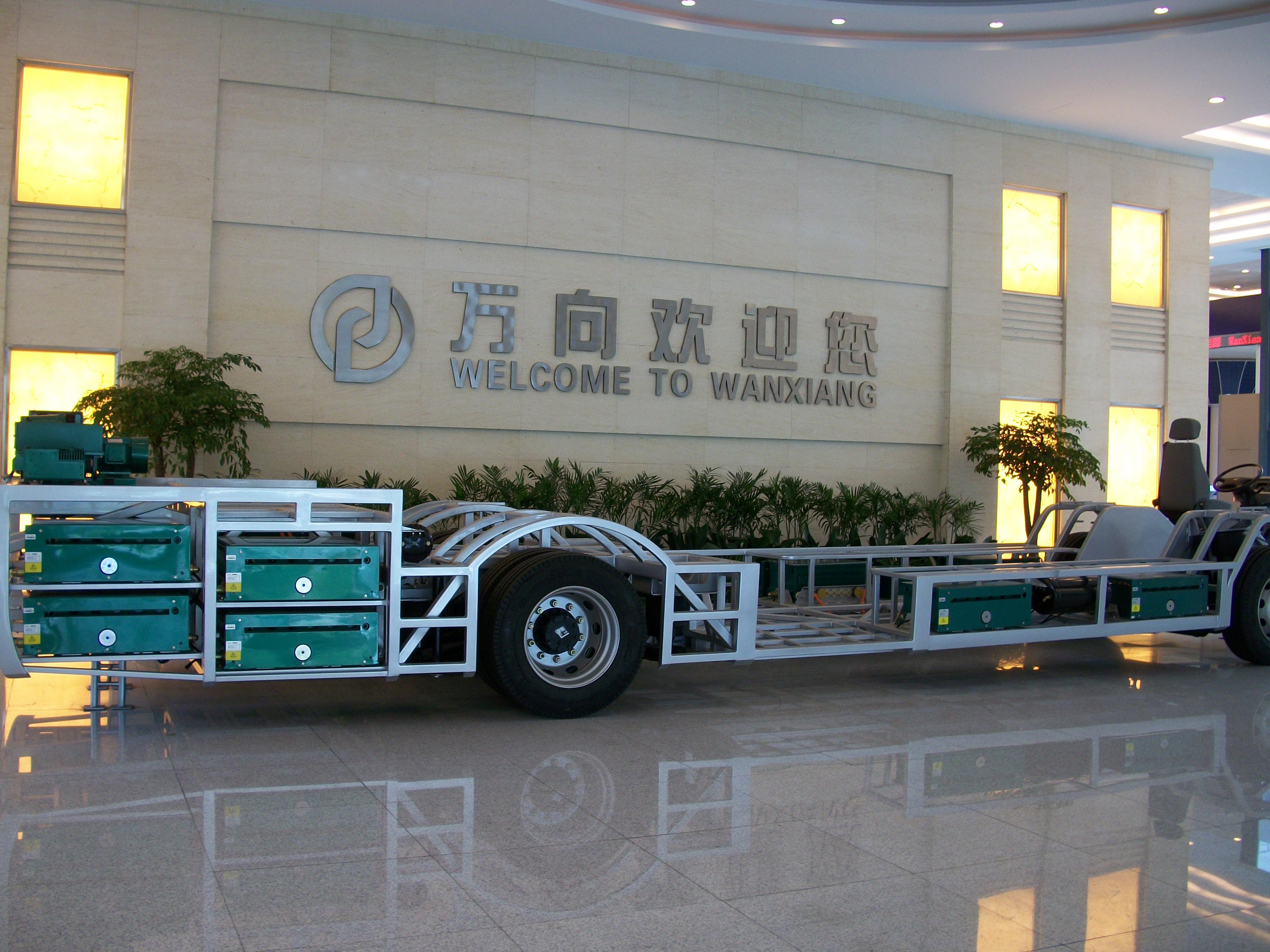
Wanxiang EV is concentrating on electric buses initially. It figures Ener1's expertise will give it an edge over local competitors.
For now, however, the JV is just getting started. It will initially concentrate on fulfilling existing contracts Wanxiang has with some local bus companies. By 2014, it should have annual cell manufacturing capacity of 300 million Ampere hours, or about 40,000 EV battery packs according to a press release.
Said Seidel: “I’m very optimistic for the JV.”
Maybe people will pay more attention to Wuling’s role in General Motors China sales now
This week I feel like writing about a non-EV related issue. Partly because I don’t have any good ideas for an EV-related blog. But also, I read some news that hit on something I’ve been keeping my eye on for a long time.
Kevin Wale, president of GM’s China group, www.gmchina.com said a few days ago that GM’s sales in China would likely grow by only about 10% this year compared to 2010. http://www.autonews.com/apps/pbcs.dll/article?AID=/20110711/GLOBAL03/307119827/1131
Granted, 10% is not to be sneezed at. But in China, that would have been considered a poor showing even last year. It’s the bottom of the growth range Wale forecast earlier this year. His bearish tone brings to the fore how dependent GM’s China sales numbers are on its minivan joint venture, Shanghai GM Wuling. www.sgmw.com.cn Many in the media seemed to have ignored that for a long time.
To GM’s credit, it didn’t try to hide the problem. Indeed, to my surprise, it talked about Wuling’s falling sales—down 5.4% in the first half of 2011– in the second paragraph of its press release of July 5, after the “Unprecedented First Half Sales” subhead. http://media.gm.com/content/media/cn/en/news.detail.brand_GM.html/content/Pages/news/cn/en/2011/Jul/0705
I guess that is because, though Wuling accounted for 50.4% of GM’s China sales, it sold a goodly number of Buicks and Chevys in the first
six months, as well. Buick sales, for example, grew by 28.2% on-year in the first half of 2011 to 324,919 vehicles, according to GM.
Nonetheless, the recent news will hopefully encourage those who read GM’s glowing sales figures out of China to disaggregate them a bit in the future.
Sales don’t tell much about the profit picture for GM in China. GM owns 44% of Wuling; it owns 49% of Shanghai GM, its flagship joint venture. So it gets only part of the proceeds. And, Wuling’s best selling model, the Sunshine mini van, costs around US$5,000. http://www.sgmw.com.cn/templates/chanpin_wlcy/index.aspx?nodeid=55
Why did Wuling’s sales fall? The main customers for its mini vans are small private businesses. They are getting hit hard by China’s raging inflation. Prices were up 6.4% in June. Also, loans have gotten more expensive—China’s central bank has raised interest rates five times since October trying to tame inflation.
And, some government policies that were boosting sales in the small towns and rural areas where Wuling’s customers live ended, such as a “cash
for clunkers” type trade in program. And, the government banned the use of mini vans for tour or school buses, according to J.D. Power and Associates. Indeed, J.D. Power www.jdpa.com forecasts sales in the light commercial vehicle segment, which includes Wuling’s main products, will fall by 2% for all of 2011 compared to 2010. So GM’s sales numbers will likely continue to take a hit on the Wuling side.
Nonetheless, General Motors made a brilliant move when itbought 34% of state-owned Wuling in 2002. (I feel a personal connection to Wuling as I was the first foreign journalist to visit the automaker. Back in 2001, when I worked for BusinessWeek in Shanghai, I interviewed Wuling general manager Shen Yang in Liuzhou, where Wuling is headquartered. The General Motors purchase of Wuling’s shares was still pending and hasn’t been officially announced. )
Wuling’s sales roared as incomes rose after China’s WTO entry. The economy grew by double-digits. GM managed to buy more of Wuling in November of 2010, and now owns 44%. According to my sources, GM wrangled that deal by giving Wuling access to some older platforms so Wuling could launch its own line of passenger cars, called Baojun or “Treasure Steed.” The first Baojun model—a small sedan– rolled off the line in November, 2010.
But Wuling–and GM–is still dependent on minivan sales to make the numbers. And farmers and small businessmen worried about inflation aren’t buying. So GM China isn’t invincible.
China needs to clarify EV incentives if it wants the market to grow. Oh, and it needs better technology…
This is, admittedly, a rehash of a blog I wrote for auto163.com, a Chinese-language website I blog for. http://alyshawebb.blog.163.com/ It is part of Netease. Actually, the blog appears in Chinese and English. If you click on the title, both versions appear.
Hey, it’s hard to come up with new ideas sometimes. And its a good blog.
China has audaciously proclaimed that it will be the largest market for electric vehicles by 2020. I’m very skeptical that will happen. But it certainly won’t get there without clarifying what kind of government support the market for electric vehicles will get over the long term. And it hasn’t done that yet.
To be sure, the central government has supported the consumer market for new energy vehicles with purchase subsidies of up to 60,000 RMB for some electric vehicles. But that hasn’t boosted sales much, judging by the numbers.
Price is one issue. The few electric vehicles for sale in China are still fairly expensive compared to a comparable gasoline-powered car, even with a rebate. Yet a study by market research firm Synovate found that, in direct comparison with their current car, only 4% of China’s owners would accept a price increase to buy a battery electric vehicle. http://www.synovate.com/news/article/2011/04/consumer-product-experience-critical-to-market-success-for-battery-electric-vehicle-technology-in-mainland-china-reveals-new-study-by-synovate.html
Another problem is the lack of actual electric vehicles available for consumers to buy. Recommendations from friends is an important factor in Chinese consumers’ car-buying decisions, yet few know anyone who drives an battery-electric vehicle, or even a hybrid. So no one is recommending them. And, there are few models to test drive, so comparison shopping is pretty much impossible.
That brings us back to the need for a clear subsidy policy. Without one, the number of electric vehicles available will remain tiny.
Many of China’s automakers have proclaimed that they are producing hybrid, electric, or other new energy vehicles. But most have only produced a prototype. Without clear market acceptance, a growing infrastructure to support EVs, and most importantly a clear indication of what kind of incentives the government will provide–and for how long–automakers in China are reluctant to do more than dip their toes in the EV sea,
much less jump in.
There are some positive signs from the government. A draft law on vehicle taxes posted on the State Council website in mid-June includes eliminating taxes for battery electric, fuel cell, and most significantly plug-in hybrid electric cars. Taxes on regular hybrid vehicles would be cut by 50%. The draft law is circulating for comment right now; it will likely become law on January 1, 2012.
But, a purchase tax reduction is attacking the problem at the “bottom end,” an executive at a U.S. company hoping to sell its PHEV technology in China pointed out to me. The government needs to foster innovation at the initial stage, he says. That is sorely needed, because Chinese companies don’t have world-class PHEV technology. They may never catch up with foreign companies in that area, but a lack of clear government support certainly doesn’t help.
In fact, Chinese firms don’t have several key technologies needed to produce electric vehicles. And without a clear indication of government support, they won’t invest in those technologies, and China will fall farther behind.
China wants to be a big player in the battery electric vehicle sector. But is the government willing to support BEV purchases until battery technology matures? Without some reassurances, the big investments needed to advance batteries won’t happen.
China’s government is aware that China is behind in three crucial EV technologies— battery management systems, engine management systems, and electric vehicle control systems. Why else would it have floated a draft law that may require any foreign company producing those three components in China to form a 50/50 joint venture?
The wording is unclear—it may mean that only 50/50 JVs will receive preferential treatment. That’s typical–the Chinese government often floats vaguely-worded draft laws for comment. Nonetheless, it is a clear indication the government recognizes China will have a hard time becoming an EV powerhouse on its own. That should spur the government to issue clearer policies.
A recent study by consultancy BCG that China and Europe, not the U.S., will be the largest market for electric vehicles in 2020. Government subsidies will be key to the development of China and Europe’s EV markets, said BCG. Well, unless China’s government is more clear on its support, perhaps the two largest markets will be the U.S. and Europe.
China’s government is already getting a bit more realistic in its goals for the new energy vehicle sector. That is China’s name for alternative fuel vehicles. Not too many months ago, the government was aiming to make China the number one producer of, and market for, battery electric vehicles by 2020. Since the technology was still nascent in all countries, China figured it could take the lead in the field.
Well, just a few months later reality has struck home. China has realized that, while it may be a big market for alternative fuel vehicles, some of those vehicles may not be all that advanced, and the technology will not all be home-grown.
That’s not to say China is not still interested in being the battery electric vehicle capital of the world. But low-speed or “city” EVs may be a big part of that plan. Fleet vehicles—can you say bus?—will also figure largely. And foreign technology or even foreign nameplates may be big players in
the sector, too.
Meanwhile, the lowly (I mean that facetiously) hybrid, a technology that Toyota www.toyota.com has most successfully commercialized, has become much more acceptable as a stepping stone towards battery electric cars. Plug-in hybrid electric vehicles are also getting some respect now.
Of course, if the government doesn’t clarify the extent of its support for the sector, the domestic content of new energy vehicles may be even smaller. See my recent blog at www.plugincars.com for more on that topic, however.
One clear sign of a more friendly attitude towards hybrids and PHEVs: A draft law on vehicle taxes posted on the State Council website in mid-June includes eliminating taxes for battery electric, fuel cell, and most significantly plug-in hybrid electric cars. Taxes on regular hybrid vehicles
would be cut by 50%. The draft law is circulating for comment right now; it will likely become law on January 1, 2012. http://www.caam.org.cn/zhengceyanjiu/20110615/1605057362.html
Let’s revisit early plans for the new energy vehicle sector.
A plan for revitalizing the auto industry released in March, 2009, called for China to have installed capacity to produce 500,000 NEVs–including EVs, PHEVs, and HEVs—by 2012. http://preview.subscribers.wardsauto.com/chinaauto/auto_industry_readjustment_090330/
Then, in August of 2010, details of a plan appeared in the local press that called for China to have 1 million electric vehicles on the road by 2015.
By 2020, China was to produce and sell one million battery-electric and plug in hybrid electric cars annually. Some five million such vehicles would be plying China’s roads by then. Annual production and sales of mild and full hybrid vehicles was to hit 3 million by 2020.
Now, I am not saying China has changed in those plans. But the way these targets will be reached seems to be morphing into something more
achievable than, say, five million full-fledged battery-electric sedans and/or SUVs plying China’s roads. Now, the government seems to be figuring on a chunk of those being low-speed vehicles, or city EVs. Fleet vehicles will also loom large.
That is probably doable given that China—especially Shandong province—is filled with low-speed vehicles manufacturers. Of course, I think
encouraging these low-speed EV makers too much is a mistake. Then they start eyeing the full-sized EV market, and wasting resources trying to enter it. I’ve blogged about that. But making really good low-speed EVs is a worthy goal.
Also promising is that major auto makers such as General Motors www.gm.com , and others, have told me the city EVs are a segment they think will be huge. They are working on products for the segment.
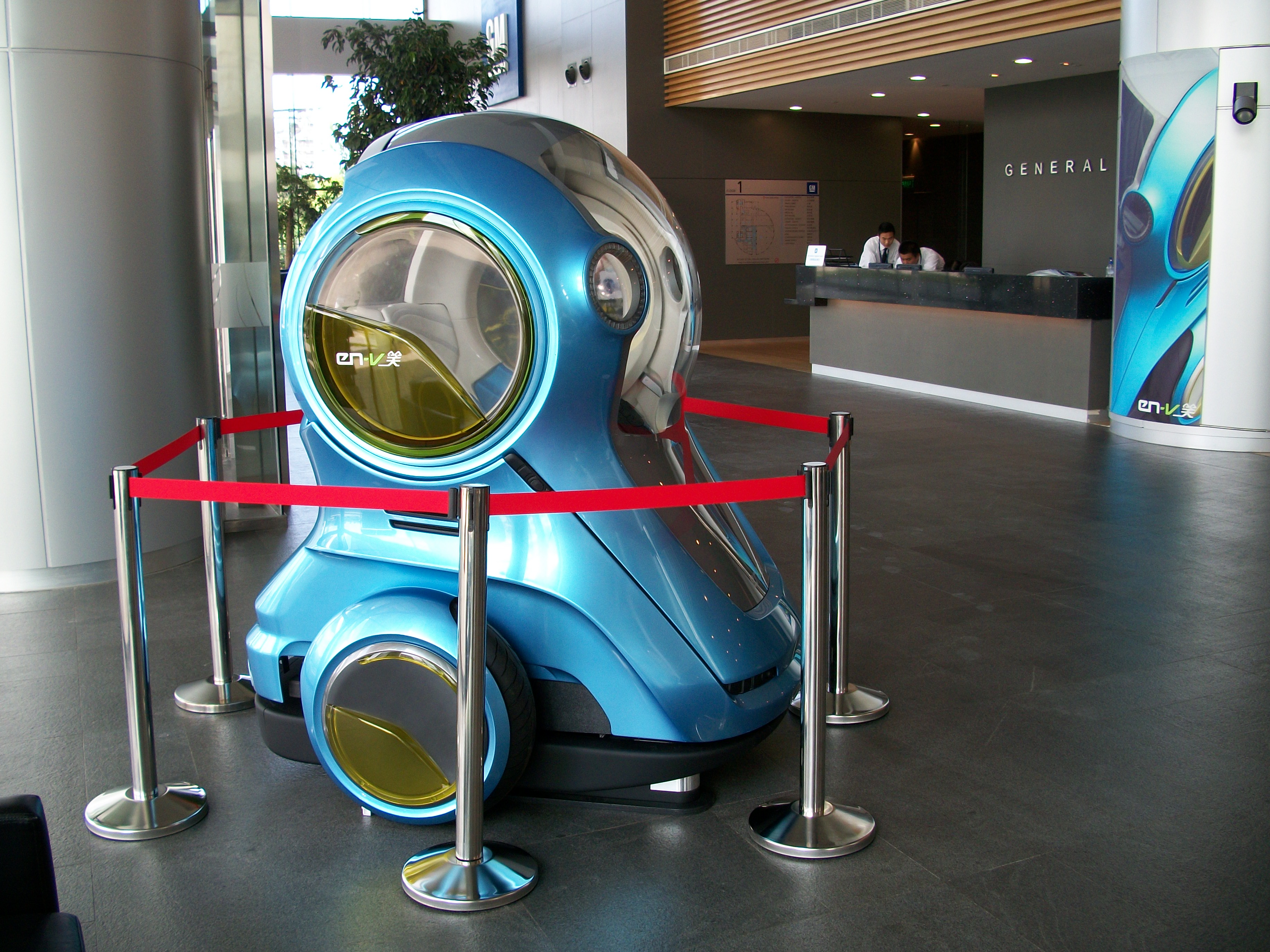
GM showed the EN-V electric car at the Shanghai Expo (here in its lobby in Shanghai.). It sees the market for small city EVs such as this--though perhaps with a more conventional shape--as a big future market.
Why the subtle shift in the government’s vision for the new energy vehicle sector? Well, it turns out that China’s electric vehicle technology was not as advanced as the government imagined, and that it is considerably more difficult than imagined to produce an electric vehicle capable of everything an internal combustion engine car is capable of.
Some of the signs of that realization were not too subtle, actually. A few months ago, the National Development and Reform Commission and
the Ministry of Commerce, floated a revision to the Guiding Catalog for Foreign Invested Industries policy that showed the government recognized the weak position China was in regarding some EV technologies.
The revision refers to joint ventures producing key components of electric vehicles such as battery management systems, engine management systems, and electric vehicle control units. Only JVs that are at least 50% owned by the local (Chinese) partner will be “encouraged” in the new wording. Of course, it likely means that only those JVs will receive preferential tax treatment, though it may mean only those will be allowed. That hasn’t been made clear. And implementing either version would meet with stiff resistance from foreign firms. Nonetheless, it shows thgovernment recognizes China’s EV sector needs foreign technology to succeed.
Finally, a confession. Perhaps some factions in China’s government have always figured that China would not become the top producer of battery electric sedans, or any other type of alternative fuel passenger car, in the near or even medium term. Perhaps low-speed EVs and fleet vehicles were always a significant part of the mix. To be sure, Chinese media did write about the difficulties of achieving the lofty NEV goals. http://www.chinadaily.com.cn/business/2009-10/26/content_8846285.htm
But the press—both foreign and Chinese—chose to interpret the early announcements about investments in the NEV sector as full speed ahead
with passenger cars. And Chinese automakers rushed to announce plans to produce NEVs. One in particular, whose name won’t mention but you know the initials, comes to mind.
In any case, things seem to be sorting themselves out now. Will China be a big market for NEVs of one kind or another in the next decade? Yes. Will it be the technological leader in the sector? Probably not.
Back in April, an EV produced by Zotye Auto www.zotye.com , a privately-owned Chinese auto maker, burst into flames while in use as a taxi in the east China city of Hangzhou. http://www.bloomberg.com/news/2011-04-12/china-s-hangzhou-suspends-electric-taxi-operations-after-fire-news-says.html I’ve had some bad taxi experiences in Hangzhou, but never one quite that bad.
The Hangzhou government investigated the cause of the conflagration. Its conclusion, reported in the local press, http://www.china4auto.com/news/showd.aspx?id=252192 suggests it is a lot harder to produce an electric vehicle than China’s automakers—or at least Zotye—imagined. And that Chinese companies producing EVs need to do a lot of testing before they put them on the road for general use.
The problems at Zotye also underscore how far Chinese automakers need to come to match the superlative safety rankings of today’s new electric cars from major global automakers.
In the U.S., electric cars, such as the Nissan Leaf www.nissan-leaf.com and Chevy Volt, http://www.chevrolet.com/volt/have been receiving very high safety scores. http://www.autoobserver.com/2011/04/leaf-and-volt-earn-highest-iihs-safety-ratings.html
The investigation determined that the battery cell design was not the problem. But, there were quality problems in the battery pack production process, and it did not satisfy the demands of the operating conditions in an automobile, it said. According to the local press story, after the battery module had been in use for a while, battery leakage and insulation damage occurred, causing a short-circuit. The report I read didn’t give more details, but it was still pretty damning.
Producing an EV is tough, especially for young companies without much experience producing any kind of cars, much less electric ones. Even if the battery cell is good, combining multiple cells to create a module is hard. Then there’s managing all that heat. And getting the battery module to talk to and work with the rest of the car’s systems ain’t easy. Battery management systems were one weaknesses in China’s EV segment that were identified in an excellent report put out in June 2010 by InterChina Consulting in Beijing. www.interchinaconsulting.com
A separate InterChina report on China’s traction battery industry concluded that the Chinese government’s policy of promoting the EV
sector had resulted in excessive investment in the battery sector, especially by small privately and collectively-owned companies. Many relied on “cheap and inferior equipment” and “a lot of manual labor” to keep prices low, said InterChina. China’s battery sector therefore “lacks
competent techniques and processing line equipment to guarantee product consistency between batches of volume production,” it concluded.
InterChina didn’t single out any companies. But the flaming taxi problem is a case in point. (Now I think I understand the traffic signs around Hangzhou of a car with flames bursting out of the top….).
Green Automotive Co., www.usaelectricauto.com a Newport Beach-based company, (it moved its headquarters from Texas last month), still aims to import Zotye EVs. The taxi that caught fire is not the same model as the EV it wants to sell in the U.S. That is a small SUV. But does the U.S. model contain the same battery modules?

The EV Green Auto proposes to sell in the U.S. is not the same model as the taxi that caught on fire. But is the battery pack the same?
Spokesman David Welch couldn’t answer that question. But battery technology in general was evolving quickly, he said, adding, “One car caught on fire. It happens. That is called testing.” He predicted there would be Zotye EVs on the road in the U.S. by the first quarter of 2012. The first model in the U.S. will be called the Zeus, said Welch. (Fortunately they didn’t chose to name it after Hephaestus, the Greek god of fire, or Vulcan, his Roman counterpart.)
Several of the Zotye EVs are being tested for FMVSS compliance at Roush Industries, www.roush.com an independent testing firm in Michigan. The next round of tests will occur on June 22, said Welch. For sure, Roush will test the Zotye EVs to see if you will survive being rammed by a larger SUV. Hopefully it will also test the battery pack to ensure it won’t bursts into flames.
I visited Wanxiang Electric Vehicle Co. http://www.wanxiang.com/Wanxiang%20EV_general.pdf in Hangzhou a few weeks ago and met with the executive director, Li Pingyi. Seems BYD isn’t the only Chinese company aiming to supply a whole range of things electric. But, I came away from our meeting thinking that Wanxiang has a more measured, and likely more successful, approach to the whole electrification trend.
First, a bit of background. Wanxiang www.wanxiang.co is China’s (and probably the world’s) largest producer of universal joints. The founder, Lu Guanqiu, got his start repairing bicycles, then agricultural machinery. In 1969, he opened the Ningwei People’s Commune Agricultural Machinery Repair Factory. That became Wanxiang Group. (I visited Wanxiang back in 2005 and interviewed Lu Guanqiu. http://www.autonews.com/apps/pbcs.dll/article?AID=/20051219/SUB/51219009; http://www.autonews.com/apps/pbcs.dll/article?AID=/20051219/SUB/51216061)
Wanxiang Group’s main source of revenue is still selling auto parts such as universal joints, bearings, and CV joints. But in 10 years it
aims for EV components to be its most important source of revenue.
Wanxiang is not gaga over the potential market for electric passenger cars in China, however. Li, the executive director of Wanxiang EV, consistently sounded a note of caution about the size of the market.

Li is cautious about the potential for sales of electric vehicles to consumers in China.
Consumer acceptance, and thus demand was uncertain, he said. And, the technology was not mature, he added. It would take up to 10 years for electric passenger cars to be accepted, he figured. So, Wanxiang has no plans to jump into the electric passenger car market right now. It will evaluate the market in 2015 and think about it then, Li said. “We have no experience developing and manufacturing passenger cars,” he said.
Wanxiang is investing heavily in electrification, however. “We are now putting our efforts into battery development,” said Li. “We should make sure we have the leading position in the battery field before we go into cars.”
Yes, you heard correctly. Wanxiang is actually getting really good at the most important part of the whole EV equation—the battery—before it jumps into a market it has no experience with. It is also expanding its production of motor and motor controls for electric vehicles, but the battery is the most important component, Li said.
Those batteries, motors, and motor controls are aimed at the electric vehicle market in China that Wanxiang is enthusiastic about—buses and
service fleet vehicles.
It’s hard not to miss that point—an electric bus chassis loaded with Wanxiang batteries is prominently displayed in the lobby of
Wanxiang EV’s main building in Hangzhou.

Wanxiang sees opportunity in the electric bus market.
Li said Wanxiang is cooperating with a number of bus companies in China. Among them: Zhengzhou Yutong Bus Co. http://www.yutong.com/english/aboutyutong/introduction/index.shtml, China’s largest bus manufacturer; SAIC www.saicgroup.com ; and Guangzhou Automobile Industry Group www.gaig.com.cn . A big portion of the buses it will produce with these companies are pure electric buses, said Li. A few will be hybrids.
Wanxiang is also working with Zhengzhou Nissan Automobile Co., a commercial vehicle joint venture between Japan’s Nissan Motor Corp. and Dongfeng Motor Co., http://www.zznissan.com.cn/english/about/Company_Profile.htm to produce a fleet of electric service vehicles for the State Grid, one of China’s two electric utilities, he added.
Of course, Wanxiang is pretty new at this electrification stuff, having only gotten into it around 1999. Wanxiang EV was founded in 2002
to focus on producing key EV components. So it wanted to find a partner with more experience. That’s where New York-based battery maker Ener1 www.ener1.com comes in. (See my Feb 19 blog for more on the partnership, and Ener1’s side of this story).
I asked Li, who has been in his current post for a couple of years, why Wanxiang partnered with Ener1. “We have only been researching EVs since 1999, he said. “Ener1 used to be part of Delphi. It has been doing this for much longer. It has good technology.” Wanxiang has some good technology, too, he said. Plus, it has a good customer base. So one plus one equals more than two.
The two aren’t just looking at the mobility side of the battery business; they are also looking to be major players in the energy
storage industry, Li said. “The cooperation with Ener1 really raises our profile in the industry,” he concluded.
Electric vehicle components isn’t the only “green tech” area Wanxiang Group is involved in. Like BYD, Wanxiang aims to supply a range of
products, including solar panels and LED lighting, as well wind farm development. Wanxiang America produces solar panels in the U.S. state of Illinois and is working with New Generation Power http://www.newgenerationpower.org/ on a large solar energy project in the
same state. http://www.greenenergyapproach.com/green-energy/illinois-governor-quinn-signs-solar-ramp-up-law-and-announces-one-of-the-largest-solar-development-projects-in-the-u-s/
It has wind power projects in China.
Like many large Chinese corporations (indeed, like many corporations worldwide), Wanxiang also has financial, real estate, hotel and restaurant management, and aquacultural (eels and snakes!) businesses, to name just a few. Indeed, after the interview we went to lunch in an excellent Chinese restaurant (no eel or snake, however) in a nearby hotel owned by Wanxiang. Saves money on hotel bills when people visit the HQ, I suppose.
Wanxiang Group is very international, including subsidiaries in the U.S., Brazil, and the U.K. That doesn’t mean it will be any more successful than other Chinese or non-Chinese company at producing complex electrical vehicle components such as batteries, motors, and motor controls. But at least it is taking a refreshingly business-like and sober approach to the EV sector. Unlike some of its compatriots.
 Alysha Webb
 Alysha Webb's ChinaEV Blog