There are only a few plug-in electric vehicles on the market, but more are on the way. Meanwhile, there are already dozen of chargers out there, also known as Electric Vehicle Supply Equipment (EVSE). Sure, the EV manufacturer recommends a certain brand. But there are so many to choose from, and others that claim to be compatible with your brand of PEV. How to know if an EVSE really is compatible with your PEV? There’s a box for that. It doesn’t work in China, though, because China doesn’t have an EVSE or plug standard yet….
Gridtest Systems Inc. www.gridtest.com of Westlake Village, CA makes an “EV in a box” test system that is says can determine if an EV and an EVSE will work smoothly together. It has versions that are designed to work in the lab and in the field. The yellow box, also known as the EVE-100, which runs about $3,900, serves a dual purpose, testing both compatibility and safety, says Gridtest CEO Neal Roche. “We run about 20 tests on the interface and make sure it is compliant to standard and that it de-energizes when it is supposed to,” he says.
The company, which was founded two and a half years ago, has sold around 400 units to its 50-odd customers. Google, which has aggressively promoted workplace charging, is his biggest customer, says Roche. Others include electrical contractors, utilities, the insurance industry, and test labs, he says.
“Part of our business is helping people get the vehicle and charger correct by design,” says Roche. “The other is make sure it is reliable.” Consumers don’t always use the recommended brand of EVSE, he says. And automakers have also run into problem, for example Nissan Leaf users ran into problems with the General Electric Level 2 chargers in 2012, he says. http://www.hybridcars.com/ge-wattstation-vindicated-nissan-accepts-blame-leaf-charging-problems-49171/ It was a software glitch with the Leaf.
Roche says would like to expand the Gridtest customer base, which would help drive production costs down. But the market has thus far been slow. One problem in North America is that federal funding for charging station installation has ended, he says. Another problem: A workable business model for public charging hasn’t been found yet, says Roche.
What about China? Isn’t it supposed to be installing lots of chargers to handle the hundreds of thousands of PEVs it has planned? Well, chargers are being installed, though not in the hundreds of thousands. The problem is, China as yet has no national EV standards for chargers or plugs.
So though Gridtest has talked to a couple of Chinese auto companies, and sold a few Gridtest test boxes to some charging station companies, the Gridtest boxes test to J1772 and IEC65851 standards, which are prevalent in the U.S. and Europe, says Roche. “We would have to buy and import some of the Chinese charging stations to test our product,” he says.
Harder than it looks
As the PEV market grows, Gridtest may run into Interoperability testing problems that it hasn’t anticipated, says Ted Bohn at Argonne National Laboratory’s Advanced Powertrain Research Facility. www.anl.gov Argonne and the SAE are working on a standard – J2953 – to establish best practices for plug-in electric vehicle and EVSE interoperability. http://www.transportation.anl.gov/pdfs/B/827.PDF Bohn is on the committee working on it. He clearly feels frustrated that many – including the folks at Gridtest – don’t get how many variables go into testing interoperability. There is a “big state department meeting” about the issue on July 18, says Bohn. “There are a whole bunch of resources behind it; everybody has it on their minds,” he says. Except even some of his colleagues at Argonne don’t grasp its significance, adds Bohn.
Bohn says that testing interoperability is about testing functionality between two definitive devices, a vehicle and an EVSE. “You can’t plug in a tester and say this is an inoperable charger. You can only say it about a vehicle and a charger,” he says. “You can’t universalize because there are too many differences.”
Gridtest’s “EV in a box” might measure what the vehicle does, but “what you really need is a precise measure of what happens on each side,” insists Bohn. There are three areas that need to be measured, he says: Plugging and unplugging; what happens when unexpected things occur on the grid such as a lightning strike; and timing issues specific to each vehicle, such as does the ignition turn all the way off before charging begins.
Okay, then what good is J2953? At least it will minimize the differences, says Bohn. So there are a lot of variables that Gridtest will have to consider. At least when J2953 come out later this year it will have something to start with….
Meanwhile, back in China, Argonne is working with China “as best we can” to have some similar standards as the U.S. and Europe, says Bohn. But China wants to simplify everything, he says with exasperation (sort of the same tone he used when discussing Gridtest). The Chinese “are trying to get at the broad answer without knowing what is the question,” says Bohn.
China’s electric infrastructure might be able to handle a bunch of buses plugging in at night, but not a bunch of individuals plugging in at random times of the day pulling 220 amps (China’s electricity is all 220V; don’t plug in your hairdryer there or it is a goner.), says Bohn. Can you say PEV-induced brownout?
Details, details. Hey, maybe that means it will be easier for Gridtest to enter then Chinese market than Roche thinks. In any case, Gridtest is focusing on the U.S. and Europe right now, says Roche.
.
China’s passenger vehicle market is in the crosshairs of many U.S. companies with “green” automotive technology. The bus market is also getting a lot of attention. There hasn’t been much focus on efforts to make the medium and heavy-duty truck sector more environmentally friendly, however.
That is a missed opportunity, said Bill Van Amberg, senior vice president of Calstart, a California-based non-profit consulting group focused on expanding clean energy transportation. www.calstart.org Van Amberg and others from Calstart have been traveling to China, meeting with companies and officials, to prepare for the second annual US-China Clean Truck and Bus Summit 2013, taking place in Shanghai in October. http://www.calstart.org/events/calstart-events/13-04-09/The_US-China_Clean_Truck_and_Bus_Summit_2013.aspx?Events=EventItem
The Summit, which last year was held in Beijing, is part of a program launched about a year and a half ago with the U.S. Department of Commerce. www.commerce.gov For the Department of Commerce, the primary goal is to help U.S. companies sell their technology in China, said Van Amberg. For Calstart, the broader goal is growing the use of greener technology globally. China is a hot market for that. “For fast-paced environmental improvements, China is a huge emerging space,” he said.
And it is emerging even more quickly since China’s netizens have become super-critical of China’s air pollution problem. China’s central government tried to pretend the air wasn’t that bad. Posts by the air quality monitor at the U.S. Embassy in Beijing ended that façade. http://beijing.usembassy-china.org.cn/aqirecent3.html Now, Chinese consumers vociferously express their discontent with the air quality via Weibo and other social media channels.
So Beijing has started paying more attention to the problem. There is a fleet of electric buses in the capitol city, at least.
Meanwhile, medium and heavy-duty trucks, while shrinking as a percentage of total vehicle sales, are still a major presence on China’s roads. Many of those trucks are older, highly-polluting models. It doesn’t help that the diesel used in China has a higher sulfur content that that used in Europe and the U.S.
Though the central government has long talked about requiring cleaner diesel, it hasn’t acted. That would mean higher fuel prices for users of the fuel, which includes a lot of farmers. They wouldn’t be happy and the central government wants social stability above all else. If the price didn’t rise, however, the companies refining the diesel would have to absorb the cost increase, which would make them unhappy. A no-win situation for the central government.
Something is changing, however. In February, the central government announced that it would soon publish new diesel quality standards that will slash sulfur omissions to one-seventh the current level, and that it would allow refiners to pass the cost on to consumers. The new standards would be enforced by the end of 2014, said the central government. http://online.wsj.com/article/SB10001424127887324906004578287693562980384.html
Of course, the central government has also talked a lot about growing the use of new energy vehicles, which includes battery electric and plug-in hybrid electric vehicles, among other technologies. http://europe.chinadaily.com.cn/business/2013-05/31/content_16550740.htm Sales are still slow, however. Hybrids seem to be the technology du jour. Just how committed China is to EVs depends on who in the government you are talking to, said Van Amberg. But, “I still think from an economic development and future technology standpoint, (China) remains highly interested in new energy vehicles,” he said.
From a pragmatic standpoint, said Van Amberg, there is a lot of interest in technology that makes diesel, natural gas, and gasoline-powered commercial vehicles more efficient and cleaner. A lot of that opportunity is at the supplier level, he said.
As for what “green” technology Chinese commercial vehicle makers are looking for they are interested in control systems for electric vehicles, said Van Amberg, ranging from hybrid drive train control to battery management systems to power electronics to control the small motors used in EVs. And of course — as companies such as Ener1 discovered when they were approached by Wanxiang about a partnership — Chinese companies are very interested in cell packaging technology. http://www.prnewswire.com/news-releases/ener1-agrees-to-joint-venture-with-wanxiang-largest-auto-parts-supplier-to-the-chinese-car-industry-95048544.html
In the non-EV area, said Van Amberg, “there is some real interest in China in more advanced diesel technology, in advanced treatment for fuels, in natural gas engine controls, and in fuel system controls.
As anyone who has spent time in China knows, there are plenty of CNG-powered buses (and taxis) running around. Those buses may be less polluting than a gas-powered version, but that doesn’t mean they are very efficient. That is an opening for U.S. companies, said Van Amberg. Even though CNG vehicles purchases aren’t incentivized the way EV purchases are, the lower price of natural gas as a fuel is creating demand for them, he said. “The first natural gas systems in the U.S. were not that efficient,” said Van Amberg. “There were a variety of things we had to work through, that is what China is working through.”
In the EV bus area, however, he thinks China is farther along than the U.S. In the U.S. electric buses are being tested in very small numbers at various cities, said Van Amberg. Even though California has a regulation in place to push zero-emission buses, few are in operation, for example.
In China, a side trip after last year’s summit visited a battery swapping site for Beijing’s fleet of 100 electric buses.
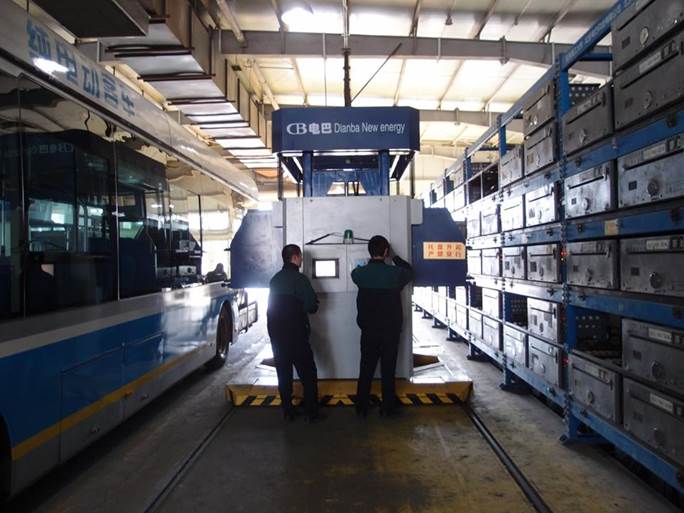
Beijing has a fleet of electric buses that use the battery swapping method.
The southwest China municipality of Chongqing has a fleet of fast-charging electric buses. “In China, not only are they fielding the buses, they have been in use for years,” said Van Amberg. “This is a technology that some people in the U.S. would have been very dubious of. In China they just did it.” I pointed out that in China the governments didn’t have to answer to voters or a budget, which makes trying out new technology easier….
Plenty of big-name U.S. companies were at last year’s summit, which had about 120 participants. They included Navistar www.navistar.com , Eaton Corp www.eaton.com, BAE www.baesystems.com , and service sector companies A.T. Kearney and Well Fargo Bank. But Chinese companies and government ministries and agencies were also a big presence, from Beijing Municipal Science Commission http://www.bjkw.gov.cn/n244495/ and the Hangzhou Public Transit Group www.hzbus.com.cn to the Ministry of Industry and Information Technology. www.miit.gov.cn Chinese automakers were there, including heavy-duty truck makers such as FAW www.faw.com.cn and Foton. www.foton-global.com
Weichai, which produces trucks, engines, and transmissions among other products, was a sponsor, said Van Amberg. No surprise there; on its website Weichai Group bills itself as “green power, drive your dreams.” www.weichaigroup.com Not to be confused with Build Your Dreams automaker BYD www.byd.com , which also sent its marketing manager Sherry Li. Plenty of smaller companies were there as well, however. Micro-EV component maker Shanghai Edrive www.chinaedrive.com was there last year and will return. Nidec Motor www.nidec-motor.com of St. Louis, MO participated last year.
Calstart is aiming for 180 to 200 participants this year, said Van Amberg. It doesn’t want to get much bigger because it aims to be a venue in which U.S. companies can get to know potential Chinese partners as well as a venue for information, he said. “The companies we would love to have take part are U.S. suppliers and manufacturers of key components,” said Van Amberg.
The BYD local sourcing question has been answered, albeit not in detail. The electric buses BYD www.byd.com will soon begin building in the city of Lancaster will have more than 70% local content, BYD SVP Stella Li told me during a press event at the company’s new Lancaster plant on May 1. “Close to 80% if the charger is included,” she said. And it can be.
A bit of background. Chinese automaker BYD in March won a contract to supply the southern California city of Long Beach with 10 all-electric buses. The city is using federal funding to cover some of the cost, so there is a requirement that at least 60% of the electric bus content be sources in the U.S. http://www.greencarcongress.com/2013/05/byd-20130503.html
Those buses will be built in Lancaster, a hot and windy city out in the desert northeast of Los Angeles. BYD bought the building from Rexhall Industries, an RV maker. The CEO of Rexhall, William Rex, will stay on at general manager of BYD Coach & Bus LLC, according to a BusinessWire story. Some current Rexhall employees will also stay on, it said. Talk about creating goodwill! http://eon.businesswire.com/news/eon/20130501005574/en
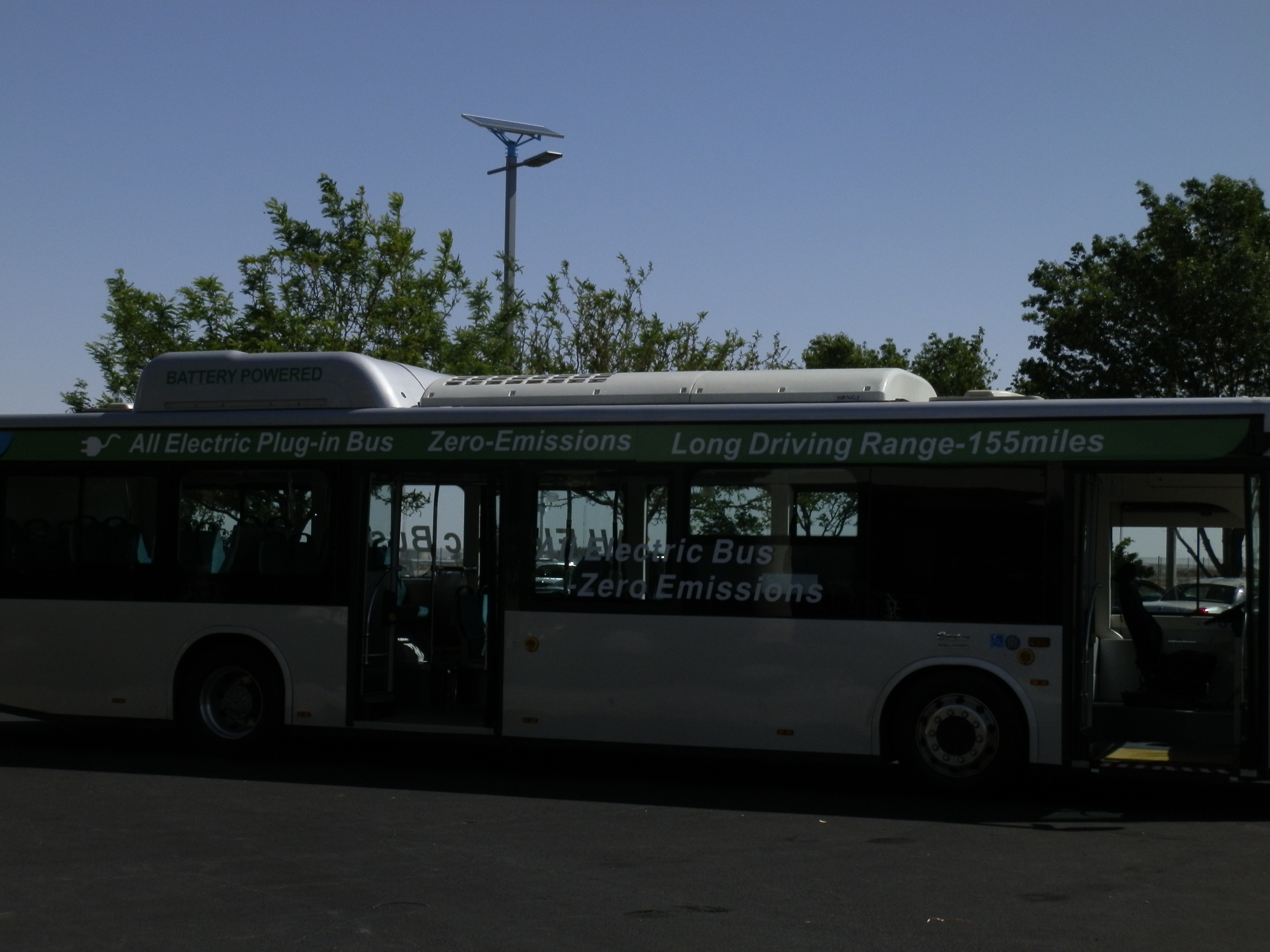
On May 1, I attended the opening of BYD’s plant in Lancaster. BYD likes Lancaster– in July of 2010 it showed off a KB Home in Lancaster that was equipped with BYD solar panels, a BYD charging station in the garage, and a BYD e6 electric car in the driveway. http://investor.kbhome.com/releasedetail.cfm?releaseid=487340
Well, the e6 has been relegated to the fleet heap, at least in the U.S. There were several of latest iteration of the electric crossover vehicle at the Lancaster event on May 1. But the model will only be used in fleets, several BYD folks told me.
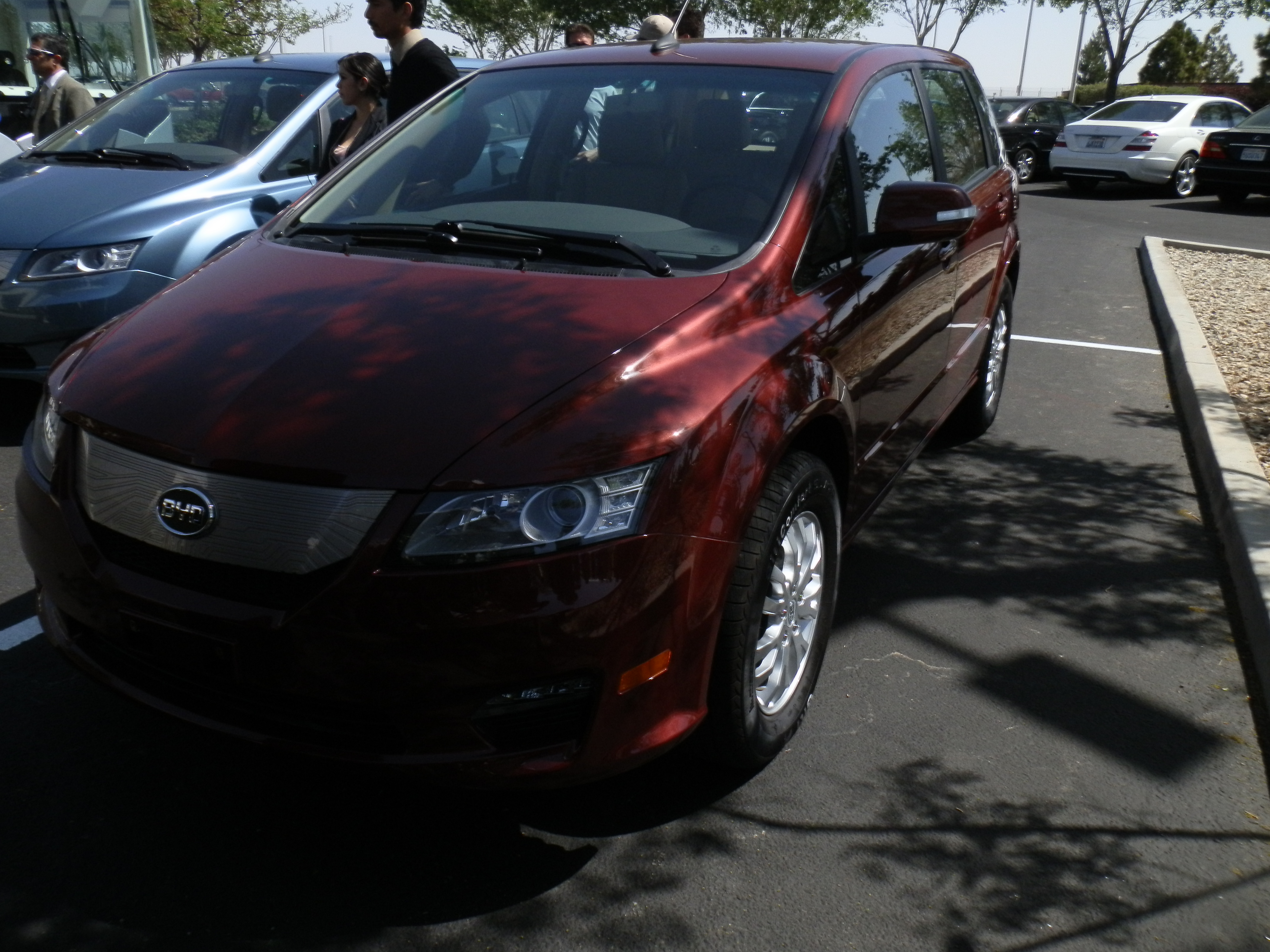
Several BYD e6 were at the Lancaster plant. They are slotted for taxi fleets.
For now, BYD in the U.S. is all about buses. The Lancaster plant is the first to be opened in the U.S. by a Chinese automaker and the first bus plant for BYD in North or South America said Li. It has an annual capacity of more than 1,000 units. Production is due to begin in October of 2013, “if we keep to our aggressive schedule,” said Li. It aims to produce 50 units in the first year of operation.
As for local content, the battery pack will be assembled in Lancaster, in a building a few miles from the bus plant. The cells will be imported from China. That will likely account for a big chunk of local content.
Other local content includes the multiplex electronic controls, which will be supplied by I/O Controls www.iocontrols.com in Azusa, CA, said Michael Kuang, regional vice president of engineering for Azusa. He was at the event. There are plenty of other things that are easy to source domestically, such as seating and lighting, he suggested.
True that. And, BYD can count the two inductive chargers that will be supplied by WAVE http://www.waveipt.com/ , a Utah-based start-up, as local content as well, says John Inglish, a board member at WAVE. He was also at the event.
As noted up top, there were several e6 BEVs parked at the event. But Li said BYD is focused on taxi fleets for the e6 sales. She also said, however, that BYD wants to sell cars to consumers in the U.S. in the next several years. Assume she means electric vehicles, though I guess she could mean gasoline-powered cars. In any case, Li said that if there was sufficient demand BYD might localize car production in the U.S. within 10 years. That includes the fleet vehicles, I ‘m guessing.
One thing I know: The City of Lancaster is pretty psyched to have BYD come to town. All the city officials showed up for the plant opening, as did an assortment of state and county officials. Lancaster is part of Los Angeles County. Inexplicably, there were at least a dozen LA County Sheriffs at the event. Lancaster contracts with the Sheriffs to provide its police force, but surely they didn’t all need to turn out for the peaceful event….
I asked Los Angeles County Supervisor Mike Antonovich if he expected any blowback because BYD is a Chinese company. There has been some noise in the press about Long Beach Transit awarding BYD the 10-bus contract over several U.S. companies.
Antonovich said: “This is a global economy. We have German companies here, we have companies from the United Kingdom here (in Los Angeles). Just as we are selling our products in China, they are selling here. What you don’t want to have is protectionism.”
Well said.
I went to the Shanghai Auto Show in April. More specifically, I was there on press day, April 20. The Shanghai show venue is gigantic. Enormous. Stupendously huge. Wear comfortable walking shoes. Even then, I always feel a bit dazed while there, though some of that may be jet lag now that I fly in a few days before to attend. It was rainy and cold on April 20.

It was cold and rainy at the Shanghai Auto Show, and the venue streches endlessly.
A few random thoughts:
Chinese automakers have really improved their design language. Used to be bad or weird. Now that many use the same design houses as the foreign automakers, and the others copy foreign automakers’ design, Chinese automakers’ vehicles are nice looking. But boring, just like most of the vehicles I saw at the show. Still, it is an improvement.
Local automakers are trying to impress with their innovation in engines and transmissions, but they aren’t there yet. They still borrow or copy much. Separate blog soon on that from interview with Gary Tan, head of Ricardo China. www.ricardo.com
Mercedes www.mercedes.com is really trying to boost China sales. The Mercedes stand was huge. Half a hall. Not surprising. The luxury market in China is one of the fastest growing – sales rose 25% in the first two months of the year to 116,606 units according to LMC Automotive. The passenger vehicle market as a whole rose 22% in the first two months of the year, though it fell 6% in February. China’s luxury car segment is seen as the holy grail of China’s automotive market. http://www.forbes.com/sites/kenrapoza/2013/03/07/luxury-car-market-turning-chinese/
Mercedes is lagging in China http://www.businessweek.com/articles/2012-10-25/mercedes-needs-to-rethink-china . It sure garnered some press with all the money it spent before and during the show. That might result in bigger market share. But Mercedes www.mercedes.com.cn is still viewed as a bit less cool than BMW www.bmw.com.cn and even Audi www.audi.com.cn in China.
Not sure what GM’s plan is for Buick www.buick.com.cn in China. The Buick stand was boooring. All the cars were champagne color or silver. Or so it seemed to me. The Chevy stand was filled with color and sound and new and old Chevy models. Dan Akerson, GM’s chairman, has said Chevy and Cadillac will be the focus of GM’s global push. http://europe.autonews.com/article/20130225/ANE/302259730#axzz2SAlFKze1 Bob Socia, president of GM China, said at a press event during the show that GM’s focus in China would be luxury –which I figure means Caddy — and SUVs. The SUV market is the other holy grail of China’s auto market– up 19% in the first two months of the year. GM says it will introduce 9 new or refreshed SUVs to the China market over the next five years. Here is anotgher take on the press event: http://online.wsj.com/article/SB10001424127887324493704578432144026830614.html
Where does that leave Buick? Buick is big, big, big for GM China. I guess GM could launch a Buick-badged SUV in China, but Buick is better known there for its executive van, the GL8. It will be interesting to see how Buick fits into GM’s future in China given it is being relegated to the back of the line in the rest of the world. To be fair, GM’s Riviera concept car, another fishlike concept car from PATAC, was badged Buick. But it is only a concept….
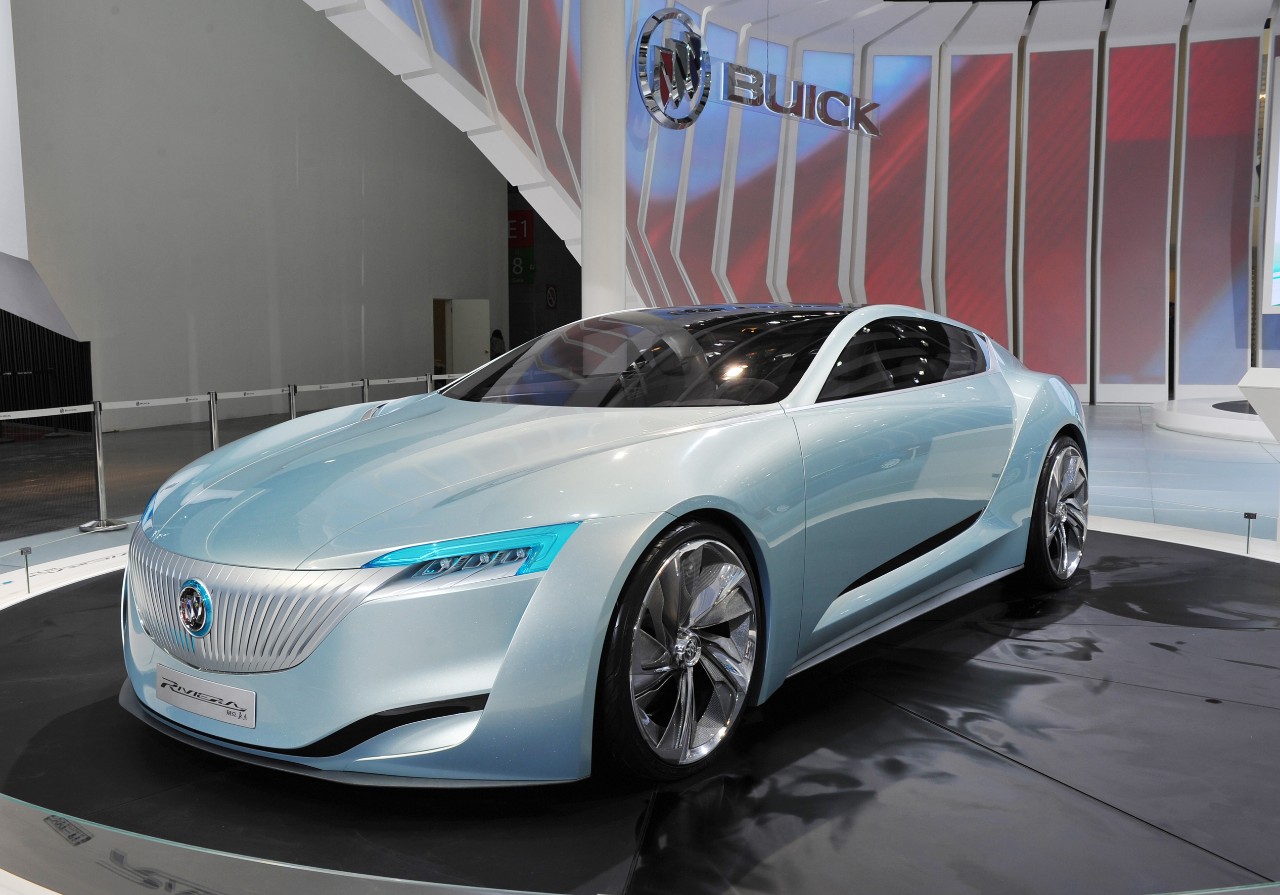
The GM Riviera Concept car, designed at PATAC, is a PHEV.
The youth market is in! The Chevrolet www.chevrolet.com.cn presser was all about appealing to the youth market, which makes sense. Relative youth will even be the focus of GM’s Cadillac marketing effort, it seems. According to GM, the average luxury car buyer in China is 35 to 40 years old, ten years younger than in the U.S. Other automakers were also courting the youth market at their stands and in their pressers (admission: I didn’t make it to that many pressers this year. Was too busy walking around looking at stuff….).
As for electric vehicles, they were everywhere and nowhere, sort of like their market presence in China. Every automaker an EV or two in its stand. SAIC had a row of six EVs: The SAIC 550 PHEV, the SAIC BEV550, a Shanghai brand Light Weight Fuel Cell Vehicle, the Roewe 750 light hybrid, the Shanghai Volkswagen e-Lavida sedan, and the Springo BEV from Shanghai GM.
Impressive, but then I ask the young men at the stand which of the EVs are available to buy right now. Only the Roewe 750 is on the market, and sales are slow. The PHEV will launch later this year, they said. Shanghai GM www.shanghaigm.com just started production of the Springo pure EV, David Dunahay, interim executive director of electrification strategy told me. GM is going to “bring it out slowly,” he said.
The GM Riviera concept car was a PHEV. Does that signal the future direction of GM’s www.gmchina.com EV strategy in China, I asked Dunahay? “I wouldn’t take it as a signal,” he naturally told me. “We want to participate in a variety of (EV) segments.”
BYD www.byd.com wasn’t touting it pure-electric car, though it did have the next-gen e6 pure BEV at its stand. Rather, it highlighted the latest generation of its “Dual Mode” hybrid technology, embodied in the Qin electric vehicle. BYD claims the BYD DMII Qin can go 50 kilometers in pure electric mode. It will be launched in the third quarter of 2013, said a BYD spokesperson.

BYD was showing off its newest dual-mode hybrid drivetrain, on the next gen DMII Qin car.
(An aside. I attended the opening of a BYD manufacturing plant here in California on May 1. It will initially produce electric buses. There were several e6 crossover EVs there. They are intended for fleets, I was told. Check out the rest of the story at http://www.plugincars.com/chinas-byd-opens-electric-bus-production-plant-california-127131.html )
Great Wall www.gwm.com.cn had a tiny EV called the Kulla, but it was just for show and likely will never go into production. The star of its booth, as befitting a company that is China’s largest SUV producer, was the H7 luxury SUV with a traditional engine. But, Great Wall’s stand also had a Haval SUV plug-in hybrid electric. Production will begin in 2015, I was told. Great Wall plans to offer PHEVs across the entire Haval lineup in the future, Wang Dingcai, a new energy vehicle engineer at Great Wall’s engineering institute told me.
Word is that Beijing will issue a revised EV policy soon (not soon as in “mashang,” which could mean years, but soon as in “xianzai,” a matter of weeks) and the new policy will subsidize plug-in hybrid electric vehicles and even regular old hybrids at higher rates. The way the subsidy is distributed may also be changed. Right now it goes to the manufacturer; it may become a direct-to-consumer subsidy.
But no one knows for sure which technologies will be favored. A Ford China executive put the situation in China’s EV sector bluntly: “Automakers don’t know what technology the government supports so we have to support them all,” said J.D. Tang, head of marketing, sales, and service for Ford Motor (China)’s import business. www.ford.com
Ford China is taking a cautious approach to China’s EV market. It showed no electric vehicles at its stand in Shanghai. It is waiting to see what types of EVs there is market demand for, said Kumar Galhotra, vice president of product development at Ford Asia Pacific. “You have to have technology and we have it,” he told me. “But whether or not we deploy it will come down to a demand for it. It is not something that can be forced on the market.” Tell that to Beijing.
BYD gets eBus contract in California; how will it meet the local content requirement?
BYD www.bydauto.com has finally gotten its foot in the door in the U.S., with its electric bus. The mystery around the deal, at least for me, is where it will source the components. That is because the bus must have 60% Made in the USA content, and I’m sure its most of its components are Made in China right now.
I wonder if BYD can duplicate the method foreign automakers in China used to get around local sourcing requirements when they first began producing there. They shipped most of the car in from the U.S. or Europe then put the wheels and a few other things on in China. Seriously, I don’t think BYD would be able to get away with that nor would it try. This bus deal is under a lot of scrutiny. But, I eagerly await the day when I find out how it does meet the local content requirements.
First, some background.
The southern California city of Long Beach will buy 10 all-electric buses from Chinese automaker BYD. http://www.lbbusinessjournal.com/long-beach-business-journal-newswatch/1433-long-beach-transit-sides-with-byd-motors-for-future-buses.html The details are still being worked out, but “we are expecting to have the buses in service during the first half of 2014,” Kevin Lee, spokesman for Long Beach Transit, www.lbtransit.com told me.
BYD submitted a bid in October of 2012 for the contract along with some purely American companies such as Proterra. www.proterra.com Based in South Carolina, Proterra also produces electric buses. It bitterly protested the recommendation of BYD. http://green.autoblog.com/2013/03/26/proterra-slams-long-beach-electric-bus-contract-china-byd/ But let’s face it; BYD’s eBus is pretty nice. At least one is already in operation here, as a shuttle bus for Hertz at LAX. Many more are on the road in Shenzhen. Plus, BYD makes charging stations and the like. It had more to offer.
Long Beach Transit recommended in February of 2013 that the BYD bid be accepted. The criteria Long Beach Transit used to select the BYD ebus included pricing and life cycle cost, charging station operational considerations, coach operational considerations, and the experience of the firm and its response to inquiries, said Lee.
Lee confirmed that the Transit Board approved awarding the contract to BYD on March 24, 2013. It is for $11.5 million, which includes the 10 all-electric buses, charging equipment, diagnostic tools, training and spare parts.
Some of the money to purchase the 10 buses will come from federal funding, hence the 60% Made in American requirement. Lee said before awarding the contract to BYD, Long Beach Transit hired third party consultants to audit BYD to verify they would meet the requirement. “The results of that audit showed that they would meet the requirements, if not exceed them,” said Lee. Long Beach Transit will continue to audit BYD to ensure the local content requirement is met, he added.
BYD also produces gasoline-powered cars and electric cars and buses in China. It produces many of the components used in the cars itself, said an executive at a multinational supplier with significant sales in China. BYD VP Michael Austin said that BYD will produce some components for the Long Beach buses at a plant in Lancaster, CA. “Though BYD prides itself on our vertical integration for many components … there are still components we buy from third parties,” he added. For example, the customer stipulates (his word) a “vast majority of components in the bus” such as seating, HVAC system, and even the types of rims and tires, he said. “BYD must source these components from third parties for the Chinese and Lancaster plants and does not and will not be manufacturing these in house,” he said in an e-mail.
As for the Lancaster reference, BYD will produce the buses in an underutilized recreational vehicle plant in Lancaster, California, a southern California city about an hour from Los Angeles. The plant was owned by recreational vehicle maker Rexhall Industries, Chenin Dow, projects assistant in the Lancaster’s Economic Development Office told me. www.cityoflancasterca.org
Currently, the buses are only produced in China, and the supplier base is in China. BYD declined to comment on what steps it is taking to develop a supplier base here in the U.S. That’s the burning question I will ask BYD execs at the Auto Show in Shanghai on April 20 (press day) and probably again at the Lancaster plant’s grand opening on May 1.
I admire John Thomas. The CEO of ALTe Powertrain Technologies www.altept.com refused to give up in his search for a Chinese investor and it seems he may have found one at last. Plus, his company is in a sweet spot technology-wise where the China EV market is concerned. ALTe produces an extended-range hybrid electric powertrain, the technology China’s central government is currently promoting to grow the number of EVs in China in the near to medium term. What could go wrong? Well, this is China so plenty. But, at least for now ALTe has some momentum and some money.

On March 20, ALTe announced it was forming a joint venture to produce medium-weight electric buses and light commercial electric vehicles. http://altept.com/?p=1074 The partner is Henan Benma Co. Ltd, http://www.cnbenma.com/about.htm a state-owned company that produces a variety of vehicles, from three-wheeled agricultural vehicles to medium-weight trucks to low speed electric vehicles. Henan Benma seems to be owned by the central government. But, the ownership structure is confusing; some elements may be owned by the provincial government, Thomas told me. No surprise there. In any case, Henan Benma likely has good connections, which never hurts in China.
Wait a minute, you may be saying. Didn’t you write a blog last September about ALTe forming a $200 million joint venture with S. Moody Alavi, a Dubai investor; and an unnamed Chinese private investor? Yep, that would be the case. I also wrote that the deal with Alavi came about after Thomas had already been stiffed by two other Chinese investors. See my September 9, 2012 blog for full details.

This JV fell through after the Chinese investor lost access to funds.
Thomas thought the deal with Alavi and the Chinese investor was solid because Alavi was recommended by ALTe investor Simon Ahn, an Atlanta-based attorney and venture capitalist. http://www.ahnlawfirm.com/Alas, Ahn had no control over the political situation in China. After China’s change of leadership in November, http://www.economist.com/news/china/21566685-china-shuffles-its-leadership-putting-princeling-command-changing-guard the Chinese investor “was no longer in possession of the funds he was previously,” said Thomas. When the Chinese investor was gone, Alavi also dropped out of the deal.
Fortunately, the EV policy tide in China has turned in ALTe’s favor. Initially China’s central government was hot about battery-electric vehicles. But it has realized the technology is not mature, and is now keen on the kind of EV technology that ALTe has.
That must have been why Henan Benma, a small player in the original joint venture, stepped in and saved the day. In fact, ALTe plans a second joint venture with another small player in the original JV. “Now we have two smaller deals, much more realistic, practical and manageable,” than the original $200 million deal, Thomas told me. More on that later. First, the Henan Benma deal.
The JV — which has a Chinese name that I believe includes the Chinese character ti2, meaning rising, but am not sure because Thomas couldn’t pronounce it very well – will be 65% owned by Henan Benma and 35% owned by ALTe, said Thomas. Henan Benma’s contribution is cash, and it has already sent some money to ALTe, said Thomas. Its initial contribution is $50 million, the most a Chinese company can invest in a foreign joint venture without central government approval, he said.
ALTe will contribute a license to use its technology and manpower plus some other things, said Thomas. “In a sense we found the right-sized strategic partner“in Henan Benma he said, “They are a strategic partner and investor because they already produce commercial vehicles.”
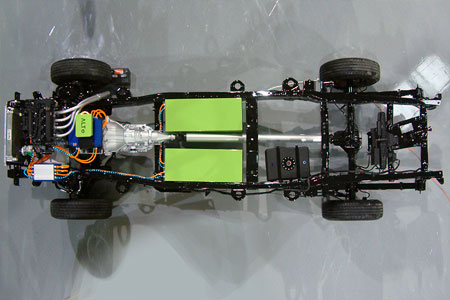
ALTe hopes the complexity of its software will protect its intellectual property
Any time a company’s technology is used in China intellectual property protection is a big concern. ALTe figures the coding in its software is too complex to be copied, which will provide some protection. It has filed half a dozen patents in China, said Thomas. Henan Benma has also taken “protective measures so no one can borrow the technology or be inspired by it,” he said diplomatically.
Though the JV has talked about producing 60,000 EVs annually, it will start with 10,000 and see what the market acceptance is, said Thomas. According to its website, Henan Benma has a 300,000 unit production capacity. I don’t know how much of that is utilized to produce its other vehicles.
The JV is not in a hurry to reach even 10,000, said Thomas. That could take as long as three years. But it might happen sooner, said Thomas. The JV already has an order for electric buses – the majority of a multi-thousand-unit order, he said. Thomas wouldn’t tell me who the customer but I’ll be it is a local government-owned company. Creating business for a company you own part of is always good business.
Joint venture #2
ALTe is also setting up a second joint venture in China, and this is where it might run into the same kind of troubles with Chinese investors it has in the past. The partner in the second venture is a retired government official in Beijing, said Thomas. Setting up the second JV will lag the first JV by 30 to 60 days, he said, adding “We can’t say anything more.”
The second JV will manufacture electric powertrains. Those might be used in the vehicles produced at the first JV. Thomas doesn’t really want to say anything more until the money for the second JV arrives in ALTe’s bank account, it seems. “We have learned to announce when the cash is moved, not when the deal is signed,” said Thomas.
For the time being, powertrains for the Henan Benma JV will be sourced from the U.S. But part of the agreement is to begin locally sourcing as much as possible as soon as possible, said Thomas. In early April, a team from ALTe will arrive in China to start vetting local suppliers. ALTe wants to take small companies in China and turn them into qualified suppliers, said Thomas. Of course, it will use Tier 1 suppliers in China when necessary. And probably some of the suppliers those Tier 1 companies have already developed. Thomas admits there is some benefit to not being the first EV powertrain company to set up in China.
The top Asia executive at a multination supplier once told me that even if the technology was mature, Chinese automakers simply lack the experience to produce an electric vehicle. It is too complex, he said. ALTe figures it can solve that problem by sending the team that created its powertrain to work at the JV. “That is the beauty of the symphony we conduct,” said Thomas. “We worked on the software in partition diagrams, getting all the parts to interact.” ALTe should be able to transplant that knowledge to China, he seems to assume.
Well, there is still a lot of integration that needs to take place. And I wonder if Henan Benma’s experience with agricultural vehicles has given its workers the skills needed to assemble a functional REEV. I guess we shall see.
Geely’s Li Shufu isn’t using his cash well with all these acquistions, but hey, this is China
I recently interviewed several executive from Group 1 Automotive, www.group1auto.com the fourth largest automotive dealership group in the U.S. We were talking about Group 1’s acquisition strategy – it acquired 16 dealerships in 2012, a year when many of the big dealership groups held back from acquisitions because they felt prices for the dealerships were too high.
Group 1 is listed on the New York Stock Exchange, so the management wants to do what is best for its shareholders at all times, and Group 1 thinks acquisitions are a good use of that cash. It has its own way of evaluating a dealership’s worth, taking into account the cost savings gained from economies of scale because of Group 1’s size, said the executives. And, Group 1 had cash because of some good decisions it made a few years back.
It won’t buy a dealership unless the investment will earn 15% return on a discounted cash flow, said Pete DeLongchamps, vice president of financial services and manufacturer relations. “That is what our job is to our shareholders, to make acquisitions and provide those types of returns,” he said. “We think acquisitions are the best use of our cash, followed by dividends or share buybacks.” www.autoretailbusiness.com
That got me thinking about Geely www.geely.com chairman Li Shufu’s acquisition splurge over the last few years. Were those acquisitions the best use of shareholder’s cash? Of course, I can’t be sure if the cash for the acquisitions came from the portion of Geely that is listed on the Hong Kong Stock Exchange. But the question is valid nonetheless. Were those purchases the best use of Geely’s cash? Not in most cases.
The purchase of Swedish luxury automaker Volvo in 2010 was arguably a good use of Geely’s cash. http://www.nytimes.com/2010/08/03/business/global/03volvo.html Geely obtained management and technical knowhow it could use. But the brand was struggling when Geely bought it, and is still struggling. In December Volvo borrowed $1.2 billion from China Development Bank to refinance existing loans in the face of falling sales and growing financial losses. http://www.reuters.com/article/2012/12/13/volvocars-loan-idUSL5E8ND9PI20121213
In February of this year, Geely bought British taxi cab maker Manganese Bronze Holdings, http://www.ft.com/intl/cms/s/0/a4fc2992-6c5c-11e2-b73a-00144feab49a.html#axzz2LUzZL0du a company in which Geely already owned a 20% stake. That seems like a questionable use of cash. Manganese Bronze was in “administration,” which seems to be a British term for something like a Chapter 11 bankruptcy in the U.S. The taxi maker hadn’t posted a profit since 2007, had faced several recalls for faulty components in the last year, and posted a pretax loss of 3.6 million pounds in the first half of 2012, according to Bloomberg news.
Also in February, Geely subsidiary Shanghai Maple Guorun announced it would form a 50/50 joint venture with Kandi Technologies Inc., a producer of low-speed electric vehicles based in the east China province of Zhejiang. http://www.greencarcongress.com/2013/02/kandi-20130204.html Also questionable. Geely said in a statement that the consumer market in China for electric passenger vehicles had not materialized, and was not likely to be viable for a long time. However, Geely believes electric vehicles will be a “major solution” for the current energy and traffic congestion problems, and “Geely took a fancy to Kandi’s smaller-sized low-cost and low-speed electric vehicles,” the company said.
China has dozens of low-speed electric vehicle producers, and Kandi’s EV technology has never been tested for mass production. The company, which is listed on the NASDAQ stock exchange in the U.S., (KNDI) had net income of $3.88 million in the first nine months of 2012 vs. $9.94 million in the same period in 2011. Go cart sales are its main source of income right now. Kandi says the fall in income is because it invested that money in R&D in hopes of establishing a leading position in the EV market. http://secfilings.nasdaq.com/filingFrameset.asp?FileName=0001062993%2D12%2D004743%2Etxt&FilePath=%5C2012%5C11%5C14%5C&CoName=KANDI+TECHNOLOGIES+CORP&FormType=10%2DQ&RcvdDate=11%2F14%2F2012&pdf=
According to a filing with the U.S. Securities and Exchange Commission, Kandi borrowed heavily the first three quarters of 2012, as well as standing as guarantor for $19.7 million in loans for local companies (who also stood as guarantors for Kandi’s loans) “It is a common business practice among companies in the region of China where Kandi is located to exchange guarantees for bank debt with no consideration given,” said the filing.
Which brings me to Geely’s bid for Fisker Automotive. www.fiskerautomotive.com Fisker has one model in production, the US $100,000 Karma. Fisker is trying to launch a new, more moderately-priced PHEV, called the Atlantic. But development of Atlantic is stalled waiting funding.
Meanwhile, the Karma has been plagued with problems. First, the batteries in a couple of Karmas spontaneously ignited. Then, the influential independent product review publication Consumer Reports bashed the Karma. The battery failed on the first test drive by Consumer Reports, not a good start. http://news.consumerreports.org/cars/2012/03/video-bad-karma-our-fisker-karma-plug-in-hybrid-breaks-down.html
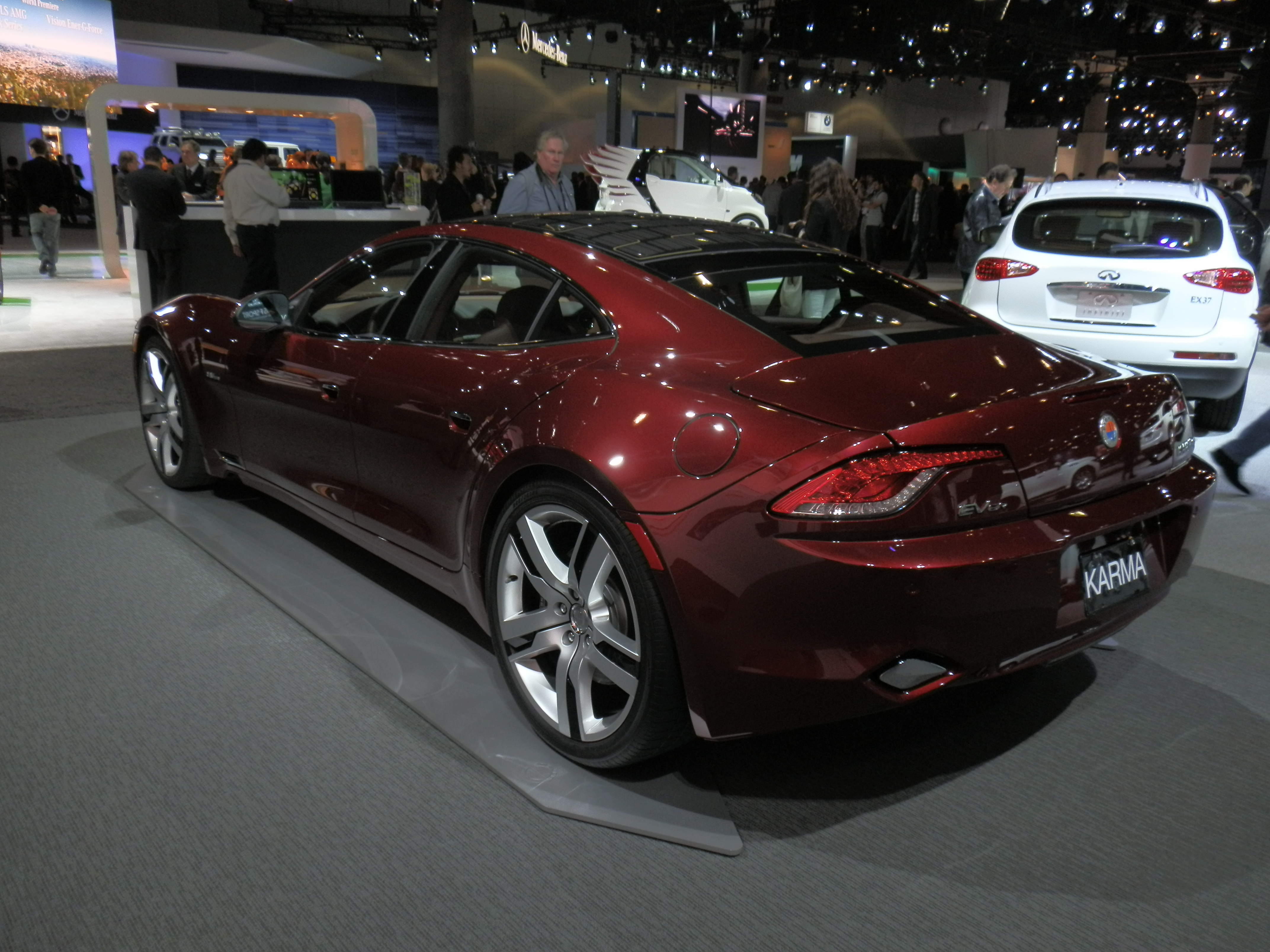
The Karma is currently Fisker’s only model. It need more cash to finish development its next model
When it did get to drive a Karma, Consumer Reports was not impressed. It wrote that the Karma had “poor dash controls, limited visibility, a cramped interior, awkward access into and out of the seats, an engine that is noisy when running, long battery recharge times, and a small backseat and trunk.” Concluded the review, “The Karma’s heavy, SUV-like weight affects agility and performance, and the Karma lacks the oomph you would expect.” Ouch.
What would Geely get out of owning Fisker? Geely has access to plug-in vehicle technology through Volvo. While there may be a market for Fisker’s cars in China – after all, Leonardo di Caprio owns one, who wouldn’t want one? – it will be small, while the investment to make Fisker a success will be big.
Li Shufu has big ambitions. But I think he should study Group 1’s approach to investment and ask if his investments are the best use of Geely’s money. The answer, in many cases, would be no.
Wanxiang’s purchase of battery maker A123 http://www.plugincars.com/wanxiang-gets-final-approval-buy-a123-systems-126289.html may turn out to be the best thing that ever happened to Fisker Automotive. www.fiskerautomotive.com Huh? Yeah, now Fisker not only has a battery supplier, but I bet Wanxiang will give Fisker some kind of bridge loan to keep it afloat while it seeks a “strategic partner” i.e. some company with cash to invest in the struggling plug-in hybrid electric company. But Fisker still needs cash, fast. And it is sniffing around China to find some.
Development of its next model, the Atlantic, is stalled awaiting funding. Production of its current model, the Karma, was also stalled as Fisker waited to hear the fate of its battery maker, A123. (and it didn’t have any money…) Now it knows A123 will survive. “We will start to re-negotiate the contract for batteries with Wanxiang in the very near future now that the sale is complete,” Fisker spokesman Roger Ormisher told me.
Fisker halted production of the Karma because A123 couldn’t supply batteries and, frankly, Fisker couldn’t pay for them!
Wanxiang American www.wanxiang.com is willing to help Fisker with more than just batteries, it seems. Wanxiang America president Pin Ni told me. “We will be interested in any way we can help Fisker since they are a customer of A123 and A123 is currently a shareholder of Fisker,” he said. There is precedent for making a loan to Fisker. Wanxiang came to the rescue of A123 back in November 2012 with a $50 million loan. http://www.bloomberg.com/news/2012-11-05/a123-systems-gets-50-million-loan-from-wanxiang.html Guess it was worth it since Wanxiang owns A123 now. Well, maybe it wasn’t worth it, but that is another blog….
But, sources tell me Fisker has also been talking to Dongfeng Motor Group www.dfmc.com and Beijing Automotive Industry Group Corp (BAIC) regarding some kind of investment. State-owned Dongfeng, the former 3rd Auto Works, is China’s second largest automotive group based on sales volume, according to LMC Automotive. www.lmcautomotive.com In case you were wondering, SAIC is the largest. Of course, I am not sure if this includes all commercial vehicles. It may only include light vehicles. In any case, Dongfeng is big.
I am not sure what part of Dongfeng Fisker has been talking to. Dongfeng is a kind of confusing company. Dongfeng Motor Corp sold half its vehicle operations to Nissan back in 2003 and the resulting Dongfeng Motor Co. is 50% owned by Nissan. http://www.dfl.com.cn/dfl/info/introduce_en.aspx But, Dongfeng the parent company also has joint ventures (these are separate companies formed to produce cars as opposed to the Nissan venture, in which Nissan actually bought part of the existing Dongfeng….) with PSA, Honda, Kia, and now it has formed a truck JV with Geely, uh I mean Volvo.
Anyway, Fisker talked to Dongfeng about getting some help, likely through a strategic partnership. That went nowhere according to a source in China. No wonder. Dongfeng has its hands full, it seems. And access to EV technology from a variety of sources. Indeed, Dongfeng has an EV subsidiary and has said it will be selling two EVs by 2015. One will be under its self-developed brand, Fengshen, another will be under the Venucia brand, which it produces with Nissan. Got it? Good cause I am not sure I do. In any case, Dongfeng has some EV technology. And its hands full with all those foreign partners.
Fisker has also approached Beijing Automotive Industry Group Corp. or BAIC about cooperation, sources tell me. BAIC is China’s fifth largest automotive group, according to LMC. I don’t know how that is progressing. Last November BAIC said it would invest 1.7 billion RMB to build three plants to produce new energy vehicles by 2015. That term, new energy vehicle, is rather vague, of course. It could mean BEVs or PHEVs or even hybrids or CNG vehicles these days. The definition has gotten a bit looser over the years.
But BAIC will likely have access to very good EV technology. It already had a 50/50 joint venture with Daimler. And the two companies just announced that Daimler will take a 12% stake in BAIC Motor, the passenger car unit of BAIC Group. http://www.daimler.com/dccom/0-5-7153-1-1571316-1-0-0-0-0-0-9293-0-0-0-0-0-0-0-0.html Now this is likely confusing to those of you who don’t follow China’s auto scene obsessively. But it is similar to what Nissan did with Dongfeng, on a smaller percentage basis. Generally when a foreign automaker wants to produce cars in China it has formed a separate company –a joint venture – which is 50% owned by each party. So, it is a separate corporate entity. Nissan, and now Daimler, actually bought into the existing Chinese company. Too much information, I know. In any case, besides being busy sorting out how this new company that is 12% owned by Daimler will work, BAIC likely has access to EV technology now.
Fisker spokesman Ormisher would not confirm that Fisker had talked to Dongfeng and BAIC. “We can confirm we have had a great deal of interest from companies across 3 continents,” he said in an email.
Another thing to consider is whether Fisker is a desirable partner. The cars are nice looking, but the Karma was totally bashed by Consumer Reports in September of 2012. Among the faults cited by Consumer Reports, aside from the fact the battery failed on the first drive: “Poor dash controls, limited visibility, a cramped interior, awkward access into and out of the seats, an engine that is noisy when running, long battery recharge times, and a small backseat and trunk. The Karma’s heavy, SUV-like weight affects agility and performance, and the Karma lacks the oomph you would expect.” Ouch. http://news.consumerreports.org/cars/2012/09/fisker-karma-earns-a-failing-grade-from-consumer-reports.html
Having said that, I do think there is a market for the Karma in China. There is a certain segment of very rich Chinese who would want to own the same car as Leonardo DiCaprio, one of Fisker’s small stable of famous owners.
My advice to Fisker? (Not that they have asked for it, but if Fisker get funding from this source my arm will hurt from patting myself on the back.) Hit up China Grand Auto http://www.chinagrandauto.com/ for money. The dealership group has already agreed to be Fisker’s distributor in China. http://www.chinagrandauto.com/ It is the second largest dealership group in China in terms of 2012 revenue. It has plenty of cash, and is even weighing going public in China, which would boost its cash hoard. Seems like an obvious choice. Unless China Grand doesn’t have confidence in Fisker’s vehicles.
GM sees car sharing in China as way to intro EVs but there are potholes in the road
Car sharing seems to work in the U.S. and Europe, and a growing number of consumers want to give it a try. Why else would global car-rental giant Avis Budget Group Inc. have recently paid $500 million to acquired Zipcar Inc., a Cambridge, Mass.-based car sharing company that has trouble making a profit? http://online.wsj.com/article/SB10001424127887324374004578217121433322386.html
But will the model work in China? There are many barriers, both structural and, in my mind, cultural.
The business, whereby a consumer becomes a member of a company and then can use one of that company’s vehicles short-term in any city where it has a presence, is growing. Zipcar www.zipcar.com says the car-sharing market could reach US $10 billion North America, Europe, and Asia. For automakers, it is also a good way to introduce consumers –and many of the users of Zipcar’s services are a targeted young demographic – to new technologies such as pure electric vehicles. American Honda has Fit EVs (a pure EV) as well as the Insight hybrid in the Zipcar fleet. http://ir.zipcar.com/releasedetail.cfm?ReleaseID=663235 General Motors has Volt extended range electric vehicles in the Zipcar stable. http://chicago.cbslocal.com/2012/03/22/zipcar-to-add-5-chevy-volts-to-its-fleet-3-electric-cars-for-i-go/
Now, General Motors is hoping car-sharing can turn Chinese consumers on to electric vehicles. But its approach in China is a bit more circuitous since there is not a Chinese version of Zipcar. In China, however, GM is battling not just consumer reluctance to use an EVs but also bureaucratic infighting that is preventing the build out of a charging infrastructure. How much to charge for the electricity is also an issue. If the car-sharing program gets off the ground, I would add to that list a Chinese consumer indifference to taking good care of something that is only borrowed, not owned.
In October of 2011, General Motors announced it had signed a Memorandum of Understanding with the Sino-Singapore Tianjin Eco-City Investment and Development Co. to integrate its EN-V personal mobility pure electric vehicles into the Eco-City. http://media.gm.com/media/cn/en/gm/news.detail.html/content/Pages/news/cn/en/2012/Jun/0627_Signs_MOU.html The Tianjin Eco-City, located 40 kilometers from the center of the northeast China city of Tianjin, aims to build a sustainable community of 350,000 residents in a 30-square-kilometer area.
Though it has not been widely discussed, a car sharing program is part of GM’s plan to introduce pure EVs to the inhabitants of the Eco-City. It’s part of a wider scheme to convince Chinese to buy GM’s just-launched Sail SPRINGO EV, http://media.gm.com/media/cn/en/gm/news.detail.html/content/Pages/news/cn/en/2012/Jun/0627_Signs_MOU.html but the SPRINGO (GM always caps that in its press releases so I am doing the same. Perhaps it wants us to shout the name when we read it….) isn’t the car GM is using in the Eco-City experiment. Rather, it will use a fleet of EN-Vs, the pod-like pure electric vehicle first introduced at the Shanghai World Expo in 2011. GM showed an artist’s rendition of the EN-V 2.0, a more advanced version, at the Beijing auto show in 2012.

The automaker aims to have a small demo fleet of EN-Vs in operation in the Eco-City within a few years, according to people familiar with the project. If it can overcome some bureaucratic barriers, that is. GM envisions charging station installation in apartment parking areas and commercial buildings for workplace charging. But currently there is no method to get permission to install charging stations. That might sound like a small thing. But it isn’t in China.
China’s various government ministries have also not agreed on what charging plug standard to use, though China has announced its own China GB standard. The China GB standard is similar to the European IEC standard with some important differences that make it less safe. The State Grid, www.sgcc.com.cn one of China’s two state-owned electric utilities, and SinoPec, http://english.sinopec.com/ a state-owned oil company that also owns gas stations, are arguing over how to resolve that issue.
Another unresolved issue is who will be allowed to sell the electricity used for charging, and at what price. The electricity price to residential customers is much cheaper than to industrial customers, but the State Grid wants to charge more than the industrial price to its customer for EV charging.
There are already nascent car-sharing programs in China using electric vehicles. The government of the east China city of Hangzhou offers car sharing through its EVnet company. Car leasing company Shanghai Dazhong has said it will offer car sharing, though it hasn’t said it will include electric vehicles. And Shanghai’s Jiading District, home to Shanghai International Auto City, is also putting together a car-sharing program using local automaker SAIC’s pure electric Roewe E50 , sources tell me. A source at an international car rental company says his company is also talking to Tianjin and Jiading about car-sharing.
What I wonder is how Chinese consumers will treat these borrowed cars. Okay, I don’t wonder. I fear. Perhaps the assumedly younger consumers who will want to become members in an electric car-sharing program will return the cars in pristine shape, both inside and out. But I doubt it. I envision smoke-filled vehicles with much trash in them and cigarette ash strewn throughout. I hope I’m wrong.
GM preps Wuling to be China’s cheap exec van production base; export also part of plan
I was in Shanghai Dec 6-17 and as usual met with many friends and gossiped a lot. One topic of discussion was GM’s plans for SGMW, its joint venture with SAIC and Wuling Auto. www.sgmw.com.cn The JV produces minivans under the Wuling badge and passenger cars under the Baojun badge. It exports to more than 40 countries, and many of the exports are badged Chevrolet.
I have always been interested in Wuling, but my interest increased a few months ago when Ray Bierzynski, GM China’s executive director of electrification strategy, was transferred to Liuzhou to become an EVP at SGMW. http://media.gm.com/media/us/en/gm/news.detail.html/content/Pages/news/cn/en/2012/Oct/1012_Bierzynski.html What was GM up to? At the time I speculated that GM wanted to boost SGMW’s importance as an export base. I still believe that. I think GM sees SGMW as its growth engine going forward in China, as well. China’s inland cities are where the growth opportunities are now for automakers. SGMW produces a model that is perfect for aspiring middle-class families in China’s interior – the Hong Guang minivan. Nah, say not that it is a minivan. When SGMW launched it in September of 2010, it was labeled “China’s first compact business vehicle.” Said Kevin Wale, then president of GM China Group (since retired): “The Hong Guang addresses the growing need for a small, economical vehicle for business use and family travel.” https://media.gm.com/media/us/en/gm/news.detail.html/content/Pages/news/us/en/2010/Sept/0914_wuling.html Translation: It is the poor man’s GL8! Okay, not poor man’s. The less wealthy man’s GL8. The GL8 is GM’s wildly successful MPV. The GL8 First Land model – the lower end – starts at 228,000 RMB (US $36,580). GM China sold 58,566 GL8s in China in Jan-Oct according to LMC Automotive.
The Hong Guang has seven models priced between 44,800 RMB and 60,800 RMB. Quite a price difference from the GL8, but income levels are lower in China’s inland areas. And not bad for a rear-wheel drive seven-seater with power windows and locks, airco, radio with an MP3 port, and a CD player, among other amenities. And here’s a news flash–remember you read it here first. SGMW will produce a front-wheel drive version of the Hong Guang. Currently it is only offered in RWD. And, they may start badging it Baojun rather than Wuling. Makes sense. The Wuling name stands for workhorse small commercial vans. SGMW is marketing the Hong Guang as a sophisticated business car that can double as a family van on weekends.
SGMW sold 258,678 Hong Guangs in January through October of 2012, according to LMC Automotive. No comparison figure was available. Wuling’s aging Sunshine minivan is still SGMW’s best-selling model at 442,593 units sold in January through October of 2012. But that was down 27% on-year. The king is dead, long live the new king!
SGMW isn’t giving up on the Sunshine. It will continue to sell well — albeit at a declining rate — for many years. So SGMW is building a new plant in the inland China city of Chongqing. Sources tell me Sunshine production will be transferred there. http://www.reuters.com/article/2012/11/28/us-gm-china-idUSBRE8AR0LV20121128 The plant, which will begin producing minivans in 2015, will have a 400,000 unit capacity and also produce 400,000 engines annually. A side note: Chongqing is home to Changan, another large minivan producer. A source tells me that the Chongqing government asked SGMW, “Why are you doing this?” when the new plant was announced. SGMW said it considered Chongqing and Chengdu as locations, but decided Chongqing was superior. I’ll bet it is. It has a ready supplier base, courtesy of Changan and joint venture partner Ford as well as good logistics, courtesy of Ford and Changan. Hey, nobody said business was friendly.
Meanwhile, back in Liuzhou, where SGMW is located, capacity has been cleared to produce lots of Hong Guang compact business vehicles. Indeed, space being used to produce the Baojun passenger cars is available now, Also in November, SGMW opened a new 400,000-unit plant in Liuzhou to produce passenger cars. http://media.gm.com/content/media/cn/en/gm/news.detail.html/content/Pages/news/cn/en/2012/Nov/1118_Wuling.html
As for the Hong Guang, SGMW is already exporting the vehicle to multiple countries, including India, where it is assembled from a kit and badged a Chevrolet. . But trouble is brewing in India between GM and SAIC. In October SAIC divested itself of shares in the GM-SAIC joint venture in India, reducing its stake to 7% from 50%. The China Daily said SAIC did so after the JV failed to make a profit but sources tell me SAIC wants to market its own brand cars in India. http://www.chinadaily.com.cn/cndy/2012-10/29/content_15852533.htm

Ray Bierzynski left his position as executive director of electrification strategy at GM China to become EVP of its joint venture with SAIC and Wuling. Will part of his new job be chief diplomat?
Which brings me back to speculation about why Bierzynski was moved to SGMW. He has years of experience working with SAIC – he was head of PATAC, GM and SAIC’s 50-50 research and engineering venture, after all. Seems his diplomatic skills may be needed to preserve the partnership as SGMW boosts it exports. He may need a strong liver, though. Those talks may involve some long nights over bai jiu.
 Alysha Webb
 Alysha Webb's ChinaEV Blog